• Wyszukiwanie zaawansowane
  • Kategorie
  • Kategorie BISAC
  • Książki na zamówienie
  • Promocje
  • Granty
  • Książka na prezent
  • Opinie
  • Pomoc
  • Załóż konto
  • Zaloguj się

The SPSS Guide to the New Statistical Analysis of Data: By T.W. Anderson and Jeremy D. Finn » książka


zaloguj się | załóż konto
Logo Krainaksiazek.pl

koszyk

konto

szukaj
topmenu
Księgarnia internetowa
Szukaj
Książki na zamówienie
Promocje
Granty
Książka na prezent
Moje konto
Pomoc
 
 
Wyszukiwanie zaawansowane
Pusty koszyk
Bezpłatna dostawa dla zamówień powyżej 20 złBezpłatna dostawa dla zamówień powyżej 20 zł

Kategorie główne

• Nauka
 [2946350]
• Literatura piękna
 [1816154]

  więcej...
• Turystyka
 [70666]
• Informatyka
 [151172]
• Komiksy
 [35576]
• Encyklopedie
 [23172]
• Dziecięca
 [611458]
• Hobby
 [135995]
• AudioBooki
 [1726]
• Literatura faktu
 [225763]
• Muzyka CD
 [378]
• Słowniki
 [2917]
• Inne
 [444280]
• Kalendarze
 [1179]
• Podręczniki
 [166508]
• Poradniki
 [469467]
• Religia
 [507199]
• Czasopisma
 [496]
• Sport
 [61352]
• Sztuka
 [242330]
• CD, DVD, Video
 [3348]
• Technologie
 [219391]
• Zdrowie
 [98638]
• Książkowe Klimaty
 [124]
• Zabawki
 [2382]
• Puzzle, gry
 [3525]
• Literatura w języku ukraińskim
 [259]
• Art. papiernicze i szkolne
 [7107]
Kategorie szczegółowe BISAC

The SPSS Guide to the New Statistical Analysis of Data: By T.W. Anderson and Jeremy D. Finn

ISBN-13: 9780387948218 / Angielski / Miękka / 1998 / 203 str.
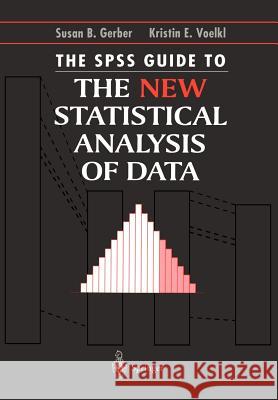
Susan B. Gerber; Kristin E. Voelkl
The SPSS Guide to the New Statistical Analysis of Data: By T.W. Anderson and Jeremy D. Finn Gerber, Susan B. 9780387948218 Springer - książkaWidoczna okładka, to zdjęcie poglądowe, a rzeczywista szata graficzna może różnić się od prezentowanej.

The SPSS Guide to the New Statistical Analysis of Data: By T.W. Anderson and Jeremy D. Finn

ISBN-13: 9780387948218 / Angielski / Miękka / 1998 / 203 str.

Susan B. Gerber; Kristin E. Voelkl
cena 402,53
(netto: 383,36 VAT:  5%)

Najniższa cena z 30 dni: 385,52
Termin realizacji zamówienia:
ok. 16-18 dni roboczych.

Darmowa dostawa!

This book is a self-teaching guide to the SPSS for Windows computer package. 'It is designed to be used hand-in-hand with The New Statistical Analysis of Data by T. W. Anderson and Jeremy D. Finn, although it may be used as a stand-alone manual as well. This guide is very easy to follow since all procedures are outlined in a straightforward, step-by-step format. Because of its self-instructional nature, the beginning student can learn to analyze statistical data with SPSS without outside assistance. The reader is "walked through" numerous examples that illustrate how to use the SPSS package. The results produced by SPSS are shown and discussed in each application. The data sets used in the examples are primarily those in the Anderson-Finn textbook. To the extent that SPSS performs the procedures in the Anderson-Finn text, this manual follows the book chapter-by-chapter. Except for Chapter 1, the section titles in the manual correspond to sections in the textbook. Each chapter demonstrates the statistical procedures described in the textbook and gives exercises that can be performed for further practice. (An instructor may choose to use these as additional class assignments. ) This manual was created using SPSS for Windows, Version 6. 1, on an IBM-compatible personal computer. There are other versions available, including: Version 7. 0 for Windows 95, Version 6. 1 for Macintosh, and Version 6. 1 for Power Macintosh.


Kategorie:
Nauka, Matematyka
Kategorie BISAC:
Mathematics > Prawdopodobieństwo i statystyka
Computers > Management Information Systems
Business & Economics > Information Management
Wydawca:
Springer
Język:
Angielski
ISBN-13:
9780387948218
Rok wydania:
1998
Wydanie:
1997
Ilość stron:
203
Waga:
0.38 kg
Wymiary:
24.4 x 17.0
Oprawa:
Miękka
Wolumenów:
01
Dodatkowe informacje:
Bibliografia
Wydanie ilustrowane

I: Introduction.- 1 The Nature of SPSS.- 1.1 Getting Started with SPSS for Windows.- 1.2 Managing Data and Files.- 1.3 Transforming Variables and Data Files.- 1.4 Examining and Printing Output.- 1.5 Missing Values.- Exercises.- II: Descriptive Statistics.- 2 Organization of Data.- 2.2 Organization of Categorical Data.- 2.3 Organization of Numerical Data.- Exercises.- Appendix II: SPSS Syntax for Organization of Data.- 3 Measures of Location.- 3.1 The Mode.- 3.2 The Median and Other Percentiles.- 3.3 The Mean.- Exercises.- Appendix III: SPSS Syntax for Measures of Location.- 4 Measures of Variability.- 4.1 Ranges.- 4.2 The Mean Deviation.- 4.3 The Standard Deviation.- 4.5 Some Uses of Location and Dispersion Measures Together.- Exercises.- Appendix IV: SPSS Syntax for Measures of Variability.- 5 Summarizing Multivariate Data: Association Between Numerical Variables.- 5.1 Association of Two Numerical Variables.- 5.2 More than Two Variables.- Exercises.- Appendix V: SPSS Syntax for Summarizing Multivariate Data: Association Between Numerical Variables.- 6 Summarizing Multivariate Data: Association Between Categorical Variables.- 6.1 Two-by-Two Frequency Tables.- 6.2 Larger Two-Way Frequency Tables.- 6.3 Three Categorical Variables.- 6.4 Effects of a Third Variable.- Exercises.- Appendix VI: SPSS Syntax for Summarizing Multivariate Data: Association Between Categorical Variables.- III: Probability.- 7 Basic Ideas of Probability.- 7.3 Probability in Terms of Equally Likely Cases.- 7.8 Random Sampling; Random Numbers.- Exercises.- Appendix VII: SPSS Syntax for Basic Ideas of Probability.- 8 Probability Distributions.- 8.5 Family of Standard Normal Distributions.- Exercises.- Appendix VIII: SPSS Syntax for Probability Distributions.- 9 Sampling Distributions.- 9.1 Sampling from a Population.- 9.2 Sampling Distribution of a Sum and of a Mean.- 9.5 The Normal Distribution of Sample Means.- Exercises.- IV: Statistical Inference.- 10 Using a Sample to Estimate Characteristics of One Population.- 10.1 Estimation of a Mean by a Single Number.- 10.2 Estimation of Variance and Standard Deviation.- 10.3 An Interval of Plausible Values for a Mean.- 10.4 Estimation of a Proportion.- 10.5 Estimation of a Median.- 10.6 Paired Measurements.- Exercises.- Appendix X: SPSS Syntax for Using a Sample to Estimate Characteristics of One Population.- 11 Answering Questions About Population Characteristics.- 11.1 Testing a Hypothesis About a Mean.- 11.3 Testing Hypotheses About a Mean when the Standard Deviation is Unknown.- 11.4 P Values: Another Way to Report Tests of Significance.- 11.5 Testing Hypotheses About a Proportion.- 11.6 Testing Hypotheses About a Median: The Sign Test.- 11.7 Paired Measurements.- Exercises.- Appendix XI: SPSS Syntax for Answering Questions About Population Characteristics.- 12 Differences Between Two Populations.- 12.1 Comparison of Two Independent Sample Means when the Population Standard Deviations are Known.- 12.2 Comparison of Two Independent Sample Means when the Population Standard Deviations are Unknown but Treated as Equal.- 12.3 Comparison of Two Independent Sample Means when the Population Standard Deviations are Unknown and not Treated as Equal.- 12.4 Comparison of Two Independent Sample Proportions.- 12.5 The Sign Test for a Difference in Locations.- Exercises.- Appendix XII: SPSS Syntax for Differences Between Two Populations.- 13 Variability in One Population and in Two Populations.- 13.1 Variability in One Population.- 13.2 Variability in Two Populations.- Exercises.- Appendix XIII: SPSS Syntax for Variability in One Population and in Two Populations.- V: Statistical Methods for Other Problems.- 14 Inference on Categorical Data.- 14.1 Tests of Goodness of Fit.- 14.2 Chi-Square Tests of Independence.- 14.3 Measures of Association.- Exercises.- Appendix XIV: SPSS Syntax for Inference on Categorical Data.- 15 Simple Regression Analysis.- 15.1 The Scatter Plot and Correlation Coefficient.- 15.2 SPSS for Simple Regression Analysis.- 15.3 Another Example: Inverse Association of x and y.- Exercises.- Appendix XV: SPSS Syntax for Simple Regression Analysis.- 16 Comparisons of Several Populations.- 16.1 One-Way Analysis of Variance.- 16.2 Which Groups Differ from Which, and by How Much?.- 16.3 Analysis of Variance of Ranks.- Exercises.- Appendix XVI: SPSS Syntax for Comparisons of Several Populations.- Appendix Data Files.

THEODORE W. ANDERSON, Professor Emeritus of Statistics and Economics at Stanford University, earned his PhD in mathematics at Princeton University. He is the author of The Statistical Analysis of Time Series, published by Wiley, as well as The New Statistical Analysis of Data and A Bibliography of Multivariate Statistical Analysis. Anderson is a member of the National Academy of Sciences and a Fellow of the Institute of Mathematical Statistics, the American Statistical Association, the Econometric Society, and the American Academy of Arts and Sciences.


Udostępnij

Facebook - konto krainaksiazek.pl


Opinie o Krainaksiazek.pl na Opineo.pl

Partner Mybenefit

Krainaksiazek.pl w programie rzetelna firma Krainaksiaze.pl - płatności przez paypal

Czytaj nas na:

Facebook - krainaksiazek.pl
  • książki na zamówienie
  • granty
  • książka na prezent
  • kontakt
  • pomoc
  • opinie
  • regulamin
  • polityka prywatności

Zobacz:

  • Księgarnia czeska

  • Wydawnictwo Książkowe Klimaty

1997-2026 DolnySlask.com Agencja Internetowa

© 1997-2022 krainaksiazek.pl
     
KONTAKT | REGULAMIN | POLITYKA PRYWATNOŚCI | USTAWIENIA PRYWATNOŚCI
Zobacz: Księgarnia Czeska | Wydawnictwo Książkowe Klimaty | Mapa strony | Lista autorów
KrainaKsiazek.PL - Księgarnia Internetowa

Polityka prywatnosci - link
Krainaksiazek.pl - płatnośc Przelewy24
Przechowalnia Przechowalnia






