• Wyszukiwanie zaawansowane
  • Kategorie
  • Kategorie BISAC
  • Książki na zamówienie
  • Promocje
  • Granty
  • Książka na prezent
  • Opinie
  • Pomoc
  • Załóż konto
  • Zaloguj się

The Pleasures of Probability » książka


zaloguj się | załóż konto
Logo Krainaksiazek.pl

koszyk

konto

szukaj
topmenu
Księgarnia internetowa
Szukaj
Książki na zamówienie
Promocje
Granty
Książka na prezent
Moje konto
Pomoc
 
 
Wyszukiwanie zaawansowane
Pusty koszyk
Bezpłatna dostawa dla zamówień powyżej 20 złBezpłatna dostawa dla zamówień powyżej 20 zł

Kategorie główne

• Nauka
 [2946600]
• Literatura piękna
 [1856966]

  więcej...
• Turystyka
 [72221]
• Informatyka
 [151456]
• Komiksy
 [35826]
• Encyklopedie
 [23190]
• Dziecięca
 [619653]
• Hobby
 [140543]
• AudioBooki
 [1577]
• Literatura faktu
 [228355]
• Muzyka CD
 [410]
• Słowniki
 [2874]
• Inne
 [445822]
• Kalendarze
 [1744]
• Podręczniki
 [167141]
• Poradniki
 [482898]
• Religia
 [510455]
• Czasopisma
 [526]
• Sport
 [61590]
• Sztuka
 [243598]
• CD, DVD, Video
 [3423]
• Technologie
 [219201]
• Zdrowie
 [101638]
• Książkowe Klimaty
 [124]
• Zabawki
 [2473]
• Puzzle, gry
 [3898]
• Literatura w języku ukraińskim
 [254]
• Art. papiernicze i szkolne
 [8170]
Kategorie szczegółowe BISAC

The Pleasures of Probability

ISBN-13: 9781461269120 / Angielski / Miękka / 2012 / 244 str.
Richard Isaac
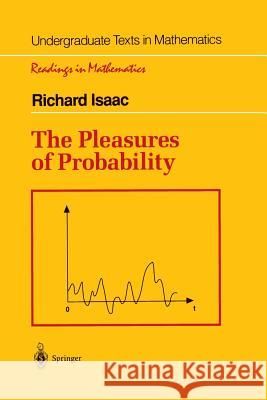
The Pleasures of Probability Richard Isaac 9781461269120 Springer - książkaWidoczna okładka, to zdjęcie poglądowe, a rzeczywista szata graficzna może różnić się od prezentowanej.

The Pleasures of Probability

ISBN-13: 9781461269120 / Angielski / Miękka / 2012 / 244 str.

Richard Isaac
cena 201,56 zł
(netto: 191,96 VAT:  5%)

Najniższa cena z 30 dni: 192,59 zł
Termin realizacji zamówienia:
ok. 22 dni roboczych
Bez gwarancji dostawy przed świętami

Darmowa dostawa!

The ideas of probability are all around us. Lotteries, casino gambling, the al- most non-stop polling which seems to mold public policy more and more- these are a few of the areas where principles of probability impinge in a direct way on the lives and fortunes of the general public. At a more re- moved level there is modern science which uses probability and its offshoots like statistics and the theory of random processes to build mathematical descriptions of the real world. In fact, twentieth-century physics, in embrac- ing quantum mechanics, has a world view that is at its core probabilistic in nature, contrary to the deterministic one of classical physics. In addition to all this muscular evidence of the importance of probability ideas it should also be said that probability can be lots of fun. It is a subject where you can start thinking about amusing, interesting, and often difficult problems with very little mathematical background. In this book, I wanted to introduce a reader with at least a fairly decent mathematical background in elementary algebra to this world of probabil- ity, to the way of thinking typical of probability, and the kinds of problems to which probability can be applied. I have used examples from a wide variety of fields to motivate the discussion of concepts.


Kategorie:
Nauka, Matematyka
Kategorie BISAC:
Science > Earth Sciences - Geology
Mathematics > Prawdopodobieństwo i statystyka
Science > Chemia - Fizyczna
Wydawca:
Springer
Seria wydawnicza:
Undergraduate Texts in Mathematics / Readings in Mathematics
Język:
Angielski
ISBN-13:
9781461269120
Rok wydania:
2012
Wydanie:
Softcover Repri
Numer serii:
000321936
Ilość stron:
244
Waga:
0.37 kg
Wymiary:
23.39 x 15.6 x 1.42
Oprawa:
Miękka
Wolumenów:
01

1 Cars, Goats, and Sample Spaces.- 1.1 Getting your goat.- 1.2 Nutshell history and philosophy lesson.- 1.3 Let those dice roll. Sample spaces.- 1.4 Discrete sample spaces. Probability distributions and spaces.- 1.5 The car-goat problem solved.- 1.6 Exercises for Chapter 1.- 2 How to Count: Birthdays and Lotteries.- 2.1 Counting your birthdays.- 2.2 Following your dreams in Lottoland.- 2.3 Exercises for Chapter 2.- 3 Conditional Probability: From Kings to Prisoners.- 3.1 Some probability rules. Conditional Probability.- 3.2 Does the king have a sister?.- 3.3 The prisoner’s dilemma.- 3.4 All about urns.- 3.5 Exercises for Chapter 3.- 4. The Formula of Thomas Bayes and Other Matters.- 4.1 On blood tests and Bayes’s formula.- 4.2 An urn problem.- 4.3 Laplace’s law of succession.- 4.4 Subjective probability.- 4.5 Questions of paternity.- 4.6 Exercises for Chapter 4.- 5 The Idea of Independence, with Applications.- 5.1 Independence of events.- 5.2 Waiting for the first head to show.- 5.3 On the likelihood of alien life.- 5.4 The monkey at the typewriter.- 5.5 Rare events do occur.- 5.6 Rare versus extraordinary events.- 5.7 Exercises for Chapter 5.- 6 A Little Bit About Games.- 6.1 The problem of points.- 6.2 Craps.- 6.3 Roulette.- 6.4 What are the odds?.- 6.5 Exercises for Chapter 6.- 7 Random Variables, Expectations, and More About Games.- 7.1 Random variables.- 7.2 The binomial random variable.- 7.3 The game of chuck-a-luck and de Méré’s problem of dice.- 7.4 The expectation of a random variable.- 7.5 Fair and unfair games.- 7.6 Gambling systems.- 7.7 Administering a blood test.- 7.8 Exercises for Chapter 7.- 8 Baseball Cards, The Law of Large Numbers, and Bad News for Gamblers.- 8.1 The coupon collector’s problem.- 8.2 Indicator variables and the expectation of a binomial variable.- 8.3 Independent random variables.- 8.4 The coupon collector’s problem solved.- 8.5 The Law of Large Numbers.- 8.6 The Law of Large Numbers and gambling.- 8.7 A gambler’s fallacy.- 8.8 The variance of a random variable.- 8.8.1 Appendix.- 8.8.2 The variance of the sum of independent random variables.- 8.8.3 The variance ofSn/n.- 8.9 Exercises for Chapter 8.- 9 From Traffic to Chocolate Chip Cookies with the Poisson Distribution.- 9.1 A traffic problem.- 9.2 The Poisson as an approximation to the binomial.- 9.3 Applications of the Poisson distribution.- 9.4 The Poisson process.- 9.5 Exercises for Chapter 9.- 10 The Desperate Case of the Gambler’s Ruin.- 10.1 Let’s go for a random walk.- 10.2 The gambler’s ruin problem.- 10.3 Bold play or timid play?.- 10.4 Exercises for Chapter 10.- 11 Breaking Sticks, Tossing Needles, and More: Probability on Continuous Sample Spaces.- 11.1 Choosing a number at random from an interval.- 11.2 Bus stop.- 11.3 The expectation of a continuous random variable.- 11.4 Normal numbers.- 11.5 Bertrand’s paradox.- 11.6 When do we have a triangle?.- 11.7 Buffon’s needle problem.- 11.8 Exercises for Chapter 11.- 12 Normal Distributions, and Order from Diversity via the Central Limit Theorem.- 12.1 Making sense of some data.- 12.2 The normal distributions.- 12.3 Some pleasant properties of normal distributions.- 12.4 The Central Limit Theorem.- 12.5 How many heads did you get?.- 12.6 Why so many quantities may be approximately normal.- 12.7 Exercises for Chapter 12.- 13 Random Numbers: What They Are and How to Use Them.- 13.1 What are random numbers?.- 13.2 When are digits random? Statistical randomness.- 13.3 Pseudo-random numbers.- 13.4 Random sequences arising from decimal expansions.- 13.5 The use of random numbers.- 13.6 The 1970 draft lottery.- 13.7 Exercises for Chapter 13.- 14 Computers and Probability.- 14.1 A little bit about computers.- 14.2 Frequency of zeros in a random sequence.- 14.3 Simulation of tossing a coin.- 14.4 Simulation of rolling a pair of dice.- 14.5 Simulation of the Buffon needle tosses.- 14.6 Monte Carlo estimate of ? using bombardment of a circle.- 14.7 Monte Carlo estimate for the broken stick problem.- 14.8 Monte Carlo estimate of a binomial probability.- 14.9 Monte Carlo estimate of the probability of winning at craps.- 14.10 Monte Carlo estimate of the gambler’s ruin probability.- 14.11 Constructing approximately normal random variables.- 14.12 Exercises for Chapter 14.- 15 Statistics: Applying Probability to Make Decisions.- 15.1 What statistics does.- 15.2 Lying with statistics?.- 15.3 Deciding between two probabilities.- 15.4 More complicated decisions.- 15.5 How many fish in the lake, and other problems of estimation.- 15.6 Polls and confidence intervals.- 15.7 Random sampling.- 15.8 Some concluding remarks.- 15.9 Exercises for Chapter 15.- 16 Roaming the Number Line with a Markov Chain: Dependence.- 16.1 A picnic in Alphaville?.- 16.2 One-dimensional random walks.- 16.3 The probability of ever returning “home”.- 16.4 About the gambler recouping her losses.- 16.5 The dying out of family names.- 16.6 The number of parties waiting for a taxi.- 16.7 Stationary distributions.- 16.8 Applications to genetics.- 16.9 Exercises for Chapter 16.- 17 The Brownian Motion, and Other Processes in Continuous Time.- 17.1 Processes in continuous time.- 17.2 A few computations for the Poisson process.- 17.3 The Brownian motion process.- 17.4 A few computations for Brownian motion.- 17.5 Brownian motion as a limit of random walks.- 17.6 Exercises for Chapter 17.- Answers to Exercises.

The purpose of this book is to introduce the basic notions of probability through the discussion of a variety of problems and applications. The most important feature is the attempt to explain fundamental ideas in classical probability to non-specialists whose only prerequisite is algebra. The book can be used as a text for a first course in probability. Each chapter ends with a few problems with answers at the end of the book.


Udostępnij

Facebook - konto krainaksiazek.pl


Opinie o Krainaksiazek.pl na Opineo.pl

Partner Mybenefit

Krainaksiazek.pl w programie rzetelna firma Krainaksiaze.pl - płatności przez paypal

Czytaj nas na:

Facebook - krainaksiazek.pl
  • książki na zamówienie
  • granty
  • książka na prezent
  • kontakt
  • pomoc
  • opinie
  • regulamin
  • polityka prywatności

Zobacz:

  • Księgarnia czeska

  • Wydawnictwo Książkowe Klimaty

1997-2025 DolnySlask.com Agencja Internetowa

© 1997-2022 krainaksiazek.pl
     
KONTAKT | REGULAMIN | POLITYKA PRYWATNOŚCI | USTAWIENIA PRYWATNOŚCI
Zobacz: Księgarnia Czeska | Wydawnictwo Książkowe Klimaty | Mapa strony | Lista autorów
KrainaKsiazek.PL - Księgarnia Internetowa

Polityka prywatnosci - link
Krainaksiazek.pl - płatnośc Przelewy24
Przechowalnia Przechowalnia






