• Wyszukiwanie zaawansowane
  • Kategorie
  • Kategorie BISAC
  • Książki na zamówienie
  • Promocje
  • Granty
  • Książka na prezent
  • Opinie
  • Pomoc
  • Załóż konto
  • Zaloguj się

The Periodic Table at a Glance » książka


zaloguj się | załóż konto
Logo Krainaksiazek.pl

koszyk

konto

szukaj
topmenu
Księgarnia internetowa
Szukaj
Książki na zamówienie
Promocje
Granty
Książka na prezent
Moje konto
Pomoc
 
 
Wyszukiwanie zaawansowane
Pusty koszyk
Bezpłatna dostawa dla zamówień powyżej 20 złBezpłatna dostawa dla zamówień powyżej 20 zł

Kategorie główne

• Nauka
 [2946600]
• Literatura piękna
 [1856966]

  więcej...
• Turystyka
 [72221]
• Informatyka
 [151456]
• Komiksy
 [35826]
• Encyklopedie
 [23190]
• Dziecięca
 [619653]
• Hobby
 [140543]
• AudioBooki
 [1577]
• Literatura faktu
 [228355]
• Muzyka CD
 [410]
• Słowniki
 [2874]
• Inne
 [445822]
• Kalendarze
 [1744]
• Podręczniki
 [167141]
• Poradniki
 [482898]
• Religia
 [510455]
• Czasopisma
 [526]
• Sport
 [61590]
• Sztuka
 [243598]
• CD, DVD, Video
 [3423]
• Technologie
 [219201]
• Zdrowie
 [101638]
• Książkowe Klimaty
 [124]
• Zabawki
 [2473]
• Puzzle, gry
 [3898]
• Literatura w języku ukraińskim
 [254]
• Art. papiernicze i szkolne
 [8170]
Kategorie szczegółowe BISAC

The Periodic Table at a Glance

ISBN-13: 9781405132992 / Angielski / Miękka / 2006 / 120 str.
M. A. Beckett; A. W. G. Platt
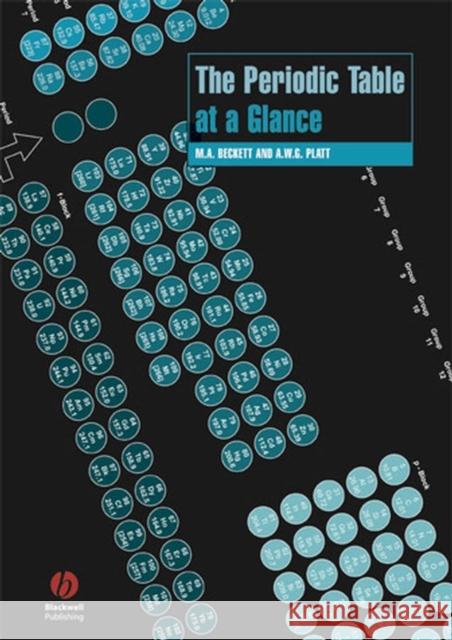
The Periodic Table at a Glance M. A. Beckett A. W. G. Platt 9781405132992 Blackwell Publishers - książkaWidoczna okładka, to zdjęcie poglądowe, a rzeczywista szata graficzna może różnić się od prezentowanej.

The Periodic Table at a Glance

ISBN-13: 9781405132992 / Angielski / Miękka / 2006 / 120 str.

M. A. Beckett; A. W. G. Platt
cena 168,84 zł
(netto: 160,80 VAT:  5%)

Najniższa cena z 30 dni: 167,45 zł
Termin realizacji zamówienia:
ok. 30 dni roboczych
Bez gwarancji dostawy przed świętami

Darmowa dostawa!

Inorganic chemistry is a core part of the chemistry curricula, though it is often felt to be a huge range of disparate facts that have little underlying organization or reasoning. The periodic table was developed in the latter part of the 19th century, providing an organizing structure which began to explain the underlying principles of inorganic chemistry

The Periodic Table at a Glance provides a concise overview of the main principles and reactions of inorganic chemistry, carefully structured around the periodic table, for students studying chemistry and related courses at undergraduate level. Based on the highly successful and student friendly -at a glance- approach, the information is presented in integrated, self contained double page spreads of text and illustrative material, to facilitate the rapid assimilation, understanding and recall of critical concepts, facts and definitions.

Students wanting a comprehensive and accessible overview of inorganic chemistry will find this book an ideal source of the information they require. In addition, the structured presentation will provide an invaluable aid to revision for students preparing for examinations.


Kategorie:
Dziecięca
Kategorie BISAC:
Juvenile Nonfiction > Science & Nature - Chemistry
Wydawca:
Blackwell Publishers
Seria wydawnicza:
At a Glance (Blackwell)
Język:
Angielski
ISBN-13:
9781405132992
Rok wydania:
2006
Numer serii:
000001609
Ilość stron:
120
Waga:
0.41 kg
Wymiary:
29.57 x 21.39 x 0.76
Oprawa:
Miękka
Wolumenów:
01
Dodatkowe informacje:
Bibliografia
Wydanie ilustrowane

"This is primarily a revision guide to assist undergraduate students in their study of degree level introductory inorganic chemistry.
The coverage is similar to that of most modern texts, with more on theoretical and physical aspects than on descriptive chemistry, and more on molecules (eg boron hydrides) than non–molecular substances (such as metal carbides). There are however outlines of important industrial processes."

Chemistry World, November 2006

"The strengths of this text are that the writing style is clear and descriptive and that the book is well organised around key topics. The authors have concentrated on presenting facts rather than concepts. Given its strengths, this book should appeal to students looking for a way to organise their thoughts about inorganic chemistry in the period leading up to exams."
Mark Winter

1. Atoms, The Periodic Table, And Periodic Properties.

1.1 Atomic Structure (I): introduction, electronic properties and wavefunctions.

1.2 Atomic Structure (II): quantum numbers, core and valence orbitals.

1.3 The Periodic Table: overview, atomic masses, the Periodic Table, historical perspective.

1.4 Periodic Properties: atomic, covalent and ionic radii, ionization energies, electron affinities, and electronegativities.

1.5 Redox Processes (I): standard reduction potentials, Latimer diagrams.

1.6 Redox Processes (II): Free Energy Oxidation STate (FROST) diagrams, construction of FROST diagrams, interpreting the FROST diagram.

2. Molecular Structures And Solid–State Giant Structures.

2.1 Covalent Interactions Between Atoms: overview, covalent bonding, Linear combination of atomic orbitals (LCAO), hybridization, polarity of covalent bonds.

2.2 Shapes Of Molecules: Valence–Shell Electron–Pair Repulsion (VSEPR).

2.3 Structure and Bonding in Metals: structures, bonding, properties.

2.4 Ionic and Covalent Solid–State Giant Structures: ionic bonding, simple ionic crystals, cation/anion radius ratio rule, ion polarization, covalent giant structure.

3. s–Block Elements Main Group Elements (Groups 1,2).

3.1 Group 1 Elements The Alkali Metals (Li, Na, K, Rb, Cs, Fr): elements, reactivity of the elements, compounds, co–ordination complexes, flame test colours.

3.2 Group 2 Elements The Alkaline Earths (Be, Mg, Ca, Sr, Ba, Ra): elements, reactivity of the elements, compounds, co–ordination complexes, flame test colours.

3.3 Some Industrial Processes Involving s–Block Elements: production and uses of salt, manufacture of caustic soda and the chloralkali industry, extraction of Na, soda ash, extraction of Mg.

.

4. p–Block Elements Main Group Elements (Groups 13–18).

4.1 General Overview Of p–Block Elements (I): introduction, electronic configurations, ionization energies, bonding.

4.2 General Overview Of p–Block elements (II): multiple bonds, molecular geometries.

4.3 Group 13 elements (B, Al, Ga, In, Tl): overview, halides, borates and aquo ions, co–ordination chemistry.

4.4 Borazene And The Boron Hydrides: borazene, boron hydrides.

4.5 Group 14 Elements (C, Si, Ge, Sn, Pb): overview, hydrides, multiple bonds, halides, oxides.

4.6 Silicate And Siloxane Chemistry: water glass solutions, solid–state silicate anions, zeolite chemistry, siloxanes.

4.7 Group 15 Elements – The Pnicogens (N, P, As, Sb, Bi): hydrides, halides, oxides, oxyanions, polyphosphazenes.

4.8 Group 16 Elements The Chalcogens (O, S, Se, Te, Po): oxidation states, hydrides, halides, Lewis acid/Lewis base behaviour.

4.9 Sulphur And Its Compounds (I): minerals and production, allotropes, hydrides and sulphide anions, oxides.

4.10 Sulphur And Its Compounds(II): oxyanions and related compounds, redox chemistry, sulphur–nitrogen chemistry.

4.11 Group 17 Elements The Halogens (F, Cl, Br, I, At): overview, oxidation states, interhalogen compounds, polyhalides, donor properties of halide anions.

4.12 Group 18 Elements The Inert Gases (He, Ne, Ar, Kr, Xe, Rn): introduction, xenon fluorides, xenon oxygen compounds, compounds with bonds between xenon and other elements, krypton compounds, compounds of radon and argon.

4.13 Some Industrial Processes Involving p–Block Elements (I): Al production, alkene polymerization, bromine.

4.14 Some Industrial Processes Involving p–Block Elements (II): ammonia, nitric acid.

5. Hydrogen.

5.1 Hydrogen The First Element: occurrence, atomic structure, physical properties of the element, H2 as an industrial chemical, position in the Periodic Table.

5.2 Hydrogen – Chemical Properties: introduction, saline hydrides, covalent hydrides, hydrogen bonds, Bronsted acidity and H+, metallic hydrides.

.

6. d–Block Elements Transition metals (Groups 3–12).

6.1 Electronic Configurations And General Reactivity: characteristic properties of the d–block elements, electronic configurations, physical properties and general reactivity.

6.2 An Overview Of Chemical And Physical Properties Of The d–Block Elements: co–ordination compounds (formation of complexes), coloured compounds, paramagnetism, catalysis by d–block metals.

6.2 Variable Oxidation States: First transition (3d) series, Group 5 – oxidation states of V, Group 6 – oxidation states of Cr, Group 7 – oxidation states of Mn, oxidation states of the second (4d) and third (5d) transition series.

6.4 Co–ordination Compounds (I): ligands and denticity, co–ordination numbers and co–ordination geometries, the chelate effect.

6.5 Co–ordination Compounds (II): kinetically inert and labile complexes, stepwise and overall stability constants, Irving Williams series for M2+, the effect of metal charge on stability constants, substitution in square–planar Pt(II) complexes.

6.6 Isomerism In Co–ordination Compounds: isomerism, geometrical isomerism, optical isomerism, ionization isomerism, linkage isomerism, co–ordination isomerism.

6.7 Reactions Of Transition Metal Aquo Ions: solution structure of aquo ions, reactivity of aquo ions (redox, acidity, substitution).

6.8 Crystal Field And Ligand field Theory: introduction, octahedral, square–planar, tetrahedral complexes, Jahn–Teller effect.

6.9 Ligand Field Theory And Electronic Spectra (Colours) Of Transition Metal Complexes: colours of transition metal complexes, factors which effect the magnitude of D.

6.10 Ligand Field Theory And Magnetic Properties: overview, magnetic susceptibilty, high spin/low spin complexes, ferromagnetism.

6.11 Metal Carbonyl Chemistry: organometallic compounds, the 18– rule, structures of binary metal carbonyls, substitution mechanisms.

6.12 d–Block Elements And Industrial Chemistry: production of Fe and steel, production of TiO2, purification of Ni, homogeneous catalysis, heterogeneous catalysis.

.

7. f–Block Elements Lanthanides and Actinides.

7.1 The 4f Elements The Lanthanides or Rare Earths: introduction, electronic configuration, lanthanide contraction, oxidation states (+3, +2 and +4), typical chemistry.

7.2 The 5f Elements – The Actinides: occurrence, electronic configuration, typical chemistry.

7.3 Some Applications Of The f–Block Elements: lanthanides (medical imaging, catalytic converters), actinides (nuclear fuels, smoke detectors).

Michael Beckett is a Senior Lecturer in Inorganic Chemistry in the Chemistry Department, University of Wales, Bangor, UK.

Andrew Platt is a Senior Lecturer in Forensic Science in the Faculty of Health and Sciences, Staffordshire University, UK

Inorganic chemistry is a core part of the chemistry curricula, though it is often felt to be a huge range of disparate facts that have little underlying organization or reasoning. The periodic table was developed in the latter part of the 19th century, providing an organizing structure which began to explain the underlying principles of inorganic chemistry

The Periodic Table at a Glance provides a concise overview of the main principles and reactions of inorganic chemistry, carefully structured around the periodic table, for students studying chemistry and related courses at undergraduate level. Based on the highly successful and student friendly at a glance approach, the information is presented in integrated, self contained double page spreads of text and illustrative material, to facilitate the rapid assimilation, understanding and recall of critical concepts, facts and definitions.

Students wanting a comprehensive and accessible overview of inorganic chemistry will find this book an ideal source of the information they require. In addition, the structured presentation will provide an invaluable aid to revision for students preparing for examinations.




Udostępnij

Facebook - konto krainaksiazek.pl


Opinie o Krainaksiazek.pl na Opineo.pl

Partner Mybenefit

Krainaksiazek.pl w programie rzetelna firma Krainaksiaze.pl - płatności przez paypal

Czytaj nas na:

Facebook - krainaksiazek.pl
  • książki na zamówienie
  • granty
  • książka na prezent
  • kontakt
  • pomoc
  • opinie
  • regulamin
  • polityka prywatności

Zobacz:

  • Księgarnia czeska

  • Wydawnictwo Książkowe Klimaty

1997-2025 DolnySlask.com Agencja Internetowa

© 1997-2022 krainaksiazek.pl
     
KONTAKT | REGULAMIN | POLITYKA PRYWATNOŚCI | USTAWIENIA PRYWATNOŚCI
Zobacz: Księgarnia Czeska | Wydawnictwo Książkowe Klimaty | Mapa strony | Lista autorów
KrainaKsiazek.PL - Księgarnia Internetowa

Polityka prywatnosci - link
Krainaksiazek.pl - płatnośc Przelewy24
Przechowalnia Przechowalnia



