• Wyszukiwanie zaawansowane
  • Kategorie
  • Kategorie BISAC
  • Książki na zamówienie
  • Promocje
  • Granty
  • Książka na prezent
  • Opinie
  • Pomoc
  • Załóż konto
  • Zaloguj się

The Pauli Exclusion Principle: Origin, Verifications, and Applications » książka


zaloguj się | załóż konto
Logo Krainaksiazek.pl

koszyk

konto

szukaj
topmenu
Księgarnia internetowa
Szukaj
Książki na zamówienie
Promocje
Granty
Książka na prezent
Moje konto
Pomoc
 
 
Wyszukiwanie zaawansowane
Pusty koszyk
Bezpłatna dostawa dla zamówień powyżej 20 złBezpłatna dostawa dla zamówień powyżej 20 zł

Kategorie główne

• Nauka
 [2949524]
• Literatura piękna
 [1817948]

  więcej...
• Turystyka
 [70715]
• Informatyka
 [151291]
• Komiksy
 [35671]
• Encyklopedie
 [23176]
• Dziecięca
 [612440]
• Hobby
 [136066]
• AudioBooki
 [1740]
• Literatura faktu
 [226030]
• Muzyka CD
 [378]
• Słowniki
 [2918]
• Inne
 [445441]
• Kalendarze
 [1181]
• Podręczniki
 [166545]
• Poradniki
 [469898]
• Religia
 [508035]
• Czasopisma
 [502]
• Sport
 [61392]
• Sztuka
 [242759]
• CD, DVD, Video
 [3348]
• Technologie
 [219537]
• Zdrowie
 [98738]
• Książkowe Klimaty
 [124]
• Zabawki
 [2382]
• Puzzle, gry
 [3543]
• Literatura w języku ukraińskim
 [259]
• Art. papiernicze i szkolne
 [7107]
Kategorie szczegółowe BISAC

The Pauli Exclusion Principle: Origin, Verifications, and Applications

ISBN-13: 9781118795323 / Angielski / Twarda / 2017 / 256 str.
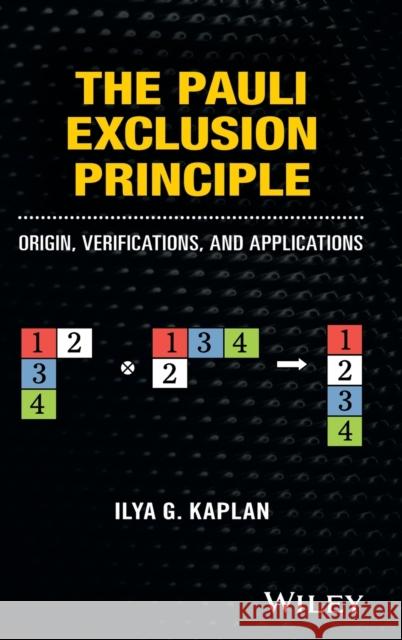
Ilya G. Kaplan
The Pauli Exclusion Principle: Origin, Verifications, and Applications Kaplan, Ilya G. 9781118795323 John Wiley & Sons - książkaWidoczna okładka, to zdjęcie poglądowe, a rzeczywista szata graficzna może różnić się od prezentowanej.

The Pauli Exclusion Principle: Origin, Verifications, and Applications

ISBN-13: 9781118795323 / Angielski / Twarda / 2017 / 256 str.

Ilya G. Kaplan
cena 559,41
(netto: 532,77 VAT:  5%)

Najniższa cena z 30 dni: 554,83
Termin realizacji zamówienia:
ok. 30 dni roboczych.

Darmowa dostawa!

This is the first scientic book devoted to the Pauli exclusion principle, which is a fundamental principle of quantum mechanics and is permanently applied in chemistry, physics, and molecular biology. However, while the principle has been studied for more than 90 years, rigorous theoretical foundations still have not been established and many unsolved problems remain. Following a historical survey in Chapter 1, the book discusses the still unresolved questions around this fundamental principle. For instance, why, according to the Pauli exclusion principle, are only symmetric and antisymmetric permutation symmetries for identical particles realized, while the SchrOdinger equation is satisfied by functions with any permutation symmetry? Chapter 3 covers possible answers to this question. The construction of function with a given permutation symmetry is described in the previous Chapter 2, while Chapter 4 presents effective and elegant methods for finding the Pauli-allowed states in atomic, molecular, and nuclear spectroscopy. Chapter 5 discusses parastatistics and fractional statistics, demonstrating that the quasiparticles in a periodical lattice, including excitons and magnons, are obeying modified parafermi statistics. With detailed appendices, The Pauli Exclusion Principle: Origin, Verifications, and Applications is intended as a self-sufficient guide for graduate students and academic researchers in the fields of chemistry, physics, molecular biology and applied mathematics. It will be a valuable resource for any reader interested in the foundations of quantum mechanics and its applications, including areas such as atomic and molecular spectroscopy, spintronics, theoretical chemistry, and applied fields of quantum information.

This is the first comprehensive scientific book devoted solely to the Pauli Exclusion Principle. Beginning with an introduction and historical overview, the book goes on to cover modern studies of the Pauli Exclusion Principle and its numerous applications in physics and chemistry.


Kategorie:
Nauka, Chemia
Kategorie BISAC:
Science > Chemia - Fizyczna
Science > Fizyka kwantowa
Wydawca:
John Wiley & Sons
Język:
Angielski
ISBN-13:
9781118795323
Rok wydania:
2017
Ilość stron:
256
Waga:
0.45 kg
Wymiary:
23.11 x 14.99 x 1.78
Oprawa:
Twarda
Wolumenów:
01
Dodatkowe informacje:
Bibliografia

Preface xi

1 Historical Survey 1

1.1 Discovery of the Pauli Exclusion Principle and Early Developments 1

1.2 Further Developments and Still Existing Problems 11

References 21

2 Construction of Functions with a Definite Permutation Symmetry 25

2.1 Identical Particles in Quantum Mechanics and Indistinguishability Principle 25

2.2 Construction of Permutation–Symmetric Functions Using the Young Operators 29

2.3 The Total Wave Functions as a Product of Spatial and Spin Wave Functions 36

2.3.1 Two–Particle System 36

2.3.2 General Case of N–Particle System 41

References 49

3 Can the Pauli Exclusion Principle Be Proved? 50

3.1 Critical Analysis of the Existing Proofs of the Pauli Exclusion Principle 50

3.2 Some Contradictions with the Concept of Particle Identity and their Independence in the Case of the Multidimensional Permutation Representations 56

References 62

4 Classification of the Pauli–Allowed States in Atoms and Molecules 64

4.1 Electrons in a Central Field 64

4.1.1 Equivalent Electrons: L S Coupling 64

4.1.2 Additional Quantum Numbers: The Seniority Number 71

4.1.3 Equivalent Electrons: j j Coupling 72

4.2 The Connection between Molecular Terms and Nuclear Spin 74

4.2.1 Classification of Molecular Terms and the Total Nuclear Spin 74

4.2.2 The Determination of the Nuclear Statistical Weights of Spatial States 79

4.3 Determination of Electronic Molecular Multiplets 82

4.3.1 Valence Bond Method 82

4.3.2 Degenerate Orbitals and One Valence Electron on Each Atom 87

4.3.3 Several Electrons Specified on One of the Atoms 91

4.3.4 Diatomic Molecule with Identical Atoms 93

4.3.5 General Case I 98

4.3.6 General Case II 100

References 104

5 Parastatistics, Fractional Statistics, and Statistics of Quasiparticles of Different Kind 106

5.1 Short Account of Parastatistics 106

5.2 Statistics of Quasiparticles in a Periodical Lattice 109

5.2.1 Holes as Collective States 109

5.2.2 Statistics and Some Properties of Holon Gas 111

5.2.3 Statistics of Hole Pairs 117

5.3 Statistics of Cooper s Pairs 121

5.4 Fractional Statistics 124

5.4.1 Eigenvalues of Angular Momentum in the Three– and Two–Dimensional Space 124

5.4.2 Anyons and Fractional Statistics 128

References 133

Appendix A: Necessary Basic Concepts and Theorems of Group Theory 135

A.1 Properties of Group Operations 135

A.1.1 Group Postulates 135

A.1.2 Examples of Groups 137

A.1.3 Isomorphism and Homomorphism 138

A.1.4 Subgroups and Cosets 139

A.1.5 Conjugate Elements. Classes 140

A.2 Representation of Groups 141

A.2.1 Definition 141

A.2.2 Vector Spaces 142

A.2.3 Reducibility of Representations 145

A.2.4 Properties of Irreducible Representations 147

A.2.5 Characters 148

A.2.6 The Decomposition of a Reducible Representation 149

A.2.7 The Direct Product of Representations 151

A.2.8 Clebsch Gordan Coefficients 154

A.2.9 The Regular Representation 156

A.2.10 The Construction of Basis Functions for Irreducible Representation 157

References 160

Appendix B: The Permutation Group 161

B.1 General Information 161

B.1.1 Operations with Permutation 161

B.1.2 Classes 164

B.1.3 Young Diagrams and Irreducible Representations 165

B.2 The Standard Young Yamanouchi Orthogonal Representation 167

B.2.1 Young Tableaux 167

B.2.2 Explicit Determination of the Matrices of the Standard Representation 170

B.2.3 The Conjugate Representation 173

B.2.4 The Construction of an Antisymmetric Function from the Basis Functions for Two Conjugate Representations 175

B.2.5 Young Operators 176

B.2.6 The Construction of Basis Functions for the Standard Representation from a Product of N Orthogonal Functions 178

References 181

Appendix C: The Interconnection between Linear Groups and Permutation Groups 182

C.1 Continuous Groups 182

C.1.1 Definition 182

C.1.2 Examples of Linear Groups 185

C.1.3 Infinitesimal Operators 187

C.2 The Three–Dimensional Rotation Group 189

C.2.1 Rotation Operators and Angular Momentum Operators 189

C.2.2 Irreducible Representations 191

C.2.3 Reduction of the Direct Product of Two Irreducible Representations 194

C.2.4 Reduction of the Direct Product of k Irreducible Representations. 3n j Symbols 197

C.3 Tensor Representations 201

C.3.1 Construction of a Tensor Representation 201

C.3.2 Reduction of a Tensor Representation into Reducible Components 202

C.3.3 Littlewood s Theorem 207

C.3.4 The Reduction of U2j + 1 R3 209

C.4 Tables of the Reduction of the Representations U 2j+1 to the Group R3 214

References 216

Appendix D: Irreducible Tensor Operators 217

D.1 Definition 217

D.2 The Wigner Eckart Theorem 220

References 222

Appendix E: Second Quantization 223

References 227

Index 228


Udostępnij

Facebook - konto krainaksiazek.pl


Opinie o Krainaksiazek.pl na Opineo.pl

Partner Mybenefit

Krainaksiazek.pl w programie rzetelna firma Krainaksiaze.pl - płatności przez paypal

Czytaj nas na:

Facebook - krainaksiazek.pl
  • książki na zamówienie
  • granty
  • książka na prezent
  • kontakt
  • pomoc
  • opinie
  • regulamin
  • polityka prywatności

Zobacz:

  • Księgarnia czeska

  • Wydawnictwo Książkowe Klimaty

1997-2026 DolnySlask.com Agencja Internetowa

© 1997-2022 krainaksiazek.pl
     
KONTAKT | REGULAMIN | POLITYKA PRYWATNOŚCI | USTAWIENIA PRYWATNOŚCI
Zobacz: Księgarnia Czeska | Wydawnictwo Książkowe Klimaty | Mapa strony | Lista autorów
KrainaKsiazek.PL - Księgarnia Internetowa

Polityka prywatnosci - link
Krainaksiazek.pl - płatnośc Przelewy24
Przechowalnia Przechowalnia






