• Wyszukiwanie zaawansowane
  • Kategorie
  • Kategorie BISAC
  • Książki na zamówienie
  • Promocje
  • Granty
  • Książka na prezent
  • Opinie
  • Pomoc
  • Załóż konto
  • Zaloguj się

The Chemistry of Antitumour Agents » książka


zaloguj się | załóż konto
Logo Krainaksiazek.pl

koszyk

konto

szukaj
topmenu
Księgarnia internetowa
Szukaj
Książki na zamówienie
Promocje
Granty
Książka na prezent
Moje konto
Pomoc
 
 
Wyszukiwanie zaawansowane
Pusty koszyk
Bezpłatna dostawa dla zamówień powyżej 40 złBezpłatna dostawa dla zamówień powyżej 40 zł

Kategorie główne

• Nauka
 [2950464]
• Literatura piękna
 [1818042]

  więcej...
• Turystyka
 [70123]
• Informatyka
 [151510]
• Komiksy
 [36386]
• Encyklopedie
 [23145]
• Dziecięca
 [612723]
• Hobby
 [135488]
• AudioBooki
 [1799]
• Literatura faktu
 [226050]
• Muzyka CD
 [373]
• Słowniki
 [2969]
• Inne
 [447626]
• Kalendarze
 [1159]
• Podręczniki
 [167118]
• Poradniki
 [469407]
• Religia
 [508205]
• Czasopisma
 [523]
• Sport
 [61168]
• Sztuka
 [242947]
• CD, DVD, Video
 [3513]
• Technologie
 [218724]
• Zdrowie
 [98968]
• Książkowe Klimaty
 [124]
• Zabawki
 [2556]
• Puzzle, gry
 [3690]
• Literatura w języku ukraińskim
 [264]
• Art. papiernicze i szkolne
 [8106]
Kategorie szczegółowe BISAC

The Chemistry of Antitumour Agents

ISBN-13: 9789401066655 / Angielski / Miękka / 2011 / 460 str.
D. E. Wilman
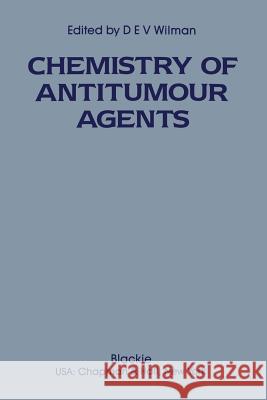
The Chemistry of Antitumour Agents D. E. Wilman 9789401066655 Springer - książkaWidoczna okładka, to zdjęcie poglądowe, a rzeczywista szata graficzna może różnić się od prezentowanej.

The Chemistry of Antitumour Agents

ISBN-13: 9789401066655 / Angielski / Miękka / 2011 / 460 str.

D. E. Wilman
cena 201,72
(netto: 192,11 VAT:  5%)

Najniższa cena z 30 dni: 192,74
Termin realizacji zamówienia:
ok. 16-18 dni roboczych.

Darmowa dostawa!

Walter C. J. ROSS Emeritus Professor, University of London To paraphrase a statement made by Howard E. Skipper many years ago, 'We cancer chemotherapists have often exploited and overworked our chemist colleagues and they have been conveniently forgotten at award giving times'. This book is an attempt to rectify this and highlight the contribution of the chemist in modifying the structure of various types of agent to enhance their effectiveness as inhibitors of the growth of neoplastic tissues. Cancer chemotherapy is a relatively new discipline, coming later than the introduction of sulphonamides and antibiotics. Modern anti-cancer therapy started with the report of the use of a war gas methyl-di-(2-chloroethyl)amine (HN2) in 1946 for the treatment of Hodgkin's disease. The recognition that this compound acted as a bifunctional alkylating agent under physiological conditions led to the synthesis of a wide range of drugs with similar properties. Amongst these were chlorambucil, melphalan, busulphan, and cyclophos phamide which still find use today. Somewhat later, a range of antibiotics was found to be effective, for example aminopterin (1948) and 6-mercaptopurine (1958) to treat acute leukaemias and 5-fluorouracil and 6-azauracil (1957-8) which were used against a variety of cancers. Since these early days the net has been cast ever wider and, as well as ingenious modifications of the compounds mentioned above, anticancer drugs now include growing classes of compounds ranging from purely synthetic agents to natural products. Many of these are discussed in the present book."


Kategorie:
Nauka, Chemia
Kategorie BISAC:
Science > Chemia - Organiczna
Medical > Oncology - General
Science > Chemia - Nieorganiczna
Wydawca:
Springer
Język:
Angielski
ISBN-13:
9789401066655
Rok wydania:
2011
Wydanie:
Softcover Repri
Ilość stron:
460
Waga:
0.66 kg
Wymiary:
22.9 x 15.2
Oprawa:
Miękka
Wolumenów:
01

1 Acridine-based antitumour agents.- 1.1 Introduction.- 1.2 Nitracrine (NSC 247561) and analogues.- 1.2.1 Synthesis.- 1.2.2 Properties.- 1.3 Amsacrine (NSC 249992) and analogues.- 1.3.1 Synthesis.- 1.3.2 Properties.- 1.4 CI-921 (NSC 343499) and other amsacrine analogues.- 1.4.1 Synthesis.- 1.4.2 Properties.- 1.5 N, N’-Bis-(9-acridinyl)-1,6-hexanediamine (NSC 219733) and related di- and triacridines.- 1.5.1 Synthesis.- 1.5.2 Properties.- 1.5.3 Triacridines.- 1.6 N-[2-(Dimethylamino)ethyl] -9-aminoacridine-4-carboxamide (NSC 342965) and related acridinecarboxamides.- 1.6.1 Synthesis.- 1.6.2 Properties.- 1.7 Conclusions.- References.- 2 Antitumour anthracyclines.- 2.1 Introduction and historical development.- 2.2 Doxorubicin.- 2.2.1 Microbiological isolation.- 2.2.2 Chemical preparation.- 2.2.3 Analytical profile.- 2.3 Epirubicine (4’-epidoxorubicin).- 2.3.1 Preparation.- 2.3.2 Analytical profile.- 2.4 Idarubicine (4-demethoxydaunorubicin).- 2.4.1 Preparation.- 2.4.2 Analytical profile.- 2.5 Spectroscopic properties.- 2.5.1 Infrared spectra.- 2.5.2 Mass spectra.- 2.5.3 Nuclear magnetic resonance spectra.- 2.5.4 Ultraviolet and visible spectra.- 2.5.5 Fluorescence spectra.- 2.5.6 Circular dichroism.- 2.6 Stability and reactivity.- 2.7 Metabolism.- 2.7.1 Synthesis of C-14 14C-labelled derivatives.- 2.7.2 Metabolism in patients.- 2.8 Methods of analysis.- 2.8.1 Spectroscopic analysis.- 2.8.2 Thin-layer chromatography.- 2.8.3 Liquid chromatography.- 2.8.4 Determination of anthracyclines in biological fluids.- 2.9 Aclacinomycin A.- 2.9.1 Microbiological isolation.- 2.9.2 Analytical profile.- 2.9.3 Spectroscopic properties.- 2.9.4 Metabolism.- References and notes.- 3 Alkylating agents.- 3.1 Introduction.- 3.2 Classification of biological alkylating agents.- 3.3 Reactivity of alkylating species.- 3.3.1 The reaction mechanisms of the alkylating agents with water and other nucleophiles.- 3.3.2 The electrophilicity of alkylating agents.- 3.3.3 Formation of DNA adducts.- 3.3.4 Structural modulation of alkylating agent reactivity.- 3.4 Chemical features involved in the transport and uptake of alkylating agents.- 3.4.1 Lipophilicity.- 3.4.2 Molecular structure.- 3.5 Preparative chemistry.- 3.5.1 Sulphur mustards.- 3.5.2 Nitrogen mustards.- 3.5.3 Aziridines.- 3.5.4 Methanesulphonates.- 3.5.5 Oxiranes.- 3.5.6 Benzo- and naphthoquinones.- 3.5.7 Piperazinediones.- 3.5.8 Diazoalkanes.- 3.5.9 ?-Methylene-?-lactones.- 3.5.10 Alkyl halides.- 3.6 The metabolism of alkylating agents.- 3.6.1 Cyclophosphamide and iphosphamide metabolism.- 3.6.2 Metabolism of CB 1954.- 3.7 Quantitative structure-activity relationships of the alkylating agents.- 3.7.1 Optimisation of lipophilicity by QSAR analysis.- 3.7.2 Separation of the structural features responsible for adverse effects from those responsible for activity.- 3.7.3 Structural effects in the carrier molecules.- 3.8 Concluding remarks.- References.- 4 Nitrosoureas.- 4.1 Introduction.- 4.2 Structure-activity relationships.- 4.2.1 Leukaemia L 1210.- 4.2.2 Solid tumours.- 4.3 Toxicity.- 4.4 Chemical basis of biologic activity.- 4.5 Structure and latentiation.- 4.5.1 Enzymic activation.- 4.5.2 Chemical activation.- 4.6 Structure and stability.- 4.7 Structure and metabolism.- 4.8 Water-soluble nitrosoureas and chlorozotocin analogues.- 4.9 Structural modifications and special carrier groups: aspirations.- References.- 5 Triazenes.- 5.1 Introduction.- 5.2 1-Aryl- and 1-heteryl-3, 3-dialkyltriazenes.- 5.2.1 Synthesis and structure.- 5.2.2 Antitumour activity.- 5.2.3 Metabolism.- 5.2.4 Chemistry.- 5.3 3-Alkyl-1-aryltriazenes.- 5.3.1 Synthesis.- 5.3.2 Structure.- 5.3.3 Chemistry.- 5.3.4 Monoalkyltriazenes as heterocyclic synthons.- 5.3.5 Biochemistry.- 5.4 Hydroxymethyltriazenes.- 5.5 Bis-triazenes: N, N-bis-(1-aryl-3-methyltriazen-3-ylmethyl)methylamines.- 5.6 1,3-Dialkyl- and 1,3,3-trialkyltriazenes.- 5.6.1 Synthesis.- 5.6.2 Reactions.- 5.6.3 Biological activity.- 5.7 Triazene N-oxides.- 5.8 Concluding remarks.- References.- 6 The chemistry of azolotetrazinones.- 6.1 Introduction.- 6.2 Synthesis.- 6.3 Reactions involving opening of the tetrazinone ring.- 6.4 Reactions involving retention of the tetrazinone ring.- 6.5 Relationship of the chemistry of the azolotetrazinones to their biochemistry.- 6.6 Concluding remarks.- References.- 7 Chemistry of antifolates.- 7.1 Introduction.- 7.2 Inhibitors of dihydrofolate reductase (EC 1.5.1.3).- 7.3 Inhibitors of thymidylate synthase (EC 2.1.1.45).- 7.4 Inhibitors of purine biosynthesis.- 7.5 The polyglutamyl metabolites of antifolates.- 7.6 Concluding remarks.- References.- 8 Inhibitors of steroid hormone biosynthesis and action.- 8.1 Introduction.- 8.2 Drugs for the treatment of breast cancer.- 8.2.1 Aminoglutethimide.- 8.2.2 4-Hydroxyandrost-4-ene-3,17-dione.- 8.2.3 Danazol.- 8.2.4 Tamoxifen.- 8.2.5 Medroxyprogesterone acetate.- 8.3 Drugs for the treatment of prostatic cancer.- 8.3.1 Luteinising hormone-releasing hormone agonists.- 8.3.2 Ketoconazole.- 8.3.3 4-Azasteroids as 5?-reductase inhibitors.- 8.3.4 Cyproterone acetate.- 8.3.5 Bifluranol.- 8.3.6 Flutamide.- 8.4 Concluding remarks.- References.- 9 Anticancer pyrimidines, pyrimidine nucleosides and prodrugs.- 9.1 Introduction.- 9.2 5-Fluorouracil and related 5-fluoropyrimidine compounds.- 9.2.1 Synthesis of 5-fluorouracil, nucleosides and derivatives.- 9.2.2 Mode of action and catabolism of 5-fluorouracil.- 9.3 1-(?-D-Arabinofuranosyl)cytosine.- 9.3.1 Syntheses of 1-(?-D-arabinofuranosyl)cytosine.- 9.4 5-Azacytidine and related nucleosides.- 9.4.1 Syntheses of 5-azacytidine and analogues.- 9.5 Selected experimental agents.- 9.6 Prodrugs of pyrimidines and pyrimidine nucleosides.- 9.6.1 Prodrugs of 1-(?-D-arabinofuranosyl)cytosine.- 9.6.2 Prodrugs of 5-fluorouracil and 2’-deoxy-5-fluorouridine.- 9.6.3 2,2’-Anhydro-l-(?-D-arabinofuranosyl)-5-fluorocytosine.- 9.7 Conclusions.- References.- 10 Purines and purine nucleoside analogues as antitumour agents.- 10.1 Introduction.- 10.2 Purine analogues.- 10.3 Purine nucleosides.- 10.4 Purine cyclic nucleotides.- 10.5 Certain other nucleosides biochemically related to purines.- 10.5.1 Tiazofurin.- 10.5.3 Pyrazofurin.- 10.5.4 2’-Deoxycoformycin (pentostatin).- References.- 11 Methylmelamines.- 11.1 Introduction.- 11.2 Hexamethylmelamine.- 11.3 Pentamethylmelamine.- 11.4 Trimelamol.- 11.5 Chemistry.- 11.5.1 Synthesis of alkylmelamines.- 11.5.2 Synthesis of N-hydroxymethylmelamines.- 11.5.3 Radiolabeled syntheses.- 11.5.4 Crystal structure.- 11.6 Concluding remarks.- References.- 12 The chemistry of platinum antitumour agents.- 12.1 Introduction.- 12.2 Cisplatin.- 12.2.1 Synthesis and characterisation.- 12.2.2 Reaction chemistry and mechanism of action.- 12.3 Carboplatin.- 12.3.1 Synthesis and characterisation.- 12.3.2 Reaction chemistry and mechanism of action.- 12.4 Iproplatin 336 12.4.1 Synthesis and characterisation.- 12.4.1 Synthesis and characterisation.- 12.4.2 Reaction chemistry and mechanism of action.- 12.5 Compounds containing the 1,2-diaminocyclohexane ligand.- 12.6 Concluding remarks.- References.- 13 Hypoxia-selective agents: radiosensitisers and cytotoxins.- 13.1 Introduction.- 13.2 Radiosensitisers.- 13.2.1 Nitroxyl free radicals.- 13.2.2 Electron-affinic radiosensitisers.- 13.3 Hypoxia-mediated cytotoxins.- 13.4 Concluding remarks.- References.- 14 The chemistry and structure-activity relationships of some new prodrugs of vinca alkaloids.- 14.1 Introduction.- 14.2 History.- 14.3 Structure-activity relationships.- 14.4 Chemical modifications.- 14.4.1 Nomenclature and abbreviations.- 14.4.2 C-23 terminal modification.- 14.4.3 C-4 modification.- 14.5 Discussion.- References.- 15 The chemistry of mitomycins.- 15.1 Introduction.- 15.2 Mitomycins and acids.- 15.3 Mitomycins and base.- 15.4 Mitomycin rearrangements.- 15.5 Chemistry at C-7.- 15.6 Mitomycins-metal complexes.- 15.7 Chemistry in the reduced state.- 15.7.1 Bioreductive alkylation as the mode of action of the mitomycins.- 15.7.2 Bioreductive alkylation products with DNA.- References.- 16 The chemistry of activated bleomycin.- 16.1 Introduction.- 16.2 Activation of metallobleomycins.- 16.3 Chemistry of DNA strand scission.- 16.4 Bleomycin-mediated degradation of structurally altered DNA substrates.- References.- 17 Actinomycins.- 17.1 Introduction.- 17.2 Mode of action.- 17.3 Natural structural variations.- 17.4 Biosynthetic analogues.- 17.5 Total synthesis of peptidic analogues.- 17.6 Total synthesis of chromophoric analogues.- 17.7 Partial synthesis of 2-substituted chromophoric analogues.- 17.8 Partial synthesis of 7-substituted chromophoric analogues.- 17.9 Tetracyclic chromophoric analogues.- 17.10 Summary.- References.- 18 Ellipticines.- 18.1 Isolation and structure of the pyrido[4,3-6]carbazole alkaloids.- 18.2 Synthesis.- 18.2.1 Syntheses involving the formation of ring B.- 18.2.2 Syntheses requiring the formation of ring C as the last step information of the tetracycle.- 18.2.3 Syntheses utilising ring D formation as the last step in construction of the tetracycle.- 18.3 Structure-activity studies.- 18.4 Theories of the mode of action.- 18.4.1 Intercalation and the effect on topoisomerases.- 18.4.2 Alkylation of macro-biomolecules.- 18.4.3 Radical and superoxide formation.- 18.5 Clinical applications.- 18.6 Subjective comments.- References.


Udostępnij

Facebook - konto krainaksiazek.pl


Opinie o Krainaksiazek.pl na Opineo.pl

Partner Mybenefit

Krainaksiazek.pl w programie rzetelna firma Krainaksiaze.pl - płatności przez paypal

Czytaj nas na:

Facebook - krainaksiazek.pl
  • książki na zamówienie
  • granty
  • książka na prezent
  • kontakt
  • pomoc
  • opinie
  • regulamin
  • polityka prywatności

Zobacz:

  • Księgarnia czeska

  • Wydawnictwo Książkowe Klimaty

1997-2026 DolnySlask.com Agencja Internetowa

© 1997-2022 krainaksiazek.pl
     
KONTAKT | REGULAMIN | POLITYKA PRYWATNOŚCI | USTAWIENIA PRYWATNOŚCI
Zobacz: Księgarnia Czeska | Wydawnictwo Książkowe Klimaty | Mapa strony | Lista autorów
KrainaKsiazek.PL - Księgarnia Internetowa

Polityka prywatnosci - link
Krainaksiazek.pl - płatnośc Przelewy24
Przechowalnia Przechowalnia





