• Wyszukiwanie zaawansowane
  • Kategorie
  • Kategorie BISAC
  • Książki na zamówienie
  • Promocje
  • Granty
  • Książka na prezent
  • Opinie
  • Pomoc
  • Załóż konto
  • Zaloguj się

The Chemical Equilibrium of Gaseous Systems » książka


zaloguj się | załóż konto
Logo Krainaksiazek.pl

koszyk

konto

szukaj
topmenu
Księgarnia internetowa
Szukaj
Książki na zamówienie
Promocje
Granty
Książka na prezent
Moje konto
Pomoc
 
 
Wyszukiwanie zaawansowane
Pusty koszyk
Bezpłatna dostawa dla zamówień powyżej 20 złBezpłatna dostawa dla zamówień powyżej 20 zł

Kategorie główne

• Nauka
 [2950560]
• Literatura piękna
 [1849509]

  więcej...
• Turystyka
 [71097]
• Informatyka
 [151150]
• Komiksy
 [35848]
• Encyklopedie
 [23178]
• Dziecięca
 [617388]
• Hobby
 [139064]
• AudioBooki
 [1657]
• Literatura faktu
 [228597]
• Muzyka CD
 [383]
• Słowniki
 [2855]
• Inne
 [445295]
• Kalendarze
 [1464]
• Podręczniki
 [167547]
• Poradniki
 [480102]
• Religia
 [510749]
• Czasopisma
 [516]
• Sport
 [61293]
• Sztuka
 [243352]
• CD, DVD, Video
 [3414]
• Technologie
 [219456]
• Zdrowie
 [101002]
• Książkowe Klimaty
 [124]
• Zabawki
 [2311]
• Puzzle, gry
 [3459]
• Literatura w języku ukraińskim
 [254]
• Art. papiernicze i szkolne
 [8079]
Kategorie szczegółowe BISAC

The Chemical Equilibrium of Gaseous Systems

ISBN-13: 9789027705563 / Angielski / Twarda / 1975 / 279 str.
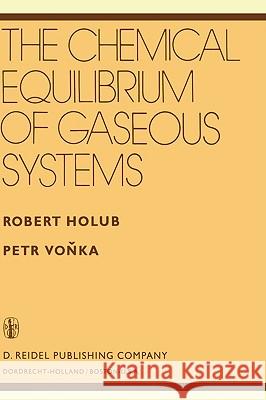
Robert Holub; R. Holub; P. Vonka
The Chemical Equilibrium of Gaseous Systems Robert Holub R. Holub P. Vonka 9789027705563 Springer - książkaWidoczna okładka, to zdjęcie poglądowe, a rzeczywista szata graficzna może różnić się od prezentowanej.

The Chemical Equilibrium of Gaseous Systems

ISBN-13: 9789027705563 / Angielski / Twarda / 1975 / 279 str.

Robert Holub; R. Holub; P. Vonka
cena 401,58
(netto: 382,46 VAT:  5%)

Najniższa cena z 30 dni: 385,52
Termin realizacji zamówienia:
ok. 22 dni roboczych
Dostawa w 2026 r.

Darmowa dostawa!
inne wydania

It is the purpose of this book to present a concise and sufficiently detailed de scription of the present state and possibilities of calculating chemical equilibria of gas mixtures. It is based on a book by one of the authors, published in Czech by the Publishing House Academia in Prague. The rapid development of the topic during the two years since publication of the Czech edition has made it necessary to revise practically all the sections in order to bring them up to the present level of know ledge. One reason for writing this book was the practical requirement of contemporary industry, where a rational utilization of equilibrium composition calculations may provide valuable information concerning processes under study in all stages of their implementation. A second reason was the need of a text-book for studying this part of chemical thermodynamics in the scope as taught at the Institute of Chemical Technology, Prague. These two basic motives determine the overall structure of the book, as well as the proportions and arrangement of the chapters. The book includes fundamental thermodynamic concepts as well as the mathematical apparatus needed to solve the problems involved, care being taken that the discussion should always l ad to a practical procedure of performing equilibrium calculations in gas-phase systems of any degree of complexity whatever. Knowledge of chemical thermodynamics on the level of a fundamental university course is assumed."


Kategorie:
Nauka, Chemia
Kategorie BISAC:
Science > Chemia - Fizyczna
Wydawca:
Springer
Język:
Angielski
ISBN-13:
9789027705563
Rok wydania:
1975
Wydanie:
1976
Ilość stron:
279
Waga:
1.27 kg
Wymiary:
23.4 x 15.6
Oprawa:
Twarda
Wolumenów:
01
Dodatkowe informacje:
Bibliografia
Wydanie ilustrowane

List of contents.- 1 Introduction.- 2 Stoichiometry of Chemical Reactions.- 2.1 Definition of a chemical reaction.- 2.2 Determination of the number of linearly independent reactions.- 2.3 Calculation of the matrix of stoichiometric coefficients.- 2.4 Expression of the mass balance.- 3 Chemical Equilibrium of a System.- 3.1 General considerations.- 3.2 The equilibrium constant and ?G° of a reaction.- 3.3 Selection of the standard state.- 3.4 Dependence of the equilibrium constant on variables of state.- 3.4.1 Dependence on temperature.- 3.4.2 Dependence on pressure.- 3.5 Dependence of the equilibrium constant on the absolute magnitude of the stoichiometric coefficients.- 3.6 Properties of the free enthalpy of a system.- 3.7 Procedure of calculating a chemical equilibrium.- 4 Chemical Equilibrium of Simple Systems in the Ideal Gas State.- 4.1 Reaction coordinate.- 4.2 Calculation of simple equilibria.- 4.3 Dependence of the degree of conversion on individual reaction conditions.- 4.3.1 Dependence of the degree of conversion on temperature.- 4.3.2 Dependence of the degree of conversion on pressure.- 4.3.3 Dependence of the degree of conversion on the composition of the initial mixture.- 4.3.4 Dependence of the degree of conversion on inert constituents.- 4.4 Dependence of the equilibrium composition on individual reaction variables in the case of more complicated systems.- 4.4.1 Temperature dependence.- 4.4.2 Pressure dependence.- 4.4.3 Dependence on the composition of the initial mixture.- 4.4.4 Dependence on the amount of inert constituents.- 5 Chemical Equilibrium of Complex System in the Ideal Gas State.- 5.1 Introduction.- 5.2 Single-purpose procedures.- 5.3 General methods requiring stoichiometric analysis of the system.- 5.3.1 Principle of the methods.- 5.3.2 Newton’s method with reduction parameter.- 5.3.3 Brinkley’s method.- 5.3.4 Modification of Brinkley’s method.- 5.3.5 The NASA method.- 5.3.6 Gradient methods.- 5.4 General methods which do not require stoichiometric analysis of the system.- 5.4.1 Principle of the methods.- 5.4.2 The White-Johnson-Dantzig method.- 5.4.3 The method of Lagrangian multipliers.- 5.4.4 Linear and convex programming methods.- 5.5 Evaluation.- 5.6 Description of selected methods.- 5.6.1 Newton’s method with reduction parameter.- 5.6.2 Brinkley’s method.- 5.6.3 The White-Johnson-Dantzig method.- 5.6.4 The method of Lagrangian multipliers.- 5.6.5 Mutual comparison of the methods.- 5.7 Calculation of the enthalpy balance of complicated systems.- 5.7.1 Calculations of adiabatic temperature.- 5.7.2 Calculations of the initial mass balance.- 6 Chemical Equilibria in Real Gas Systems.- 6.1 Fundamentals thermodynamic notions.- 6.1.1 Fugacity of a constituent in a mixture.- 6.1.2 Partial molar volume.- 6.1.2.1 Viral expansion.- 6.1.2.2 The Redlich-Kwong equation.- 6.1.2.3 The Beattie-Bridgman equation.- 6.1.2.4 The Benedict-Webb-Rubin equation.- 6.2 Determination of equilibrium composition.- 6.2.1 The generalized solution.- 6.2.1.1 Procedure based on expressing the equilibrium constants of individual reactions.- 6.2.1.2 Procedure based on the White-Johnson-Dantzig method.- 6.2.1.3 Method of Lagrangian multipliers.- 6.2.2 The iterative procedure.- 6.2.3 Approximate solution.- 6.2.3.1 Determination of the equilibrium composition from known equilibrium constants of the individual reactions.- 6.2.3.2 Determination of equilibrium composition from the minimum of overall free enthalpy of the system.- 6.3 Determination of the fugacity coefficients of constituents in the system.- 6.3.1 Determination of fugacity coefficients for high pressures.- 6.3.1.1 Virial expansion.- 6.3.1.2 The Redlich-Kwong equation.- 6.3.1.3 The Beattie-Bridgman equation.- 6.3.1.4 The Benedict-Webb-Rubin equation.- 6.3.2 Determination of fugacity coefficients at low pressures.- 6.3.2.1 Virial expansion.- 6.3.2.2 The Redlich-Kwong equation.- 6.3.2.3 The Beattie-Bridgman equation.- 6.4 Determination of the constants of equations of state of pure constituents.- 6.4.1 Tabulated data.- 6.4.2 Determination of the constants of equations of state from critical data.- 6.4.2.1 Virial expansion.- 6.4.2.2 The Redlich-Kwong equation.- 6.4.2.3 The Beattie-Bridgman equation.- 6.4.2.4 The Benedict-Webb-Rubin equation.- 6.4.3 Estimation of constants.- 7 Practical Calculation Procedure.- 7.1 Source of thermochemical data.- 7.1.1 Accuracy of data.- 7.1.2 Methods of determining thermochemical data.- 7.1.2.1 Experimental methods.- 7.1.2.2 Calculation methods.- 7.1.3 Method of tabulating data.- 7.1.4 Data collections.- 7.2 Strategy of calculation.- 7.3 Processing the calculated results.- 7.4 Example.- 7.4.1 Preliminary classification of reactions taking place.- 7.4.2 Thermochemical data.- 7.4.3 Calculation of the equilibrium composition.- 7.4.4 Technologic conclusions.- Appendix 1 Solution of one non-linear equation.- Appendix 2 Solution of a set of non-linear equations.- Appendix 3 Proof of the inequality.- Appendix 4 Proof of the asymptotic relationship.- Appendix 5 Maximum yield of a reaction.- Appendix 6 Proof of the existence and unambiguous nature of the solution to the problem of chemical equilibrium in ideal gas systems.- Appendix 7 Values of the most frequently encountered compounds in the range of 298.15 to 1200 K, and values of in cal mole and cal mole resp..- Appendix 9 Critical data of selected organic substances.- Appendix 10 Values of constants of the Beattie-Bridgman equation.- Appendix 11 Values of constants of the Benedict-Webb-Rubin equation.- References.


Udostępnij

Facebook - konto krainaksiazek.pl


Opinie o Krainaksiazek.pl na Opineo.pl

Partner Mybenefit

Krainaksiazek.pl w programie rzetelna firma Krainaksiaze.pl - płatności przez paypal

Czytaj nas na:

Facebook - krainaksiazek.pl
  • książki na zamówienie
  • granty
  • książka na prezent
  • kontakt
  • pomoc
  • opinie
  • regulamin
  • polityka prywatności

Zobacz:

  • Księgarnia czeska

  • Wydawnictwo Książkowe Klimaty

1997-2025 DolnySlask.com Agencja Internetowa

© 1997-2022 krainaksiazek.pl
     
KONTAKT | REGULAMIN | POLITYKA PRYWATNOŚCI | USTAWIENIA PRYWATNOŚCI
Zobacz: Księgarnia Czeska | Wydawnictwo Książkowe Klimaty | Mapa strony | Lista autorów
KrainaKsiazek.PL - Księgarnia Internetowa

Polityka prywatnosci - link
Krainaksiazek.pl - płatnośc Przelewy24
Przechowalnia Przechowalnia





