• Wyszukiwanie zaawansowane
  • Kategorie
  • Kategorie BISAC
  • Książki na zamówienie
  • Promocje
  • Granty
  • Książka na prezent
  • Opinie
  • Pomoc
  • Załóż konto
  • Zaloguj się

Teas, Cocoa and Coffee: Plant Secondary Metabolites and Health » książka


zaloguj się | załóż konto
Logo Krainaksiazek.pl

koszyk

konto

szukaj
topmenu
Księgarnia internetowa
Szukaj
Książki na zamówienie
Promocje
Granty
Książka na prezent
Moje konto
Pomoc
 
 
Wyszukiwanie zaawansowane
Pusty koszyk
Bezpłatna dostawa dla zamówień powyżej 20 złBezpłatna dostawa dla zamówień powyżej 20 zł

Kategorie główne

• Nauka
 [2946912]
• Literatura piękna
 [1852311]

  więcej...
• Turystyka
 [71421]
• Informatyka
 [150889]
• Komiksy
 [35717]
• Encyklopedie
 [23177]
• Dziecięca
 [617324]
• Hobby
 [138808]
• AudioBooki
 [1671]
• Literatura faktu
 [228371]
• Muzyka CD
 [400]
• Słowniki
 [2841]
• Inne
 [445428]
• Kalendarze
 [1545]
• Podręczniki
 [166819]
• Poradniki
 [480180]
• Religia
 [510412]
• Czasopisma
 [525]
• Sport
 [61271]
• Sztuka
 [242929]
• CD, DVD, Video
 [3371]
• Technologie
 [219258]
• Zdrowie
 [100961]
• Książkowe Klimaty
 [124]
• Zabawki
 [2341]
• Puzzle, gry
 [3766]
• Literatura w języku ukraińskim
 [255]
• Art. papiernicze i szkolne
 [7810]
Kategorie szczegółowe BISAC

Teas, Cocoa and Coffee: Plant Secondary Metabolites and Health

ISBN-13: 9781444334418 / Angielski / Twarda / 2011 / 264 str.
Crozier, Alan
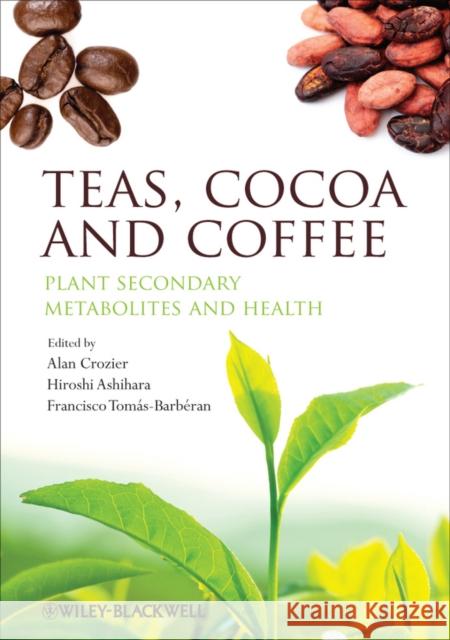
Teas, Cocoa and Coffee: Plant Secondary Metabolites and Health Crozier, Alan 9781444334418 Wiley & Sons - książkaWidoczna okładka, to zdjęcie poglądowe, a rzeczywista szata graficzna może różnić się od prezentowanej.

Teas, Cocoa and Coffee: Plant Secondary Metabolites and Health

ISBN-13: 9781444334418 / Angielski / Twarda / 2011 / 264 str.

Crozier, Alan
cena 800,92
(netto: 762,78 VAT:  5%)

Najniższa cena z 30 dni: 797,62
Termin realizacji zamówienia:
ok. 30 dni roboczych
Bez gwarancji dostawy przed świętami

Darmowa dostawa!

In recent years, the role of plant secondary metabolites as protective constituents in the human diet has been a growing area of research. Unlike the traditional vitamins, they are not essential for short-term wellbeing, but there is increasing evidence that modest long-term intakes can have favourable impacts on the incidence of cancers and many chronic diseases, including cardiovascular disease and type II diabetes, which are occurring in Western populations with increasing frequency. This book covers the latest science on the metabolism and potential health benefits of teas, cocoa, coffee and their extracts in the human diet. From an opening chapter tracing the origins of teas, cocoa and coffee as beverage, the book proceeds to explore the phytochemical content of coffee, cocoa and the various types of tea. The bioavailability of secondary metabolites from each of the beverages is then considered in depth, and related directly to their health benefits. Embracing the full range of tea, coffee and cocoa beverages and products, the book offers the most up-to-date and comprehensive treatment of these increasingly important dietary components. As the only book to bring together the latest information on the biochemistry and health benefits of teas, coffee and cocoa, this book is essential reading for food scientists and technologists involved in the production of tea, coffee and cocoa products. Nutritionists will value the book's health focus, while agricultural scientists working on the cultivation of these crops will prize its scope and depth of detail. It is also an important resource for all those who use functional ingredients in other products, whether they are based in industry or research.


In recent years, the role of plant secondary metabolites as protective constituents in the human diet has been a growing area of research. Unlike the traditional vitamins, they are not essential for short-term wellbeing, but there is increasing evidence that modest long-term intakes can have favourable impacts on the incidence of cancers and many chronic diseases, including cardiovascular disease and type II diabetes, which are occurring in Western populations with increasing frequency.§This book covers the latest science on the metabolism and potential health benefits of teas, cocoa, coffee and their extracts in the human diet. From an opening chapter tracing the origins of teas, cocoa and coffee as beverage, the book proceeds to explore the phytochemical content of coffee, cocoa and the various types of tea. The bioavailability of secondary metabolites from each of the beverages is then considered in depth, and related directly to their health benefits. Embracing the full range of tea, coffee and cocoa beverages and products, the book offers the most up-to-date and comprehensive treatment of these increasingly important dietary components.§As the only book to bring together the latest information on the biochemistry and health benefits of teas, coffee and cocoa, this book is essential reading for food scientists and technologists involved in the production of tea, coffee and cocoa products. Nutritionists will value the book's health focus, while agricultural scientists working on the cultivation of these crops will prize its scope and depth of detail. It is also an important resource for all those who use functional ingredients in other products, whether they are based in industry or research.

Kategorie:
Nauka, Biologia i przyroda
Kategorie BISAC:
Technology & Engineering > Food Science - General
Wydawca:
Wiley & Sons
Język:
Angielski
ISBN-13:
9781444334418
Rok wydania:
2011
Ilość stron:
264
Waga:
0.67 kg
Wymiary:
24.64 x 17.27 x 1.78
Oprawa:
Twarda
Wolumenów:
01
Dodatkowe informacje:
Bibliografia
Wydanie ilustrowane

Overall, this book is packed with interesting information, resulting from the lifetime s work of some of the editors.    (Chromatographia., 17 April 2014)

As such the book would serve as an excellent introduction for scientists wanting to transfer into the area, or as a useful state of the art overview for those in the field.  Highly recommended.   (Chemistry & Industry, 1 July 2012)

Additionally, this text should be included in all college and university science and medical libraries, as there are no comparable up–to–date treatises on the health benefits, composition, and bioavailability of teas,  coffee, and cocoa.   (HerbalGram, 2012)

Highly recommended.  Lower–division undergraduates through professionals and general readers interested in human medicine, natural health, or plant biology.   (Choice, 1 May 2012)

Contributors ix

1 The Origins of Tea, Coffee and Cocoa as Beverages 1
Timothy J. Bond

1.1 Introduction 1

1.2 The beverages in question 1

1.3 Discoveries myth and legend 2

1.3.1 Tea 3

1.3.2 Coffee 4

1.3.3 Cacao products 5

1.4 Global domination begins 8

1.4.1 Tea overland and a race by sea 9

1.4.2 Coffee from persecution to epitomising the protestant work ethic 13

1.4.3 Chocolate from lying down . . . to sitting up 14

1.5 From foreign fancies to the drinks of the masses 15

1.6 Tea, coffee and chocolate go public 18

1.7 Opinion is divided on the merits of the three beverages 19

1.8 Tea, coffee and chocolate the future 22

References 22

2 Purine Alkaloids: A Focus on Caffeine and Related Compounds in Beverages 25
Michael E.J. Lean, Hiroshi Ashihara, Michael N. Clifford and Alan Crozier

2.1 Introduction 25

2.2 Occurrence of purine alkaloids 26

2.3 Biosynthesis of purine alkaloids 27

2.4 Degradation of purine alkaloids 27

2.5 Decaffeinated tea and coffee 29

2.6 Metabolism of caffeine by humans 31

2.7 Effects of caffeine consumption on human health 33

2.7.1 Biochemical and biological actions of caffeine 34

2.7.2 Mental performance enhancement 37

2.7.3 Physical performance enhancement 37

2.7.4 Caffeine toxicity 38

2.7.5 Tolerance, withdrawal and dependence 39

2.7.6 Caffeine in pregnancy 39

2.7.7 Toxicity in other species 40

2.8 Summary 40

References 40

3 Phytochemicals in Teas and Tisanes and Their Bioavailability 45
Michael N. Clifford and Alan Crozier

3.1 Introduction 45

3.2 Phytochemical content of teas and tisanes 45

3.2.1 Camellia teas 45

3.2.2 Yerba mat´e tea 54

3.2.3 Itadori tea 58

3.2.4 Rooibos tea 59

3.2.5 Honeybush tea 59

3.2.6 Chamomile tea 62

3.2.7 Hibiscus tea 62

3.2.8 Fennel tea 63

3.2.9 Anastatica tea 63

3.2.10 Ficus tea 66

3.3 Bioavailability absorption, distribution, metabolism and excretion 66

3.3.1 Green tea 68

3.3.2 Black tea 77

3.3.3 Itadori tea 80

3.3.4 Rooibos tea 81

3.3.5 Honeybush tea 84

3.3.6 Hibiscus tea 85

3.3.7 Fennel tea 85

3.3.8 Other teas 87

3.4 Summary 87

References 88

4 Teas, Tisanes and Health 99
Diane L. McKay, Marshall G. Miller and Jeffrey B. Blumberg

4.1 Introduction 99

4.2 Black, oolong and green tea (C. sinensis) 100

4.2.1 Black tea 100

4.2.2 Oolong tea 107

4.2.3 Green tea 109

4.3 Other teas and tisanes 116

4.3.1 Yerba mat´e (Ilex paraguariensis) 116

4.3.2 Itadori (Polygonum cuspidatum) 118

4.3.3 Chamomile (Chamomilla recutita L.) 119

4.3.4 Hibiscus (Hibiscus sabdariffa L.) 120

4.3.5 Rooibos (Aspalathus linearis) 126

4.3.6 Honeybush (Cyclopia intermedia) 128

4.4 Summary and conclusions 130

References 131

5 Phytochemicals in Coffee and the Bioavailability of Chlorogenic Acids 143
Angelique Stalmach, Michael N. Clifford, Gary Williamson and Alan Crozier

5.1 Introduction 143

5.2 Harvesting coffee beans, roasting and blending 144

5.3 Phytochemicals in coffee 144

5.3.1 Effects of roasting on the phytochemical content of coffee beans 149

5.3.2 Chlorogenic acid intake and coffee consumption 154

5.4 Bioavailability of coffee chlorogenic acids in humans 155

5.4.1 Studies involving volunteers with and without a functioning colon 156

5.5 Conclusions 164

References 164

6 Coffee and Health 169
Gary Williamson

6.1 Introduction 169

6.2 Antioxidant status 170

6.2.1 Effect of coffee consumption on antioxidant status: epidemiological and cohort studies 179

6.2.2 Effect of coffee consumption on antioxidant status: intervention studies 179

6.3 Diabetes 180

6.3.1 Effect of coffee consumption on diabetes risk: epidemiological and cohort studies 180

6.3.2 Effect of coffee consumption on diabetes risk: intervention studies 182

6.4 Cardiovascular disease 183

6.4.1 Effect of coffee consumption on cardiovascular risk: epidemiological and cohort studies 183

6.4.2 Effect of coffee consumption on cardiovascular risk: intervention studies 184

6.5 Effect of coffee on inflammation 186

6.6 Effect of coffee consumption on cancer risk 186

6.6.1 Effect of coffee consumption on cancer risk: epidemiological and cohort studies 186

6.6.2 Effect of coffee consumption on cancer risk: intervention studies 188

6.7 Summary 188

References 188

7 Phytochemicals in Cocoa and Flavan–3–ol Bioavailability 193
Francisco Tomas–Barberan, Gina Borges and Alan Crozier

7.1 Introduction 193

7.2 Phytochemicals in cocoa 194

7.2.1 Purine alkaloids, theobromine and caffeine 194

7.2.2 Flavan–3–ols 194

7.2.3 Phenolic acid derivatives 196

7.2.4 Minor phytochemicals 197

7.3 Bioavailability of cocoa flavan–3–ols 198

7.3.1 Background 198

7.3.2 Flavan–3–ol monomers 200

7.3.3 Procyanidins 210

7.4 Conclusions 212

References 213

8 Cocoa and Health 219
Jennifer L. Donovan, Kelly A. Holes–Lewis, Kenneth D. Chavin and Brent M. Egan

8.1 Introduction 219

8.2 Composition of cocoa products 220

8.3 Worldwide consumption of cocoa and its contribution to flavonoid intake 222

8.4 Epidemiological and ecological studies of cocoa 222

8.5 Cocoa effects on vascular endothelial function and platelet activity 224

8.6 Cocoa and hypertension 227

8.7 Antioxidant and anti–inflammatory effects of cocoa 229

8.8 Effects of cocoa consumption on lipid and lipoprotein metabolism 232

8.9 Cocoa effects on insulin sensitivity 233

8.10 Cocoa effects on cerebral blood flow and neurocognitive functioning 234

8.11 Potential negative health effects of cocoa consumption 237

8.11.1 Obesity 237

8.11.2 Testicular health 237

8.11.3 Acne 238

8.11.4 Dental caries 238

8.12 Effects of consumption of cocoa with milk or other foods 238

8.13 Conclusions 239

References 240

Index 247

A color plate section falls between pages 6 and 7

Alan Crozier is Professor of Plant Biochemistry and Human Nutrition at the University of Glasgow, UK.

Hiroshi Ashihara is Professor of Plant Biochemistry at Ochanomizu University, Tokyo, Japan.

Francisco Tomás–Barbéran is Research Professor of the Spanish Council for Scientific Research (CSIC) in the CEBAS Institute, Murcia, Spain.

In recent years, the role of plant secondary metabolites as protective constituents in the human diet has been a growing area of research. Unlike the traditional vitamins, they are not essential for short–term wellbeing, but there is increasing evidence that modest long–term intakes can have favourable impacts on the incidence of cancers and many chronic diseases, including cardiovascular disease and type II diabetes, which are occurring in Western populations with increasing frequency.

This book covers the latest science on the metabolism and potential health benefits of teas, cocoa, coffee and their extracts in the human diet. From an opening chapter tracing the origins of teas, cocoa and coffee as beverages, the book proceeds to explore the phytochemical content of coffee, cocoa and the various types of tea. The bioavailability of secondary metabolites from each of the beverages is then considered in depth,

and related directly to their health benefits. Embracing the full range of tea, coffee and cocoa beverages and products, the book offers the most up–to–date and comprehensive treatment of these increasingly important dietary components.

As the only book to bring together the latest information on the biochemistry and health benefits of teas, coffee and cocoa, this book is essential reading for food scientists and technologists involved in the production of tea, coffee and cocoa products. Nutritionists will value the book s health focus, while agricultural scientists working on the cultivation of these crops will prize its scope and depth of detail. It is also an important resource for all those who use functional ingredients in other products, whether they are based in industry or research.




Udostępnij

Facebook - konto krainaksiazek.pl


Opinie o Krainaksiazek.pl na Opineo.pl

Partner Mybenefit

Krainaksiazek.pl w programie rzetelna firma Krainaksiaze.pl - płatności przez paypal

Czytaj nas na:

Facebook - krainaksiazek.pl
  • książki na zamówienie
  • granty
  • książka na prezent
  • kontakt
  • pomoc
  • opinie
  • regulamin
  • polityka prywatności

Zobacz:

  • Księgarnia czeska

  • Wydawnictwo Książkowe Klimaty

1997-2025 DolnySlask.com Agencja Internetowa

© 1997-2022 krainaksiazek.pl
     
KONTAKT | REGULAMIN | POLITYKA PRYWATNOŚCI | USTAWIENIA PRYWATNOŚCI
Zobacz: Księgarnia Czeska | Wydawnictwo Książkowe Klimaty | Mapa strony | Lista autorów
KrainaKsiazek.PL - Księgarnia Internetowa

Polityka prywatnosci - link
Krainaksiazek.pl - płatnośc Przelewy24
Przechowalnia Przechowalnia




