System Safety for the 21st Century » książka





System Safety for the 21st Century
ISBN-13: 9781119634751 / Angielski / Twarda / 2022 / 416 str.
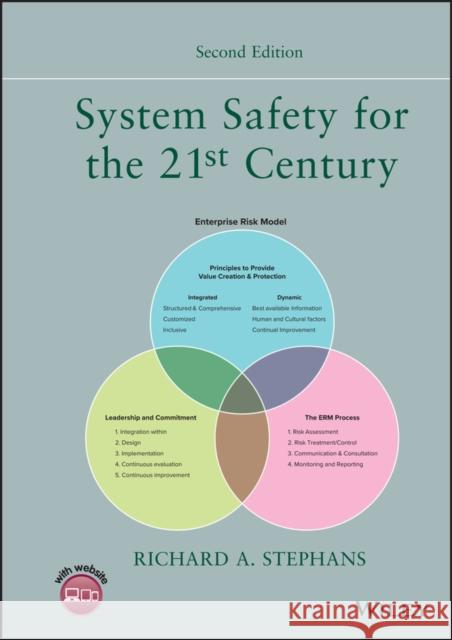
System Safety for the 21st Century
ISBN-13: 9781119634751 / Angielski / Twarda / 2022 / 416 str.
(netto: 545,51 VAT: 5%)
Najniższa cena z 30 dni: 565,79
ok. 22 dni roboczych.
Darmowa dostawa!
Foreword xiiiPreface xvAcknowledgments xviiAbout The Companion Website xixPart I Introduction to System Safety 11. The History of System Safety 3The 1960s--Mil-Std-882, DoD, and Nasa 4The 1970s--The Management Oversight and Risk Tree 4The 1980s--Facility System Safety 5The 1990s--Risk-Based Process System Safety 6The 2000s--Quest for Intrinsic Safety 6The 2010s--Risk Management Integration 7The 2020s--Improvements and International Approach to Risk Maturing 7Review Questions 8Bibliography 82. Fundamentals of System Safety 9Basic Definitions 9Fundamental Safety Concepts 9System Safety Fundamentals 13System Safety Tenets 18Review Questions 19Bibliography 193. Current Approaches to System Safety 21Department of Defense 21Nasa 26Facility System Safety 28The Chemical Industry 31Department of Energy 32Review Questions 34Bibliography 354. Problem Areas 37Standardization 38Risk Assessment Codes 39Data 40Communications 40Life Cycle 41Education and Training 41Human Factors 41Software 42Review Questions 42Bibliography 425. The Future of System Safety 43More First-TimeSafe Systems 43Cost-Effective Management Tools 43The Face of System Safety 44Proactive or Reactive? 47Review Questions 47Bibliography 47Part II System Safety Program Planning and Management 496. Establishing the Groundwork 51Generic Model 51Product Safety 51Dual Programs 52Planning and Development Methodology 52Review Questions 537. Tasks 55Hazard Identification 56Hazard Analysis and Control 58System Safety Support Tasks 60Review Questions 618. System Safety Products 63System Safety Program Plan 63Preliminary Hazard List 64Preliminary Hazard Analysis 66Hazard Tracking Log 67Subsystem Hazard Analysis 68System Hazard Analysis 71Operating Hazard Analysis 72Change Analysis Report 73Accident Analysis Report 74Review Questions 759. Program Implementation 77Steps 77Review Questions 88Table of Contents vii10. Risk Management 89Introduction 89Types of Risk 89Risk Management 90Review Questions 96Bibliography 96Part Iii Analytical Aids 10111. Analytical Trees 103Purposes 104Tree Construction 105Fault Trees Versus Fault Tree Analysis 110Review Questions 115Bibliography 11512. Risk Assessment and Risk Acceptance 117Risk Management Concepts 117Risk Assessment Shortcomings 123Total Risk Exposure Codes 124Review Questions 126Bibliography 12613. Human Factors 127Human Reliability 127Human Error Rates 129Improving Human Reliability 130Human Factors for Engineering Design 132Review Questions 135Bibliography 135Part IV System Safety Analysis Techniques 13714. Energy Trace and Barrier Analysis 139Purpose of ETBA 139Input Requirements 139General Approach 140Instructions 140Review Questions 142Bibliography 14215. Failure Mode and Effects Analysis 143Purpose of FMEA 144Input Requirements 144General Approach 144Instructions 144Appendix: Sample FMEA 147Summary 147Project Description 147Methodology 149Review Questions 152Bibliography 15216. Fault Tree Analysis 155Purpose of FTA 155Input Requirements 156General Approach 156Instructions 157Appendix: Sample FTA 165Summary 165Project Description 166Methodology 167Review Questions 171Bibliography 17117. Project Evaluation Tree 173Purpose of PET 174Input Requirements 174General Approach 174Instructions 175Appendix: PET User's Guide 179Review Questions 188Bibliography 18818. Change Analysis 189Purpose 189Input Requirements 190General Approach 190Instructions 190Review Questions 193Bibliography 19319. Management Oversight and Risk Tree 195Purpose of Mort and Mini-Mort 197Input Requirements 198General Approach 198Instructions 205Review Questions 221Bibliography 22120. Event and Causal Factors Charts 223Purpose 223Input Requirements 223General Approach 224Instructions 224Review Questions 228Bibliography 22821. Other Analytical Techniques 229Software Hazard Analysis 229Common Cause Failure Analysis 229Sneak Circuit Analysis 230Extreme Value Projection 231Time-LossAnalysis 235Additional Techniques 237Review Questions 238Bibliography 238Part V Process Safety 24122. Process Safety Management 243Introduction 243Background 243Future 248Summary 249Review Questions 249Bibliography 249Appendix: List of Highly Hazardous Chemicals, Toxics and Reactives 25023. EPA's Equivalent Process Safety Requirements--Risk Management Program (RMP) 255Background 255Overall Risk Management Program 255Summary 259Review Questions 260Bibliography 260Appendix: Substances Listed Under 40 CFR 68 26124. Process Safety Implementation 263Introduction 263PSM Implementation 263RMP Implementation 270Implementation Lessons 271Summary 272Review Questions 272Bibliography 27325. Process Safety Reviews 275Introduction 275Mechanics of an Individual Audit 277Lessons 279Summary 281Review Questions 281Bibliography 281Part VI System Safety Applied To The Medical Field 28326. Medical Devices and Equipment 285Introduction 285Purpose 285System Safety Review 285System Safety Application to Medical Devices 286System Safety Interface with Medical Devices 288Considerations for Improvement 289Conclusions 291Review Questions 292Bibliography 292Appendix 29327. Infection Control 295Introduction 295The Problem 296What's Being Done 296System Safety Considerations 298Further Improvements 298System Safety Application 301Cronavirus 303Review Questions 304Bibliography 30528. Hospitals 307Introduction 307Challenges Faced 308System Safety Application 312Case Study Hypothetical System Safety Application to a Hospital 315Anticipating the Future 318Review Questions 319Bibliography 31929. Future Considerations 321Introduction 321Definitions 321Health Care Future Discussion Areas 322Research and Development 326System Safety Application to Medical Care in the Future 327Other Thoughts 329Conclusions 330Review Questions 331Bibliography 331Part VII Professionalism and Professional Development 33330. Professionalism and Professional Development 335Introduction 335What is Professionalism? 335Professional Development 337Accreditation of Certifications 337Why Become Certified? 339Summary 341Review Questions 342Bibliography 342Appendices 343Appendix I: The Scope and Functions of the Professional Safety Position 343Appendix II: International System Safety Society Fundamental Principles and Canons 347Appendix III: Professional System Safety and Related Societies and Organizations 351Glossary 357Acronyms 365Bibliography 369Further Reading 373About The Author 375Book Contributor 377Book Back Cover 379Index 381
Richard A. Stephans semi-retired consultant, former PE, CSP (and Board member of BCSP), CEM, has been an International System Safety Society member for more than thirty years and a Society Fellow, who has served in local and national Society positions, and received several Society awards to include Engineer of the Year. He is coeditor of the System Safety Analysis Handbook, a publication of the International System Safety Society. Stephans is a retired Army Colonel, Paratrooper, Ranger, nuclear weapons specialist, and Vietnam War veteran.




Czytaj nas na:
1997-2026 DolnySlask.com Agencja Internetowa
KrainaKsiazek.PL - Księgarnia Internetowa


