• Wyszukiwanie zaawansowane
  • Kategorie
  • Kategorie BISAC
  • Książki na zamówienie
  • Promocje
  • Granty
  • Książka na prezent
  • Opinie
  • Pomoc
  • Załóż konto
  • Zaloguj się

Surface Reactions » książka


zaloguj się | załóż konto
Logo Krainaksiazek.pl

koszyk

konto

szukaj
topmenu
Księgarnia internetowa
Szukaj
Książki na zamówienie
Promocje
Granty
Książka na prezent
Moje konto
Pomoc
 
 
Wyszukiwanie zaawansowane
Pusty koszyk
Bezpłatna dostawa dla zamówień powyżej 20 złBezpłatna dostawa dla zamówień powyżej 20 zł

Kategorie główne

• Nauka
 [2952079]
• Literatura piękna
 [1850969]

  więcej...
• Turystyka
 [71058]
• Informatyka
 [151066]
• Komiksy
 [35579]
• Encyklopedie
 [23181]
• Dziecięca
 [620496]
• Hobby
 [139036]
• AudioBooki
 [1646]
• Literatura faktu
 [228729]
• Muzyka CD
 [379]
• Słowniki
 [2932]
• Inne
 [445708]
• Kalendarze
 [1409]
• Podręczniki
 [164793]
• Poradniki
 [480107]
• Religia
 [510956]
• Czasopisma
 [511]
• Sport
 [61267]
• Sztuka
 [243299]
• CD, DVD, Video
 [3411]
• Technologie
 [219640]
• Zdrowie
 [100984]
• Książkowe Klimaty
 [124]
• Zabawki
 [2281]
• Puzzle, gry
 [3363]
• Literatura w języku ukraińskim
 [258]
• Art. papiernicze i szkolne
 [8020]
Kategorie szczegółowe BISAC

Surface Reactions

ISBN-13: 9783642787485 / Angielski / Miękka / 2011 / 282 str.
R. J. Madix; D. J. Auerbach; B. E. Bent
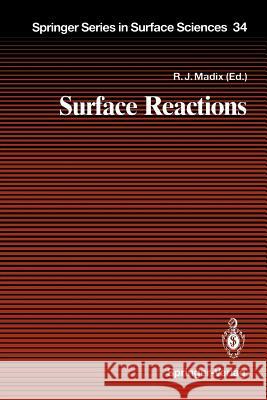
Surface Reactions R. J. Madix D. J. Auerbach B. E. Bent 9783642787485 Springer - książkaWidoczna okładka, to zdjęcie poglądowe, a rzeczywista szata graficzna może różnić się od prezentowanej.

Surface Reactions

ISBN-13: 9783642787485 / Angielski / Miękka / 2011 / 282 str.

R. J. Madix; D. J. Auerbach; B. E. Bent
cena 403,47
(netto: 384,26 VAT:  5%)

Najniższa cena z 30 dni: 385,52
Termin realizacji zamówienia:
ok. 22 dni roboczych.

Darmowa dostawa!

In the past ten years the study of the mechanisms of chemical transformations on metal surfaces has advanced appreciably. Today complex reaction networks can be unraveled by combining several spectroscopies, derived principally from the practice of ultrahigh-vacuum surface physics. Of paramount importance in this field is the combination of mass spectrometric methods for the identification of reaction products with spectroscopies which help identify surface-bound reactive intermediates. This quasi-monograph highlights the progress in this field with studies which clearly exemplify such research and at the same time provide more general understanding of chemical reactivity at surfaces. This book was constructed to be a resource to all scientists interested in the chemical reactivity of metals, including those whose primary interest may lie in fields outside surface reactivity. The book is'intended to be an advanced case study text, not a "review" in the standard sense. Each chapter develops principles and illustrates the use of experimental methods. Consequently, more attention is given to experimentation than normally found in journal articles or review articles. My intent in organizing these chapters was to make this field accessible to professionals and graduate students in the fields of chemistry, material science, and physics. Even so, we hope that experts in the field of surface reactivity will also find these chapters informative. After the introduction (Chap. 1) the book consists of chapters on the mechanism of selective oxidation by silver (Chap. 2 by R.1. Madix and J.T."


Kategorie:
Technologie
Kategorie BISAC:
Science > Chemia - Nieorganiczna
Science > Physics - Condensed Matter
Technology & Engineering > Materials Science - Thin Films, Surfaces & Interfaces
Wydawca:
Springer
Seria wydawnicza:
Springer Series in Surface Sciences
Język:
Angielski
ISBN-13:
9783642787485
Rok wydania:
2011
Wydanie:
Softcover Repri
Numer serii:
000022131
Ilość stron:
282
Waga:
0.46 kg
Wymiary:
23.5 x 15.5
Oprawa:
Miękka
Wolumenów:
01

"Professor Madix and the individual authors are to be congratulated in putting together a casebook which will serve as an introduction to scientists in related fields as well as a guidebook for practitioners of surface science." Journal of the American Chemical Society

1. Introduction.- References.- 2. The Problem of Heterogeneously Catalyzed Partial Oxidation: Model Studies on Single Crystal Surfaces.- 2.1 Modes of Oxygen Chemisorption on Metal Surfaces.- 2.2 Reactions of Molecularly Chemisorbed Oxygen.- 2.3 Reactions of Atomically Chemisorbed Oxygen.- 2.3.1 Atomic Oxygen as a Nucleophile on Silver.- 2.3.2 Atomic Oxygen as a Bronsted Base on Silver.- 2.3.3 Addition of Atomic Oxygen to Carbon-Carbon Double Bonds on Silver.- 2.3.4 Generalization to Other Metals.- 2.4 Conclusion.- References.- 3. Desulfurization Reactions Induced by Transition Metal Surfaces.- 3.1 Background.- 3.2 The Reactions of Thiols on Transition-Metal Surfaces.- 3.2.1 Spectroscopic Identification and Characterization.- 3.2.2 Structural Studies of Adsorbed Intermediates.- 3.2.3 Chemical Probes of the Mechanism.- 3.2.4 Coverage Dependence of Reactivity.- 3.3 Desulfurization of Cyclic Sulfur-Containing Molecules.- 3.4 Conclusions.- References and Notes.- 4. Tricyclisation and Heterocyclisation Reactions of Ethyne over Well-Defined Palladium Surfaces.- 4.1 Background.- 4.2 Mechanistic Studies of Ethyne Tricyclisation.- 4.2.1 Molecular Beam Results, Temperature-Programmed Reaction and Isotope Labelling: Molecular Formula of the Reaction Intermediate.- 4.2.2 Characterisation of the C4H4 Intermediate.- 4.2.3 The Reactively Formed Benzene is Tilted: Effect of Surface Packing Density on the Conformation, Yield and Desorption Kinetics of Benzene Formation.- 4.3 Studies at High Pressures.- 4.4 The Effects of Promoters, Poisons and Other Coadsorbed Species.- 4.5 The Structure and Bonding of Ethyne Chemisorbed on Transition Metal Surfaces.- 4.6 Why is Tricyclisation so Specific to Palladium and Why is the (111) Plane so Strongly Favoured?.- 4.7 Other Cyclisation Reactions.- 4.8 Conclusions.- References.- 5. Model Organic Rearrangements on Aluminum Surfaces.- 5.1 Background.- 5.2 Carbon-Halogen Bond Cleavage.- 5.2.1 Reactive Sticking Probability.- 5.2.2 High-Resolution EELS and TPRS Observations of C-X Bond Cleavage.- 5.3 Integrated Desorption Mass Spectrometry.- 5.4 Alkyl Surface Chemistry.- 5.4.1 Iodoalkanes with ?-Hydrogens.- 5.4.2 Dihaloalkanes.- 5.4.3 Radical Participation in Aluminum Alkyl Chemistry.- 5.5 Etching of Aluminum Surfaces with Alkyl Halides.- 5.6 Model and Real Systems: A Comparison.- 5.7 Aluminum Surfaces vs. Aluminum Compounds: A Summary.- 5.8 Conclusion.- References and Notes.- 6. The Adsorption of Hydrogen at Copper Surfaces: A Model System for the Study of Activated Adsorption.- 6.1 Introductory Remarks.- 6.2 A One-Dimensional Description: The Translational Degree of Freedom.- 6.2.1 The Activation Barrier.- 6.2.2 Early Adsorption Measurements with Molecular Beams.- 6.2.3 Early Desorption Measurements and Detailed Balance.- 6.3 A Two-Dimensional Description: The Translational and Vibrational Degrees of Freedom.- 6.3.1 The 2-D Potential Energy Surface.- 6.3.2 Recent Adsorption Measurements with Molecular Beams.- 6.3.3 Quantitative Treatment of Adsorption and Desorption Data.- a) Sticking Probability Models.- b) Quantitative Comparison of Adsorption Data.- c) Desorption and the Role of Surface Motion.- 6.3.4 State-Resolved Scattering Measurements.- a) Reflection Probability Measurements.- b) Inelastic Scattering Measurements: Vibrational Excitation.- 6.3.5 State-Resolved Desorption Measurements: S0(v,Ei) via Detailed Balance.- 6.4 A Multidimensional Description: The Degrees of Freedom Including Translation, Vibration, Rotation, Molecular Orientation, and Impact Parameter.- 6.4.1 Theoretical Descriptions for More than Two Dimensions.- 6.4.2 Activation Energy Measurements: The Effect of Rotation on Adsorption Rate.- 6.4.3 State-Resolved Desorption Measurements: The Role of Rotation in Adsorption and Desorption.- 6.4.4 Inelastic Scattering Measurements: The Influence of Rotation on Vibrational Excitation.- 6.5 Summary.- References.- 7. Kinetics and Dynamics of Alkane Activation on Transition Metal Surfaces.- 7.1 Background.- 7.2 Trapping-Mediated Dissociative Chemisorption.- 7.2.1 Trapping Dynamics.- 7.2.2 Kinetics.- 7.2.3 Microscopic Reaction Mechanism.- 7.3 Direct Dissociative Chemisorption.- 7.3.1 Activation via Translational Energy.- 7.3.2 Activation via Vibrational Energy.- 7.3.3 Collision-Induced Activation.- References.

Surface Reactions gives case studies of mechanistic studies of molecular transformations on metal surfaces. It focuses on surface chemistry and the way the tools of modern ultrahigh vacuum techniques can be utilized to delineate details of chemical reactions on metal surfaces. It presents a uniform, complementary set of case studies and, although each chapter stands on its own, as a whole the book presents a uniquely integrated picture. The reader will gain a comprehensive understanding of the methods used to understand surface reactivity and a broad understanding of the principles.


Udostępnij

Facebook - konto krainaksiazek.pl


Opinie o Krainaksiazek.pl na Opineo.pl

Partner Mybenefit

Krainaksiazek.pl w programie rzetelna firma Krainaksiaze.pl - płatności przez paypal

Czytaj nas na:

Facebook - krainaksiazek.pl
  • książki na zamówienie
  • granty
  • książka na prezent
  • kontakt
  • pomoc
  • opinie
  • regulamin
  • polityka prywatności

Zobacz:

  • Księgarnia czeska

  • Wydawnictwo Książkowe Klimaty

1997-2025 DolnySlask.com Agencja Internetowa

© 1997-2022 krainaksiazek.pl
     
KONTAKT | REGULAMIN | POLITYKA PRYWATNOŚCI | USTAWIENIA PRYWATNOŚCI
Zobacz: Księgarnia Czeska | Wydawnictwo Książkowe Klimaty | Mapa strony | Lista autorów
KrainaKsiazek.PL - Księgarnia Internetowa

Polityka prywatnosci - link
Krainaksiazek.pl - płatnośc Przelewy24
Przechowalnia Przechowalnia






