Superatoms: Principles, Synthesis and Applications » książka





Superatoms: Principles, Synthesis and Applications
ISBN-13: 9781119619529 / Angielski / Twarda / 2021 / 400 str.
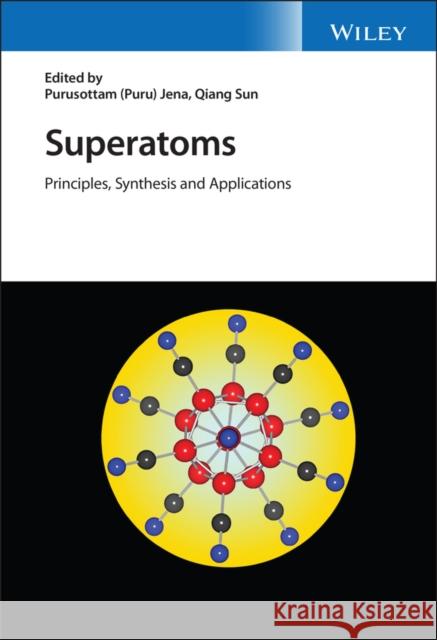
Preface xiList of Contributors xiii1 Introduction 1Puru Jena and Qiang SunReferences 72 Rational Design of Superatoms Using Electron-Counting Rules 15Puru Jena, Hong Fang, and Qiang Sun2.1 Introduction 152.2 Electron-Counting Rules 172.2.1 Jellium Rule 172.2.2 Octet Rule 242.2.2.1 Superalkalis and Superhalogens 252.2.2.2 Superchalcogens 272.2.3 18-Electron Rule 292.2.4 32-Electron Rule 302.2.5 Aromaticity Rule 312.2.6 Wade-Mingos Rule 342.3 Stabilizing Negative Ions Using Multiple Electron-Counting Rules 372.3.1 Monoanions 372.3.2 Dianions 412.3.3 Trianions 432.3.4 Tetra-Anions and Beyond 442.4 Conclusions 46References 463 Superhalogens - Enormously Strong Electron Acceptors 53Piotr Skurski3.1 Superhalogen Concept 533.1.1 Early Studies 533.1.2 Further Research (until 1999) 553.1.3 First Measurement of Gas-Phase Experimental Electron Detachment Energies 573.1.4 The Performance of Theoretical Treatments in Estimating VDEs 583.2 Alternative Superhalogens 613.2.1 Nonmetal Central Atoms 623.2.2 Nonhalogen Ligands 633.2.3 Beyond the MXk+1 Formula 663.2.4 Superhalogens as Ligands 683.3 Polynuclear Systems and the Search for EA and VDE Limits 703.3.1 Polynuclear Superhalogens 713.3.2 Search for EA and VDE Limits 743.3.3 Magnetic Superhalogens 763.4 Superhalogens' Applications at a Glance 773.5 Final Remarks 78Acknowledgements 79References 794 Endohedrally Doped Superatoms and Assemblies 85Vijay Kumar4.1 Introduction 854.2 Magic Clusters and Their Electronic Stability 884.3 Discovery of Silicon Fullerenes and Other Polyhedral Forms 894.4 Endohedral Superatoms of Ge, Sn, and Pb 974.5 Magnetic Superatoms 1014.6 Endohedral Clusters of Group 11 Elements 1014.7 Endohedral Clusters of B, Al, and Ga 1044.8 Hydrogenated Silicon Fullerenes 1074.9 Compound Superatoms and Other Systems 1084.10 Assemblies of Superatoms 1104.11 Concluding Remarks 117Acknowledgements 117References 1185 Magnetic Superatoms 129Nicola Gaston5.1 Introduction 1295.2 The Arrival of the Magnetic Superatom 1305.3 Tunable Superatoms 1335.4 The Delocalisation of d-electrons 1345.5 Prospects for Nanostructured Magnetic Material Design 137References 1386 Atomically Precise Synthesis of Chemically Modified Superatoms 141Shinjiro Takano and Tatsuya Tsukuda6.1 Introduction 1416.1.1 The Concept of Superatoms 1416.1.2 Chemically Modified Au/Ag Superatoms 1426.2 Electronic Structures of Chemically Modified Superatoms 1476.2.1 Size Effects 1476.2.2 Composition Effects 1516.2.3 Shape Effects 1536.3 Atomically Precise Synthesis of Chemically Modified Superatoms 1606.3.1 Size Control 1606.3.1.1 Top-down Approach: Size Focusing 1616.3.1.2 Bottom-up Approach: Size Convergence 1636.3.1.3 Template Method 1686.3.1.4 Kinetic Control 1686.3.2 Composition Control 1696.3.2.1 Co-reduction Method 1696.3.2.2 Antigalvanic Method 1706.3.2.3 Hydride-Mediated Transformation 1726.3.3 Shape Control 1726.3.4 Surface Control 1746.3.4.1 Ligand Exchange 1746.3.4.2 Hydrogen-Mediated Transformation 1766.4 Summary 176References 1777 Atomically Precise Noble Metals in the Nanoscale, Stabilized by Ligands 183Hannu Häkkinen7.1 Introduction 1837.2 Fundamentals 1847.2.1 Free Electron Model and the Kubo Gap 1847.2.2 Electron Shell Structure 1857.2.3 Ligand-Stabilized Metal Clusters as Superatoms 1887.2.3.1 Case Study: The (Ag44(SR)30)¯4. Superatom 1887.2.4 Transition from Electronic to Atomic Shells 1917.3 Applications 1947.3.1 Catalysis 1947.3.2 Biological and Medical Applications 1997.3.2.1 Case Study: Imaging of Enteroviruses 2007.3.3 Self-Assembling Cluster Materials from Superatoms 2017.3.3.1 Case Study: Polymeric 1D Cluster Materials 2037.4 Summary and Outlook 205References 2068 Superatoms as Building Blocks of 2D Materials 209Zhifeng Liu8.1 Introduction 2098.2 Fullerene-Assembled 2D Materials 2118.2.1 C60-assembled Monolayer 2118.2.1.1 Freestanding vdWC60 Monolayer 2128.2.1.2 Freestanding Covalent Polymerized C60 Monolayer 2138.2.2 Cn (n = 20, 26, 32, 36)-assembled Monolayers 2178.2.3 Fullerene Monolayers on Substrates 2208.3 Si-Based Cluster Assembled 2D Materials 2238.3.1 V@Si12 Assembled 2D Monolayer 2238.3.1.1 Structure and Stability 2238.3.1.2 Electronic and Ferromagnetic Properties 2248.3.2 Other TM@Si12 Assembled 2D Monolayers 2258.3.3 Ta@Si16 Assembled 2D Monolayer and That on Substrate 2268.4 Binary Semiconductor Cluster Assembled 2D Materials 2318.4.1 Cd6Se6 Assembled Sheets 2328.4.2 X12Y12 Cage Cluster Assembled Monolayer 2358.5 Simple and Noble Metal Cluster-assembled 2D Materials 2368.5.1 Mg7 Assembled Monolayer 2368.5.2 Au9 and Pt9 Assembled Square Monolayer 2378.6 Zintl-ion Cluster-assembled 2D Materials 2408.6.1 Ge9 Ion Cluster Monolayer 2408.6.2 Ti@Au12 Ion Cluster Monolayer 2418.7 Chevrel Cluster-Assembled 2D Materials 2438.7.1 Re6Se8 Cluster-based Monolayer 2438.7.2 Co6Se8 Cluster-based Monolayer 2458.8 Summary and Future Perspectives 247References 2499 Superatom-Based Ferroelectrics 257Menghao Wu and Puru Jena9.1 Introduction 2579.2 Organic Ferroelectrics 2589.3 Hybrid Organic-Inorganic Perovskites 2629.4 Supersalts 2669.5 Conclusion 270References 27010 Cluster-based Materials for Energy Harvesting and Storage 277Puru Jena, Hong Fang, and Qiang Sun10.1 Introduction 27710.2 Cluster-Based Materials for Moisture-resistant Hybrid Perovskite Solar Cells 28310.3 Cluster-Based Materials for Optoelectronic Devices 28710.4 Cluster-Based Materials for Solid-state Electrolytes in Li-and Na-ion Batteries 28710.4.1 Halogen-free Electrolytes 28910.4.2 Cluster-based Antiperovskites for Electrolytes in Li-ion Batteries 29210.4.3 Cluster-based Antiperovskites for Electrolytes in Na-ion Batteries 29710.5 Cluster-Based Materials for Hydrogen Storage 30010.5.1 Hydrogen Interaction Mechanism 30010.5.2 Intermediate States 30310.5.3 Catalysts for Lowering the Dehydrogenation Temperature 30510.6 Clusters Promoting Unusual Reactions 30510.6.1 Zn in +III Oxidation State 30710.6.2 Covalent Binding of Noble Gas Atoms 30710.7 Conclusions 310References 31111 Thermal and Thermoelectric Properties of Cluster-based Materials 317Tingwei Li, Qiang Sun, and Puru Jena11.1 Introduction 31711.2 Basic Theory 31811.2.1 Thermoelectric Effect 31811.2.2 Material Performance 31911.2.3 Tuning ZT by Carrier Concentration 32011.2.4 Tuning ZT by Electronic Structure 32111.2.4.1 Carrier Effective Mass, m* 32111.2.4.2 Carrier Mobility 32211.3 Low Lattice Thermal Conductivity of Cluster-based Materials 32311.3.1 Crystal Complexity of Cluster-based Materials 32411.3.2 Chemical Bond Hierarchy in Cluster-based Materials 32511.3.3 Structural Disorder in Cluster-based Materials 32611.3.4 Orientational Disorder in Cluster-based Materials 32711.3.4.1 Co6E8(PEt3)6 and [Co6E8(PEt3)6][C60]2 32811.3.4.2 Fullerene Assembled Films 32911.4 Thermoelectric Properties of some Selected Cluster-based Materials 33011.4.1 Mo6 and Mo9 Cluster-based Selenides 33011.4.1.1 Crystal Structures 33011.4.1.2 Electronic Structures 33111.4.1.3 Thermal Properties 33211.4.1.4 Thermoelectric Figure of Merit ZT 33411.4.2 Boron-based Cluster Materials 33411.4.2.1 Crystal Structures 33511.4.2.2 Thermoelectric Properties 33511.4.3 Silver-based Cluster Materials 33811.5 Conclusion 341References 34212 Clusters for CO2 Activation and Conversion 349Haoming Shen, Qiang Sun, and Puru Jena12.1 Introduction 34912.2 Superalkali Catalysts 35112.2.1 Li-based Superalkalis for CO2 Activation 35112.2.2 Supported or Embedded Superalkalis for CO2 Capture 35812.3 Al-Based Clusters for CO2 Capture 35912.4 Ligand-Protected Au25 Clusters for CO2 Conversion 36112.5 M@Ag24 Clusters for CO2 Conversion 36412.6 Cu-Based Clusters for CO2 Conversion 36712.7 Metal Encapsulated Silicon Nanocages for CO2 Conversion 37012.8 Summary and Perspectives 370References 37213 Conclusions and Future Outlook 375Puru Jena and Qiang SunIndex 379
Purusottam (Puru) Jena is Distinguished Professor of Physics at Virginia Commonwealth University, USA. He originated the idea of superatoms and co-authored the first paper in the field in 1992. He has since published numerous papers and review articles on superatom clusters as materials building blocks. He has worked extensively on superhalogens and superalkalis.Qiang Sun is Professor at Peking University, China and Visiting Professor at Virginia Commonwealth University, USA. His research focus is on nanostructure physics, including 2D materials and clusters, and the physics of energy materials.




Czytaj nas na:
1997-2026 DolnySlask.com Agencja Internetowa
KrainaKsiazek.PL - Księgarnia Internetowa


