• Wyszukiwanie zaawansowane
  • Kategorie
  • Kategorie BISAC
  • Książki na zamówienie
  • Promocje
  • Granty
  • Książka na prezent
  • Opinie
  • Pomoc
  • Załóż konto
  • Zaloguj się

Structural Methods in Molecular Inorganic Chemistry » książka


zaloguj się | załóż konto
Logo Krainaksiazek.pl

koszyk

konto

szukaj
topmenu
Księgarnia internetowa
Szukaj
Książki na zamówienie
Promocje
Granty
Książka na prezent
Moje konto
Pomoc
 
 
Wyszukiwanie zaawansowane
Pusty koszyk
Bezpłatna dostawa dla zamówień powyżej 20 złBezpłatna dostawa dla zamówień powyżej 20 zł

Kategorie główne

• Nauka
 [2946912]
• Literatura piękna
 [1852311]

  więcej...
• Turystyka
 [71421]
• Informatyka
 [150889]
• Komiksy
 [35717]
• Encyklopedie
 [23177]
• Dziecięca
 [617324]
• Hobby
 [138808]
• AudioBooki
 [1671]
• Literatura faktu
 [228371]
• Muzyka CD
 [400]
• Słowniki
 [2841]
• Inne
 [445428]
• Kalendarze
 [1545]
• Podręczniki
 [166819]
• Poradniki
 [480180]
• Religia
 [510412]
• Czasopisma
 [525]
• Sport
 [61271]
• Sztuka
 [242929]
• CD, DVD, Video
 [3371]
• Technologie
 [219258]
• Zdrowie
 [100961]
• Książkowe Klimaty
 [124]
• Zabawki
 [2341]
• Puzzle, gry
 [3766]
• Literatura w języku ukraińskim
 [255]
• Art. papiernicze i szkolne
 [7810]
Kategorie szczegółowe BISAC

Structural Methods in Molecular Inorganic Chemistry

ISBN-13: 9780470972786 / Angielski / Miękka / 2013 / 496 str.
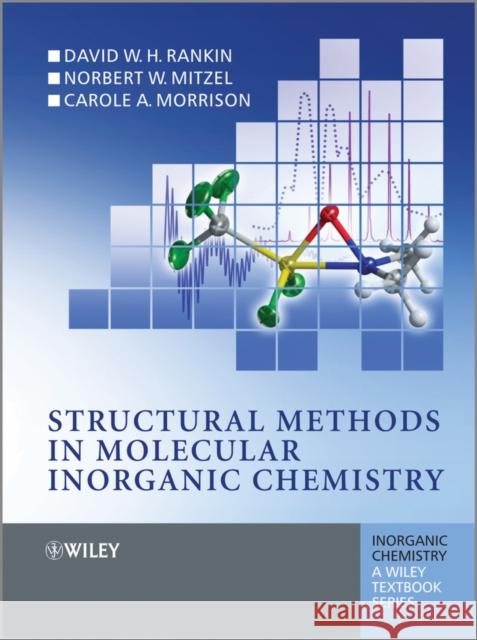
David Rankin; Norbert Mitzel; Carole Morrison
Structural Methods in Molecular Inorganic Chemistry Rankin, David; Mitzel, Norbert; Morrison, Carole 9780470972786 John Wiley & Sons - książkaWidoczna okładka, to zdjęcie poglądowe, a rzeczywista szata graficzna może różnić się od prezentowanej.

Structural Methods in Molecular Inorganic Chemistry

ISBN-13: 9780470972786 / Angielski / Miękka / 2013 / 496 str.

David Rankin; Norbert Mitzel; Carole Morrison
cena 260,00
(netto: 247,62 VAT:  5%)

Najniższa cena z 30 dni: 258,93
Termin realizacji zamówienia:
ok. 30 dni roboczych
Bez gwarancji dostawy przed świętami

Darmowa dostawa!

Determining the structure of molecules is a fundamental skill that all chemists must learn. Structural Methods in Molecular Inorganic Chemistry is designed to help readers interpret experimental data, understand the material published in modern journals of inorganic chemistry, and make decisions about what techniques will be the most useful in solving particular structural problems. Following a general introduction to the tools and concepts in structural chemistry, the following topics are covered in detail: - computational chemistry
- nuclear magnetic resonance spectroscopy
- electron paramagnetic resonance spectroscopy
- Mossbauer spectroscopy
- rotational spectra and rotational structure
- vibrational spectroscopy
- electronic characterization techniques
- diffraction methods
- mass spectrometry The final chapter presents a series of case histories, illustrating how chemists have applied a broad range of structural techniques to interpret and understand chemical systems. Throughout the textbook a strong connection is made between theoretical topics and the real world of practicing chemists. Each chapter concludes with problems and discussion questions, and a supporting website contains additional advanced material. Structural Methods in Molecular Inorganic Chemistry is an extensive update and sequel to the successful textbook Structural Methods in Inorganic Chemistry by Ebsworth, Rankin and Cradock. It is essential reading for all advanced students of chemistry, and a handy reference source for the professional chemist.


Kategorie:
Nauka, Chemia
Kategorie BISAC:
Science > Chemia - Nieorganiczna
Science > Chemia - Fizyczna
Wydawca:
John Wiley & Sons
Seria wydawnicza:
Inorganic Chemistry: A Textbook Series
Język:
Angielski
ISBN-13:
9780470972786
Rok wydania:
2013
Ilość stron:
496
Waga:
0.95 kg
Wymiary:
24.38 x 18.29 x 2.29
Oprawa:
Miękka
Wolumenów:
01
Dodatkowe informacje:
Bibliografia
Podręcznik

Preface xiii

CompanionWebsite xv

Acknowledgements xvii

Biographies xix

1. Determining Structures – How and Why 1

1.1 Structural chemistry – where did it come from? 1

1.2 Asking questions about structure 4

1.3 Answering questions about structure 5

1.4 Plan of the book 7

1.5 Supplementary information 8

2. Tools and Concepts 9

2.1 Introduction 9

2.2 How structural chemistry techniques work 10

2.3 Symmetry 11

2.4 Electron density 21

2.5 Potential–energy surfaces 21

2.6 Timescales 24

2.7 Structural definitions 26

2.8 Sample preparation 27

2.9 Quantitative measurements 30

2.10 Instrumentation 32

2.11 Data analysis 36

3. Theoretical Methods 45

3.1 Introduction 45

3.2 Approximating the multi–electron Schrodinger equation 46

3.3 Exploring the potential–energy surface 52

3.4 Extending the computational model to the solid state 56

3.5 Calculating thermodynamic properties 61

3.6 Calculating properties of chemical bonding 63

3.7 Comparing theory with experiment: geometry 65

3.8 Comparing theory with experiment: molecular properties 68

3.9 Combining theory and experiment 74

4. Nuclear Magnetic Resonance Spectroscopy 79

4.1 Introduction 79

4.2 The nuclear magnetic resonance phenomenon 79

4.3 Experimental set–up 83

4.4 The pulse technique 86

4.5 Information from chemical shifts 92

4.6 Information from NMR signal intensities. 100

4.7 Simple splitting patterns due to coupling between nuclear spins 101

4.8 Information from coupling constants 112

4.9 Not–so–simple spectra 116

4.10 The multi–nuclear approach 120

4.11 Multiple resonance 121

4.12 Multi–pulse methods 126

4.13 Two–dimensional NMR spectroscopy 129

4.14 Gases 140

4.15 Liquid crystals 140

4.16 Solids 141

4.17 Monitoring dynamic phenomena and reactions 147

4.18 Paramagnetic compounds 154

5. Electron Paramagnetic Resonance Spectroscopy 169

5.1 The electron paramagnetic resonance experiment 169

5.2 Hyperfine coupling in isotropic systems 171

5.3 Anisotropic systems 175

5.4 Transition–metal complexes 179

5.5 Multiple resonance 182

6. Mossbauer Spectroscopy 189

6.1 Introduction 189

6.2 The Mossbauer effect 189

6.3 Experimental arrangements 192

6.4 Information from Mossbauer spectroscopy 194

6.5 Compound identification 204

6.6 Temperature– and time–dependent effects 208

6.7 Common difficulties encountered in Mossbauer spectroscopy 212

6.8 Further possibilities in Mossbauer spectroscopy 213

7. Rotational Spectra and Rotational Structure 219

7.1 Introduction 219

7.2 The rotation of molecules 219

7.3 Rotational selection rules 224

7.4 Instrumentation 228

7.5 Using the information in a spectrum 229

7.6 Using rotation constants to define molecular structures 232

8. Vibrational Spectroscopy 237

8.1 Introduction 237

8.2 The physical basis; molecular vibrations 237

8.3 Observing molecular vibrations 239

8.4 Effects of phase on spectra 245

8.5 Vibrational spectra and symmetry 248

8.6 Assignment of bands to vibrations 254

8.7 Complete empirical assignment of vibrational spectra 262

8.8 Information from vibrational spectra 263

8.9 Normal coordinate analysis 272

9. Electronic Characterization Techniques 277

9.1 Introduction 277

9.2 Electron energy levels in molecules 278

9.3 Symmetry and molecular orbitals 279

9.4 Photoelectron spectroscopy 281

9.5 Valence excitation spectroscopy 286

9.6 Electronic energy levels and transitions in transition–metal complexes 289

9.7 Circular dichroism 298

10. Diffraction Methods 303

10.1 Introduction 303

10.2 Diffraction of electrons, neutrons and X–rays 304

10.3 Diffraction by gases 308

10.4 Diffraction by liquids 321

10.5 Diffraction by single crystals; symmetry 323

10.6 Diffraction by single crystals; the theoretical basis 329

10.7 Diffraction by single crystals; the experiment. 333

10.8 Diffraction by single crystals; interpretation of results 341

10.9 Diffraction by single crystals; electron density determination 349

10.10 Topological features of the electron density 352

10.11 Phase dependence of molecular structures 363

10.12 Diffraction of neutrons by crystals 365

10.13 Diffraction by powders 368

10.14 High–pressure crystallography 368

10.15 Extended X–ray absorption fine structure 371

11. Mass Spectrometry 383

11.1 Introduction 383

11.2 Experimental arrangements 383

11.3 Data analysis 387

11.4 Combined mass spectrometry methods 392

12. Case Histories 399

12.1 Introduction 399

12.2 Xenon compounds 400

12.3 The structure of N2O3 407

12.4 Bismuthine 409

12.5 Tetrahydroborates 410

12.6 Is beryllocene a sandwich compound? 415

12.7 Silylium cations – free at last 418

12.8 True phosphinous acids 422

12.9 Dihydrogen and dihydride complexes 425

12.10 Agostic interactions: alkyl hydrogen atoms binding to metal atoms 428

12.11 Lower symmetry than expected in some phosphines and phosphoranes 430

12.12 Three–membered rings with dative bonds? 432

12.13 Stable radicals 436

12.14 Induced proton transfer in an adduct of squaric acid and bipyridine 441

12.15 High–pressure studies of metal organic framework materials 443

12.16 Mistaken identity: mono–coordinate copper(I) and silver(I) complexes 446

12.17 Oxidation states in a palladium–tin complex 447

12.18 Structural and spectroscopic consequences of a chemical change in an iron complex 450

12.19 Some metalloproteins 454

12.20 Atoms inside fullerene cages 459

12.21 Structural chemistry – where is it going? 463

Discussion problem 464

References 464

Index 467

Determining the structure of molecules is a fundamental skill that all chemists must learn. Structural Methods in Molecular Inorganic Chemistry is designed to help readers interpret experimental data, understand the material published in modern journals of inorganic chemistry, and make decisions about what techniques will be the most useful in solving particular structural problems. 

Following a general introduction to the tools and concepts in structural chemistry,  the following topics are covered in detail: 

  • computational chemistry
  • nuclear magnetic resonance spectroscopy
  • electron paramagnetic resonance spectroscopy
  • Mössbauer spectroscopy
  • rotational spectra and rotational structure
  • vibrational spectroscopy
  • electronic  characterization techniques
  • diffraction methods
  • mass spectrometry 

The final chapter presents a series of case histories, illustrating how chemists have applied a broad range of structural techniques to interpret and understand chemical systems. 

Throughout the textbook a strong connection is made between theoretical topics and the real world of practicing chemists. Each chapter concludes with problems and discussion questions, and a supporting website contains additional advanced material.

Structural Methods in Molecular Inorganic Chemistry is an extensive update and sequel to the successful textbook Structural Methods in organic Chemistry by Ebsworth, Rankin and Cradock. It is essential reading for all advanced students of chemistry, and a handy reference source for the professional chemist.




Udostępnij

Facebook - konto krainaksiazek.pl


Opinie o Krainaksiazek.pl na Opineo.pl

Partner Mybenefit

Krainaksiazek.pl w programie rzetelna firma Krainaksiaze.pl - płatności przez paypal

Czytaj nas na:

Facebook - krainaksiazek.pl
  • książki na zamówienie
  • granty
  • książka na prezent
  • kontakt
  • pomoc
  • opinie
  • regulamin
  • polityka prywatności

Zobacz:

  • Księgarnia czeska

  • Wydawnictwo Książkowe Klimaty

1997-2025 DolnySlask.com Agencja Internetowa

© 1997-2022 krainaksiazek.pl
     
KONTAKT | REGULAMIN | POLITYKA PRYWATNOŚCI | USTAWIENIA PRYWATNOŚCI
Zobacz: Księgarnia Czeska | Wydawnictwo Książkowe Klimaty | Mapa strony | Lista autorów
KrainaKsiazek.PL - Księgarnia Internetowa

Polityka prywatnosci - link
Krainaksiazek.pl - płatnośc Przelewy24
Przechowalnia Przechowalnia




