• Wyszukiwanie zaawansowane
  • Kategorie
  • Kategorie BISAC
  • Książki na zamówienie
  • Promocje
  • Granty
  • Książka na prezent
  • Opinie
  • Pomoc
  • Załóż konto
  • Zaloguj się

Structural Adhesives: Properties, Characterization and Applications » książka


zaloguj się | załóż konto
Logo Krainaksiazek.pl

koszyk

konto

szukaj
topmenu
Księgarnia internetowa
Szukaj
Książki na zamówienie
Promocje
Granty
Książka na prezent
Moje konto
Pomoc
 
 
Wyszukiwanie zaawansowane
Pusty koszyk
Bezpłatna dostawa dla zamówień powyżej 20 złBezpłatna dostawa dla zamówień powyżej 20 zł

Kategorie główne

• Nauka
 [2952079]
• Literatura piękna
 [1850969]

  więcej...
• Turystyka
 [71058]
• Informatyka
 [151066]
• Komiksy
 [35579]
• Encyklopedie
 [23181]
• Dziecięca
 [620496]
• Hobby
 [139036]
• AudioBooki
 [1646]
• Literatura faktu
 [228729]
• Muzyka CD
 [379]
• Słowniki
 [2932]
• Inne
 [445708]
• Kalendarze
 [1409]
• Podręczniki
 [164793]
• Poradniki
 [480107]
• Religia
 [510956]
• Czasopisma
 [511]
• Sport
 [61267]
• Sztuka
 [243299]
• CD, DVD, Video
 [3411]
• Technologie
 [219640]
• Zdrowie
 [100984]
• Książkowe Klimaty
 [124]
• Zabawki
 [2281]
• Puzzle, gry
 [3363]
• Literatura w języku ukraińskim
 [258]
• Art. papiernicze i szkolne
 [8020]
Kategorie szczegółowe BISAC

Structural Adhesives: Properties, Characterization and Applications

ISBN-13: 9781394174720 / Angielski / Twarda / 2023 / 460 str.
K. L. Mittal; S. K. Panigrahi
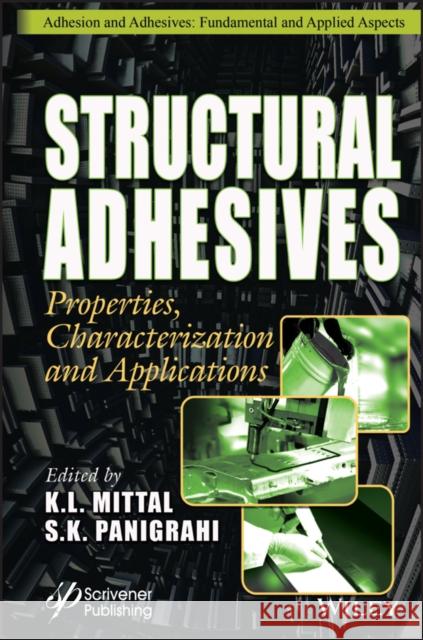
Structural Adhesives: Properties, Characterization and Applications K. L. Mittal S. K. Panigrahi 9781394174720 Wiley-Scrivener - książkaWidoczna okładka, to zdjęcie poglądowe, a rzeczywista szata graficzna może różnić się od prezentowanej.

Structural Adhesives: Properties, Characterization and Applications

ISBN-13: 9781394174720 / Angielski / Twarda / 2023 / 460 str.

K. L. Mittal; S. K. Panigrahi
cena 869,30
(netto: 827,90 VAT:  5%)

Najniższa cena z 30 dni: 742,56
Termin realizacji zamówienia:
ok. 30 dni roboczych
Dostawa w 2026 r.

Darmowa dostawa!

Structural Adhesives Uniquely provides up-to-date and comprehensive information on the topic in an easily-accessible form. A structural adhesive can be described as a high-strength adhesive material that is isotropic in nature and bonds two or more parts together in a load-bearing structure. A structural adhesive material must be capable of transmitting the stress/load without loss of structural integrity within design limits. There are many types of established structural adhesives, including epoxy, urethane, acrylic, silicone, etc. Structural Adhesives comprises nine chapters and is divided into two parts: Part 1, Preparation, Properties, and Characterization; Part 2, Applications. The topics covered include: structural epoxy adhesives; biological reinforcement of epoxies as structural adhesives; marble dust reinforced epoxy structural adhesive composites; characterization of various structural adhesive materials; effects of shear and peel stress distributions on the behavior of structural adhesives; the inelastic response of structural aerospace adhesives; structural reactive acrylic adhesives: their preparation, characterization, properties, and applications; application of structural adhesives in composite connections; and naval applications of structural adhesives. Audience This book should be of much use and interest to adhesionists, materials scientists, adhesive technologists, polymer scientists, and those working in the construction, railway, automotive, aviation, bridge, and shipbuilding industries.


Kategorie:
Nauka, Chemia
Kategorie BISAC:
Technology & Engineering > Materials Science - Metals & Alloys
Wydawca:
Wiley-Scrivener
Język:
Angielski
ISBN-13:
9781394174720
Rok wydania:
2023
Dostępne języki:
Ilość stron:
460
Oprawa:
Twarda

Preface xiiiPart 1: Preparation, Properties and Characterization 11 Structural Epoxy Adhesives 3Chunfu Chen1.1 Introduction 41.2 Epoxy Adhesive Chemistry 41.2.1 Epoxy Resins 41.2.2 Curing Agents and Catalysts 71.2.3 Formulating Epoxy Adhesives 101.3 Properties, Testing and Characterization 111.4 Typical Epoxy Adhesives 131.4.1 Room Temperature Cure Epoxy Adhesives 131.4.2 Thermal Cure Epoxy Adhesives 141.4.3 UV Cure Epoxy Adhesives 161.5 Recent Developments and New Trends 181.5.1 High Performance Toughened Epoxy Adhesives 181.5.2 Low Temperature Cure One-Component Epoxy Adhesives 191.5.3 Instant Bonding Epoxy Adhesives 201.5.4 Sustainable Epoxy Adhesive Development 221.6 Summary 22References 232 Biological Reinforcement of Epoxies as Structural Adhesives 31Anna Rudawska, Jakub Szabelski, Izabela Miturska-BaraDska and El|bieta Doluk2.1 Introduction 312.2 Epoxy Resins and Curing Agents 332.2.1 Epoxy Resins 332.2.2 Curing Agents 342.2.3 Curing Methods 382.2.4 Epoxy Structural Adhesives 402.3 Modification of Epoxies, and Modifying Agents 412.3.1 Epoxy Modification Methods 412.3.2 Fillers Properties 442.3.3 Fillers Types 452.3.3.1 Filler Classification Criterion: Type of Material 462.3.3.2 Filler Classification Criterion: Shape of the Filler Particles 472.3.3.3 Filler Classification Criterion: Filler Particle Size 482.3.3.4 Filler Classification Criterion: Origin 492.3.3.5 Filler Classification Criterion: Activity 502.4 Biological Reinforcement of Epoxy Adhesives 512.4.1 Introduction 512.4.2 Types of Biological Reinforcements 512.4.2.1 Natural Fibers 532.4.2.2 Wood 532.4.2.3 Vegetable Oils 582.4.2.4 Fungi 592.4.2.5 Extracted Plant Ingredients 602.4.2.6 Nut Shells 642.4.2.7 Straw 652.4.3 Natural Fibers 662.4.4 Plant Fibers 682.4.4.1 Cotton Fibers 682.4.4.2 Hemp Fibers 682.4.4.3 Linen (Flax) Fibers 692.4.4.4 Jute Fibers 712.4.4.5 Sisal Fibers 722.4.4.6 Coconut (Coir) Fibers 732.4.4.7 Cellulose Fibers 742.4.4.8 Bamboo Fibers 762.4.4.9 Kenaf Fibers 772.4.4.10 Other Fibers 782.5 Fungi-Modified Adhesives 802.6 Prospects 832.7 Summary 84References 853 Marble Dust Reinforced Epoxy Structural Adhesive Composites 105Amar Patnaik, Pankaj Agarwal, Ankush Sharma, Deepika Shekhawat and Tapan Kumar Patnaik3.1 Introduction 1063.2 Materials and Methods 1103.2.1 Procurement of Raw Materials 1103.2.2 Fabrication of Composites 1113.2.3 Physical and Mechanical Characterization 1133.2.3.1 Density and Void Content 1133.2.3.2 Water Absorption 1143.2.3.3 Vickers Hardness 1153.2.3.4 Tensile Test 1153.2.3.5 Flexure Test 1173.2.3.6 Impact Test 1173.2.3.7 Thermal Conductivity 1173.2.3.8 Specific Wear Rate 1173.2.3.9 TOPSIS Approach 1183.3 Results and Discussion 1193.3.1 Density and Void Content 1193.3.2 Water Absorption 1203.3.3 Hardness 1213.3.4 Tensile Strength and Tensile Modulus 1213.3.5 Flexural Strength and Flexural Modulus 1223.3.6 Impact Energy 1233.3.7 Thermal Conductivity 1233.3.8 Specific Wear Rate 1253.3.9 Ranking of Epoxy Adhesive Composites 1263.4 Summary and Conclusions 131References 1324 Characterization of Various Structural Adhesive Materials 135Srujan Sapkal, Pooja Maske, S. K. Panigrahi and Himanshu S. PandaList of Abbreviations 136List of Symbols 1374.1 Introduction 1384.2 Various Structural Adhesives and their Properties 1394.2.1 Phenolic Structural Adhesives 1394.2.2 Epoxy Structural Adhesives 1404.2.3 Polyurethane (PU) Structural Adhesives 1414.2.4 Acrylic Structural Adhesives 1424.2.5 Cyanoacrylate Structural Adhesives 1434.2.6 Silicone Structural Adhesives 1434.3 Characterization Techniques for Structural Adhesives 1444.3.1 Chemical Characterization 1444.3.1.1 Energy Dispersive X-ray (EDX) 1444.3.1.2 X-ray Photoelectron Spectroscopy (XPS) 1454.3.1.3 Fourier Transform Infrared Spectroscopy (FTIR) 1474.3.1.4 Gas-Liquid Chromatography (GLC) 1514.3.1.5 Nuclear Magnetic Resonance 1534.3.1.6 Raman Spectroscopy 1564.3.2 Physical Characterization 1614.3.2.1 Contact Angle Measurement 1614.3.2.2 Scanning Electron Microscopy (SEM) 1644.3.2.3 Gelation Time 1654.3.2.4 Small Angle X-ray Scattering (SAXS) 1664.3.2.5 Atomic Force Microscopy (AFM) 1674.3.3 Thermal Characterization 1684.3.3.1 Thermogravimetric Analysis (TGA) 1704.3.3.2 Differential Thermal Analysis (DTA) 1714.3.3.3 Differential Scanning Calorimetry (DSC) 1724.3.4 Mechanical Characterization 1764.3.4.1 Tensile Test 1774.3.4.2 Lap Shear Test 1784.3.4.3 Dynamic Mechanical Analysis (DMA) 1794.4 Summary 185Acknowledgements 186References 1865 The Effects of Shear and Peel Stress Distributions on the Behavior of Structural Adhesives in Tubular Composite Joints 193Mohammad Shishesaz5.1 Introduction 1945.1.1 A Brief Review of Loads (Stresses) and Failure of Adhesively Bonded Tubular Composite Joints 1945.1.2 Major Factors Affecting the Peel and Shear Stresses in the Adhesive Layer and its Performance (Failure) 1995.2 Governing Equations Based on Linear Elasticity 2005.2.1 Typical Assumptions in a Tubular Lap Joint under Torsion 2005.3 Factors Influencing the Adhesive Behavior and Stresses 2095.3.1 The Effects of Geometric and Mechanical Properties of the Adhesive and Adherends 2095.3.2 The Effects of Load Type on the Adhesive Stresses and Behavior 2175.3.3 The Effects of Damages due to Voids, Debonds, or Delaminations 2215.3.4 Additional Factors Influencing the Adhesive Behavior and Its Performance 2305.3.5 The Effect of Nonlinear Behavior of the Adhesive on Its Performance 2365.3.6 Factors Influencing the Failure Behavior of the Adhesive Layer 2385.4 Design Aspects Regarding the Selection of Adhesive Layer 2395.5 Summary 244Acknowledgement 245Nomenclature 245References 2496 Inelastic Response of Structural Aerospace Adhesives 255Yi Chen and Lloyd SmithList of Symbols 2556.1 Introduction 2576.2 Time-Independent Plasticity 2586.2.1 Yield Stress 2586.2.2 Elasto-Plastic Models 2626.3 Time-Dependent Inelasticity 2636.3.1 Creep Loading 2636.3.2 Cyclic Loading 2676.3.3 Time-Dependent Models 2706.3.3.1 Modeling of Creep 2706.3.3.2 Modeling of Ratcheting 2746.4 Environmental Factors 2766.4.1 Temperature 2766.4.2 Moisture 2776.4.3 Modeling 2786.5 Summary 280References 281Part 2: Applications 2917 Structural Reactive Acrylic Adhesives: Preparation, Characterization, Properties and Applications 293D.A. Aronovich and L.B. Boinovich7.1 Introduction 2937.2 Compositions and Chemistries 2957.2.1 Base Monomer 2967.2.2 Thickeners and Elastomeric Components 2997.2.3 Adhesive Additives 3087.2.4 Initiators 3107.2.5 Aerobically Curable Systems 3197.2.6 Fillers 3197.3 Physico-Mechanical Properties of SAAs 3237.4 Adhesives for Low Surface Energy Materials 3297.4.1 Initiators Based on Trialkylboranes 3297.4.2 Comparison of the Initiation System Containing Trialkylborane with the Redox System Benzoyl Peroxide (BPO) - Tertiary Aromatic Amine 3407.4.3 Alternative Types of Trialkylborane Initiators 3427.4.4 Additives Modifying the Curing Stage 3447.4.5 Other Components of SAAs 3467.4.6 Hybrid SAAs 3487.5 Comparison of the Properties of SAAs and Other Reactive Adhesives 3547.6 Summary and Outlook 358References 3598 Application of Structural Adhesives in Composite Connections 375M. D. Banea and H.F.M. de Queiroz8.1 Introduction 3758.2 Factors Affecting the Performance of Composite Adhesive Joints 3768.2.1 Effect of Surface Preparation 3778.2.2 Effect of Joint Configuration and Failure Mode 3788.2.3 Effect of Mechanical Properties of Adhesive and Adherend Materials 3838.2.4 Effect of the Environmental Conditions 3868.3 Recent Developments and Trends 3888.4 Summary 389References 3909 Naval Applications of Structural Adhesives 397Bikash Chandra ChakrabortyList of Abbreviations 398List of Symbols with Units 3999.1 Introduction 4009.2 Type of Marine Adhesives 4019.2.1 Essential Characteristics 4029.2.2 Flexible Adhesives 4039.2.2.1 Bonding Multilayer Rubber Tiles 4069.2.2.2 Bonding Silicone Rubber Gaskets 4079.2.3 Thermoset-Based Marine Adhesives 4089.3 Application on Naval Platform 4159.3.1 Vibrodamping Arrangements 4159.3.2 Underwater Application 4169.3.3 Acid-Resistant Rubber Bonding 4219.3.3.1 Example 4229.4 Diffusion of Water in Adhesive Matrix 4239.4.1 Fickian Diffusion 4239.4.1.1 Example 4279.4.2 Dual-Fickian Prediction 4309.4.3 Effect on Flexural Strength 4319.4.3.1 Example 4329.5 Summary 436References 437Index 445

Kashmiri Lal Mittal was employed by the IBM Corporation from 1972 through 1993. Currently, he is teaching and consulting worldwide in the broad areas of adhesion as well as surface cleaning. He has received numerous awards and honors including the title of doctor honoris causa from Maria Curie-Sklodowska University, Lublin, Poland. He is the editor of more than 160 books dealing with adhesion measurement, adhesion of polymeric coatings, polymer surfaces, adhesive joints, adhesion promoters, thin films, polyimides, surface modification surface cleaning, and surfactants.S. K. Panigrahi, PhD, is a professor in the Department of Mechanical Engineering of the Defence Institute of Advanced Technology (DIAT), Pune, India. He has worked as an international visiting academic with the University of New South Wales at the Australian Defence Force Academy. With over 27 years of extensive teaching, research, training, and administrative experience, Dr. Panigrahi is currently focused on advanced finite element methods, nonlinear finite element analyses, and modeling engineering structures with functionally graded/monolithic adhesively-bonded joints. His publications include over 190 research articles and peer-reviewed scholarly papers, four books, a monograph, and many conference proceedings, including a series of lecture materials.


Udostępnij

Facebook - konto krainaksiazek.pl


Opinie o Krainaksiazek.pl na Opineo.pl

Partner Mybenefit

Krainaksiazek.pl w programie rzetelna firma Krainaksiaze.pl - płatności przez paypal

Czytaj nas na:

Facebook - krainaksiazek.pl
  • książki na zamówienie
  • granty
  • książka na prezent
  • kontakt
  • pomoc
  • opinie
  • regulamin
  • polityka prywatności

Zobacz:

  • Księgarnia czeska

  • Wydawnictwo Książkowe Klimaty

1997-2025 DolnySlask.com Agencja Internetowa

© 1997-2022 krainaksiazek.pl
     
KONTAKT | REGULAMIN | POLITYKA PRYWATNOŚCI | USTAWIENIA PRYWATNOŚCI
Zobacz: Księgarnia Czeska | Wydawnictwo Książkowe Klimaty | Mapa strony | Lista autorów
KrainaKsiazek.PL - Księgarnia Internetowa

Polityka prywatnosci - link
Krainaksiazek.pl - płatnośc Przelewy24
Przechowalnia Przechowalnia





