Stress Signaling in Plants: Genomics and Proteomics Perspective, Volume 2 » książka





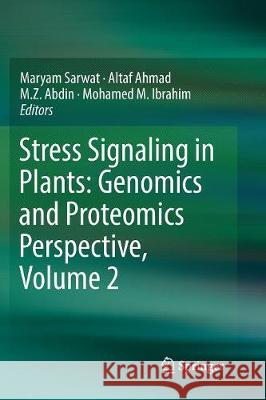
Stress Signaling in Plants: Genomics and Proteomics Perspective, Volume 2
ISBN-13: 9783319825199 / Angielski / Miękka / 2018 / 350 str.
Stress Signaling in Plants: Genomics and Proteomics Perspective, Volume 2
ISBN-13: 9783319825199 / Angielski / Miękka / 2018 / 350 str.
(netto: 775,94 VAT: 5%)
Najniższa cena z 30 dni: 616,85
ok. 10-14 dni roboczych.
Darmowa dostawa!
Physiological, Metabolic and Molecular Responses of Plants to Abiotic Stress.- Molecular Network of Monoterpene Indole Alkaloids (MIAs) Signaling In Plants With Reference To Catharanthus Roseus (L.) G. Don.- Glutamate Receptor Like Ion Channels in Arabidopsis Thaliana.- Phosphate Signalling in Plants - Biochemical and Molecular Approach.- Glycine Betaine Mediated Abiotic Oxidative Stress Tolerance in Plants: Possible Physiological and Biochemical Mechanisms.- Role of Plant Calreticulins in Abiotic Stress Signalling.- DNA Damage, Signaling, and Repair Mechanisms under Genotoxic Stress in Plants.- Plant Responses to Salinity Through an Antioxidative Metabolism and Proteomic Point of View.- Tolerance Response Mechanisms to Iron Deficiency Stress In Citrus Plants.- Brassinosteroids: Physiological Roles And Its Signalling in Plants.- Trehalose: Metabolism and role in stress signaling in plants.- The Role of Ethylene and Other Signals in the Regulation of Fe Deficiency Responses by Dicot Plants.- Leaf Senescence in Plants: Nutrient Remobilization and Gene Regulation.- Role of Phytohormones and miRNAs in Nitrogen and Sulphur Deficiency Stress Signaling in Plants.
Dr. Maryam Sarwat obtained her Ph.D. in the year 2007from Jamia Hamdard University. She then carried out postdoctoral research at the International Centre for Genetic Engineering and Biotechnology (ICGEB), New Delhi Chapter. Presently, she is working as a Senior Assistant Professor (Pharmaceutical Biotechnology) at Amity Institute of Pharmacy, Amity University, NOIDA.
She has successfully handled three research projects funded by the Government of India. She has received extra mural grant of US$15,980, US$31,961 and US$36,755, respectively from D.S.T., D.B.T. and C.C.R.U.M., Government of India. She has presented her research work in various conferences nationally as well as internationally (France, Prague and Germany). Based on her research findings, she has filed two patents.
She has successfully guided 15 Master’s research projects. Her students are also awarded in various conferences and workshops. She has 25 international publications with a cumulative impact factor of more than 50. Several other papers are in various stages of publication.
Considering all her achievements and outstanding contributions, the International Board Of Awards of the National Academy of Environmental Sciences has bestowed her with the Scientist Of The Year Award-2015. She has published first volume of “Stress Signalling in Plants, Genomics and Proteomics Perspective” with Springer in July 2013. This is the second volume.
Altaf Ahmad holds a M.Sc. and Ph.D. in Botany from the CCS University (Meerut, India) and Jamia Hamdard (New Delhi, India). He is a Professor of Plant Biotechnology at Department of Botany, Aligarh Muslim University, Aligarh, India. His professional research interest focuses on the identification of candidate genes for low-N tolerance in wheat and rice through analysis of proteome profile and differentially expressed miRNAs. Professor Ahmad is also developing FRET-based genetically encoded nanosensors for real time monitoring of various metabolites in living cells. He has to his credit more than 100 significant publications and has guided thesis research of 18 Ph.D. students (8 as supervisor and 10 as co-supervisor) and over 30 M.Sc. students. He has organized several national and international seminars/symposia and has been a visiting scholar to many countries including U.S.A., Germany, Austria, Brazil and Australia. Professor Ahmad handled several research projects funded by various government agencies. Dr. Ahmad was a Visiting Scientist at the Virginia Polytechnic and State University, USA on Biotechnology Overseas Associateship of the Department of Biotechnology, Ministry of Science and Technology, Govt. of India. He also visited University of Freiburg, Germany on INSA-DFG Fellowship in 2013 to study differential expression of root-specific nine sulfate transporter genes of poplar by Real time-PCR. Based on his research contribution, Professor Ahmad has been honoured with the INSA Medal for Young Scientist (2003) of Indian National Science Academy, Young Scientist Award (2005) of Council of Science & Technology, Govt. of Uttar Pradesh, and elected as Associate of National Academy of Agricultural Sciences.
M.Z. Abdin graduated from Aligarh Muslim University, Aligarh, U.P. in Botany and obtained Ph.D. in Plant Physiology from Indian Agricultural Research Institute, New Delhi, India. Presently, he is working as Professor in the Department of Biotechnology in Jamia Hamdard, New Delhi. He also became the Vice-Chancellor of Singhania University, Rajasthan in the year 2008. In addition to having many administrative positions in Jamia Hamdard including Dean, Faculty of Science, Member of Executive Council and Jamia Hamdard Society, he is currently Head, Department of Biotechnology, and member, Executive Council, of Integral University, Lucknow, India. Professor Abdin has published more than 138 original research papers and edited two books. He has guided 37 Ph.D. students as supervisors and 19 as Co-Supervisors in the area of Biotechnology. He has also visited several countries including U.S.A., France, Germany, Japan, Australia, China, Saudi Arabia and Iran to deliver lectures in International conferences.
Mohamed M. Ibrahim holds a B.Sc. degree in Science “Botany” from Alexandria University, an M.Sc. degree in Eco-physiological Studies “Heavy metal pollution and their impact on crop plant”, Faculty of Science, Alexandria University, and a Ph.D. degree in Molecular Plant Physiology. He is a molecular plant physiologist and a Professor in Faculty of Science, Alexandria University. His professional research interest focuses on studying the role of gene expression in plant tolerance mechanism under several abiotic stresses. He is a Professor at King Saud University for 10 years. Moreover, he has served as a visiting professor to many academic institutions and departments including Istanbul University and King Abdulla University in the years 2010-2015. He has more than 23 years of research experience working on the impact of various environmental pollutions using molecular biology tools. Having served as Coordinator for many research projects granted by various funding agencies, Dr. Ibrahim authors an impressive number of peer reviewed quality publications in reputable scientific journals. In addition, he regularly serves as a referee for various international journals. He serves as a grant reviewer and evaluator of research proposals from the Deanships of Scientific Research in King Saud, Dammam and Tibba Saudi universities. He is a member of various academic bodies including the American Society of Plant Biologist, Saudi Biological Society and Egyptian Society of Botanist.
This two-volume set takes an in-depth look at stress signaling in plants from a uniquely genomic and proteomic perspective and offers a comprehensive treatise that covers all of the signaling pathways and mechanisms that have been researched so far. Currently, plant diseases, extreme weather caused by climate change, drought and an increase in metals in soil are amongst the major limiting factors of crop production worldwide. They devastate not only the food supply but also the economy of a nation. With global food scarcity in mind, there is an urgent need to develop crop plants with increased stress tolerance so as to meet the global food demands and to preserve the quality of our planet. In order to do this, it is necessary to understand how plants react and adapt to stress from the genomic and proteomic perspective. Plants adapt to stress conditions by activating cascades of molecular mechanisms, which result in alterations in gene expression and synthesis of protective proteins. From the perception of the stimulus to the transduction of the signal, followed by an appropriate cellular response, the plants employ a complex network of primary and secondary messenger molecules. Cells exercise a large number of noticeably distinct signaling pathways to regulate their activity. In order to contend with different environmental adversities, plants have developed a series of mechanisms at the physiological, cellular and molecular levels that respond to stress. Each chapter in this volume provides an in-depth explanation of what we currently know of a particular aspect of stress signaling and where we are heading. Together with the highly successful first volume, Stress Signaling in Plants: Genomics and Proteomics Perspective, Volume 2 covers an important aspect of plant biology for both students and seasoned researchers.




Czytaj nas na:
1997-2026 DolnySlask.com Agencja Internetowa
KrainaKsiazek.PL - Księgarnia Internetowa


