• Wyszukiwanie zaawansowane
  • Kategorie
  • Kategorie BISAC
  • Książki na zamówienie
  • Promocje
  • Granty
  • Książka na prezent
  • Opinie
  • Pomoc
  • Załóż konto
  • Zaloguj się

Spin Dynamics: Basics of Nuclear Magnetic Resonance » książka


zaloguj się | załóż konto
Logo Krainaksiazek.pl

koszyk

konto

szukaj
topmenu
Księgarnia internetowa
Szukaj
Książki na zamówienie
Promocje
Granty
Książka na prezent
Moje konto
Pomoc
 
 
Wyszukiwanie zaawansowane
Pusty koszyk
Bezpłatna dostawa dla zamówień powyżej 20 złBezpłatna dostawa dla zamówień powyżej 20 zł

Kategorie główne

• Nauka
 [2946600]
• Literatura piękna
 [1856966]

  więcej...
• Turystyka
 [72221]
• Informatyka
 [151456]
• Komiksy
 [35826]
• Encyklopedie
 [23190]
• Dziecięca
 [619653]
• Hobby
 [140543]
• AudioBooki
 [1577]
• Literatura faktu
 [228355]
• Muzyka CD
 [410]
• Słowniki
 [2874]
• Inne
 [445822]
• Kalendarze
 [1744]
• Podręczniki
 [167141]
• Poradniki
 [482898]
• Religia
 [510455]
• Czasopisma
 [526]
• Sport
 [61590]
• Sztuka
 [243598]
• CD, DVD, Video
 [3423]
• Technologie
 [219201]
• Zdrowie
 [101638]
• Książkowe Klimaty
 [124]
• Zabawki
 [2473]
• Puzzle, gry
 [3898]
• Literatura w języku ukraińskim
 [254]
• Art. papiernicze i szkolne
 [8170]
Kategorie szczegółowe BISAC

Spin Dynamics: Basics of Nuclear Magnetic Resonance

ISBN-13: 9780470511176 / Angielski / Miękka / 2008 / 744 str.
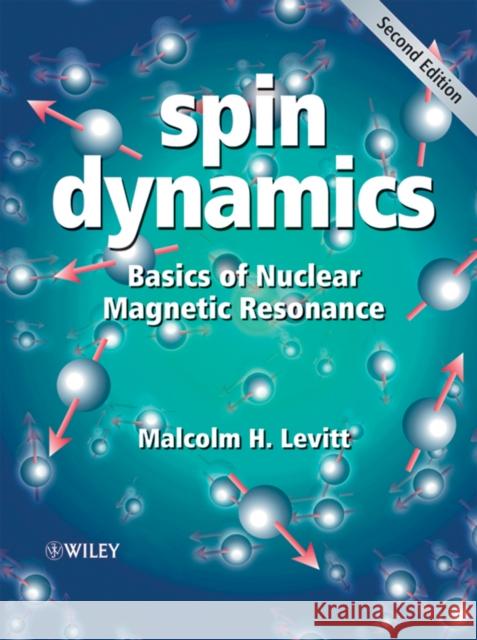
 University of Southampton Malcolm H. (School of Chemistry
Spin Dynamics: Basics of Nuclear Magnetic Resonance Malcolm H. (School of Chemistry, University of Southampton, UK) Levitt 9780470511176 John Wiley & Sons - książkaWidoczna okładka, to zdjęcie poglądowe, a rzeczywista szata graficzna może różnić się od prezentowanej.

Spin Dynamics: Basics of Nuclear Magnetic Resonance

ISBN-13: 9780470511176 / Angielski / Miękka / 2008 / 744 str.

 University of Southampton Malcolm H. (School of Chemistry
cena 286,69 zł
(netto: 273,04 VAT:  5%)

Najniższa cena z 30 dni: 284,34 zł
Termin realizacji zamówienia:
ok. 30 dni roboczych
Bez gwarancji dostawy przed świętami

Darmowa dostawa!

Spin Dynamics: Basics of Nuclear Magnetic Resonance, Second Edition is a comprehensive and modern introduction which focuses on those essential principles and concepts needed for a thorough understanding of the subject, rather than the practical aspects. The quantum theory of nuclear magnets is presented within a strong physical framework, supported by figures. The book assumes only a basic knowledge of complex numbers and matrices, and provides the reader with numerous worked examples and exercises to encourage understanding. With the explicit aim of carefully developing the subject from the beginning, the text starts with coverage of quarks and nucleons and progresses through to a detailed explanation of several important NMR experiments, including NMR imaging, COSY, NOESY and TROSY. Completely revised and updated, the Second Edition features new material on the properties and distributions of isotopes, chemical shift anisotropy and quadrupolar interactions, Pake patterns, spin echoes, slice selection in NMR imaging, and a complete new chapter on the NMR spectroscopy of quadrupolar nuclei. New appendices have been included on Euler angles, and coherence selection by field gradients. As in the first edition, all material is heavily supported by graphics, much of which is new to this edition. Written for undergraduates and postgraduate students taking a first course in NMR spectroscopy and for those needing an up-to-date account of the subject, this multi-disciplinary book will appeal to chemical, physical, material, life, medical, earth and environmental scientists. The detailed physical insights will also make the book of interest for experienced spectroscopists and NMR researchers. - An accessible and carefully written introduction, designed to help students to fully understand this complex and dynamic subject - Takes a multi-disciplinary approach, focusing on basic principles and concepts rather than the more practical aspects - Presents a strong pedagogical approach throughout, with emphasis placed on individual spins to aid understanding - Includes numerous worked examples, problems, further reading and additional notes Praise from the reviews of the First Edition: "This is an excellent book... that many teachers of NMR spectroscopy will cherish... It deserves to be a 'classic' among NMR spectroscopy texts." NMR IN BIOMEDICINE "I strongly recommend this book to everyone...it is probably the best modern comprehensive description of the subject." ANGEWANDTE CHEMIE, INTERNATIONAL EDITION


Kategorie:
Nauka, Chemia
Kategorie BISAC:
Science > Spectroscopy & Spectrum Analysis
Wydawca:
John Wiley & Sons
Język:
Angielski
ISBN-13:
9780470511176
Rok wydania:
2008
Wydanie:
Revised, Update
Ilość stron:
744
Waga:
1.58 kg
Wymiary:
24.38 x 18.82 x 4.52
Oprawa:
Miękka
Wolumenów:
01
Dodatkowe informacje:
Bibliografia
Wydanie ilustrowane
Podręcznik

?What makes this book stand out compared to similar books is the extensive use of pictures and diagrams, which will make this book more appealing to nonphysicists, like chemists and biologists. That this was achieved without loss of rigor is indeed an accomplishment.? ( Doody?s Reviews , November 2009)

Preface.

Preface to the First Edition.

Introduction.

Part 1 Nuclear Magnetism.

1 Matter.

1.1 Atoms and Nuclei.

1.2 Spin.

1.3 Nuclei.

1.4 Nuclear Spin.

1.5 Atomic and Molecular Structure.

1.6 States of Matter.

Notes.

Further Reading.

Exercises.

2 Magnetism.

2.1 The Electromagnetic Field.

2.2 Macroscopic Magnetism.

2.3 Microscopic Magnetism.

2.4 Spin Precession.

2.5 Larmor Frequency.

2.6 Spin–Lattice Relaxation: Nuclear Paramagnetism.

2.7 Transverse Magnetization and Transverse Relaxation.

2.8 NMR Signal.

2.9 Electronic Magnetism.

Notes.

Further Reading.

Exercises.

3 NMR Spectroscopy.

3.1 A Simple Pulse Sequence.

3.2 A Simple Spectrum.

3.4 Relative Spectral Frequencies: Case of Positive

Gyromagnetic Ratio.

3.5 Relative Spectral Frequencies: Case of Negative Gyromagnetic Ratio.

3.6 Inhomogeneous Broadening.

3.7 Chemical Shifts.

3.8 J–Coupling Multiplets.

3.9 Heteronuclear Decoupling.

Notes.

Further Reading.

Exercises.

Part 2 The NMR Experiment.

4 The NMR Spectrometer.

4.1 The Magnet.

4.2 The Transmitter Section.

4.3 The Duplexer.

4.4 The Probe.

4.5 The Receiver Section.

4.6 Overview of the Radio–Frequency Section.

4.7 Pulsed Field Gradients.

Notes.

Further Reading.

5 Fourier Transform NMR.

5.1 A Single–Pulse Experiment.

5.2 Signal Averaging.

5.3 Multiple–Pulse Experiments: Phase Cycling.

5.4 Heteronuclear Experiments.

5.5 Pulsed Field Gradient Sequences.

5.6 Arrayed Experiments.

5.7 NMR Signal.

5.8 NMR Spectrum.

5.9 Two–Dimensional Spectroscopy.

5.10 Three–Dimensional Spectroscopy.

Part 3 Quantum Mechanics.

6 Mathematical Techniques.

6.1 Functions.

6.2 Operators.

6.3 Eigenfunctions, Eigenvalues and Eigenvectors.

6.4 Diagonalization.

6.5 Exponential Operators.

6.6 Cyclic Commutation.

Notes.

Further Reading.

Exercises.

7 Review of Quantum Mechanics.

7.1 Spinless Quantum Mechanics.

7.2 Energy Levels.

7.3 Natural Units.

7.4 Superposition States and Stationary States.

7.5 Conservation Laws.

7.6 Angular Momentum.

7.7 Spin.

7.8 Spin–1/2.

7.9 Higher Spin.

Notes.

Further Reading.

Exercises.

Part 4 Nuclear Spin Interactions.

8 Nuclear Spin Hamiltonian.

8.1 Spin Hamiltonian Hypothesis.

8.2 Electromagnetic Interactions.

8.3 External and Internal Spin Interactions.

8.4 External Magnetic Fields.

8.5 Internal Spin Hamiltonian.

8.6 Motional Averaging.

Notes.

Further Reading.

Exercises.

9 Internal Spin Interactions.

9.1 Chemical Shift.

9.2 Electric Quadrupole Coupling.

9.3 Direct Dipole–Dipole Coupling.

9.4 J–Coupling.

9.5 Spin–Rotation Interaction.

9.6 Summary of the Spin Hamiltonian Terms.

Notes.

Further Reading.

Exercises.

Part 5 Uncoupled Spins.

10 Single Spin–1/2.

10.1 Zeeman Eigenstates.

10.2 Measurement of Angular Momentum: Quantum Indeterminacy.

10.3 Energy Levels.

10.4 Superposition States.

10.5 Spin Precession.

10.6 Rotating Frame.

10.7 Precession in the Rotating Frame.

10.8 Radio–Frequency Pulse.

Notes.

Further Reading.

Exercises.

11 Ensemble of Spins–1/2.

11.1 Spin Density Operator.

11.2 Populations and Coherences.

11.3 Thermal Equilibrium.

11.4 Rotating–Frame Density Operator.

11.5 Magnetization Vector.

11.6 Strong Radio–Frequency Pulse.

11.7 Free Precession Without Relaxation.

11.8 Operator Transformations.

11.9 Free Evolution with Relaxation.

11.10 Magnetization Vector Trajectories.

11.11 NMR Signal and NMR Spectrum.

11.12 Single–Pulse Spectra.

Notes.

Further Reading.

Exercises.

12 Experiments on Non–Interacting Spins–1/2.

12.1 Inversion Recovery: Measurement of T1.

12.2 Spin Echoes: Measurement of T2.

12.3 Spin Locking: Measurement of T1 .

12.4 Gradient Echoes.

12.5 Slice Selection.

12.6 NMR Imaging.

Notes.

Further Reading.

Exercises.

13 Quadrupolar Nuclei.

13.1 Spin I = 1.

13.2 Spin I = 3/2.

13.3 Spin I = 5/2.

13.4 Spins I = 7/2.

13.5 Spins I = 9/2.

Notes.

Further Reading.

Exercises.

Part 6 Coupled Spins.

14 Spin–1/2 Pairs.

14.1 Coupling Regimes.

14.2 Zeeman Product States and Superposition States.

14.3 Spin–Pair Hamiltonian.

14.4 Pairs of Magnetically Equivalent Spins.

14.5 Weakly Coupled Spin Pairs.

Notes.

Further Reading.

Exercises.

15 Homonuclear AX System.

15.1 Eigenstates and Energy Levels.

15.2 Density Operator.

15.3 Rotating Frame.

15.4 Free Evolution.

15.5 Spectrum of the AX System: Spin–Spin Splitting.

15.6 Product Operators.

15.7 Thermal Equilibrium.

15.8 Radio–Frequency Pulses.

15.9 Free Evolution of the Product Operators.

15.10 Spin Echo Sandwich.

Notes.

Further Reading.

Exercises.

16 Experiments on AX Systems.

16.1 COSY.

16.2 INADEQUATE.

16.3 INEPT.

16.4 Residual Dipolar Couplings.

Notes.

Further Reading.

Exercises.

17 Many–Spin Systems.

17.1 Molecular Spin System.

17.2 Spin Ensemble.

17.3 Motionally Suppressed J–Couplings.

17.4 Chemical Equivalence.

17.5 Magnetic Equivalence.

17.6 Weak Coupling.

17.7 Heteronuclear Spin Systems.

17.8 Alphabet Notation.

17.9 Spin Coupling Topologies.

Notes.

Further Reading.

Exercises.

18 Many–Spin Dynamics.

18.1 Spin Hamiltonian.

18.2 Energy Eigenstates.

18.3 Superposition States.

18.4 Spin Density Operator.

18.5 Populations and Coherences.

18.6 NMR Spectra.

18.7 Many–Spin Product Operators.

18.8 Thermal Equilibrium.

18.9 Radio–Frequency Pulses.

18.10 Free Precession.

18.11 Spin Echo Sandwiches.

18.12 INEPT in an I2S System.

18.13 COSY in Multiple–Spin Systems.

18.14 TOCSY.

Notes.

Further Reading

Exercises.

Part 7 Motion and Relaxation.

19 Motion.

19.1 Motional Processes.

19.2 Motional Time–Scales.

19.3 Motional Effects.

19.4 Motional Averaging.

19.5 Motional Lineshapes and Two–Site Exchange.

19.6 Sample Spinning.

19.7 Longitudinal Magnetization Exchange.

19.8 Diffusion.

Notes.

Further Reading.

Exercises.

20 Relaxation.

20.1 Types of Relaxation.

20.2 Relaxation Mechanisms.

20.3 Random Field Relaxation.

20.4 Dipole–Dipole Relaxation.

20.5 Steady–State Nuclear Overhauser Effect.

20.6 NOESY.

20.7 ROESY.

20.8 Cross–Correlated Relaxation.

Notes.

Further Reading.

Exercises.

Appendices.

Appendix A.

A.1 Euler Angles and Frame Transformations.

A.2 Rotations and Cyclic Commutation.

A.3 Rotation Sandwiches.

A.4 Spin–1/2 Rotation Operators.

A.5 Quadrature Detection and Spin Coherences.

A.6 Secular Approximation.

A.7 Quadrupolar Interaction.

A.8 Strong Coupling.

A.9 J–Couplings and Magnetic Equivalence.

A.10 Spin Echo Sandwiches.

A.11 Phase Cycling.

A.12 Coherence Selection by Pulsed Field Gradients.

A.13 Bloch Equations.

A.14 Chemical Exchange.

A.15 Solomon Equations.

A.16 Cross–Relaxation Dynamics.

Notes.

Further Reading.

Appendix B.

B.1 Symbols and Abbreviations.

B.2 Answers to the Exercises.

Spin Dynamics: Basics of Nuclear Magnetic Resonance, Second Edition is a comprehensive and modern introduction which focuses on those essential principles and concepts needed for a thorough understanding of the subject, rather than the practical aspects. The quantum theory of nuclear magnets is presented within a strong physical framework, supported by figures. 

The book assumes only a basic knowledge of complex numbers and matrices, and provides the reader with numerous worked examples and exercises to encourage understanding. With the explicit aim of carefully developing the subject from the beginning, the text starts with coverage of quarks and nucleons and progresses through to a detailed explanation of several important NMR experiments, including NMR imaging, COSY, NOESY and TROSY. 

Completely revised and updated, the Second Edition features new material on the properties and distributions of isotopes, chemical shift anisotropy and quadrupolar interactions, Pake patterns, spin echoes, slice selection in NMR imaging, and a complete new chapter on the NMR spectroscopy of quadrupolar nuclei. New appendices have been included on Euler angles, and coherence selection by field gradients. As in the first edition, all material is heavily supported by graphics, much of which is new to this edition. 

Written for undergraduates and postgraduate students taking a first course in NMR spectroscopy and for those needing an up–to–date account of the subject, this multi–disciplinary book will appeal to chemical, physical, material, life, medical, earth and environmental scientists. The detailed physical insights will also make the book of interest for experienced spectroscopists and NMR researchers. 

An accessible and carefully written introduction, designed to help students to fully understand this complex and dynamic subject. 

Takes a multi–disciplinary approach, focusing on basic principles and concepts rather than the more practical aspects. 

Presents a strong pedagogical approach throughout, with emphasis placed on individual spins to aid understanding. 

Includes numerous worked examples, problems, further reading and additional notes.


Udostępnij

Facebook - konto krainaksiazek.pl


Opinie o Krainaksiazek.pl na Opineo.pl

Partner Mybenefit

Krainaksiazek.pl w programie rzetelna firma Krainaksiaze.pl - płatności przez paypal

Czytaj nas na:

Facebook - krainaksiazek.pl
  • książki na zamówienie
  • granty
  • książka na prezent
  • kontakt
  • pomoc
  • opinie
  • regulamin
  • polityka prywatności

Zobacz:

  • Księgarnia czeska

  • Wydawnictwo Książkowe Klimaty

1997-2025 DolnySlask.com Agencja Internetowa

© 1997-2022 krainaksiazek.pl
     
KONTAKT | REGULAMIN | POLITYKA PRYWATNOŚCI | USTAWIENIA PRYWATNOŚCI
Zobacz: Księgarnia Czeska | Wydawnictwo Książkowe Klimaty | Mapa strony | Lista autorów
KrainaKsiazek.PL - Księgarnia Internetowa

Polityka prywatnosci - link
Krainaksiazek.pl - płatnośc Przelewy24
Przechowalnia Przechowalnia





