• Wyszukiwanie zaawansowane
  • Kategorie
  • Kategorie BISAC
  • Książki na zamówienie
  • Promocje
  • Granty
  • Książka na prezent
  • Opinie
  • Pomoc
  • Załóż konto
  • Zaloguj się

Software Development Activity Cycles: Collaborative Development, Continuous Testing and User Acceptance » książka


zaloguj się | załóż konto
Logo Krainaksiazek.pl

koszyk

konto

szukaj
topmenu
Księgarnia internetowa
Szukaj
Książki na zamówienie
Promocje
Granty
Książka na prezent
Moje konto
Pomoc
 
 
Wyszukiwanie zaawansowane
Pusty koszyk
Bezpłatna dostawa dla zamówień powyżej 20 złBezpłatna dostawa dla zamówień powyżej 20 zł

Kategorie główne

• Nauka
 [2946350]
• Literatura piękna
 [1816154]

  więcej...
• Turystyka
 [70666]
• Informatyka
 [151172]
• Komiksy
 [35576]
• Encyklopedie
 [23172]
• Dziecięca
 [611458]
• Hobby
 [135995]
• AudioBooki
 [1726]
• Literatura faktu
 [225763]
• Muzyka CD
 [378]
• Słowniki
 [2917]
• Inne
 [444280]
• Kalendarze
 [1179]
• Podręczniki
 [166508]
• Poradniki
 [469467]
• Religia
 [507199]
• Czasopisma
 [496]
• Sport
 [61352]
• Sztuka
 [242330]
• CD, DVD, Video
 [3348]
• Technologie
 [219391]
• Zdrowie
 [98638]
• Książkowe Klimaty
 [124]
• Zabawki
 [2382]
• Puzzle, gry
 [3525]
• Literatura w języku ukraińskim
 [259]
• Art. papiernicze i szkolne
 [7107]
Kategorie szczegółowe BISAC

Software Development Activity Cycles: Collaborative Development, Continuous Testing and User Acceptance

ISBN-13: 9781484282380 / Angielski / Miękka / 2022 / 279 str.
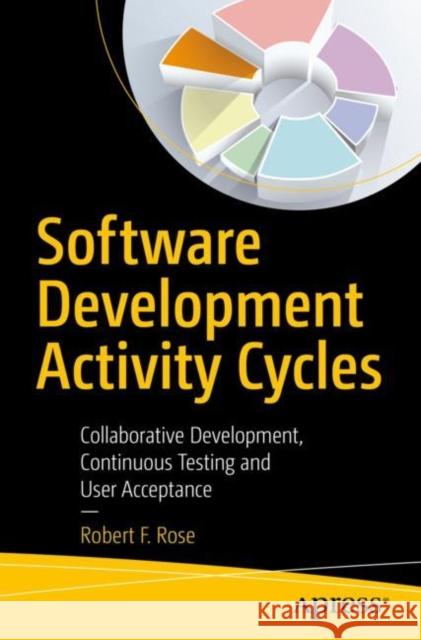
Robert F. Rose
Software Development Activity Cycles: Collaborative Development, Continuous Testing and User Acceptance Robert F. Rose 9781484282380 APress - książkaWidoczna okładka, to zdjęcie poglądowe, a rzeczywista szata graficzna może różnić się od prezentowanej.

Software Development Activity Cycles: Collaborative Development, Continuous Testing and User Acceptance

ISBN-13: 9781484282380 / Angielski / Miękka / 2022 / 279 str.

Robert F. Rose
cena 211,90
(netto: 201,81 VAT:  5%)

Najniższa cena z 30 dni: 209,01
Termin realizacji zamówienia:
ok. 16-18 dni roboczych.

Darmowa dostawa!
Kategorie:
Informatyka, Bazy danych
Kategorie BISAC:
Business & Economics > Information Management
Computers > Business & Productivity Software - Business Intelligence
Computers > Management Information Systems
Wydawca:
APress
Język:
Angielski
ISBN-13:
9781484282380
Rok wydania:
2022
Ilość stron:
279
Wymiary:
23.5 x 15.5
Oprawa:
Miękka
Dodatkowe informacje:
Wydanie ilustrowane


Introduction.  Traditional vs. Agile Approach
Review of the best known traditional models - waterfall, spiral, V -model - and alternative agile models - Scrum, SAFe, DAD, RUP/UP, DSDM, XP  and introduction to DPAC

Chapter 1.  The DPAC Model
Presents the DPAC Model in a static view describing the Stages and Activity Cycles in generalized form.  Shows where Test is included in the model in the backswing of the PDCA overlay for each cycle. Continuous testing.
1.1 Intent and purpose
1.2 Phases of the DPAC activity cycles

1.3 DPAC is inherently a “shift left” model

1.4 DPAC Embraces Agile and DevOps
1.5 Activities represented in the DPAC model
                        1.6 Roles and responsibilities 
1.7 Stages of Application Development 
    1.8 The objective of this model
Paradigms as a hindrance to understanding
1.9 Summary
Chapter 2. Why Include Support in a Development Model?
Offers quotes referring to the importance of including maintenance in the development cycles. Displays statistics regarding the cost of maintenance as a part of the overall lifecycle.
Every project that succeeds, even if challenged becomes a Support project.  Shows the consequences of types of error.  Cites the top ten software development problems from the perspective of maintenance. Building political and social capital.
2.1 Statement of the Problem
2.2 To put this in terms of total cost…
2.3 Putting Support in the Equation
2.4. Freeing the statue from the stone
2.5 Factors supporting code reliability
2.6 Measures during development to improve software system maintainability.
2.7 Ameliorative measures
2.8 Political and Social Capital  
What’s Ahead

Chapter 3.  Inception
Stresses the importance of a Vision Statement as a project charter.  The role of the charter as a first step in creating “conceptual integrity.” 
 Introduces non-functional requirements. Planning for security including privacy concerns.
3.1 Goal: Achieving Consensus

3.2 Nine Objectives  

3.3 The importance of the Vision Statement

3.4 Introduction to the Traceability Matrix

3.5 Non-functional Requirements
   
3.6 Planning for Information Security and 
                                         System Security
3.7 Privacy
3.7 Legacy data
3.8 Summary of Security requirements
3.9 Identification of security requirements 
                                         is initiated in the Inception Stage

Summary

Chapter 4.  Elaboration
The goal of Elaboration is to create an overall process model that will serve as a Functional Requirements Specification (FRS), the second step in preserving conceptual integrity.  The FRS forms the basis of level of effort and cost estimation.
Outlines the role of the system architecture and the system backbone. Introduces the Configuration Management Database (CMDB) and the Traceability Matrix.
4.1 The goal of the Elaboration Stage
4.2 Objectives
4.3 Activities during Elaboration
4.4 Ongoing Activities
4.5 Implement Quality Engineering Plan
4.6 Additional responsibilities:
4.7 Data Flow Diagrams (DFD)
4.8 Functional Requirements Specification (FRS)
4.9 Design Review
4.10 Following design approval
4.11 Determine staffing, roles and responsibilities.  
4.12 Rules of the Road (staffing)
4.13 Design, develop and document the system architecture 

4.14 Demonstrate an operating backbone
4.15 Application Design Requirements

4.16 Introduction to Configuration Management Data Base (CMDB)
4.17 The CMDB includes tools
4.18 The Traceability Matrix
4.19 On Joint Application Development (JAD)

4.20 On Workshops (in general)

Chapter 5  Construction
Describes activities in the Process Detail and Unit Development Cycles.  Introduces the practice of iterative development.  Includes measures to assure the quality of the code as developed. 
Technical review subcycle.  The triad principle.
5.1 Process Detail Cycle
5.1.1 Approach

5.1.2 Phases

5.1.3 Roles and responsibilities

5.1.4 Business Rules Definition

5.1.5 Form of Business Rules

5.1.6 Business rule review

5.1.7 Summation

5.2 Unit Development Cycle
 5.2.1 Overview

 5.2.2 Changing requirements

 5.2.3 Processing Change Reports (CRpt)

 5.2.4 Configuration Management

 5.2.5 Advancement 

 5.2.6 Unit development

5.3 “Mechanical” tests   

5.4 Test plans

5.5 Iterative development

5.6 Code check

5.7 Technical review sub-cycle

5.8 Refactoring, Test driven development (TDD)

5.9 True to requirements

5.10 User review

 5.11 Regarding tools

 5.12 Automated testing 

 5.13 Power of three
  
 5.14 Staffing
 
5.15 Summation

Chapter 6. Assembly
“Service” assembly and system assembly.  Continuous Integration and Continuous Delivery.  Role of the agile DBA.  Role of automation.
6.1 Definitions

6.2 Service Assembly
6.3 Continuous Integration and Continuous Deployment

6.4 When to use Automation tools
6.5 Automation is suited to following types

6.6 Roles and Responsibilities

6.7 Systems of Record (SOR) 
      and Systems of Engagement (SOE)
6.8 Test Data Management 
6.9 The Agile DBA
6.10 DevOps and the Database

6.11 Staffing


Chapter 7. Evolution
Support defined.  Bureaucratic impediments.  Types of support.  Limited understanding. Lehman’s Laws.  Software Support Lifecycle (SMLC).  Tribal knowledge.
7.1 Support Defined

7.2 Processes, activities, and practices that are 
     applicable to software Support:

7.3 About software Support

7.4 Support Personnel

7.5 Error Correction
7.6 Bureaucratic Impediments

7.7 On the difficulty of correcting an error 
      during Support:

7.8 Types of Support

7.9 Another View

7.10 Software Support Effort

7.11 Limited Understanding

7.12 Technical Problems

7.13 Forces for evolution
7.14 Lehman’s Laws

7.15 Model of the Software Support Lifecycle (SMLC)
7.16 The importance of ‘Tribal Knowledge’
Chapter 8.  Risk Management
A personal accounting of risks encountered in 35 years of software development.  “Man month” is a unit of cost, not progress.
8.1 General Mayhem
8.2 Loss of Key Personnel - Missing a window of opportunity
8.3  Software Development always has a political dimension
8.4. Unrealistic Expectations. 
8.5 Lack of a competent Project “Champion.”
8.6 Missing Man
8.7 Keep documentation up to date.
8.8 Missing Tools - Loss of “Tribal Knowledge.”
8.9 Missing Overview.
8.10 Lack of Quality Engineering measures
8.11 Lack of proper tools.
8.12 Over optimistic level of effort 
8.13 “Man Month” is a unit of cost, not progress.
8.14 No tool alone will “fix” gaps in the business model
8.15 Learning what a tool does NOT do

8.16 Lack of appropriate skills

8.17 “Round Up the Usual Suspects!” 
8.18  Necessary elements

Chapter 9.  Engineering Software Quality
Software quality defined.  Sofwware quality assurance (SQA)  Configuration management.  Test  - continuous testing. Test driven development (TDD).  The sum and intent of Software Quality Engineering.
Software Quality defined
9.1 Software Quality Assurance (SQA)
9.1.1 Ongoing Documentation
9.1.2 Data Flow Diagram (DFD)
9.2 Configuration Management (CM)
9.2.1 Identification of Configuration Items
9.2.2 CMDB
9.2.3 Change Reports (CRpt) and Discrepancy Reports (DR)

9.2.4 The Hardware Configuration Inventory (HWCI)
9.2.5 Change Control
9.2.6 Status Accounting    

9.3 Test 
9.3.1 Test Driven Development (TDD)
9.3.2 Perform Test
9.3.3  Audits
9.4  Data Related Quality Engineering
9.4.1 Conversion Plan
9.5 Software Quality Engineering for Programming 
9.6 The Sum and Intent of Software Quality Engineering

Chapter 10.  Final Remarks
tbd

Appendix  1.  Attributes of Quality: International Organization for Standardization (ISO)
Appendix  2.  Summary of Standards, Guidelines and Procedures

Appendix  3.  Data Flow Diagramming:  Symbols and Rules, An example 

Resources

Robert F. Rose has provided services to both private and public sectors including telecom and healthcare, NavAir, the Environmental Protection Agency (EPA) and Housing and Urban Development (HUD).  His experience includes pioneering design and development of a warehouse system for storing and analyzing medical records, design and development of an early prototype logistics tracking system for the V22 Osprey, and design and implementation of a complex enterprise wide web based directory system.  Among his accomplishments he was Technical Project Manager for the Presidential Commission’s Inquiry on the Challenger Disaster. The DPAC model is the product of independent efforts both in management and in preparation of the technical approach section for various responses to Requests for Proposals (RFP).  Now retired, Robert has pulled together the sum of his experience with the process of developing software into the DPAC framework. It is entirely original work not derivative from other approaches.

Written from the perspective of a Technical Project Manager, this study presents a scenario for a complete “shift left” software development effort.  It brings considerations for Test and Support as early as the Inception Stage.  Based on an innovative model - Development Process Activity Cycles (DPAC) - this representation allows visualization of progress including recursive activities.  The model is based on an interpretation of the Deming quality cycle of Plan Do, Check Act (PDCA).   Periodic Management reports are generated using configuration management data generated during the Act phase of each iteration.  There is no Test stage in the DPAC model; Test is represented in the back swing Check Phase of each iteration.

This approach allows the user or Subject Mater Expert (SME) to contemplate the face of the system through several iterations of design and development, using the triad principle (“Power of Three”) matching a programmer, tester and member of the user community   This approach incrementally reveals the best fit to the intent of the vision statement and iteratively uncovers the needs of the user while maintaining conceptual integrity.

This book provides a holistic and comprehensible view of the entire development process including ongoing evolution and support, staffing, and establishment of a comprehensive quality engineering program. It describes activity inside the “belly of the beast.”  By including support services as a part of the development model a complete return on investment (ROI) can be calculated and a value stream can be measured over the entire Application Life Cycle.

You will

·         See how the various disciplines constituting the software development process come together

·         Understand where in the iterative development process progress  can be measured and control exercised

·         Review how a quality engineering program will positively affect the quality of the development process

·         Examine how the quality of the development process profoundly affects the quality of the software system

Who this book is for

Intended for a technical audience, this work should be of interest to all technical personnel including analysts, programmers, test and production, especially mid level managers and anyone familiar with the principles of a Lean, Agile approach to development.




Udostępnij

Facebook - konto krainaksiazek.pl


Opinie o Krainaksiazek.pl na Opineo.pl

Partner Mybenefit

Krainaksiazek.pl w programie rzetelna firma Krainaksiaze.pl - płatności przez paypal

Czytaj nas na:

Facebook - krainaksiazek.pl
  • książki na zamówienie
  • granty
  • książka na prezent
  • kontakt
  • pomoc
  • opinie
  • regulamin
  • polityka prywatności

Zobacz:

  • Księgarnia czeska

  • Wydawnictwo Książkowe Klimaty

1997-2026 DolnySlask.com Agencja Internetowa

© 1997-2022 krainaksiazek.pl
     
KONTAKT | REGULAMIN | POLITYKA PRYWATNOŚCI | USTAWIENIA PRYWATNOŚCI
Zobacz: Księgarnia Czeska | Wydawnictwo Książkowe Klimaty | Mapa strony | Lista autorów
KrainaKsiazek.PL - Księgarnia Internetowa

Polityka prywatnosci - link
Krainaksiazek.pl - płatnośc Przelewy24
Przechowalnia Przechowalnia



