• Wyszukiwanie zaawansowane
  • Kategorie
  • Kategorie BISAC
  • Książki na zamówienie
  • Promocje
  • Granty
  • Książka na prezent
  • Opinie
  • Pomoc
  • Załóż konto
  • Zaloguj się

Simple Theorems, Proofs, and Derivations in Quantum Chemistry » książka


zaloguj się | załóż konto
Logo Krainaksiazek.pl

koszyk

konto

szukaj
topmenu
Księgarnia internetowa
Szukaj
Książki na zamówienie
Promocje
Granty
Książka na prezent
Moje konto
Pomoc
 
 
Wyszukiwanie zaawansowane
Pusty koszyk
Bezpłatna dostawa dla zamówień powyżej 20 złBezpłatna dostawa dla zamówień powyżej 20 zł

Kategorie główne

• Nauka
 [2949965]
• Literatura piękna
 [1857847]

  więcej...
• Turystyka
 [70818]
• Informatyka
 [151303]
• Komiksy
 [35733]
• Encyklopedie
 [23180]
• Dziecięca
 [617748]
• Hobby
 [139972]
• AudioBooki
 [1650]
• Literatura faktu
 [228361]
• Muzyka CD
 [398]
• Słowniki
 [2862]
• Inne
 [444732]
• Kalendarze
 [1620]
• Podręczniki
 [167233]
• Poradniki
 [482388]
• Religia
 [509867]
• Czasopisma
 [533]
• Sport
 [61361]
• Sztuka
 [243125]
• CD, DVD, Video
 [3451]
• Technologie
 [219309]
• Zdrowie
 [101347]
• Książkowe Klimaty
 [123]
• Zabawki
 [2362]
• Puzzle, gry
 [3791]
• Literatura w języku ukraińskim
 [253]
• Art. papiernicze i szkolne
 [7933]
Kategorie szczegółowe BISAC

Simple Theorems, Proofs, and Derivations in Quantum Chemistry

ISBN-13: 9780306474095 / Angielski / Twarda / 2003 / 337 str.
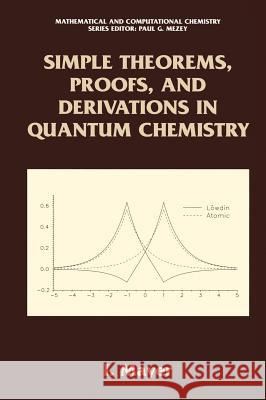
Istvan Mayer
Simple Theorems, Proofs, and Derivations in Quantum Chemistry Istvan Mayer 9780306474095 Kluwer Academic/Plenum Publishers - książkaWidoczna okładka, to zdjęcie poglądowe, a rzeczywista szata graficzna może różnić się od prezentowanej.

Simple Theorems, Proofs, and Derivations in Quantum Chemistry

ISBN-13: 9780306474095 / Angielski / Twarda / 2003 / 337 str.

Istvan Mayer
cena 887,69 zł
(netto: 845,42 VAT:  5%)

Najniższa cena z 30 dni: 771,08 zł
Termin realizacji zamówienia:
ok. 22 dni roboczych
Bez gwarancji dostawy przed świętami

Darmowa dostawa!

Since 1983 I have been delivering lectures at Budapest University that are mainly attended by chemistry students who have already studied quantum chem- istry in the amount required by the (undergraduate) chemistry curriculum of the University, and wish to acquire deeper insight in the field, possibly in prepara- tion of a master's or Ph.D. thesis in theoretical chemistry. In such a situation, I have the freedom to discuss, in detail, a limited number of topics which I feel are important for one reason or another. The exact coverage may vary from year to year, but I usually concentrate on the general principles and theorems and other basic theoretical results which I foresee will retain their importance despite the rapid development of quantum chemistry. I commonly organize my lectures by treating the subject from the begin- ning, without referring explicitly to any actual previous knowledge in quantum chemistry-only some familiarity with its goals, approaches and, to a lesser ex- tent, techniques is supposed. I concentrate on the formulae and their derivation, assuming the audience essentially understands the reasons for deriving these results. This book is basically derived from the material of my lectures. The spe- cial feature, distinguishing it from most other textbooks, is that all results are explicitly proved or derived, and the derivations are presented completely, step by step. True understanding of a theoretical result can be achieved only if one has gone through its derivation.


Kategorie:
Nauka, Chemia
Kategorie BISAC:
Science > Chemia - Fizyczna
Science > Fizyka kwantowa
Science > Fizyka jądrowa
Wydawca:
Kluwer Academic/Plenum Publishers
Seria wydawnicza:
Mathematical and Computational Chemistry
Język:
Angielski
ISBN-13:
9780306474095
Rok wydania:
2003
Wydanie:
2003
Numer serii:
000206754
Ilość stron:
337
Waga:
0.84 kg
Wymiary:
18.9 x 26.6 x 2.6
Oprawa:
Twarda
Wolumenów:
01
Dodatkowe informacje:
Wydanie ilustrowane

I. The Born-Oppenheimer Hamiltonian. 1. Separating the center of mass motion in quantum mechanics. 1.1. Reducing the two-body problem to two one-body ones. 1.2. The center of mass in quantum mechanics 1.3. Free atoms and atomcules. 2. The Born--Oppenheimer approximation. 2.1. Introductory remarks. 2.2. The Born-Oppenheimer separation. 2.3. Why the Born-Oppenheimer separation is not exact? 2.4. Approximate decoupling. 2.5. A note on the Born-Oppenheimer separation. II. General Theorems And Principles. 1. The variation principle. 1.1. The Rayleigh quotient. 1.2. The variation principle for the ground state. 1.3. The variation principle as an equivalent of the Schrodinger equation: a useful formulation of the variation principle. 1.4. Eckart's inequality. 1.5. Excited states. 2. The Hellmann - Feynman theorem. 2.1. The differential Hellmann - Feynman theorem. 2.2. The integral Hellmann -Feynman theorem. 3. The virial theorem in quantum mechanics. 3.1. Time dependence of a physical quantity. 3.2. The virial theorem. 3.3. Scaling - a connection with the variation principle. 3.4. The virial theorem in the Born-Oppenheimer approximation. 3.5. The virial theorem and the chemical bonding. III. The Linear Variational Method And Lowdin's Orthogonalization Schemes. 1. The linear variational method (Ritz -method) 2. Lowdin's symmetric orthogonalization. 2.1. Matrix SAND-1/2. 2.2. The S∧-1/2 transformation. 2.3. The Lowdin basis. 2.4. The stationary property of Lowdin's symmetric orthogonalization scheme. 2.5. Lowdin-orthogonalization: a two-dimensional example. 3. Linear independence of the basis and Lowdin's canonic orthogonalization. 3.1. Eigenvalues of the overlap matrix: a measure for the linear. 3.2. Lowdin's canonic orthogonalization. IV. Perturbational Methods. 1. Non-degenerate Rayleigh-Schrodinger perturbation theory. 1.1. The problem. 1.2. `Algebraic' expansion. 1.3. The use of the reduced resolvent in the Rayleigh-Schrodinger perturbation theory. 1.4. Wigner's 2n+1 theorem. 2. Variational-perturbational method: the Hylleraas-functional.3. Degenerate Rayleigh-Schrodinger perturbation theory. 4. Brillouin-Wigner perturbation theory. 4.1. The size-consistency problem. 5. Size consistency of the Rayleigh-Schrodinger perturbation. 5.1. Formal considerations based on the properties of power series. 5.2. Size consistency of the perturbational expansions. 6. Lowdin's partitioning method. V. Determinant Wave Functions. 1. Spin-orbitals. 2. Many-electron spin states. 3. Slater determinants. 3.1. Two-electron examples. 4. The antisymmetrizing operator. 4.1. The projection character of the antisymmetrizing operator. 4.2. Commutation properties of the antisymmetrizing operator. 5. Invariance of the determinant wave function with respect of. 6. Matrix elements between determinant wave functions. 6.1. Overlap. 6.2. One-electron operators. 6.3.


Udostępnij

Facebook - konto krainaksiazek.pl


Opinie o Krainaksiazek.pl na Opineo.pl

Partner Mybenefit

Krainaksiazek.pl w programie rzetelna firma Krainaksiaze.pl - płatności przez paypal

Czytaj nas na:

Facebook - krainaksiazek.pl
  • książki na zamówienie
  • granty
  • książka na prezent
  • kontakt
  • pomoc
  • opinie
  • regulamin
  • polityka prywatności

Zobacz:

  • Księgarnia czeska

  • Wydawnictwo Książkowe Klimaty

1997-2025 DolnySlask.com Agencja Internetowa

© 1997-2022 krainaksiazek.pl
     
KONTAKT | REGULAMIN | POLITYKA PRYWATNOŚCI | USTAWIENIA PRYWATNOŚCI
Zobacz: Księgarnia Czeska | Wydawnictwo Książkowe Klimaty | Mapa strony | Lista autorów
KrainaKsiazek.PL - Księgarnia Internetowa

Polityka prywatnosci - link
Krainaksiazek.pl - płatnośc Przelewy24
Przechowalnia Przechowalnia





