• Wyszukiwanie zaawansowane
  • Kategorie
  • Kategorie BISAC
  • Książki na zamówienie
  • Promocje
  • Granty
  • Książka na prezent
  • Opinie
  • Pomoc
  • Załóż konto
  • Zaloguj się

Silicon Biomineralization: Biology -- Biochemistry -- Molecular Biology -- Biotechnology » książka


zaloguj się | załóż konto
Logo Krainaksiazek.pl

koszyk

konto

szukaj
topmenu
Księgarnia internetowa
Szukaj
Książki na zamówienie
Promocje
Granty
Książka na prezent
Moje konto
Pomoc
 
 
Wyszukiwanie zaawansowane
Pusty koszyk
Bezpłatna dostawa dla zamówień powyżej 20 złBezpłatna dostawa dla zamówień powyżej 20 zł

Kategorie główne

• Nauka
 [2949965]
• Literatura piękna
 [1857847]

  więcej...
• Turystyka
 [70818]
• Informatyka
 [151303]
• Komiksy
 [35733]
• Encyklopedie
 [23180]
• Dziecięca
 [617748]
• Hobby
 [139972]
• AudioBooki
 [1650]
• Literatura faktu
 [228361]
• Muzyka CD
 [398]
• Słowniki
 [2862]
• Inne
 [444732]
• Kalendarze
 [1620]
• Podręczniki
 [167233]
• Poradniki
 [482388]
• Religia
 [509867]
• Czasopisma
 [533]
• Sport
 [61361]
• Sztuka
 [243125]
• CD, DVD, Video
 [3451]
• Technologie
 [219309]
• Zdrowie
 [101347]
• Książkowe Klimaty
 [123]
• Zabawki
 [2362]
• Puzzle, gry
 [3791]
• Literatura w języku ukraińskim
 [253]
• Art. papiernicze i szkolne
 [7933]
Kategorie szczegółowe BISAC

Silicon Biomineralization: Biology -- Biochemistry -- Molecular Biology -- Biotechnology

ISBN-13: 9783540005377 / Angielski / Twarda / 2003 / 340 str.
Werner E. G. Muller; Werner E. G. Mueller; Werner E. G. M]ller
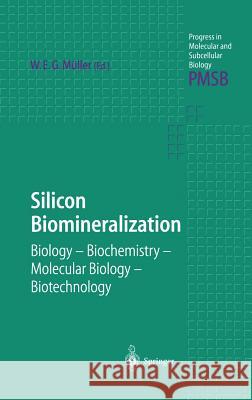
Silicon Biomineralization: Biology -- Biochemistry -- Molecular Biology -- Biotechnology Müller, Werner E. G. 9783540005377 Springer - książkaWidoczna okładka, to zdjęcie poglądowe, a rzeczywista szata graficzna może różnić się od prezentowanej.

Silicon Biomineralization: Biology -- Biochemistry -- Molecular Biology -- Biotechnology

ISBN-13: 9783540005377 / Angielski / Twarda / 2003 / 340 str.

Werner E. G. Muller; Werner E. G. Mueller; Werner E. G. M]ller
cena 605,23 zł
(netto: 576,41 VAT:  5%)

Najniższa cena z 30 dni: 578,30 zł
Termin realizacji zamówienia:
ok. 22 dni roboczych
Bez gwarancji dostawy przed świętami

Darmowa dostawa!

During evolution silica deposition has been used in Protozoa, Metazoa and in plants as skeletal elements. It appears that the mechanisms for the formation of biogenic silica have evolved independently in these three taxa. In Protozoa and plants biosilicification appears to be primarily driven by non-enzymatic processes and procedes on organic matrices. In contrast, in sponges (phylum Porifera) this process is mediated by enzymes; the initiation of this process is likewise dependent on organic matrices. In this monograph the role of biosilica as stabilizing structures in different organisms is reviewed and their role for morphogenetic processes is outlined. It provides an up-to-date summary of the mechanisms by which polymeric biosilica is formed. The volume is intended for biologists, biochemists and molecular biologists, involved in the understanding of structure formation in living organisms and will also be very useful for scientists working in the field of applied Nanotechnology and Nanobiotechnology.


Kategorie:
Nauka, Biologia i przyroda
Kategorie BISAC:
Science > Biochemia
Medical > Microbiology
Science > Biotechnology
Wydawca:
Springer
Seria wydawnicza:
Progress in Molecular and Subcellular Biology
Język:
Angielski
ISBN-13:
9783540005377
Rok wydania:
2003
Wydanie:
2003
Ilość stron:
340
Waga:
0.74 kg
Wymiary:
24.0 x 16.4 x 3.0
Oprawa:
Twarda
Wolumenów:
01
Dodatkowe informacje:
Wydanie ilustrowane

Organisms: Diatoms.- Living Inside a Glass Box-Silica in Diatoms.- 1 Introduction.- 2 Silica in Protozoa, Sponges and Higher Plants.- 2.1 Phaeodaria.- 2.2 Choanoflagellates.- 2.3 Silicoflagellates.- 2.4 Sponges.- 2.5 Plants.- 3 Living in a Glass Box-the Diatoms.- 4 Biosilicification in Diatoms.- 5 Conclusion.- References.- Components and Control of Silicification in Diatoms.- 1 Introduction.- 2 Features of Diatom Cell Walls and Terminology.- 3 Transport of Silicic Acid into the Diatom Cell.- 4 Intracellular Silicic Acid Transport.- 5 Micromorphogenesis vs.Macromorphogenesis.- 5.1 Micromorphogenesis-the Nanostructure of Diatom Biosilica.- 5.2 Control of Micromorphogenesis.- 6 Macromorphogenesis-the Formation of Large-Scale Silicified Structures in the Diatom Cell Wall.- 7 The Silica Deposition Vesicle-the “Black Box” in the Process of Silicification.- 8 Conclusions and Future Prospects.- References.- The Phylogeny of the Diatoms.- 1 Introduction.- 2 Approaches to Reconstruct Phylogenies.- 3 The Diatom Silica Frustule.- 3.1 Morphology of the Silica Frustule.- 3.2 Taxonomy Based on Characteristics of the Silica Frustule.- 3.3 The Phylogeny Inferred from Nuclear SSU rDNA Sequences.- 3.4 Phylogenetic Relevance of Taxonomy and Frustule Characters.- 3.4.1 The Radial Centrics.- 3.4.2 The Bipolar Centrics.- 3.4.3 The Bipolar Centric Toxarium.- 3.4.4 The Araphid Pennates.- 3.4.5 The Position of Pseudohimantidium.- 3.4.6 The Raphid Pennates.- 4 Phylogenetic Signal in Diatom Chloroplast Structure.- 5 Phylogenetic Signal in the Life Cycle and Auxospore Ontogeny.- 5.1 Gamete Formation.- 5.2 Auxospore Development.- 6 The Phylogenetic Position of the Diatoms Within Heterokonta.- 6.1 The Ancestry of the Diatoms.- 6.2 Origin of Pigmented Heterokontophyta and the End Permian Mass Extinction.- 6.3 Origin of the Silica Cell Wall Within Heterokonta.- 7 Historical Ecology.- 8 Palaeontology and Phylogeny.- 9 Conclusions.- References.- Silicon-a Central Metabolite for Diatom Growth and Morphogenesis.- 1 Introduction.- 2 Silicon Uptake and Transport: Regulation and Influencing Factors.- 2.1 Uptake, Transport and Soluble Pools.- 2.2 Energy Requirement.- 2.3 Factors Affecting the Uptake and Transport Processes.- 3 Link Between Silicon Metabolism, Growth and Cell Division.- 3.1 Coupling Between Silicon Metabolism and Cell Growth.- 3.2 Cell-Cycle Regulation.- 4 Diatom Morphogenesis.- 4.1 Overview of the Morphogenesis Process.- 4.2 Differentiation Programs Involving Silicon Morphogenesis.- 5 Morphological Plasticity and Variation.- 5.1 Size Reduction and Polymorphism.- 5.2 Impact of Growth Conditions and Environment.- 5.2.1 Light, Major Nutrients and Temperature.- 5.2.2 Salinity and Osmotic Stress.- 5.2.3 Trace Elements and Pollutants.- 6 Regulatory Mechanisms in Silicon Metabolism and Morphogenesis.- References.- Organisms: Higher Plants.- Functions of Silicon in Higher Plants.- 1 Introduction.- 2 Beneficial Effects of Silicon in Different Plant Species.- 2.1 Si-Accumulating Plants Versus Si Nonaccumulating Plants.- 2.2 Accumulation Process of Si in Si-Accumulating Plants.- 2.3 Effect of Si on the Growth of Si-Accumulating Plants.- 2.4 Effect of Si on the Growth of Si Nonaccumulating Plants.- 3 Functions of Si in Higher Plants.- 3.1 Stimulation of Photosynthesis.- 3.2 Alleviation of Physical Stress.- 3.2.1 Radiation Damage.- 3.2.2 Water Stress.- 3.2.3 Climatic Stress.- 3.3 Improvement of Resistance to Chemical Stress.- 3.3.1 Nutrient Imbalance Stress.- 3.3.1.1 Phosphorus Deficiency and Excess 13.- 3.3.1.2 N Excess 13.- 3.3.2 Metal Toxicity Stress.- 3.3.2.1 Mn and Fe Toxicity 14.- 3.3.2.2 Na Excess 14.- 3.3.2.3 Al Toxicity 14.- 3.4 Increase in Resistance to Abiotic Stress.- 3.4.1 Disease.- 3.4.2 Pests.- 4 Conclusion.- References.- Silicon in Plants.- 1 Introduction.- 2 Silicon in Monocots.- 2.1 SiO2 Deposits in Monocots.- 2.2 Silicic Acid in Monocots.- 3 Si in Dicots.- 4 Si in Cell Walls.- 5 Formation of SiO2 Deposits in Plants.- 6 Uptake and Long-Distance Transport.- References.- Organisms: Sponges.- Silica Deposition in Demosponges.- 1 Introduction.- 2 The Cells Involved.- 3 The Axial Filament.- 4 Extracellular Versus Intracellular Silica Deposition: the Role of Membranes.- 5 The Process of Silica Polymerization.- 6 Environmental Factors Modulating Silica Deposition.- 7 The Future.- References.- Molecular Mechanism of Spicule Formation in the Demosponge Suberites domuncula: Silicatein-Collagen-Myotrophin.- 1 Introduction.- 2 Sponges.- 3 Spiculogenesis.- 3.1 The Model Test System: Primmorphs.- 3.2 Effect of Silicon on the Spicule Formation.- 3.3 Silicon-Responsive Genes.- 3.3.1 Silicatein.- 3.3.2 Collagen.- 3.3.3 Myotrophin.- 3.4 Effect of Silicon on Silicon-Responsive Genes.- 3.5 Inhibition of Biosilica Formation by Germanium.- 3.6 Proposed Pathway for Spicule Formation.- 4 Expression of Silicatein in Primmorphs and in Sponge Tissue.- 5 Biosilica Formation.- 5.1 Silicatein cDNA Expression.- 5.2 Silicatein Enzyme Assay.- 6 Effect of Iron.- 6.1 Effect of Iron on the Expression of Ferritin, Septin and Scavenger Receptor in Primmorphs.- 7 Conclusion.- References.- Biotechnology.- Biotechnological Advances in Biosilicification.- 1 Introduction.- 2 Silicon Transport in Diatoms.- 3 Proteins Closely Associated with the Silica Wall of Diatoms.- 4 Polycationic Peptides and Polyamines Accelerate Silica Condensation.- 5 Employing Silica-Condensing Peptides to Fabricate Nanostructured Devices.- 6 Polycondensation-Catalyzing, Structure-Directing Catalytic Proteins from Sponge Biosilica.- 7 Structure-Directing Polycondensation-Catalyzing Diblock Copolypeptides.- 8 Gene Expression During Sponge Development.- 9 The Biological Precursor for Silica Synthesis.- 10 Recognition of Inorganic Compounds Using Phage Display.- 11 Future Prospects.- References.- Silicase, an Enzyme Which Degrades Biogenous Amorphous Silica: Contribution to the Metabolism of Silica Deposition in the Demosponge Suberites domuncula.- 1 Introduction.- 2 Siliceous Spicule Turnover.- 3 Screening for Silica Degrading Enzymes.- 3.1 The Model Test System: Primmorphs.- 3.2 ¡°Differential Display¡± of Transcripts.- 3.3 Cloning of the Gene Encoding the Silicase.- 3.3.1 Silicase.- 3.3.2 Phylogenetic Analysis of Silicase.- 4 Cloning of a Marker Gene of the Intermediary Metabolism.- 5 Preparation of Recombinant Silicase.- 6 Enzymatic Activities of Recombinant Silicase.- 6.1 Carbonic Anhydrase Activity.- 6.2 Silicase Activity.- 7 Expression of Silicase in Response to Silicon.- 8 Proposed Mechanism of Action of Silicase.- 9 Conclusion.- References.- Studies of Biosilicas; Structural Aspects, Chemical Principles, Model Studies and the Future.- 1 Terminology.- 2 Introduction.- 3 Structural Chemistry of Biosilicas.- 4 Organic Matrix-Controlled Silica Production in Biological Organisms.- 5 The Chemistry of Silica Formation.- 5.1 Silica Chemistry in Aqueous Solution.- 5.1.1 Effects of pH and M+ Ion Identity on Speciation in Aqueous Solution.- 5.2 Silica Chemistry in Non-Aqueous Solution.- 6 Solution Additives and Model Precipitation Reactions.- 6.1 Rationale for Use of Model Precipitation Reactions; Experimental Approaches.- 6.2 Studies of the Effect of Biosilica Extracts on the In Vitro Formation of Silica.- 6.3 Biomimetic Studies of Silica Precipitation.- 7 Other Areas of Interest.- 7.1 Transport.- 7.2 The Significance of Hypervalency in Biological Silicon Chemistry.- 8 Future Directions.- 8.1 Molecular Engineering in Diatoms.- 8.2 Isolation and Identification: Labelling.- 8.3 Theoretical Studies.- 9 Conclusions.- References.- Silicon Biomineralisation: Towards Mimicking Biogenic Silica Formation in Diatoms.- 1 Introduction.- 2 Biochemical and Physico-Chemical Characteristics of Diatomaceous Silica.- 2.1 Organic Composition.- 2.2 Chemical Aspects.- 2.2.1 Principles of Silica Synthesis.- 2.2.2 Silica Synthesis in Diatoms.- 2.3 Nanoscale Structure.- 2.3.1 Specific Surface Area.- 2.3.2 Coordination of Molecules of Biogenic Silica.- 2.3.3 X-Ray Diffraction and Wide-Angle X-Ray Scattering.- 2.3.4 Small-Angle X-Ray Scattering.- 3 In Situ Silica Synthesis.- 3.1 The Application of Templates.- 3.2 Synthesis of PEG-Templated Silicas.- 4 A New Concept: Mesophases in Structure-Directing Processes in Diatom Silica Biomineralization.- 5 Conclusions and Future Perspectives.- References.

During evolution silica deposition has been used in Protozoa, Metazoa and in plants as skeletal elements. It appears that the mechanisms for the formation of biogenic silica have evolved independently in these three taxa. In Protozoa and plants biosilicification appears to be primarily driven by non-enzymatic processes and procedes on organic matrices. In contrast, in sponges (phylum Porifera) this process is mediated by enzymes; the initiation of this process is likewise dependent on organic matrices.

In this monograph the role of biosilica as stabilizing structures in different organisms is reviewed and their role for morphogenetic processes is outlined. It provides an up-to-date summary of the mechanisms by which polymeric biosilica is formed. The volume is intended for biologists, biochemists and molecular biologists, involved in the understanding of structure formation in living organisms and will also be very useful for scientists working in the field of applied Nanotechnology and Nanobiotechnology.




Udostępnij

Facebook - konto krainaksiazek.pl


Opinie o Krainaksiazek.pl na Opineo.pl

Partner Mybenefit

Krainaksiazek.pl w programie rzetelna firma Krainaksiaze.pl - płatności przez paypal

Czytaj nas na:

Facebook - krainaksiazek.pl
  • książki na zamówienie
  • granty
  • książka na prezent
  • kontakt
  • pomoc
  • opinie
  • regulamin
  • polityka prywatności

Zobacz:

  • Księgarnia czeska

  • Wydawnictwo Książkowe Klimaty

1997-2025 DolnySlask.com Agencja Internetowa

© 1997-2022 krainaksiazek.pl
     
KONTAKT | REGULAMIN | POLITYKA PRYWATNOŚCI | USTAWIENIA PRYWATNOŚCI
Zobacz: Księgarnia Czeska | Wydawnictwo Książkowe Klimaty | Mapa strony | Lista autorów
KrainaKsiazek.PL - Księgarnia Internetowa

Polityka prywatnosci - link
Krainaksiazek.pl - płatnośc Przelewy24
Przechowalnia Przechowalnia



