• Wyszukiwanie zaawansowane
  • Kategorie
  • Kategorie BISAC
  • Książki na zamówienie
  • Promocje
  • Granty
  • Książka na prezent
  • Opinie
  • Pomoc
  • Załóż konto
  • Zaloguj się

Signaling Mechanisms in Protozoa and Invertebrates » książka


zaloguj się | załóż konto
Logo Krainaksiazek.pl

koszyk

konto

szukaj
topmenu
Księgarnia internetowa
Szukaj
Książki na zamówienie
Promocje
Granty
Książka na prezent
Moje konto
Pomoc
 
 
Wyszukiwanie zaawansowane
Pusty koszyk
Bezpłatna dostawa dla zamówień powyżej 20 złBezpłatna dostawa dla zamówień powyżej 20 zł

Kategorie główne

• Nauka
 [2952079]
• Literatura piękna
 [1850969]

  więcej...
• Turystyka
 [71058]
• Informatyka
 [151066]
• Komiksy
 [35579]
• Encyklopedie
 [23181]
• Dziecięca
 [620496]
• Hobby
 [139036]
• AudioBooki
 [1646]
• Literatura faktu
 [228729]
• Muzyka CD
 [379]
• Słowniki
 [2932]
• Inne
 [445708]
• Kalendarze
 [1409]
• Podręczniki
 [164793]
• Poradniki
 [480107]
• Religia
 [510956]
• Czasopisma
 [511]
• Sport
 [61267]
• Sztuka
 [243299]
• CD, DVD, Video
 [3411]
• Technologie
 [219640]
• Zdrowie
 [100984]
• Książkowe Klimaty
 [124]
• Zabawki
 [2281]
• Puzzle, gry
 [3363]
• Literatura w języku ukraińskim
 [258]
• Art. papiernicze i szkolne
 [8020]
Kategorie szczegółowe BISAC

Signaling Mechanisms in Protozoa and Invertebrates

ISBN-13: 9783642801082 / Angielski / Miękka / 2011 / 212 str.
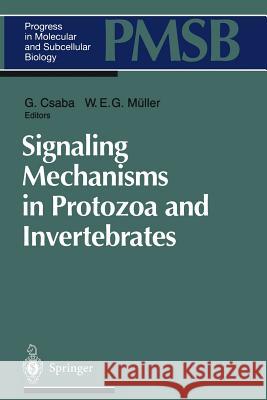
G. Csaba; W. E. G. M. Ller
Signaling Mechanisms in Protozoa and Invertebrates G. Csaba W. E. G. M 9783642801082 Springer - książkaWidoczna okładka, to zdjęcie poglądowe, a rzeczywista szata graficzna może różnić się od prezentowanej.

Signaling Mechanisms in Protozoa and Invertebrates

ISBN-13: 9783642801082 / Angielski / Miękka / 2011 / 212 str.

G. Csaba; W. E. G. M. Ller
cena 402,53
(netto: 383,36 VAT:  5%)

Najniższa cena z 30 dni: 385,52
Termin realizacji zamówienia:
ok. 22 dni roboczych
Dostawa w 2026 r.

Darmowa dostawa!

Comparative endocrinology helps to find the roots of homeostatic regulation in organisms. In this context, many years ago a series of experiments were done, which demonstrated the hormonal regula tion also on the invertebrate level. The mechanisms are partly similar, partly different, from those found in vertebrates. The new receptor era of mammalian endocrinology stimulated research on invertebrate hormone receptors, and sophisticated methods are applied also to determine hormones. The experiments demonstrated the existence and even similar function of these structures and signaling molecules. However, data on hormones and receptors at the lowest level of metazoan life and the highest level of protozoan life were not at our disposal. About two decades ago, first observations on the presence of hormone receptors reacting to vertebrate hormones in protozoa were made. Since the early 1980s we know that hormone-like molecules similar to those of higher vertebrates are present also in unicellular organisms. The presence of some second messengers in Tetrahymena was recognized. Since then, the research has been extended and many structures - previously believed to be solely vertebrate characteristics, such as opiate receptors, similar to mammalian ones - were found in unicellular organisms. These observations justified the assumption of a complete endocrine system at protozoan level, where - considering the unicellularit- this seemed to be not required. However, it became clear that the roots of endocrine communication date back at least 2 billion years."


Kategorie:
Nauka, Biologia i przyroda
Kategorie BISAC:
Science > Biochemia
Science > Zoologia i nauki o zwierzętach
Medical > Fizjologia
Wydawca:
Springer
Seria wydawnicza:
Progress in Molecular and Subcellular Biology
Język:
Angielski
ISBN-13:
9783642801082
Rok wydania:
2011
Wydanie:
Softcover Repri
Numer serii:
000038507
Ilość stron:
212
Waga:
0.36 kg
Wymiary:
23.5 x 15.5
Oprawa:
Miękka
Wolumenów:
01

Evolutionary Significance of the Hormone Recognition Capacity in Unicellular Organisms. Development of Hormone Receptors.- 1 Introduction.- 2 Receptor Memory: Hormonal Imprinting.- 3 Problems of the Specificity of Imprinting.- 4 Time, Concentration, and Downregulation.- 5 Sugars of the Receptors.- 6 Cell Aging and Imprinting.- 7 Imprinting by Amino Acids and Oligopeptides.- 8 Receptors of the Nuclear Envelope.- 9 Possible Mechanisms of Imprinting.- 10 The Other Component: Hormones in Protozoa.- 11 Evolutionary Conclusions Based on the Unicellular Model.- References.- Studies on the Opioid Mechanism in Tetrahymena.- 1 Introduction to Opioid Mechanisms.- 1.1 Opioid Mechanisms in Invertebrate Metazoa.- 1.2 Opioid Mechanisms in Unicellular Organisms.- 2 The Opioid Mechanism in Tetrahymena.- 2.1 Pharmacological Characterization of the Endogenous Opioid.- 2.2 Pharmacological Characterization of the Opioid Receptor.- 2.3 Biochemical Characterization of the Signal Transduction Pathway.- 3 Conclusions.- References.- Adenylate and Guanylate Cyclases in Tetrahymena.- 1 Introduction.- 2 Cyclic Nucleotide Metabolism in Tetrahymena.- 2.1 Cell Growth- and Cycle-Associated Changes.- 2.2 Involvement in Biological Regulation.- 3 Cyclases Involved in Cell Metabolism and Functions.- 4 Regulatory Mechanisms of Cyclases.- 4.1 Adenylate Cyclase.- 4.2 Guanylate Cyclase.- 5 Structure and Intracellular Distribution of Calmodulin.- 6 Conclusion.- References.- Signal Peptide-Induced Sensory Behavior in Free Ciliates: Bioassays and Cellular Mechanisms.- 1 Introduction.- 2 Peptide Signals in Ciliates.- 2.1 Signal Peptides Found Intracellularly.- 2.2 Signal Peptides Having Sensory Effects.- 2.2.1 Physiological Effects of Insulin on Tetrahymena.- 3 Bioassays Measuring Peptide-Induced Changes of Cell Behavior and Ciliary Activity.- 3.1 Population Assays for Chemoattraction.- 3.2 Single Cell Assays for Chemoattraction.- 3.3 Assays of Ciliary Activity.- 4 Cellular Mechanisms Related to Peptide Action on Individual Cell Behavior.- 4.1 Adaptation.- 4.2 Persistence.- 5 Concluding Remarks.- References.- Ciliate Pheromones.- 1 Introduction.- 2 Background.- 3 Pheromone Notation and Origin.- 4 Pheromone Secretion and Purification.- 5 Pheromone Structure.- 6 Pheromone Genes.- 7 Pheromone Receptors.- 8 Competitive Pheromone Receptor-Binding Reactions.- 9 Pheromones as Growth Factors.- 10 Concluding Remarks.- References.- Cell-Surface GPI Expression in Protozoa. The Connection with the PI System.- 1 Introduction.- 1.1 The GPI Anchor.- 1.2 The GPI Anchor Biosynthesis.- 1.3 Enzymes with Specificities for GPI Anchors.- 1.4 The Inositol Phospholipids and Signal Transduction.- 2 The Cell-Surface Expression of GPI-Anchored Proteins in the Protozoa.- 2.1 GPI-Anchored Proteins in the Parasitic Protozoa.- 2.2 GPI-Anchored Proteins in the Free-Living Protozoa.- 3 Inositol Phospholipids in Tetrahymena pyriformis. The Possible Link Between the PI System and Synthesis of GPI.- References.- Cell Adhesion Proteins in the Nonvertebrate Eukaryotes.- 1 Introduction.- 1.1 History and Philosophy.- 1.2 Evolution.- 2 Approaches and Findings.- 3 Protista.- 3.1 Trypanosoma cruzi.- 3.2 Cellular Slime Molds.- 4 Higher Eukaryotes.- 5 An Alveolate: Plasmodium.- 6 Plants.- 6.1 Chlamydomonas.- 6.2 Volvox.- 6.3 Higher Plants.- 7 Fungi.- 7.1 Saccharomyces cerevisiae.- 7.2 Candida.- 8 Metazoa.- 8.1 Sponges.- 8.2 Cnidaria: Hydra.- 8.3 Tripoblasts.- 8.3.1 Pseudocoelatomates: Caenorhabditis elegans.- 8.4 Insects.- 8.5 Deuterostomes.- 8.5.1 Fertilization in Sea Urchins.- 9 Conclusions.- 10 Characteristics of Cell Adhesion Proteins.- 10.1 Modules.- 10.2 Cell Surface Association.- 10.3 Role of Ca2+.- 10.4 Binding Characteristics.- 11 Extracellular Matrix Interactions.- 12 Role of Lectins and Carbohydrates.- 13 Signal Transduction and Cytoplasmic Domains.- References.- Animal Lectins as Cell Surface Receptors: Current Status for Invertebrate Species.- 1 Introduction.- 2 Animal Lectins as Cell Membrane Receptors.- 3 Lectin Families in Invertebrate and Protochordate Species. Their Association with the Hemocyte Plasma Membrane.- 4 Summary and Prospects.- References.- Characterization of the Receptor Protein-Tyrosine Kinase Gene from the Marine Sponge Geodia cydonium.- 1 Introduction.- 2 Protein Kinases.- 3 Receptor Protein-Tyrosine Kinases.- 4 Receptor Protein-Tyrosine Kinase from the Sponge Geodia cydonium.- 4.1 Ligand-Binding Domain (Immunoglobulin-Like Domain).- 4.2 Intron/Exon.- 4.3 Transmembrane Domain.- 4.4 Juxtamembrane Region.- 4.5 Catalytic Domain.- 4.6 3?-Nontranslated Region.- 5 Proposed Function of the Sponge Receptor Protein-Tyrosine Kinase.- 6 Implication for Molecular Evolution of Metazoa.- 7 Summary and Perspectives.- References.


Udostępnij

Facebook - konto krainaksiazek.pl


Opinie o Krainaksiazek.pl na Opineo.pl

Partner Mybenefit

Krainaksiazek.pl w programie rzetelna firma Krainaksiaze.pl - płatności przez paypal

Czytaj nas na:

Facebook - krainaksiazek.pl
  • książki na zamówienie
  • granty
  • książka na prezent
  • kontakt
  • pomoc
  • opinie
  • regulamin
  • polityka prywatności

Zobacz:

  • Księgarnia czeska

  • Wydawnictwo Książkowe Klimaty

1997-2025 DolnySlask.com Agencja Internetowa

© 1997-2022 krainaksiazek.pl
     
KONTAKT | REGULAMIN | POLITYKA PRYWATNOŚCI | USTAWIENIA PRYWATNOŚCI
Zobacz: Księgarnia Czeska | Wydawnictwo Książkowe Klimaty | Mapa strony | Lista autorów
KrainaKsiazek.PL - Księgarnia Internetowa

Polityka prywatnosci - link
Krainaksiazek.pl - płatnośc Przelewy24
Przechowalnia Przechowalnia






