• Wyszukiwanie zaawansowane
  • Kategorie
  • Kategorie BISAC
  • Książki na zamówienie
  • Promocje
  • Granty
  • Książka na prezent
  • Opinie
  • Pomoc
  • Załóż konto
  • Zaloguj się

Sensing, Intelligence, Motion: How Robots and Humans Move in an Unstructured World » książka


zaloguj się | załóż konto
Logo Krainaksiazek.pl

koszyk

konto

szukaj
topmenu
Księgarnia internetowa
Szukaj
Książki na zamówienie
Promocje
Granty
Książka na prezent
Moje konto
Pomoc
 
 
Wyszukiwanie zaawansowane
Pusty koszyk
Bezpłatna dostawa dla zamówień powyżej 20 złBezpłatna dostawa dla zamówień powyżej 20 zł

Kategorie główne

• Nauka
 [2946600]
• Literatura piękna
 [1856966]

  więcej...
• Turystyka
 [72221]
• Informatyka
 [151456]
• Komiksy
 [35826]
• Encyklopedie
 [23190]
• Dziecięca
 [619653]
• Hobby
 [140543]
• AudioBooki
 [1577]
• Literatura faktu
 [228355]
• Muzyka CD
 [410]
• Słowniki
 [2874]
• Inne
 [445822]
• Kalendarze
 [1744]
• Podręczniki
 [167141]
• Poradniki
 [482898]
• Religia
 [510455]
• Czasopisma
 [526]
• Sport
 [61590]
• Sztuka
 [243598]
• CD, DVD, Video
 [3423]
• Technologie
 [219201]
• Zdrowie
 [101638]
• Książkowe Klimaty
 [124]
• Zabawki
 [2473]
• Puzzle, gry
 [3898]
• Literatura w języku ukraińskim
 [254]
• Art. papiernicze i szkolne
 [8170]
Kategorie szczegółowe BISAC

Sensing, Intelligence, Motion: How Robots and Humans Move in an Unstructured World

ISBN-13: 9780471707400 / Angielski / Twarda / 2005 / 456 str.
Vladimir Lumelsky
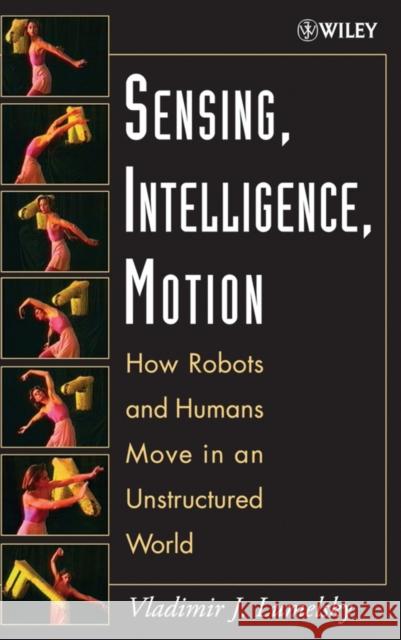
Sensing, Intelligence, Motion: How Robots and Humans Move in an Unstructured World Lumelsky, Vladimir J. 9780471707400 Wiley-Interscience - książkaWidoczna okładka, to zdjęcie poglądowe, a rzeczywista szata graficzna może różnić się od prezentowanej.

Sensing, Intelligence, Motion: How Robots and Humans Move in an Unstructured World

ISBN-13: 9780471707400 / Angielski / Twarda / 2005 / 456 str.

Vladimir Lumelsky
cena 829,84 zł
(netto: 790,32 VAT:  5%)

Najniższa cena z 30 dni: 823,03 zł
Termin realizacji zamówienia:
ok. 30 dni roboczych
Bez gwarancji dostawy przed świętami

Darmowa dostawa!

A leap forward in the field of robotics

Until now, most of the advances in robotics have taken place in structured environments. Scientists and engineers have designed highly sophisticated robots, but most are still only able to operate and move in predetermined, planned environments designed specifically for the robots and typically at very high cost. This new book takes robotics to the next level by setting forth the theory and techniques needed to achieve robotic motion in unstructured environments. The ability to move and operate in an arbitrary, unplanned environment will lead to automating a wide range of new robotic tasks, such as patient care, toxic site cleanup, and planetary exploration.

The approach that opens the door for robots to handle unstructured tasks is known as Sensing-Intelligence-Motion (SIM), which draws from research in topology, computational complexity, control theory, and sensing hardware. Using SIM as an underlying foundation, the author's carefully structured presentation is designed to:
* Formulate the challenges of sensor-based motion planning and then build a theoretical foundation for sensor-based motion planning strategies
* Investigate promising algorithmic strategies for mobile robots and robot arm manipulators, in both cases addressing motion planning for the whole robot body
* Compare robot performance to human performance in sensor-based motion planning to gain better insight into the challenges of SIM and help build synergistic human-robot teams for tele-operation tasks. It is both exciting and encouraging to discover that robot performance decisively exceeds human performance in certain tasks requiring spatial reasoning, even when compared to trained operators
* Review sensing hardware that is necessary to realize the SIM paradigm

Some 200 illustrations, graphic sketches, and photos are included to clarify key issues, develop and validate motion planning approaches, and demonstrate full systems in operation.

As the first book fully devoted to robot motion planning in unstructured environments, Sensing, Intelligence, Motion is a must-read for engineers, scientists, and researchers involved in robotics. It will help them migrate robots from highly specialized applications in factories to widespread use in society where autonomous robot motion is needed.


Kategorie:
Informatyka
Kategorie BISAC:
Technology & Engineering > Robotics
Wydawca:
Wiley-Interscience
Język:
Angielski
ISBN-13:
9780471707400
Rok wydania:
2005
Ilość stron:
456
Waga:
0.69 kg
Wymiary:
24.28 x 16.0 x 2.59
Oprawa:
Twarda
Wolumenów:
01
Dodatkowe informacje:
Bibliografia
Wydanie ilustrowane

"This book represents a very stimulating and personal contribution to the field of algorithmic robotics." ( Pragmatics & Cognition)

" a good text for senior undergraduates and graduate students with an interest in robot motion." (Computing Reviews.com, May 25, 2006)

Preface.

Acknowledgments.

1 Motion Planning Introduction.

1.1 Introduction.

1.2 Basic Concepts.

1.2.1 Robot? What Robot?

1.2.2 Space. Objects.

1.2.3 Input Information. Sensing.

1.2.4 Degrees of Freedom. Coordinate Systems.

1.2.5 Motion Control.

1.2.6 Robot Programming.

1.2.7 Motion Planning.

2 A Quick Sketch of Major Issues in Robotics.

2.1 Kinematics.

2.2 Statics.

2.3 Dynamics.

2.4 Feedback Control.

2.5 Compliant Motion.

2.6 Trajectory Modification.

2.7 Collision Avoidance.

2.8 Motion Planning with Complete Information.

2.9 Motion Planning with Incomplete Information.

2.9.1 The Beginnings.

2.9.2 Maze–to–Graph Transition.

2.9.3 Sensor–Based Motion Planning.

2.10 Exercises.

3 Motion Planning for a Mobile Robot.

3.1 The Model.

3.2 Universal Lower Bound for the Path Planning Problem.

3.3 Basic Algorithms.

3.3.1 First Basic Algorithm: Bug1.

3.3.2 Second Basic Algorithm: Bug2.

3.4 Combining Good Features of Basic Algorithms.

3.5 Going After Tighter Bounds.

3.6 Vision and Motion Planning.

3.6.1 The Model.

3.6.2 Algorithm VisBug–21.

3.6.3 Algorithm VisBug–22.

3.7 From a Point Robot to a Physical Robot.

3.8 Other Approaches.

3.9 Which Algorithm to Choose?

3.10 Discussion.

3.11 Exercises.

4 Accounting for Body Dynamics: The Jogger s Problem.

4.1 Problem Statement.

4.2 Maximum Turn Strategy.

4.2.1 The Model.

4.2.2 Sketching the Approach.

4.2.3 Velocity Constraints. Minimum Time Braking.

4.2.4 Optimal Straight–Line Motion.

4.2.5 Dynamics and Collision Avoidance.

4.2.6 The Algorithm.

4.2.7 Examples.

4.3 Minimum Time Strategy.

4.3.1 The Model.

4.3.2 Sketching the Approach.

4.3.3 Dynamics and Collision Avoidance.

4.3.4 Canonical Solution.

4.3.5 Near–Canonical Solution.

4.3.6 The Algorithm.

4.3.7 Convergence. Computational Complexity.

4.3.8 Examples.

5 Motion Planning for Two–Dimensional Arm Manipulators.

5.1 Introduction.

5.1.1 Model and Definitions.

5.2 Planar Revolute Revolute (RR) Arm.

5.2.1 Analysis.

5.2.2 Algorithm.

5.2.3 Step Planning.

5.2.4 Example.

5.2.5 Motion Planning with Vision and Proximity Sensing.

5.2.6 Concluding Remarks.

5.3 Distinct Kinematic Configurations of RR Arm.

5.4 Prismatic Prismatic (PP, or Cartesian) Arm.

5.5 Revolute Prismatic (RP) Arm with Parallel Links.

5.6 Revolute Prismatic (RP) Arm with Perpendicular Links.

5.7 Prismatic Revolute (PR) Arm.

5.8 Topology of Arm s Free Configuration Space.

5.8.1 Workspace; Configuration Space.

5.8.2 Interaction Between the Robot and Obstacles.

5.8.3 Uniform Local Connectedness.

5.8.4 The General Case of 2–DOF Arm Manipulators.

5.9 Appendix.

5.10 Exercises.

6 Motion Planning for Three–Dimensional Arm Manipulators.

6.1 Introduction.

6.2 The Case of the PPP (Cartesian) Arm.

6.2.1 Model, Definitions, and Terminology.

6.2.2 The Approach.

6.2.3 Topology of W–Obstacles and C–Obstacles.

6.2.4 Connectivity of C.

6.2.5 Algorithm.

6.2.6 Examples.

6.3 Three–Link XXP Arm Manipulators.

6.3.1 Robot Arm Representation Spaces.

6.3.2 Monotonicity of Joint Space.

6.3.3 Connectivity of Jf.

6.3.4 Retraction of Jf.

6.3.5 Configuration Space and Its Retract.

6.3.6 Connectivity Graph.

6.3.7 Lifting 2D Algorithms into 3D.

6.3.8 Step Planning.

6.3.9 Discussion.

6.4 Other XXX Arms.

7 Human Performance in Motion Planning.

7.1 Introduction.

7.2 Preliminary Observations.

7.2.1 Moving in a Maze.

7.2.2 Moving an Arm Manipulator.

7.2.3 Conclusions and Plan for Experiment Design.

7.3 Experiment Design.

7.3.1 The Setup.

7.3.2 Test Protocol.

7.4 Results Experiment One.

7.4.1 Principal Components Analysis.

7.4.2 Nonparametric Statistics.

7.4.3 Univariate Analysis of Variance.

7.4.4 Two–Way Analysis of Variance.

7.4.5 Implementation: Two–Way Analysis for Path Length.

7.4.6 Implementation: Two–Way Analysis for Completion Time.

7.5 Results Experiment Two.

7.5.1 The Technique.

7.5.2 Implementation Scheme.

7.5.3 Results and Interpretation.

7.6 Discussion.

8 Sensitive Skin Designing an All–Sensitive Robot Arm Manipulator.

8.1 Introduction.

8.2 Salient Characteristics of a Sensitive Skin.

8.3 Skin Design.

8.4 Examples.

9 Suggested Course Projects.

References.

Index.

VLADIMIR J. LUMELSKY, PhD, is Consolidated Papers Professor of Engineering, University of Wisconsin Madison. Prior to his current appointment, he held positions with Ford Motor Research Laboratories, General Electric Research Center, and Yale University. Dr. Lumelsky is the author or coauthor of more than 200 scholarly publications.

A leap forward in the field of robotics

Until now, most of the advances in robotics have taken place in structured environments. Scientists and engineers have designed highly sophisticated robots, but most are still only able to operate and move in predetermined, planned environments designed specifically for the robots and typically at very high cost. This new book takes robotics to the next level by setting forth the theory and techniques needed to achieve robotic motion in unstructured environments. The ability to move and operate in an arbitrary, unplanned environment will lead to automating a wide range of new robotic tasks, such as patient care, toxic site cleanup, and planetary exploration.

The approach that opens the door for robots to handle unstructured tasks is known as Sensing–Intelligence–Motion (SIM), which draws from research in topology, computational complexity, control theory, and sensing hardware. Using SIM as an underlying foundation, the author′s carefully structured presentation is designed to:

  • Formulate the challenges of sensor–based motion planning and then build a theoretical foundation for sensor–based motion planning strategies
  • Investigate promising algorithmic strategies for mobile robots and robot arm manipulators, in both cases addressing motion planning for the whole robot body
  • Compare robot performance to human performance in sensor–based motion planning to gain better insight into the challenges of SIM and help build synergistic human–robot teams for tele–operation tasks. It is both exciting and encouraging to discover that robot performance decisively exceeds human performance in certain tasks requiring spatial reasoning, even when compared to trained operators
  • Review sensing hardware that is necessary to realize the SIM paradigm

Some 200 illustrations, graphic sketches, and photos are included to clarify key issues, develop and validate motion planning approaches, and demonstrate full systems in operation.

As the first book fully devoted to robot motion planning in unstructured environments, Sensing, Intelligence, Motion is a must–read for engineers, scientists, and researchers involved in robotics. It will help them migrate robots from highly specialized applications in factories to widespread use in society where autonomous robot motion is needed.

Lumelsky, Vladimir VLADIMIR J. LUMELSKY, PhD, is Consolidated Papers ... więcej >


Udostępnij

Facebook - konto krainaksiazek.pl


Opinie o Krainaksiazek.pl na Opineo.pl

Partner Mybenefit

Krainaksiazek.pl w programie rzetelna firma Krainaksiaze.pl - płatności przez paypal

Czytaj nas na:

Facebook - krainaksiazek.pl
  • książki na zamówienie
  • granty
  • książka na prezent
  • kontakt
  • pomoc
  • opinie
  • regulamin
  • polityka prywatności

Zobacz:

  • Księgarnia czeska

  • Wydawnictwo Książkowe Klimaty

1997-2025 DolnySlask.com Agencja Internetowa

© 1997-2022 krainaksiazek.pl
     
KONTAKT | REGULAMIN | POLITYKA PRYWATNOŚCI | USTAWIENIA PRYWATNOŚCI
Zobacz: Księgarnia Czeska | Wydawnictwo Książkowe Klimaty | Mapa strony | Lista autorów
KrainaKsiazek.PL - Księgarnia Internetowa

Polityka prywatnosci - link
Krainaksiazek.pl - płatnośc Przelewy24
Przechowalnia Przechowalnia




