Self-Assembling Systems: Theory and Simulation » książka





Self-Assembling Systems: Theory and Simulation
ISBN-13: 9781119113140 / Angielski / Twarda / 2016 / 384 str.
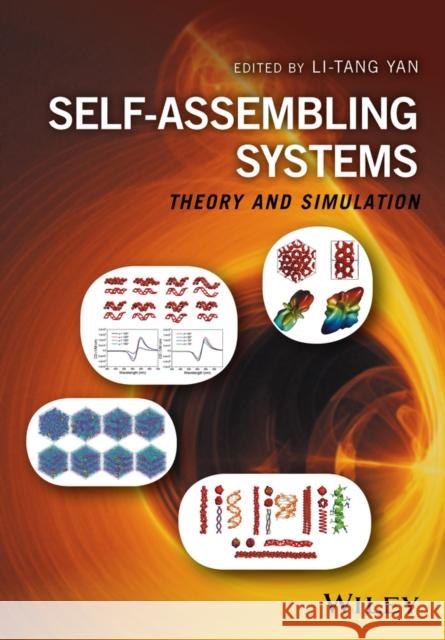
Self-Assembling Systems: Theory and Simulation
ISBN-13: 9781119113140 / Angielski / Twarda / 2016 / 384 str.
(netto: 631,86 VAT: 5%)
Najniższa cena z 30 dni: 655,33
ok. 30 dni roboczych.
Darmowa dostawa!
Provides comprehensive knowledge on concepts, theoretical methods and state-of-the-art computational techniques for the simulation of self-assembling systems
- Looks at the field of self-assembly from a theoretical perspective
- Highlights the importance of theoretical studies and tailored computer simulations to support the design of new self-assembling materials with useful properties
- Divided into three parts covering the basic principles of self-assembly, methodology, and emerging topics
Wydanie ilustrowane
List of Contributors xiii
Preface xvii
1 Theoretical Studies and Tailored Computer Simulations in Self–Assembling Systems: A General Aspect 1
Zihan Huang and Li–Tang Yan
1.1 Introduction 1
1.2 Emerging Self–Assembling Principles 3
1.2.1 Predictive Science and Rational Design of Complex Building Blocks 3
1.2.2 Entropy–Driven Ordering and Self–Assembly 5
1.2.3 Programmable Self–Assembly 10
1.2.4 Self–Assembling Kinetics: Supracolloidal Reaction 14
Acknowledgments 16
References 16
2 Developing Hybrid ModelingMethods to Simulate Self–Assembly in Polymer Nanocomposites 20
Xin Yong, Stephen C. Snow, Olga Kuksenok and Anna C. Balazs
2.1 Introduction 20
2.2 Methodology 21
2.2.1 Dissipative Particle Dynamics 21
2.2.2 Polymer Chains, Gels, and Nanoparticles 22
2.2.3 Radical PolymerizationModel 24
2.3 Results and Discussions 27
2.3.1 Modeling Bulk Polymerization Using FRP and ATRP 27
2.3.2 Modeling Regeneration of Severed Polymer Gels with Interfacially Active Nanorods 32
2.3.3 Modeling the Formation of Polymer Clay Composite Gels 43
2.4 Conclusions 47
Acknowledgments 48
References 49
3 Theory and Simulation Studies of Self–Assembly of Helical Particles 53
Giorgio Cinacchi, Alberta Ferrarini, Elisa Frezza, Achille Giacometti and Hima Bindu Kolli
3.1 Introduction: Why Hard Helices? 53
3.2 Liquid Crystal Phases 55
3.3 Hard Helices: A MinimalModel 56
3.4 Numerical Simulations 57
3.4.1 Monte Carlo in Various Ensembles 57
3.4.1.1 Canonical Monte Carlo simulations (NVT MC) 59
3.4.1.2 Isothermal IsobaricMonte Carlo Simulations (NPT MC) 59
3.4.2 Details on the MC Simulation of Hard Helices 59
3.5 Onsager (Density Functional) Theory 61
3.6 Onsager–LikeTheory for the Cholesteric and Screw–Nematic Phases 64
3.7 Order Parameters and Correlation Functions 67
3.7.1 Nematic Order Parameter P2 68
3.7.2 Screw–Like Nematic Order Parameter 68
3.7.3 Smectic Order Parameter 70
3.7.4 Hexatic Order Parameter 70
3.7.5 Parallel and Perpendicular Pair Correlation Functions 71
3.8 The Physical Origin of Cholesteric and Screw–Like Order 73
3.9 The Phase Diagram of Hard Helices 74
3.9.1 The Equation of State 75
3.9.2 Phase Diagrams in the Volume Fraction Pitch Plane 76
3.9.2.1 Phase Diagram for r = 0.1 77
3.9.2.2 Phase Diagram for r = 0.2 78
3.9.2.3 Phase Diagram for r = 0.4 79
3.10 Helical (Bio)Polymers and Colloidal Particles 79
3.11 Conclusions and Perspectives 81
Acknowledgments 82
References 82
4 Self–Consistent Field Theory of Self–Assembling Multiblock Copolymers 85
Weihua Li and An–Chang Shi
4.1 Introduction 85
4.2 Theoretical Framework: Self–Consistent Field Theory of Block Copolymers 88
4.3 Numerical Methods of SCFT 90
4.3.1 Reciprocal–Space Method 90
4.3.2 Real–Space Method 93
4.3.3 Pseudo–SpectralMethod 95
4.3.4 Fourth–Order Pseudo–Spectral Method 98
4.4 Application of SCFT to Multiblock Copolymers 98
4.5 Conclusions and Discussions 104
Acknowledgments 107
References 107
5 Simulation Models of Soft Janus and Patchy Particles 109
Zhan–Wei Li, Zhao–Yan Sun and Zhong–Yuan Lu
5.1 Introduction 109
5.2 Soft Janus Particle Models 111
5.2.1 Soft One–Patch Janus Particle Model 111
5.2.2 Soft ABA–Type Triblock Janus Particle Model 113
5.2.3 Soft BAB–Type Triblock Janus Particle Model 114
5.2.4 Integration Algorithm 116
5.3 Soft Patchy Particle Models 117
5.3.1 The Model 117
5.3.2 Integration Algorithm 118
5.4 Physical Meanings of the Simulation Parameters in Our Models 121
5.5 GPU Acceleration 121
5.6 Self–Assembly of Soft Janus and Patchy Particles 122
5.6.1 Self–Assembly of Soft One–Patch Janus Particles 122
5.6.2 The Role of Particle Softness in Self–Assembling Different Supracolloidal Helices 123
5.6.3 Self–Assembly of Soft ABA–Type Triblock Janus Particles 124
5.6.4 Template–Free Fabrication of Two–Dimensional Exotic Nanostructures through the Self–Assembly of Soft BAB–Type Triblock Janus Particles 125
5.6.5 Self–Assembly of Soft Multi–Patch Particles 126
5.7 Conclusions 127
Acknowledgments 128
References 128
6 Molecular Models for Hepatitis B Virus Capsid Formation, Maturation, and Envelopment 134
Jehoon Kim and Jianzhong Wu
6.1 Introduction 134
6.2 Molecular Thermodynamics of Capsid Formation 140
6.2.1 Energetics of Viral Assembly 141
6.2.1.1 Rigid Capsids 141
6.2.1.2 Nucleocapsids 144
6.2.2 Thermodynamics of Capsid Formation and Stability 147
6.2.2.1 Stability of CTD–Free Empty Capsids 147
6.2.2.2 Stability of Nucleocapsids 150
6.2.3 Modulation Effects 152
6.2.4 T3/T4 Dimorphism 153
6.3 Electrostatics of Genome Packaging 154
6.3.1 Thermodynamics of RNA Encapsidation 155
6.3.2 The Optimal Genome Size of an HBV Nucleocapsid 157
6.3.3 Charge Balance between Packaged RNA and CTD Tails 157
6.4 Dynamic Structure of HBV Nucleocapsids 159
6.4.1 Structure ofWT and Mutant Nucleocapsids 159
6.4.2 The Location of CTD Residues 161
6.4.3 Implication of the CTD Exposure 165
6.4.4 The Effect of Phosphorylation of Capsid Structure 165
6.5 Capsid Envelopment with Surface Proteins 167
6.6 Summary and Outlook 171
Acknowledgments 173
References 174
7 Simulation Studies of Metal Ligand Self–Assembly 186
Makoto Yoneya
7.1 Introduction 186
7.2 Modeling Metal Ligand Self–Assembly 187
7.2.1 Modeling Metals, Ligands and their Interactions 187
7.2.2 Modeling Solvents 189
7.2.3 ComputationalMethods 190
7.3 Self–Assembly of Supramolecular Coordination Complex 190
7.3.1 Self–Assembly of M6L8 Spherical Complex 190
7.3.2 Self–Assembly of M12L24 Spherical Complex 194
7.4 Self–Assembly of Metal Organic Frameworks 198
7.4.1 Self–Assembly of 2D–Like MOF 198
7.4.2 Self–Assembly of 3D–Like MOF 200
7.5 Conclusion and Outlook 203
Acknowledgments 204
References 204
8 Simulations of Cell Uptake of Nanoparticles: Membrane–Mediated Interaction, Internalization Pathways, and Cooperative Effect 208
Falin Tian, Tongtao Yue, Ye Li and Xianren Zhang
8.1 Introduction 208
8.2 N–Varied DPD Technique 210
8.2.1 Traditional DPD Method 210
8.2.2 N–Varied DPD Method 210
8.3 The Interaction between NP and Membrane 211
8.3.1 Membrane–Mediated Interaction between NPs 211
8.3.2 Internalization Pathways of the NPs 214
8.3.2.1 NP Properties Affecting the NP Membrane Interaction 216
8.3.2.2 The Effect of Membrane Properties on NP Membrane Interaction 221
8.4 Cooperative Effect between NPs during Internalization 222
8.5 Conclusions 226
References 226
9 Theories for PolymerMelts Consisting of Rod Coil Polymers 230
Ying Jiang and Jeff Z. Y. Chen
9.1 Introduction 230
9.1.1 Rod Coil Polymers and Recent Theoretical Progress 230
9.1.2 Basic Parameters 235
9.1.2.1 Molecular Parameters 235
9.1.2.2 Polymer–Melt Parameters 236
9.1.2.3 Other Parameters 236
9.2 Theoretical Models 237
9.2.1 The Ideal Rod Coil Diblock Model 237
9.2.1.1 Comments 237
9.2.1.2 Formalism 237
9.2.2 The Lattice Model 240
9.2.2.1 Comments 240
9.2.2.2 Formalism 240
9.2.3 TheWormlike wormlike diblock model 242
9.2.3.1 Comments 242
9.2.3.2 Formalism 242
9.2.3.3 Reduction to the Rod Coil Problem 244
9.2.4 Numerical Algorithms 245
9.2.4.1 Comments 245
9.2.4.2 Lattice Sampling 245
9.2.4.3 Spectral Method 245
9.2.4.4 Pseudo–Spectral Method for GSC Propagator and Finite Difference for Rod Probability 246
9.2.4.5 Single–Chain Mean–Field Calculation 246
9.2.4.6 Finite Difference Method for aWLC Problem 247
9.2.4.7 Combined Finite Difference and Spherical Harmonics Expansion 247
9.2.4.8 Full Spectral Method for aWLC Problem 247
9.2.4.9 PseudospectralMethod for aWLC Problem 248
9.2.4.10 Pseudospectral Backward Differentiation Formula Method for aWLC Problem 248
9.3 Concluding Remarks 250
References 251
10 Theoretical and Simulation Studies of Hierarchical Nanostructures Self–Assembled fromSoft Matter Systems 254
Liangshun Zhang and Jiaping Lin
10.1 Introduction 254
10.2 ComputationalModeling and Methods 255
10.2.1 Particle–Based Methods 255
10.2.2 Field–Based Methods 256
10.3 Hierarchical Nanostructures of Block Copolymer Melts 256
10.3.1 Hierarchical Structures Self–Assembled from ABC Terpolymers 257
10.3.2 Hierarchical Patterns Self–Assembled from Multiblock Copolymers 259
10.3.3 Hierarchical Structures Self–Assembled from Supramolecular Polymers 262
10.4 Hierarchical Aggregates of Block Copolymer Solutions 264
10.4.1 Hierarchical Aggregates Self–Assembled from Block Copolymer Solutions 265
10.4.2 Multicompartment Aggregates Self–Assembled from Triblock Terpolymer Solutions 267
10.4.3 Multicompartment Aggregates Self–Assembled from Amphiphilic Copolymer Blends 270
10.4.3.1 Mixtures of Diblock Copolymers 270
10.4.3.2 Blends of Terpolymers and Copolymers 270
10.4.3.3 Blends of Distinct Terpolymers 271
10.4.3.4 Multicomponent Rigid Homopolymer/Rod Coil Diblock Copolymer Systems 272
10.5 Hierarchically Ordered Nanocomposites Self–Assembled from Organic Inorganic Systems 272
10.5.1 Hierarchical Self–Assembly of Block Copolymer/Nanoparticle Mixtures 273
10.5.2 Hierarchical Self–Assembly of Polymer/Nanoparticle/Solvent Systems 275
10.6 Conclusions and Perspectives 277
10.6.1 New Theoretical Insights 277
10.6.2 Horizontal MultiscaleModeling 278
10.6.3 Inverse Design Strategy 278
10.6.4 Element Structure Property Relationships 278
Acknowledgments 278
References 279
11 Nucleation in Colloidal Systems: Theory and Simulation 288
Ran Ni
11.1 Introduction 288
11.2 Theory of Nucleation 289
11.2.1 Free Energy Barrier 291
11.2.2 Kinetics of Nucleation 293
11.2.3 Equilibrium Distribution of Cluster Sizes 295
11.3 Order Parameter 296
11.4 SimulationMethods for Studying Nucleation 298
11.4.1 Brute Force Molecular Dynamics Simulations 299
11.4.2 Umbrella Sampling 299
11.4.3 Forward Flux Sampling 301
11.5 Crystal Nucleation of Hard Spheres: Debates and Progress 304
11.6 Two–Step Nucleation in Systems of Attractive Colloids 308
11.7 Nucleation of Anisotropic Colloids 310
11.8 Crystal Nucleation in Binary Mixtures 313
11.9 Concluding Remarks and Future Directions 316
Acknowledgments 316
References 316
12 Atomistic and Coarse–Grained Simulation of Liquid Crystals 320
Saientan Bag, Suman Saurabh, Yves Lansac and Prabal K. Maiti
12.1 Introduction 320
12.2 Thermotropic Liquid Crystal 321
12.2.1 Fully Atomistic Simulation 321
12.2.2 Coarse–Grained Model 328
12.3 Discotic Liquid Crystals 339
12.4 Chromonic Liquid Crystals 344
12.5 Conclusion and Outlook 347
Acknowledgment 347
References 348
Index 353




Czytaj nas na:
1997-2026 DolnySlask.com Agencja Internetowa
KrainaKsiazek.PL - Księgarnia Internetowa


