• Wyszukiwanie zaawansowane
  • Kategorie
  • Kategorie BISAC
  • Książki na zamówienie
  • Promocje
  • Granty
  • Książka na prezent
  • Opinie
  • Pomoc
  • Załóż konto
  • Zaloguj się

Seeing Between the Pixels: Pictures in Interactive Systems » książka


zaloguj się | załóż konto
Logo Krainaksiazek.pl

koszyk

konto

szukaj
topmenu
Księgarnia internetowa
Szukaj
Książki na zamówienie
Promocje
Granty
Książka na prezent
Moje konto
Pomoc
 
 
Wyszukiwanie zaawansowane
Pusty koszyk
Bezpłatna dostawa dla zamówień powyżej 20 złBezpłatna dostawa dla zamówień powyżej 20 zł

Kategorie główne

• Nauka
 [2946912]
• Literatura piękna
 [1852311]

  więcej...
• Turystyka
 [71421]
• Informatyka
 [150889]
• Komiksy
 [35717]
• Encyklopedie
 [23177]
• Dziecięca
 [617324]
• Hobby
 [138808]
• AudioBooki
 [1671]
• Literatura faktu
 [228371]
• Muzyka CD
 [400]
• Słowniki
 [2841]
• Inne
 [445428]
• Kalendarze
 [1545]
• Podręczniki
 [166819]
• Poradniki
 [480180]
• Religia
 [510412]
• Czasopisma
 [525]
• Sport
 [61271]
• Sztuka
 [242929]
• CD, DVD, Video
 [3371]
• Technologie
 [219258]
• Zdrowie
 [100961]
• Książkowe Klimaty
 [124]
• Zabawki
 [2341]
• Puzzle, gry
 [3766]
• Literatura w języku ukraińskim
 [255]
• Art. papiernicze i szkolne
 [7810]
Kategorie szczegółowe BISAC

Seeing Between the Pixels: Pictures in Interactive Systems

ISBN-13: 9783642643705 / Angielski / Miękka / 2011 / 380 str.
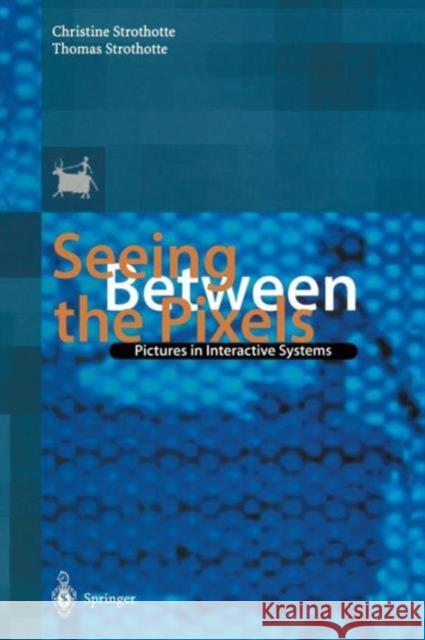
Christine Strothotte; Thomas Strothotte
Seeing Between the Pixels: Pictures in Interactive Systems Strothotte, Christine 9783642643705 Springer - książkaWidoczna okładka, to zdjęcie poglądowe, a rzeczywista szata graficzna może różnić się od prezentowanej.

Seeing Between the Pixels: Pictures in Interactive Systems

ISBN-13: 9783642643705 / Angielski / Miękka / 2011 / 380 str.

Christine Strothotte; Thomas Strothotte
cena 201,24
(netto: 191,66 VAT:  5%)

Najniższa cena z 30 dni: 192,74
Termin realizacji zamówienia:
ok. 22 dni roboczych
Bez gwarancji dostawy przed świętami

Darmowa dostawa!

Pictures are at the heart of how we communicate with computers, emblematic of our cur rent fascination with multimedia and web-based computing. Nevertheless, most of us know far less about pictures and the way in which they work than we know about the text that often accompanies them. In an attempt to understand pictures, perhaps the most fundamental question we can ask is, "What is a picture?" What is it that objects as di verse as icons, bar charts, paintings, and photographs have in common that makes us refer to all of them as pictures? And what is it about pictures that convinces us to use them instead of, or in addition to, text? We often talk about how pictures "depict" things. But, even the process of depiction seems to differ from one picture to another. On a computer, we may use a paint system to guide a virtual brush over the screen, a video camera to capture a live image, a spread sheet to automatically generate a corresponding bar chart, or a rendering system that models the interactions of synthetic lights, objects, and cameras. Is there some un derlying property that these processes all share? Computer scientists are used to thinking of pictures in terms of their representation: an array of pixels, a list or hierarchy of graphics primitives, or even a program written in a language such as PostScript."


Kategorie:
Informatyka
Kategorie BISAC:
Computers > Software Development & Engineering - Computer Graphics
Computers > Internet - General
Gardening > General
Wydawca:
Springer
Język:
Angielski
ISBN-13:
9783642643705
Rok wydania:
2011
Wydanie:
Softcover Repri
Ilość stron:
380
Waga:
0.61 kg
Wymiary:
23.5 x 15.5
Oprawa:
Miękka
Wolumenów:
01

PartI: Preliminaries.- 1 Introduction.- 1.1 Pictures and Society.- 1.2 Pictures and Language in Computer Science.- 1.3 Dialogue Systems.- 1.4 Pictures as Systems.- 1.5 Organization of the Book.- II: Fundamentals.- 2 Pictures in Computer Systems.- 2.1 Desktop Publishing.- 2.2 Drawing Programs.- 2.3 Hypertext Systems.- 2.4 Image Processing Software.- 2.5 Three-Dimensional Computer Graphics Systems.- 2.6 Computer Simulation.- 2.7 Summary.- 3 Classification of Pictures.- 3.1 Classes of Pictures,.- 3.1.1 Presentational Pictures.- 3.1.2 Abstract-Graphical Pictures.- 3.1.3 Pictograms.- 3.2 Pictures Made of Visual Signs.- 3.2.1 Natural and Non-Natural Signs.- 3.2.2 Other Classes of Signs.- 3.2.3 Are There Visual Signs Independent of Conventions?.- 3.2.4 Arbitrariness of Conventional Signs.- 3.2.5 Summary of the Semiotic Excurse.- 3.3 Classification Scheme for Pictures.- 3.3.1 Characteristics of the Classes of Pictures.- 3.3.2 Contours of the Terms of the Classification Scheme.- 3.4 Discussion.- 4 Picture Processing by Humans.- 4.1 Pictures and the Iconic Code.- 4.2 Perception, Learning and Cognition.- 4.3 Cognitive Theories.- 4.4 Understanding of Pictures: The Communicative Theory Point of View.- 4.5 Human Memory Performance.- 5 Information Flow During Human-Computer Interaction.- 5.1 Information Theory.- 5.2 Information Transfer Between Humans.- 5.3 Transmitted and Transputed Information in Human-Computer Interaction.- 5.3.1 Information Transmitted and Transputed by a Computer.- 5.3.2 Information Transmitted and Transputed by Users.- 5.4 Methods of Transputing Information.- 5.5 Analysis of Some Dialogue Systems.- 5.6 Discussion.- III: Abstract-Graphical Pictures.- 6 Abstract-Graphical Pictures and Some Applications.- 6.1 Characterization.- 6.2 Focus on Relations Between Elements.- 6.3 Focus on Functionality.- 6.4 Focus on Behavior.- 6.5 Focus on Properties of Elements.- 6.6 Abstract-Graphical Pictures for Cognitive Processing.- 6.7 Discussion 1ll.- 7 Analysis of Abstract-Graphical Pictures.- 7.1 Requirements.- 7.2 Methodology.- 7.3 An Application to Pictures in Dictionaries.- 7.4 An Application to Business Graphics.- 7.5 Discussion.- 8 Users’Analysis and Criticism of Abstract-Graphical Pictures.- 8.1 The Role of Animation During Simulation.- 8.1.1 Simulation Methodology.- 8.1.2 Model Validation and User Support.- 8.1.3 Underestimation of Animation.- 8.2 Information Sources for the Computer.- 8.2.1 User Observations.- 8.2.2 Oracles Yesterday and Today.- 8.2.3 Architecture of an Oracle-Based Model Modification.- 8.3 Requirements and Components of an Oracle System for Simulation.- 8.3.1 Typical Oracles in Simulation.- 8.3.2 Knowledge Base.- 8.3.3 Results of the Reasoning Component.- 8.4 A Prototypical Implementation.- 8.4.1 Environment for the Implementation.- 8.4.2 Scenario.- 8.5 Discussion.- 9 Viewpoint Descriptions.- 9.1 Viewpoint Descriptions in Simulation.- 9.2 Information Conveyed by Animations.- 9.3 Formalism of Viewpoint Descriptions.- 9.3.1 Documentation.- 9.3.2 Criticism.- 9.3.3 The Complete Formalism.- 9.3.4 Temporal Aspects and Verbal Descriptions as General Additions.- 9.4 Implementation of the Viewpoint Description for the Simulator Create!.- 9.4.1 How to Use the Viewpoint Description.- 9.4.2 Example of a Viewpoint Description.- 9.5 Applications.- 9.5.1 Addition to the Knowledge Base for Oracle-Based Model Modification.- 9.5.2 Model Documentation with Viewpoint Descriptions.- 9.6 Discussion.- IV: Pictograms.- 10 The Nature of Pictograms and Their Use.- 10.1 Typicality of Pictograms.- 10.2 Pictograms and Their Normalization Demands.- 10.3 Methods for Describing Pictures.- 10.3.1 Frege’s Notation.- 10.3.2 Pictureless Knowledge Processing.- 10.4 Picture Frames.- 10.4.1 Constituent Parts of Picture Frames.- 10.4.2 Interactive Problem Solving with Picture Frames.- 10.4.3 An Application in Computer Aided Instruction of Chemistry.- 10.5 Are Combinations of Pictograms Still Pictograms?.- 11 Pictograms as Words.- 11.1 Choice of Pictograms.- 11.2 Evaluation of Pictograms.- 11.3 Ambiguity of Pictograms.- 11.4 Some Drawbacks of Pictograms in User Interfaces.- 11.4.1 Physiological Stress.- 11.4.2 Cognitive Stress.- 11.5 Speech to Augment Pictograms in User Interfaces.- 11.5.1 Speech in User Interfaces.- 11.5.2 An Experimental Interface.- 11.6 Discussion.- 12 Pictograms as Pictures.- 12.1 Design of Pictograms as Pictures.- 12.2 Pragmatics of Pictograms.- 12.3 Pictograms and Their Context.- 13 Formal Representations and Informal Presentations.- 13.1 Pictures as Write-Only Data Structures.- 13.2 Formal and Less Formal Aspects of Human-Computer Interaction.- 13.2.1 Formal Notations as Extensions to Informal Concepts.- 13.2.2 Formalization in Knowledge-Based Systems.- 13.3 Semi-Formal Representations.- 13.3.1 Characteristics of Semi-Formal Representations.- 13.3.2 The Trichotomy Informal - Semi-Formal - Formal.- 13.4 Discussion.- PartV: Presentational Pictures.- 14 Image Generation.- 14.1 Background.- 14.2 Object Layout.- 14.3 Choosing the Perspective.- 14.4 Choosing Light Sources.- 14.5 Cutaways and Ghosting.- 14.6 Complex Communicative Goals.- 14.7 Animation.- 14.7.1 Cinematic Editing.- 14.7.2 Animation of Complex Processes.- 15 Alternative Rendering of Images.- 15.1 Standardization.- 15.2 Standardization in Computer Graphics.- 15.3 Affecting the Effect of Rendered Images.- 15.3.1 Some Advanced Graphical Presentation Techniques.- 15.3.2 Information Flow.- 15.4 The Sketch-Renderer.- 15.4.1 Software Organization.- 15.4.2 The User Interface.- 15.4.3 Examples.- 15.5 Algorithms for the Sketch-Renderer.- 15.5.1 Rendering.- 15.5.2 Sketching Shadows.- 15.5.3 Drawing Lines and Circles.- 15.6 Special Effects in Line Drawings.- 15.6.1 Leaving Out Detail.- 15.6.2 Representing Movements of Objects.- 15.7 Assessing the Effect of Rendered Images.- 15.7.1 Experiment.- 15.7.2 Results.- 15.7.3 Interpretation of the Results.- 15.8 Discussion.- 16 Tactile Computer Graphics.- 16.1 Introduction.- 16.2 Tactile Output.- 16.3 Blind Computer Users.- 16.4 Visual and Tactile Graphics: A Comparison.- 16.5 Constructing 2D/3D Models.- 16.6 A Rendering/Editing System for Tactile Graphics.- 16.7 Discussion.- 17 Immersive Systems.- 17.1 Reality and Immersion.- 17.1.1 The Role Model.- 17.1.2 Augmented Reality.- 17.2 Degrees of Immersion.- 17.2.1 Low Level of Immersion.- 17.2.2 Head-Tracking and Parallax to Improve Immersion.- 17.2.3 Head-Mounted Displays in Immersive Systems.- 17.3 How Much Immersion Is Enough?.- 17.3.1 Monitors Versus Head-Mounted Displays.- 17.3.2 Spatial Perception of Architects.- 17.3.3 Degree of Presence.- 17.4 Support for Richer Interaction in Immersive Systems.- 17.4.1 Requirements.- 17.4.2 Hyper-Rendering.- 17.4.3 Notes on the Implementation of a Hyper-Renderer.- 17.4.4 Applications of Hyper-Rendering.- 17.5 Discussion.- VI: Epilogue.- 18 Pictures and Language.- 18.1 A Comparison Between Pictures and Language.- 18.1.1 Disadvantages of Presentational Pictures Compared to Language.- 18.1.2 Advantages of Presentational Pictures over Language.- 18.1.3 Common Strengths of Presentational Pictures and Language.- 18.2 Languages for Non-verbal Communication.- 18.3 Going Full Circle.- 19 Quovadis?.- 19.1 Falsification of Pictures.- 19.2 The Grey Area Between Enhancement and Falsification.- 19.3 The Bottom Line.- List of Figures, Tables, and Credits.- List of Petroglyphs.- Author Index.

Strothotte, Thomas Strothotte-University of Magdeburg, Germany... więcej >


Udostępnij

Facebook - konto krainaksiazek.pl


Opinie o Krainaksiazek.pl na Opineo.pl

Partner Mybenefit

Krainaksiazek.pl w programie rzetelna firma Krainaksiaze.pl - płatności przez paypal

Czytaj nas na:

Facebook - krainaksiazek.pl
  • książki na zamówienie
  • granty
  • książka na prezent
  • kontakt
  • pomoc
  • opinie
  • regulamin
  • polityka prywatności

Zobacz:

  • Księgarnia czeska

  • Wydawnictwo Książkowe Klimaty

1997-2025 DolnySlask.com Agencja Internetowa

© 1997-2022 krainaksiazek.pl
     
KONTAKT | REGULAMIN | POLITYKA PRYWATNOŚCI | USTAWIENIA PRYWATNOŚCI
Zobacz: Księgarnia Czeska | Wydawnictwo Książkowe Klimaty | Mapa strony | Lista autorów
KrainaKsiazek.PL - Księgarnia Internetowa

Polityka prywatnosci - link
Krainaksiazek.pl - płatnośc Przelewy24
Przechowalnia Przechowalnia






