• Wyszukiwanie zaawansowane
  • Kategorie
  • Kategorie BISAC
  • Książki na zamówienie
  • Promocje
  • Granty
  • Książka na prezent
  • Opinie
  • Pomoc
  • Załóż konto
  • Zaloguj się

Sands, Powders, and Grains: An Introduction to the Physics of Granular Materials » książka


zaloguj się | załóż konto
Logo Krainaksiazek.pl

koszyk

konto

szukaj
topmenu
Księgarnia internetowa
Szukaj
Książki na zamówienie
Promocje
Granty
Książka na prezent
Moje konto
Pomoc
 
 
Wyszukiwanie zaawansowane
Pusty koszyk
Bezpłatna dostawa dla zamówień powyżej 20 złBezpłatna dostawa dla zamówień powyżej 20 zł

Kategorie główne

• Nauka
 [2946600]
• Literatura piękna
 [1856966]

  więcej...
• Turystyka
 [72221]
• Informatyka
 [151456]
• Komiksy
 [35826]
• Encyklopedie
 [23190]
• Dziecięca
 [619653]
• Hobby
 [140543]
• AudioBooki
 [1577]
• Literatura faktu
 [228355]
• Muzyka CD
 [410]
• Słowniki
 [2874]
• Inne
 [445822]
• Kalendarze
 [1744]
• Podręczniki
 [167141]
• Poradniki
 [482898]
• Religia
 [510455]
• Czasopisma
 [526]
• Sport
 [61590]
• Sztuka
 [243598]
• CD, DVD, Video
 [3423]
• Technologie
 [219201]
• Zdrowie
 [101638]
• Książkowe Klimaty
 [124]
• Zabawki
 [2473]
• Puzzle, gry
 [3898]
• Literatura w języku ukraińskim
 [254]
• Art. papiernicze i szkolne
 [8170]
Kategorie szczegółowe BISAC

Sands, Powders, and Grains: An Introduction to the Physics of Granular Materials

ISBN-13: 9781461267904 / Angielski / Miękka / 2012 / 214 str.
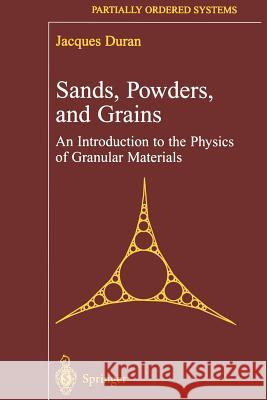
Jacques Duran; A. Reisinger; P. -G De Gennes
Sands, Powders, and Grains: An Introduction to the Physics of Granular Materials Duran, Jacques 9781461267904 Springer - książkaWidoczna okładka, to zdjęcie poglądowe, a rzeczywista szata graficzna może różnić się od prezentowanej.

Sands, Powders, and Grains: An Introduction to the Physics of Granular Materials

ISBN-13: 9781461267904 / Angielski / Miękka / 2012 / 214 str.

Jacques Duran; A. Reisinger; P. -G De Gennes
cena 443,82 zł
(netto: 422,69 VAT:  5%)

Najniższa cena z 30 dni: 424,07 zł
Termin realizacji zamówienia:
ok. 22 dni roboczych
Bez gwarancji dostawy przed świętami

Darmowa dostawa!

This introductory text develops the fundamental physics of the behavior of granular materials. It covers the basic properties of flow, friction, and fluidization of uniform granular materials; discusses mixing and segregation of heterogeneous materials (the famous "brazil-nut problem"); and concludes with an introduction to numerical models. The presentation begins with simple experiments and uses their results to build concepts and theorems about materials whose behavior is often quite counter-intuitive; presenting in a unified way the background needed to understand current work in the field. Developed for students at the University of Paris, the text will be suitable for advanced undergraduates and beginning graduates; while also being of interest to researchers and engineers just entering the field.


Kategorie:
Nauka, Fizyka
Kategorie BISAC:
Technology & Engineering > Engineering (General)
Science > Physics - Condensed Matter
Technology & Engineering > Materials Science - General
Wydawca:
Springer
Seria wydawnicza:
Partially Ordered Systems
Język:
Angielski
ISBN-13:
9781461267904
Rok wydania:
2012
Wydanie:
Softcover Repri
Numer serii:
000017699
Ilość stron:
214
Waga:
0.36 kg
Wymiary:
23.5 x 15.5
Oprawa:
Miękka
Wolumenów:
01
Dodatkowe informacje:
Bibliografia

FROM THE REVIEWS:

PURE AND APPLIED GEOPHYSICS
"In total, the book is lucidly written and offers a complementary approach to that usually found in the books treating soil and granular media mechanics. It presents a physicist's viewpoint of granular media. It can also be used by both the researchers and in courses of soil mechanics."

PHYSICS TODAY
"Duran's book is didactic in style and provides an excellent starting point for an advanced student to enter the field...the prose is clear...would be a valuable addition for those with interest in the field."

1. Introduction.- 1.1 Some Orders of Magnitude Defining the Problem.- 1.2 Economic Implications and Industrial Problems.- 1.2.1 Industrial Processing of Granulars.- Construction Materials.- Processing Industries.- An Example: Casting by Sacrificial Polystyrene.- The Agriculture Industry.- 1.2.2 Flow Problems.- 1.2.3 Problems of Segregation.- 1.3 Granular Materials and Geophysics.- 1.4 A Brief Historical Review.- 1.5 Prerequisites and Selected Bibliography.- 2. Interactions in Granular Media.- 2.1 A Single Particle and Its Environment.- Laminar Drag.- Turbulent Drag.- Granular Dendrites.- Humidity, Electrostatic Interactions, and Other Perturbations.- Classification of Granular Materials and Definitions.- 2.2 Interactions between Two Particles.- 2.2.1 The Laws of Friction between Solids.- The Three Fundamental Laws of Solid Friction.- A Microscopic Explanation.- Gliding and Rotations: Frustrated Rotations.- Rolling without Gliding.- Gliding without Rolling.- Transition from One Regime to the Other.- Stick—Slip Motion.- 2.2.2 Collisions and Deformations of Elastic Spheres.- Frontal Elastic Collision.- Nonfrontal Elastic Collision and Rotation of Particles.- A Ball Thrown Against a Wall.- Nonfrontal Collision Between Two Elastic Spheres with Friction.- The Tangential Restitution Coefficient.- Penetration During Frontal Collision:Hertz’s Problem.- Inhomogeneous Spheres: The Soft Crust Model.- 2.3 A Single Particle on Top of a Granular Medium.- 2.4 Interactions Between Several Particles.- 2.4.1 The Laws of Friction in a Granular Medium.- 2.4.2 Bagnold’s Number.- 3. Fluidization, Decompaction, and Fragmentation.- 3.1 The Static Properties of a Granular Pile.- 3.1.1 First Principle: The Role of Friction.- The Stacking of Cannon Balls.- Indetermination of Solid Friction: Hysteresis.- Distribution of Stresses in a Granular Medium.- Arch in Equilibrium Under its Own Weight.- Arch Supporting an Evenly Distributed Load.- 3.1.2 Stress—Strain Relations.- Identical Spherical Granules.- Granules of Different Sizes: Power Law and Electrical Analogy.- 3.1.3 Second Principle: Reynolds’s Dilatancy.- Deformation of a Simple Parallelogram.- Deformation of a Row of Parallelograms Placed Between Two Walls.- 3.1.4 Cylindrical Container: Janssen’s Model.- Generic Model: The Silo Problem.- Specific Applications.- Cylindrical Container of Diameter D.- Two-Dimensional Container.- 3.2 Dynamic Properties of a Granular Pile.- 3.2.1 A Column of Spheres Subjected to a Vertical Vibration.- Some Orders of Magnitude.- Mathematical Analysis of the Problem.- Results: Fluidized Phase and Condensed Phase.- Fluidization and Condensation as Functions of Acceleration.- Fluidization and Condensation as Functions of Height.- 3.2.2 Two-Dimensional Stack of Frictionless Spheres.- Some Comments on Scaling.- 3.2.3 Two-Dimensional Stack of Spheres with Friction.- Generic Model.- Levitation of Cylindrical Stacks.- Levitation of Two-Dimensional Stacks.- Experimental Observation of Decompaction and Convection in a Two-Dimensional Granular Structure.- Experimental Technique: Image Processing.- Measurements of the Velocity of Moving Particles.- Measurements of the Relative Motion of Particles.- Convection and Pile Formation.- Threshold of Pile Formation and Decompaction.- Dynamics of Pile Formation in Two Dimensions.- Experimental Verifications of the Decompaction Model.- Short-Term Decompaction: Fragmentation.- 3.2.4 Fragmentation of a Stack in Guided Fall.- Two-Dimensional Experiment.- Theoretical Modeling.- Fall Without Fragmentation.- Where Do Fractures Initially Appear’?.- Numerical Simulation of a Stack in Guided Fall.- Distribution of Pressure in a Stack: Arch Effects.- Self-Organization of Rotations.- 3.2.5 Surface Instabilities in an Extended Granular Medium.- Extended Three-Dimensional Stacks.- Wavelength Dependence on Vibration Frequency.- Extended Two-Dimensional Stacks.- Summary.- 4. Granular Media in a State of Flow.- 4.1 A Sand Pile in Equilibrium: The Angle of Repose.- The Embankment Angle of a Pile Made of a Small Number of Particles.- Transition from Intermittent to Continuous Regime—Power Laws.- Power Law for a Newtonian Fluid.- Power Law for a Granular Surface.- 4.2 Avalanche Models.- 4.2.1 Cellular Automaton Model (CAM).- The Principle.- Implementations of the Cellular Automaton Model (CAM).- Lifetime and 1/f Noise.- The Statistics of Avalanches.- Piles Involving Large Numbers of Particles.- Piles Involving Small Numbers of Particles.- Relaxation of the Critical Angle—Granular Temperature.- 4.2.2 Stick–Slip Model of Avalanches.- Different Friction Models.- Burridge–Knopoff (BK) Pads.- Other Friction Laws F(v).- A Few Remarks Concerning the Stick–Slip Model of Avalanches.- 4.2.3 Avalanche Models Based on Coupled Variables.- Upward Propagation of Perturbations.- Simulation of Avalanches.- De Gennes’s Modified Model.- Rotating Drum Experiment.- 5. Mixing and Segregation.- 5.1 Introduction.- 5.1.1 Oyama’s Cylindrical Drum.- 5.1.2 Potential Energy of a Heterogeneous Pile.- Superposition of Stacks—Two Compact Stacks.- Where Are the Defects Concentrated?.- 5.2 Segregation by Vibration.- 5.2.1 Simulation of Segregation by Size.- Two-Dimensional Model.- Three-Dimensional Model.- 5.2.2 Experiments on Segregation by Vibration.- Experiments on Continuous and Intermittent Ascent.- Convection or Arch Effect?.- Convection and Segregation in Three Dimensions.- Convection and Segregation in Two Dimensions.- 5.3 Segregation by Shearing.- 5.3.1 A Single Particle in a Uniform Medium.- 5.3.2 Segregation of Two Populations of Particles of Different Size.- Segregation Speed and Particle Size.- Segregation Speed and Rotation Velocity.- Fractal Growth of the Central Cluster.- 5.4 Segregation in Oyama’s Three-Dimensional Drum.- 5.4.1 Experimental Observations.- 5.4.2 Savage’s Model.- 6. Numerical Simulations.- 6.1 Introduction.- 6.1.1 The Challenges of Numerical Simulation.- 6.1.2 The Different Simulation Methods.- Hard Spheres and Soft Spheres.- Duration of Collisions and Chronology Problems.- 6.1.3 The Transition from a Discrete to a Continuous Description.- 6.2 Simulations of Collisions.- 6.2.1 Introduction.- 6.2.2 One-Dimensional LRV Procedure.- 6.3 Molecular Dynamics (MD) Simulations.- 6.3.1 Elastic and Friction Forces.- Linear and Nonlinear Equations.- Mechanical Analogies.- 6.3.2 MD Collision Model.- Linear Model of a Binary Collision.- Nonlinear Model of a Binary Collision.- The Detachment Effect.- 6.4 Simulation of the Dynamics of Contacts.- 6.5 Monte Carlo (MC) Simulations.- Monte Carlo Technique for Stacking and Relaxation.- 6.6 Sequential Model of a Pile.

Granular materials can be found in an enormous variety of places: from the powders used to make vitamin pills to the rings of Saturn, from beaches to grain elevators, and from pottery clay to interstellar dust. This text covers the basic properties of uniform granular materials, the mixing and segregation of heterogeneous materials (the famous "brazil-nut problem"), and numerical models.

This is an introduction to the physical principles underlying the behavior of materials consisting of grains. These can be found in an enormous variety of places, ranging from the powders used to make vitamin pills to the rings of Saturn, from beaches to grain elevators, and from pottery clay to interstellar dust. Granular materials have interested physicists from Coulomb to Faraday to Reynolds and Rayleigh, but only recently have mathematical and experimental methods been developed to analyze their properties in detail.
This introductory text develops the fundamental physics of the behavior of granular materials. It covers the basic properties of flow, friction, and fluidization of uniform granular materials; discusses mixing and segregation of heterogeneous materials (the famous "brazil-nut problem"); and concludes with an introduction to numerical models. The presentation begins with simple experiments and uses their results to build concepts and theorems about materials whose behavior is often quite counter-intuitive; presenting in a unified way the background needed to understand current work in the field. Developed for students at the University of Paris, the text will be suitable for advanced undergraduates and beginning graduates; while also being of interest to researchers and engineers just entering the field.

Duran, Jacques Duran, CNRS and University of Paris VI, France.... więcej >
Reisinger, A. Reisinger, Lockheed Martin, Lexington, MA.... więcej >


Udostępnij

Facebook - konto krainaksiazek.pl


Opinie o Krainaksiazek.pl na Opineo.pl

Partner Mybenefit

Krainaksiazek.pl w programie rzetelna firma Krainaksiaze.pl - płatności przez paypal

Czytaj nas na:

Facebook - krainaksiazek.pl
  • książki na zamówienie
  • granty
  • książka na prezent
  • kontakt
  • pomoc
  • opinie
  • regulamin
  • polityka prywatności

Zobacz:

  • Księgarnia czeska

  • Wydawnictwo Książkowe Klimaty

1997-2025 DolnySlask.com Agencja Internetowa

© 1997-2022 krainaksiazek.pl
     
KONTAKT | REGULAMIN | POLITYKA PRYWATNOŚCI | USTAWIENIA PRYWATNOŚCI
Zobacz: Księgarnia Czeska | Wydawnictwo Książkowe Klimaty | Mapa strony | Lista autorów
KrainaKsiazek.PL - Księgarnia Internetowa

Polityka prywatnosci - link
Krainaksiazek.pl - płatnośc Przelewy24
Przechowalnia Przechowalnia





