• Wyszukiwanie zaawansowane
  • Kategorie
  • Kategorie BISAC
  • Książki na zamówienie
  • Promocje
  • Granty
  • Książka na prezent
  • Opinie
  • Pomoc
  • Załóż konto
  • Zaloguj się

Relativity and Scientific Computing: Computer Algebra, Numerics, Visualization » książka


zaloguj się | załóż konto
Logo Krainaksiazek.pl

koszyk

konto

szukaj
topmenu
Księgarnia internetowa
Szukaj
Książki na zamówienie
Promocje
Granty
Książka na prezent
Moje konto
Pomoc
 
 
Wyszukiwanie zaawansowane
Pusty koszyk
Bezpłatna dostawa dla zamówień powyżej 20 złBezpłatna dostawa dla zamówień powyżej 20 zł

Kategorie główne

• Nauka
 [2946912]
• Literatura piękna
 [1852311]

  więcej...
• Turystyka
 [71421]
• Informatyka
 [150889]
• Komiksy
 [35717]
• Encyklopedie
 [23177]
• Dziecięca
 [617324]
• Hobby
 [138808]
• AudioBooki
 [1671]
• Literatura faktu
 [228371]
• Muzyka CD
 [400]
• Słowniki
 [2841]
• Inne
 [445428]
• Kalendarze
 [1545]
• Podręczniki
 [166819]
• Poradniki
 [480180]
• Religia
 [510412]
• Czasopisma
 [525]
• Sport
 [61271]
• Sztuka
 [242929]
• CD, DVD, Video
 [3371]
• Technologie
 [219258]
• Zdrowie
 [100961]
• Książkowe Klimaty
 [124]
• Zabawki
 [2341]
• Puzzle, gry
 [3766]
• Literatura w języku ukraińskim
 [255]
• Art. papiernicze i szkolne
 [7810]
Kategorie szczegółowe BISAC

Relativity and Scientific Computing: Computer Algebra, Numerics, Visualization

ISBN-13: 9783642957345 / Angielski / Miękka / 2012 / 389 str.
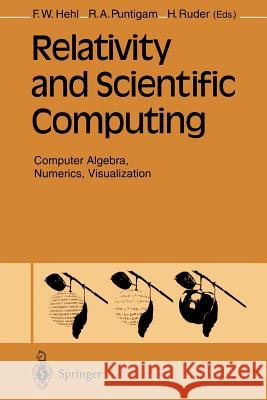
Friedrich W. Hehl; Roland A. Puntigam; Hanns Ruder
Relativity and Scientific Computing: Computer Algebra, Numerics, Visualization Hehl, Friedrich W. 9783642957345 Springer - książkaWidoczna okładka, to zdjęcie poglądowe, a rzeczywista szata graficzna może różnić się od prezentowanej.

Relativity and Scientific Computing: Computer Algebra, Numerics, Visualization

ISBN-13: 9783642957345 / Angielski / Miękka / 2012 / 389 str.

Friedrich W. Hehl; Roland A. Puntigam; Hanns Ruder
cena 401,58
(netto: 382,46 VAT:  5%)

Najniższa cena z 30 dni: 385,52
Termin realizacji zamówienia:
ok. 22 dni roboczych
Dostawa w 2026 r.

Darmowa dostawa!

For this set of lectures we assumed that the reader has a reasonable back ground in physics and some knowledge of general relativity, the modern theory of gravity in macrophysics, and cosmology. Computer methods are present ed by leading experts in the three main domains: in numerics, in computer algebra, and in visualization. The idea was that each of these subdisciplines is introduced by an extended set of main lectures and that each is conceived as being of comparable 'importance. Therefpre we believe that the book represents a good introduction into scientific I computing for any student who wants to specialize in relativity, gravitation, and/or astrophysics. We took great care to select lecturers who teach in a comprehensible way and who are, at the same time, at the research front of their respective field. In numerics we had the privilege of having a lecturer from the National Center for Supercomputing Applications (NCSA, Champaign, IL, USA) and some from other leading institutions of the world; visualization was taught by a visualization expert from Boeing; and in com puter algebra we took recourse to practitioners of different computer algebra systems as applied to classical general relativity up to quantum gravity and differential geometry."


Kategorie:
Nauka, Fizyka
Kategorie BISAC:
Science > Astronomia, przestrzeń i czas
Science > Astrofizyka
Science > Grawitacja
Wydawca:
Springer
Język:
Angielski
ISBN-13:
9783642957345
Rok wydania:
2012
Wydanie:
Softcover Repri
Ilość stron:
389
Waga:
0.58 kg
Wymiary:
23.39 x 15.6 x 2.16
Oprawa:
Miękka
Wolumenów:
01
Dodatkowe informacje:
Komentarz

Color Plates.- I: Numerics.- 1. Numerical Relativity and Black-Hole Collisions.- 1. Astrophysical Motivation and Mathematical Formulation for Numerical Relativity.- 1.1 Overview and Motivation.- 1.2 Mathematical Formulation of the Equations.- 2. Numerical Techniques and Supercomputing.- 2.1 Finite Difference Techniques.- 2.2 Treating Elliptic Equations.- 2.3 Treating Evolution Equations.- 2.4 Testbeds and Convergence of Numerical Solutions.- 2.5 Coding and Parallel-Computing Issues.- 2.6 General Code Strategies.- 3. Black-Hole Initial-Data Sets, Tools for Analysis, and Techniques for Evolution.- 3.1 Basic Theory and Initial-Data Sets.- 3.2 Tools for Numerical Black-Hole Spacetimes.- 3.3 Evolution.- 4. Present Research Status in Black-Hole Studies.- 4.1 Spherical BH — 1D.- 4.2 Distorted BH — 2D.- 4.3 Rotating BH — 2D.- 4.4 Colliding BH — 2D.- 4.5 Black-Hole Horizon Studies.- 4.6 3D Black-Hole Studies.- References.- 2. Four Lectures on Numerical Relativity.- 1. The Causal Structure of Einstein’s Field Equations.- 1.1 The Space-Plus-Time Decomposition.- 1.2 Invariant Algebraic Slicing.- 1.3 The Evolution System.- 1.4 Causal Structure of the Evolution System.- 2. First-Order Flux-Conservative Systems.- 2.1 Linear Systems.- 2.2 Nonlinear Systems.- 2.3 Einstein’s Evolution Equations.- 3. Standard Numerical Methods.- 3.1 Flux-Conservative Equations.- 3.2 Boundary Conditions.- 3.3 Nonsmooth Data.- 4. Total Variation Diminishing Methods.- 4.1 Flux-Conservative Methods.- 4.2 The 1D Black-Hole Test.- References.- 3. Alternatives to Finite Difference Methods in Numerical Relativity.- 1. Introduction.- 2. The 3+1 Formalism.- 3. The Initial-Data Problem.- 3.1 Multiquadrics.- 3.2 Finite Elements.- 4. Matter Evolution in Curved Spacetimes.- 4.1 Particle-Mesh Methods.- 4.2 Smoothed Particle Hydrodynamics in Curved Space.- 5. Conclusions.- References.- 4. Temporal and Spatial Foliations of Spacetimes.- 1. Introduction.- 2. Time Slicings.- 2.1 Maximal Slicing.- 2.2 Harmonic Slicing.- 2.3 Results for the Oppenheimer-Snyder Spacetime.- 3. Spatial Foliations.- 3.1 Constant Mean Curvature Foliations.- 3.2 Examples of CMC Foliations.- References.- 5. Rotating and Oscillating Neutron Stars.- 1. Introduction: Nonrotating Neutron Stars.- 2. Rotating Neutron Stars.- 2.1 Basic Formulation.- 2.2 Numerical Solution Method.- 2.3 Results.- 3. Oscillations of Neutron Stars.- 3.1 Basic Formalism.- 3.2 Results for Quasinormal Mode Frequencies.- References.- 6. Rotating Boson Stars.- 1. Introduction.- 2. Field Equations.- 3. Spherically Symmetric Boson Star.- 4. Field Equations of a Rotating Boson Star.- 5. Particle Number, Mass, and Angular Momentum.- 6. Differential Rotation.- 7. Numerical Solution.- 8. Remarks.- References.- 7. Numerical Investigation of Cosmological Singularities.- 1. Introduction.- 2. Symplectic Methods.- 3. Mixmaster Model.- 4. Gowdy Model on T3 × R.- 5. U(1) Models.- 6. Conclusions.- References.- II: Computer Algebra.- 8. Overview of Computer Algebra in Relativity.- 1. Introduction.- 2. General-Purpose Systems.- 2.1 Computer Algebra.- 2.2 Modern Systems.- 2.3 Evaluation.- 2.4 Simplification.- 2.5 Programming.- 2.6 Data Types.- 3. General Relativity Systems.- 3.1 Requirements: Riemannian Geometry.- 3.2 Requirements: GR Library.- 3.3 Requirements: Generalizations and Applications.- 3.4 Efficiency.- 3.5 Dummy Indices.- 4. Applications.- 5. Summary.- References.- 9. Two-Loop Quantum Gravity with the Computer Algebra Program FORM.- 1. Introduction.- 2. Covariant Quantization of Gravity.- 2.1 Noncovariant Method.- 2.2 Covariant Method.- 3. FORM.- 3.1 Annotated Yang-Mills Program.- 3.2 Quantum Gravity.- References.- 10. The Mathematic Packages CARTAN and MathTensor for Tensor Analysis.- 1. Mathematica.- 1.1 The Front End.- 1.2 The Kernel.- 2. Tensor Calculations.- 3. CARTAN.- 3.1 General Features.- 3.2 A Charged Black Hole.- 3.3 A Spin-Polarized Cosmic String.- 4. MathTensor.- 4.1 Tensor Indices.- 4.2 Metric Variation of R2.- 4.3 Differential Forms with MathTensor.- 5. Conclusions.- References.- 11. A Quadratic Curvature Lagrangian of Paw?owski and Raczka: A Finger Exercise with MathTensor.- 1. Introduction.- 2. Riemann Tensor and its Irreducible Pieces.- 3. The Topological Euler Density.- 4. Bach Tensor.- 5. The Bach Tensor Streamlined.- 6. Gravitational Field Equation of the P&R Model.- 7. Discussion.- References.- 12. The Program CRACK for Solving PDEs in General Relativity.- 1. Introduction.- 2. Contents of CRACK.- 2.1 General Remarks.- 2.2 Decoupling.- 2.3 Integrating Exact PDEs.- 2.4 Separation of PDEs.- 2.5 Solving Standard ODEs.- 3. The Calculation of Spacetime Symmetries.- 3.1 General Remarks.- 3.2 Generation of the Conditions.- 3.3 Post Processing of Results.- 3.4 An Example.- 4. Symmetries of a Field Theory.- 5. Applying Symmetries of Differential Equations.- 6. Future Work.- 6.1 General Remarks.- 6.2 Extending Capabilities in Dealing with DEs.- 6.3 Advanced Symmetry Investigations.- 7. Availability.- References.- 13. Algebraic Programming in the Hamiltonian Version of General Relativity.- 1. Introduction.- 2. The Local Form of the Canonical Formalism of Gravity.- 3. The Computer Procedures.- 4. About the Concrete Results.- 4.1 Spacetime Model with a Three Subspace in Form of a 3-Torus.- References.- 14. Causal Structure and Integrability in Moving Frames with Reduce.- 1. Introduction.- 2. Exterior Differential Systems.- 3. EDS Package.- 4. Ricci-Flat Immersions.- 5. Twisting Type-N Solutions.- References.- III: Visualization.- 15. Four Lectures on Computer Graphics and Dkta Visualization.- 1. Introduction.- 2. Computers, Humans, and Interaction.- 2.1 Computer Graphics Defined.- 2.2 Computer Displays.- 2.3 Graphics Hardware.- 2.4 Human Visual System.- 2.5 History of Computer Graphics.- 3. Visual Simulation.- 3.1 Visibility Calculation.- 3.2 Simulated Optics.- 3.3 Ray-Tracing.- 3.4 Rasterization.- 3.5 Graphics Pipeline.- 4. Data Visualization.- 4.1 Seeing the Invisible.- 4.2 The Analysis and Visualization Cycles.- 4.3 History of Visualization.- 4.4 Data Sources and Structure.- 4.5 Data Interpolation.- 5. Visualization Techniques.- 5.1 Scalar Fields.- 5.2 Vector Fields.- 5.3 Tensor Fields.- 5.4 Differential Geometry Applied to Height Maps.- 5.5 Second Derivatives and Curvature.- 5.6 Visualizing Higher Dimensions.- 5.7 How to Lie and Confuse with Visualization.- 6. Interactive Visualization Environments.- 6.1 Data Structures.- 6.2 Modules.- 6.3 Visual Programming Language and Execution Model.- 6.4 Programmers’ Tools.- 7. Virtual Environments in Visualization.- 7.1 Visualization over the World Wide Web.- 8. Applications and Demonstrations.- 8.1 Case Study: Structural Dynamics Using DYNA3D.- 8.2 Case Study: Helicopter Rotor Wake Visualization.- 8.3 An Example of Remote Collaboration.- 9. Conclusions.- References.- 16. Visualization in Curved Spacetimes. I. Visualization of Objects via Four-Dimensional Ray-Tracing.- 1. Introduction.- 2. Ray-Tracing Special Relativity.- 2.1 Geometrical Appearance.- 2.2 Lighting.- 3. Ray-Tracing General Relativity.- 3.1 Requirements.- 3.2 Geodesic Equation.- 3.3 Camera.- 3.4 Realizing Relativistic Ray-Tracing with Conventional Ray-Tracing Programs.- 3.5 Astrophysical Examples.- 3.6 Astrophysical Application: Light Curves of X-Ray Pulsars.- 4. Discussion.- References.- 17. Visualization in Curved Spacetimes. II. Visualization of Surfaces via Embedding.- 1. Introduction.- 2. Finding the Parametric Representation of the Embedding in R3.- 2.1 Useful Results from Differential Geometry of Surfaces.- 2.2 The System of Equations.- 2.3 An Alternative: The Darboux Equation.- 3. Examples.- 3.1 Kerr Horizon.- 3.2 Colliding Black Holes.- 4. Direct Construction of Wire Frames.- 4.1 Triangular Wire Frames.- 4.2 Surfaces with Spherical Topology.- 4.3 Procedure.- 4.4 Examples.- 4.5 Future Developments.- References.- IV: Exotica.- 18. Exotic Smoothness on Spacetime.- 1. Introduction.- 2. Differential Topology.- 3. Early Exotica of Various Kinds.- 4. Gauge Theory and Moduli Spaces.- 5. The Road to R4?.- 6. Some General Properties of R4?.- 7. Some Geometry and Physics on R4?s.- 8. Conclusions.- References.- List of Figures.- List of Tables.

Prof. Dr. Hanns Ruder war bis zu seiner Emeritierung 1996 Professor für Theoretische Astrophysik an der Universität Tübingen. 2006 erhielt er die Medaille für Naturwissenschaftliche Publizistik von der Deutschen Physikalischen Gesellschaft.

This book contains lectures given by leading scientists from internationally reputed centers of research and teaching who provide insight into the state of the art of scientific computing in relativity. It is split into four parts covering numerics, computer algebra, visualization, and exotic smoothness on spacetime. As well as introducing the techniques the authors stress the importance of combining complementary methods to attack complex problems in general relativity and gravitation. Care has been taken to select lecturers who teach in a comprehensible way, so this work provides an excellent introduction to scientific computing for students who wish to specialize in relativity, gravitation, and/or astrophysics.


Udostępnij

Facebook - konto krainaksiazek.pl


Opinie o Krainaksiazek.pl na Opineo.pl

Partner Mybenefit

Krainaksiazek.pl w programie rzetelna firma Krainaksiaze.pl - płatności przez paypal

Czytaj nas na:

Facebook - krainaksiazek.pl
  • książki na zamówienie
  • granty
  • książka na prezent
  • kontakt
  • pomoc
  • opinie
  • regulamin
  • polityka prywatności

Zobacz:

  • Księgarnia czeska

  • Wydawnictwo Książkowe Klimaty

1997-2025 DolnySlask.com Agencja Internetowa

© 1997-2022 krainaksiazek.pl
     
KONTAKT | REGULAMIN | POLITYKA PRYWATNOŚCI | USTAWIENIA PRYWATNOŚCI
Zobacz: Księgarnia Czeska | Wydawnictwo Książkowe Klimaty | Mapa strony | Lista autorów
KrainaKsiazek.PL - Księgarnia Internetowa

Polityka prywatnosci - link
Krainaksiazek.pl - płatnośc Przelewy24
Przechowalnia Przechowalnia





