• Wyszukiwanie zaawansowane
  • Kategorie
  • Kategorie BISAC
  • Książki na zamówienie
  • Promocje
  • Granty
  • Książka na prezent
  • Opinie
  • Pomoc
  • Załóż konto
  • Zaloguj się

Regulatory Nascent Polypeptides » książka


zaloguj się | załóż konto
Logo Krainaksiazek.pl

koszyk

konto

szukaj
topmenu
Księgarnia internetowa
Szukaj
Książki na zamówienie
Promocje
Granty
Książka na prezent
Moje konto
Pomoc
 
 
Wyszukiwanie zaawansowane
Pusty koszyk
Bezpłatna dostawa dla zamówień powyżej 20 złBezpłatna dostawa dla zamówień powyżej 20 zł

Kategorie główne

• Nauka
 [2952079]
• Literatura piękna
 [1850969]

  więcej...
• Turystyka
 [71058]
• Informatyka
 [151066]
• Komiksy
 [35579]
• Encyklopedie
 [23181]
• Dziecięca
 [620496]
• Hobby
 [139036]
• AudioBooki
 [1646]
• Literatura faktu
 [228729]
• Muzyka CD
 [379]
• Słowniki
 [2932]
• Inne
 [445708]
• Kalendarze
 [1409]
• Podręczniki
 [164793]
• Poradniki
 [480107]
• Religia
 [510956]
• Czasopisma
 [511]
• Sport
 [61267]
• Sztuka
 [243299]
• CD, DVD, Video
 [3411]
• Technologie
 [219640]
• Zdrowie
 [100984]
• Książkowe Klimaty
 [124]
• Zabawki
 [2281]
• Puzzle, gry
 [3363]
• Literatura w języku ukraińskim
 [258]
• Art. papiernicze i szkolne
 [8020]
Kategorie szczegółowe BISAC

Regulatory Nascent Polypeptides

ISBN-13: 9784431550518 / Angielski / Twarda / 2014 / 315 str.
Koreaki Ito
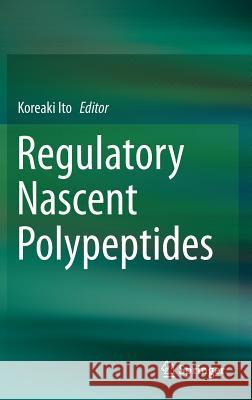
Regulatory Nascent Polypeptides Koreaki Ito 9784431550518 Springer - książkaWidoczna okładka, to zdjęcie poglądowe, a rzeczywista szata graficzna może różnić się od prezentowanej.

Regulatory Nascent Polypeptides

ISBN-13: 9784431550518 / Angielski / Twarda / 2014 / 315 str.

Koreaki Ito
cena 603,81
(netto: 575,06 VAT:  5%)

Najniższa cena z 30 dni: 578,30
Termin realizacji zamówienia:
ok. 22 dni roboczych
Dostawa w 2026 r.

Darmowa dostawa!

This book highlights a new paradigm of translation control by regulatory nascent polypeptides, which is integrated into cellular regulatory systems. Translation lies in the hub of the central dogma of biology, in which the genetic information in the forms of 4-letter sentences is translated into 20-letter sentences: sequences of amino acids that constitute proteins, the functional molecules of life. The process involves a huge number of chemical reactions as well as physical movements of the ribosome along a messenger RNA and takes, on average, tens of seconds in prokaryotes and a few minutes in eukaryotes. Detailed knowledge about the progression of translation, called "elongation," only recently started to accumulate. Newly synthesized and growing polypeptides, called nascent polypeptides, can interact with the intra-ribosomal conduit, called the ribosomal exit tunnel, when they have some specific amino acid sequences, called "an arrest sequence." Such interaction leads to a halt in the elongation reaction. Resulting stalling of the ribosome on messenger RNA can affect the secondary structure and/or localization of the message in the cell, consequently leading to biological outputs such as elevation or reduction of a gene product. This book provides a first collection of knowledge focused on regulatory nascent polypeptides, which have been studied recently using diverse organisms including bacteria, plants, and animals. Readers will be impressed by a new paradigm showing that proteins can function even during the course of their biosynthesis and that the ribosome, the "factory" of protein production, interacts with and inspects its products to adjust the speed of completion of each product. Moreover, regulatory nascent polypeptides can sense or monitor physiological states of the cell and modulate its ability to arrest translation. Living organisms use such intricate control mechanisms of translational speed to regulate gene expression. This book will be a useful addition for established scientists while inspiring students and young scientists to gain deeper insights into the processes of expression of genetic information.


Kategorie:
Nauka, Biologia i przyroda
Kategorie BISAC:
Science > Biochemia
Science > Biologia molekularna
Medical > Genetyka kliniczna
Wydawca:
Springer
Język:
Angielski
ISBN-13:
9784431550518
Rok wydania:
2014
Wydanie:
2014
Ilość stron:
315
Waga:
0.63 kg
Wymiary:
23.39 x 15.6 x 1.91
Oprawa:
Twarda
Wolumenów:
01

(1) Introduction 1. Biological significance of divergent sequences that stall the ribosome Koreaki Ito (Professor, Kyoto Sangyo University, Japan) and Shinobu Chiba (Assistant Professor, Kyoto Sangyo University, Japan) (2) The ribosomal tunnel 2. Structural basis for the exit tunnel-nascent chain interactions Roland Beckmann (Professor, Gene Center and Department of Biochemistry, Ludwig-Maximilians-Universität München, Germany) 3. Biochemical and biophysical properties of the ribosomal exit tunnel Carol Deutsch (Professor, Department of Physiology, University of Pennsylvania School of Medicine, USA) (3) Regulatory nascent chains sensing metabolites and drugs 4. Ribosomal stalling by TnaC, a tryptophan-sensing nascent chain Luis Rogelio Cruz-Vera (Assistant Professor, Department of Biological Sciences, University of Alabama in Huntsvill, USA. 5. Ribosomal stalling by antibiotic-sensing leader peptides that regulate antibiotic-resistance genes Alexander Mankin (Professor, Center for Pharmaceutical Biotechnology, University of Illinois at Chicago, USA.) 6. Ribosome stalling by the fungal arginine attenuator peptide Matthew S. Sachs (Professor, Texas A & M University) 7. Ribosome stalling by S-adenosyl methionine-sensing nascent peptide in plants Satoshi Naito (Professor, Hokkaido University. Japan) (4) Elongation-arresting nascent chains and translocation sensing 8. Amino acid motifs that induce elongation pausing Allen Buskirk (Department of Chemistry and Biochemistry, Brigham Young University, USA) 9. SecM as an elongation arresting nascent chain that senses and regulates protein export activity Koreaki Ito (Professor, Kyoto Sangyo University, Japan) 10. Translocation sensing by SecM Harris Bernstein (Senior Investigator, NIDDK, National Institutes of Health. USA) 11. MifM as an elongation arresting nascent chain that senses and regulates cellular activity of protein insertion into the membrane Shinobu Chiba (Assistant Professor, Kyoto Sangyo University, Japan) 12. Arrest-releasing forces generated by partition into the lipid phase of the membrane Gunnar von Heijne (Professor, Center for Biomembrane Research, Stockholm University, Sweden) 13. Nascent chain mediated localization of mRNA on the endoplasmic reticulum as an important step of unfolded protein response Kenji Kohno (Professor, Nara Institute of Science and Technology, Japan) 14. Co-translational recruitment of a targeting factor to the ribosome Ramanujan Hegde (Group Leader, MRC Laboratory of Molecular Biology, UK) 15. Signaling from within the ribosome Arthur E. Johnson (Professor, Texas A&M University, USA)​

Koreaki Ito, Senior Research Fellow, Kyoto Sangyo University

This book highlights a new paradigm of translation control by regulatory nascent polypeptides, which is integrated into cellular regulatory systems. Translation lies in the hub of the central dogma of biology, in which the genetic information in the forms of 4-letter sentences is translated into 20-letter sentences: sequences of amino acids that constitute proteins, the functional molecules of life. The process involves a huge number of chemical reactions as well as physical movements of the ribosome along a messenger RNA and takes, on average, tens of seconds in prokaryotes and a few minutes in eukaryotes. Detailed knowledge about the progression of translation, called "elongation", only recently started to accumulate. Newly synthesized and growing polypeptides, called nascent polypeptides, can interact with the intra-ribosomal conduit, called the ribosomal exit tunnel, when they have some specific amino acid sequences, called "an arrest sequence". Such interaction leads to a halt in the elongation reaction. Resulting stalling of the ribosome on messenger RNA can affect the secondary structure and/or localization of the message in the cell, consequently leading to biological outputs such as elevation or reduction of a gene product. This book provides a first collection of knowledge focused on regulatory nascent polypeptides, which have been studied recently using diverse organisms including bacteria, plants, and animals. Readers will be impressed by a new paradigm showing that proteins can function even during the course of their biosynthesis and that the ribosome, the "factory" of protein production, interacts with and inspects its products to adjust the speed of completion of each product. Moreover, regulatory nascent polypeptides can sense or monitor physiological states of the cell and modulate its ability to arrest translation. Living organisms use such intricate control mechanisms of translational speed to regulate gene expression. This book will be a useful addition for established scientists while inspiring students and young scientists to gain deeper insights into the processes of expression of genetic information.




Udostępnij

Facebook - konto krainaksiazek.pl


Opinie o Krainaksiazek.pl na Opineo.pl

Partner Mybenefit

Krainaksiazek.pl w programie rzetelna firma Krainaksiaze.pl - płatności przez paypal

Czytaj nas na:

Facebook - krainaksiazek.pl
  • książki na zamówienie
  • granty
  • książka na prezent
  • kontakt
  • pomoc
  • opinie
  • regulamin
  • polityka prywatności

Zobacz:

  • Księgarnia czeska

  • Wydawnictwo Książkowe Klimaty

1997-2025 DolnySlask.com Agencja Internetowa

© 1997-2022 krainaksiazek.pl
     
KONTAKT | REGULAMIN | POLITYKA PRYWATNOŚCI | USTAWIENIA PRYWATNOŚCI
Zobacz: Księgarnia Czeska | Wydawnictwo Książkowe Klimaty | Mapa strony | Lista autorów
KrainaKsiazek.PL - Księgarnia Internetowa

Polityka prywatnosci - link
Krainaksiazek.pl - płatnośc Przelewy24
Przechowalnia Przechowalnia




