• Wyszukiwanie zaawansowane
  • Kategorie
  • Kategorie BISAC
  • Książki na zamówienie
  • Promocje
  • Granty
  • Książka na prezent
  • Opinie
  • Pomoc
  • Załóż konto
  • Zaloguj się

Reasoning Robots: The Art and Science of Programming Robotic Agents » książka


zaloguj się | załóż konto
Logo Krainaksiazek.pl

koszyk

konto

szukaj
topmenu
Księgarnia internetowa
Szukaj
Książki na zamówienie
Promocje
Granty
Książka na prezent
Moje konto
Pomoc
 
 
Wyszukiwanie zaawansowane
Pusty koszyk
Bezpłatna dostawa dla zamówień powyżej 20 złBezpłatna dostawa dla zamówień powyżej 20 zł

Kategorie główne

• Nauka
 [2949965]
• Literatura piękna
 [1857847]

  więcej...
• Turystyka
 [70818]
• Informatyka
 [151303]
• Komiksy
 [35733]
• Encyklopedie
 [23180]
• Dziecięca
 [617748]
• Hobby
 [139972]
• AudioBooki
 [1650]
• Literatura faktu
 [228361]
• Muzyka CD
 [398]
• Słowniki
 [2862]
• Inne
 [444732]
• Kalendarze
 [1620]
• Podręczniki
 [167233]
• Poradniki
 [482388]
• Religia
 [509867]
• Czasopisma
 [533]
• Sport
 [61361]
• Sztuka
 [243125]
• CD, DVD, Video
 [3451]
• Technologie
 [219309]
• Zdrowie
 [101347]
• Książkowe Klimaty
 [123]
• Zabawki
 [2362]
• Puzzle, gry
 [3791]
• Literatura w języku ukraińskim
 [253]
• Art. papiernicze i szkolne
 [7933]
Kategorie szczegółowe BISAC

Reasoning Robots: The Art and Science of Programming Robotic Agents

ISBN-13: 9781402030680 / Angielski / Twarda / 2005 / 328 str.
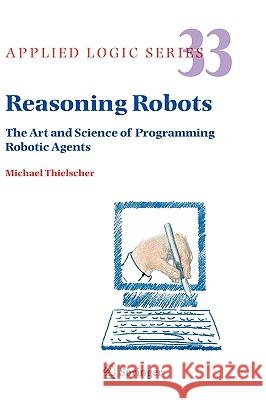
Michael Thielscher
Reasoning Robots: The Art and Science of Programming Robotic Agents Thielscher, Michael 9781402030680 Springer - książkaWidoczna okładka, to zdjęcie poglądowe, a rzeczywista szata graficzna może różnić się od prezentowanej.

Reasoning Robots: The Art and Science of Programming Robotic Agents

ISBN-13: 9781402030680 / Angielski / Twarda / 2005 / 328 str.

Michael Thielscher
cena 201,72 zł
(netto: 192,11 VAT:  5%)

Najniższa cena z 30 dni: 192,74 zł
Termin realizacji zamówienia:
ok. 22 dni roboczych
Bez gwarancji dostawy przed świętami

Darmowa dostawa!

The creation of intelligent robots is surely one of the most exciting and ch- lenginggoals of Arti?cial Intelligence. A robot is, ?rst of all, nothing but an inanimate machine with motors and sensors. In order to bring life to it, the machine needs to be programmed so as to make active use of its hardware c- ponents. This turns a machine into an autonomous robot. Since about the mid nineties of the past century, robot programming has made impressive progress. State-of-the-art robots are able to orient themselves and move around freely in indoor environments or negotiate di?cult outdoor terrains, they can use stereo vision to recognize objects, and they are capable of simple object manipulation with the help of arti?cial extremities. At a time where robots perform these tasks more and more reliably, weare ready to pursue the next big step, which is to turn autonomous machines into reasoning robots.Areasoning robot exhibits higher cognitive capabilities like following complex and long-term strategies, making rational decisions on a high level, drawing logical conclusions from sensor information acquired over time, devising suitable plans, and reacting sensibly in unexpected situations. All of these capabilities are characteristics of human-like intelligence and ultimately distinguish truly intelligent robots from mere autonomous machines


Kategorie:
Informatyka, Bazy danych
Kategorie BISAC:
Computers > Programming - General
Computers > Artificial Intelligence - General
Technology & Engineering > Robotics
Wydawca:
Springer
Seria wydawnicza:
Applied Logic
Język:
Angielski
ISBN-13:
9781402030680
Rok wydania:
2005
Wydanie:
2005
Numer serii:
000107238
Ilość stron:
328
Waga:
0.65 kg
Wymiary:
24.13 x 16.26 x 2.29
Oprawa:
Twarda
Wolumenów:
01
Dodatkowe informacje:
Bibliografia
Wydanie ilustrowane

From the reviews:

"This book presents the 'fluent calculus' as one possible approach to solve the frame problem in artificial intelligence. ... The book is very understandable and recommendable for anybody who wants to solve AI problems by means of predicate logics and logic programming. It shows that this approach is more and more applicable to the solution of real-world problems. It will be an excellent textbook for appropriate AI or robotics courses and very appropriate for graduate students." (Christian Posthoff, Zentralblatt MATH, Vol. 1092 (18), 2006)

Special Fluent Calculus.- Special FLUX.- General Fluent Calculus.- General FLUX.- Knowledge Programming.- Planning.- Nondeterminism.- Imprecision*.- Indirect Effects: Ramification Problem*.- Troubleshooting: Qualification Problem.- Robotics.

The book provides an in-depth and uniform treatment of a mathematical

model for reasoning robotic agents. The book also contains an introduction

to a programming method and system based on this model.

The mathematical model, known as the "Fluent Calculus,'' describes how

to use classical first-order logic to set up symbolic models of dynamic

worlds and to represent knowledge of actions and their effects. Robotic

agents use this knowledge and their reasoning facilities to make decisions

when following high-level, long-term strategies. The book covers

the issues of reasoning about sensor input, acting under incomplete

knowledge and uncertainty, planning, intelligent troubleshooting, and many

other topics.

The mathematical model is supplemented by a programming method which

allows readers to design their own reasoning robotic agents. The usage of

this method, called "FLUX,'' is illustrated by many example programs. The

book includes the details of an implementation of FLUX using the standard

programming language PROLOG, which allows readers to re-implement or

to modify and extend the generic system.

The design of autonomous agents, including robots, is one of the most

exciting and challenging goals of Artificial Intelligence. Reasoning robotic

agents constitute a link between knowledge representation and reasoning on

the one hand, and agent programming and robot control on the other. The

book provides a uniform mathematical model for the problem-driven,

top-down design of rational agents, which use reasoning for decision

making, planning, and troubleshooting. The implementation of the

mathematical model by a general PROLOG program allows readers to

practice the design of reasoning robotic agents. Since all implementation

details are given, the generic system can be easily modified and extended.

Thielscher, Michael Stanford University... więcej >


Udostępnij

Facebook - konto krainaksiazek.pl


Opinie o Krainaksiazek.pl na Opineo.pl

Partner Mybenefit

Krainaksiazek.pl w programie rzetelna firma Krainaksiaze.pl - płatności przez paypal

Czytaj nas na:

Facebook - krainaksiazek.pl
  • książki na zamówienie
  • granty
  • książka na prezent
  • kontakt
  • pomoc
  • opinie
  • regulamin
  • polityka prywatności

Zobacz:

  • Księgarnia czeska

  • Wydawnictwo Książkowe Klimaty

1997-2025 DolnySlask.com Agencja Internetowa

© 1997-2022 krainaksiazek.pl
     
KONTAKT | REGULAMIN | POLITYKA PRYWATNOŚCI | USTAWIENIA PRYWATNOŚCI
Zobacz: Księgarnia Czeska | Wydawnictwo Książkowe Klimaty | Mapa strony | Lista autorów
KrainaKsiazek.PL - Księgarnia Internetowa

Polityka prywatnosci - link
Krainaksiazek.pl - płatnośc Przelewy24
Przechowalnia Przechowalnia





