• Wyszukiwanie zaawansowane
  • Kategorie
  • Kategorie BISAC
  • Książki na zamówienie
  • Promocje
  • Granty
  • Książka na prezent
  • Opinie
  • Pomoc
  • Załóż konto
  • Zaloguj się

Reaction Engineering of Step Growth Polymerization » książka


zaloguj się | załóż konto
Logo Krainaksiazek.pl

koszyk

konto

szukaj
topmenu
Księgarnia internetowa
Szukaj
Książki na zamówienie
Promocje
Granty
Książka na prezent
Moje konto
Pomoc
 
 
Wyszukiwanie zaawansowane
Pusty koszyk
Bezpłatna dostawa dla zamówień powyżej 20 złBezpłatna dostawa dla zamówień powyżej 20 zł

Kategorie główne

• Nauka
 [2946600]
• Literatura piękna
 [1856966]

  więcej...
• Turystyka
 [72221]
• Informatyka
 [151456]
• Komiksy
 [35826]
• Encyklopedie
 [23190]
• Dziecięca
 [619653]
• Hobby
 [140543]
• AudioBooki
 [1577]
• Literatura faktu
 [228355]
• Muzyka CD
 [410]
• Słowniki
 [2874]
• Inne
 [445822]
• Kalendarze
 [1744]
• Podręczniki
 [167141]
• Poradniki
 [482898]
• Religia
 [510455]
• Czasopisma
 [526]
• Sport
 [61590]
• Sztuka
 [243598]
• CD, DVD, Video
 [3423]
• Technologie
 [219201]
• Zdrowie
 [101638]
• Książkowe Klimaty
 [124]
• Zabawki
 [2473]
• Puzzle, gry
 [3898]
• Literatura w języku ukraińskim
 [254]
• Art. papiernicze i szkolne
 [8170]
Kategorie szczegółowe BISAC

Reaction Engineering of Step Growth Polymerization

ISBN-13: 9781461290087 / Angielski / Miękka / 2011 / 444 str.
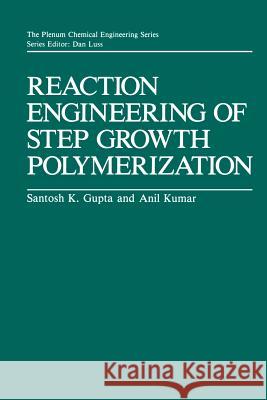
Santosh K. Gupta; Ajit Kumar; Santosh K. Gupta
Reaction Engineering of Step Growth Polymerization Santosh K Ajit Kumar Santosh K. Gupta 9781461290087 Springer - książkaWidoczna okładka, to zdjęcie poglądowe, a rzeczywista szata graficzna może różnić się od prezentowanej.

Reaction Engineering of Step Growth Polymerization

ISBN-13: 9781461290087 / Angielski / Miękka / 2011 / 444 str.

Santosh K. Gupta; Ajit Kumar; Santosh K. Gupta
cena 201,72 zł
(netto: 192,11 VAT:  5%)

Najniższa cena z 30 dni: 192,74 zł
Termin realizacji zamówienia:
ok. 22 dni roboczych
Bez gwarancji dostawy przed świętami

Darmowa dostawa!

The literature in polymerization reaction engineering has bloomed sufficiently in the last several years to justify our attempt in putting together this book. Rather than offer a comprehensive treatment of the entire field, thereby duplicating earlier texts as well as some ongoing bookwriting efforts, we decided to narrow down our aim to step growth polymerization systems. This not only provides us the lUxury of a more elaborate presentation within the constraints of production costs, but also enables us to remain on somewhat familiar terrain. The style and format we have selected are those of a textbook. The first six chapters present the principles of step growth polymerization. These are quite general, and can easily be applied in such diverse and emerging fields as polymerization applications in photolithography and microelec tronics. A detailed discussion of several important step growth polymeriz ations follows in the next five chapters. One could cover the first six chapters of this book in about six to eight weeks of a three-credit graduate course on polymerization reactors, with the other chapters assigned for reading. This could be followed by a discussion of chain-growth and other polymeriz ations, with which our material blends well. Alternately, the entire contents of this book could be covered in a course on step growth systems alone."


Kategorie:
Nauka, Chemia
Kategorie BISAC:
Technology & Engineering > Chemical & Biochemical
Gardening > General
Science > Chemia - Nieorganiczna
Wydawca:
Springer
Seria wydawnicza:
Plenum Chemical Engineering
Język:
Angielski
ISBN-13:
9781461290087
Rok wydania:
2011
Wydanie:
Softcover Repri
Numer serii:
000032806
Ilość stron:
444
Waga:
0.65 kg
Wymiary:
22.9 x 15.2
Oprawa:
Miękka
Wolumenów:
01
Dodatkowe informacje:
Wydanie ilustrowane

1. Introduction.- 1.1. Step and Chain Growth Polymerizations.- 1.2. Step Growth Polymerization.- 1.3. Molecular Weight Distribution.- 1.4. Measurement of MWD and Its Moments.- 1.5. Types of Reactors.- 1.6. Conclusions.- References.- Exercises.- 2. Linear Step Growth Polymerization Following the Equal Reactivity Hypothesis.- 2.1. Introduction.- 2.2. Rate Constants for Elementary Step Growth Polymerization Reactions.- 2.3. Equal Reactivity Hypothesis.- 2.4. Kinetic Model of Irreversible Step Growth Polymerization under the Equal Reactivity Hypothesis.- 2.5. Experimental Verification of the Kinetic Model.- 2.6. Irreversible ARB Polymerizations with Monofunctional Compounds in Batch Reactors.- 2.7. Polymerization in Plug Flow Reactors (PFR) with Recycle.- 2.8. ARB Polymerization in Homogeneous Continuous-Flow Stirred Tank Reactors (HCSTRs).- 2.9. Reversible ARB Polymerization.- 2.10. Conclusions.- Appendix 2.1. Moment Generation Function.- References.- Exercises.- 3. Linear Step Growth Polymerization Violating the Equal Reactivity Hypothesis.- 3.1. Introduction.- 3.2. Irreversible ARB Polymerization with Oligomers Having Chain Length Dependent Reactivity.- 3.3. Reversible Step Growth Polymerization with Oligomers Having Chain Length Dependent Reactivity.- 3.4. Step Growth Polymerization Involving Asymmetric Functional Groups.- 3.5. Conclusions.- References.- Exercises.- 4. Nonlinear Step Growth Polymerization.- 4.1. Introduction.- 4.2. Average Molecular Weights and the Onset of Gelation in Batch Reactors.- 4.3. Postgel Properties for Nonlinear Polymerizations in Batch Reactors.- 4.4. Effect of Unequal Reactivity of Functional Groups.- 4.5. Experimental Results.- 4.6. Kinetic Approach in the Polymerization of RAf in Batch Reactors.- 4.7. Intramolecular Reactions in Nonlinear Polymerization.- 4.8. Nonlinear Step Growth Polymerization in HCSTRs.- 4.9. Conclusions.- References.- Exercises.- 5. Mass Transfer in Step Growth Polymerization.- 5.1. Introduction.- 5.2. Polymerization with Negligible Mass Transfer Resistance (Semibatch Reactors).- 5.3. Polymerization with Finite Mass Transfer Resistance.- 5.4. Finishing Reactors.- 5.5. Step Growth Polymerizations at High Conversions.- 5.6. Conclusions.- References.- Exercises.- 6. Optimal Control of Step Growth Polymerizations.- 6.1. Introduction.- 6.2. The Basic Algorithm.- 6.3. Optimization of ARB Polymerization in Batch Reactors.- 6.4. Optimization of Irreversible ARB Polymerizations in HCSTRs.- 6.5. Periodic Operation of HCSTRs.- 6.6. Conclusions.- References.- Exercises.- 7. Nylon Reactors.- 7.1. Introduction.- 7.2. Polymerization of ?-Caprolactam.- 7.3. Hydrolytic Polymerization of ?-Caprolactam in Batch Reactors.- 7.4. Nylon 6 Polymerization in Isothermal Recycle Reactors.- 7.5. Nylon 6 Polymerization in HCSTRs and in Cascades of Reactors.- 7.6. Effect of Nonidealities.- 7.7. Simulation of Industrial Reactors.- 7.8. Optimization of Nylon 6 Reactors.- 7.9. Cyclization Reactions in Nylon 6 Polymerization.- 7.10. Polymerization of Nylon-6,6.- 7.11. Conclusions.- References.- Exercises.- 8. Polyester Reactors.- 8.1. Introduction.- 8.2. Transesterification Stage of PET Formation from Dimethyl Terephthalate.- 8.2a. Industrial Process and Various Side Reactions.- 8.2b. Rate Constants.- 8.2c. Simulation of the Ester Interchange Reactor.- 8.3. Optimization of Ester Interchange Reactor.- 8.4. Direct Esterification of Terephthalic Acid.- 8.4a. Industrial Process.- 8.4b. Reactions and Their Rate Constants.- 8.4c. Simulation of the Reactor.- 8.5. Polycondensation Step (Second Stage) of PET Formation.- 8.5a. Side Reactions in Polycondensation Step.- 8.5b. Rate Constants of Various Reaction Steps.- 8.5c. Simulation of the MWD of the Polymer Formed in Polycondensation Reactors.- 8.6. Wiped Film Reactors for the Final Stages of PET Formation.- 8.7. Unsaturated Polyester.- 8.8. Conclusions.- Appendix 8.1. Orthogonal Collocation Technique for the Solution of Partial Differential Equations.- References.- Exercises.- 9. Urethane Polymers and Reaction Injection Molding.- 9.1. Introduction.- 9.2. Modeling of Cross-Linked Polyurethane Formation.- 9.3. Gelation.- 9.4. Approximate Rate Expression for Urethane Formation.- 9.5. Reaction Injection Molding.- 9.6. Impingement Mixing in RIM.- 9.7. Filling and Curing in Molds in RIM.- 9.7a. Main Flow Region.- 9.7b. Flow Front Region.- 9.7c. Curing.- 9.8. Conclusions.- References.- Exercises.- 10. Epoxy Polymers.- 10.1. Introduction.- 10.2. Taffy Process.- 10.3. Advancement Process.- 10.4. Curing of Epoxies.- 10.5. Conclusions.- References.- Exercises.- 11. Polymerization with Formaldehyde.- 11.1. Introduction.- 11.2. Modeling of Novolac Reactors.- 11.3. Concentrations of Sites oeT, oi, pi, and pe in Novolac Formation.- 11.4. Molecular Weight Distributions in Novolac Polymer Formation.- 11.5. Modeling of Resole Reactors.- 11.6. Conclusions.- References.- Exercises.

Kumar, Ajit Ajit Kumar has around 10 years of software develop... więcej >


Udostępnij

Facebook - konto krainaksiazek.pl


Opinie o Krainaksiazek.pl na Opineo.pl

Partner Mybenefit

Krainaksiazek.pl w programie rzetelna firma Krainaksiaze.pl - płatności przez paypal

Czytaj nas na:

Facebook - krainaksiazek.pl
  • książki na zamówienie
  • granty
  • książka na prezent
  • kontakt
  • pomoc
  • opinie
  • regulamin
  • polityka prywatności

Zobacz:

  • Księgarnia czeska

  • Wydawnictwo Książkowe Klimaty

1997-2025 DolnySlask.com Agencja Internetowa

© 1997-2022 krainaksiazek.pl
     
KONTAKT | REGULAMIN | POLITYKA PRYWATNOŚCI | USTAWIENIA PRYWATNOŚCI
Zobacz: Księgarnia Czeska | Wydawnictwo Książkowe Klimaty | Mapa strony | Lista autorów
KrainaKsiazek.PL - Księgarnia Internetowa

Polityka prywatnosci - link
Krainaksiazek.pl - płatnośc Przelewy24
Przechowalnia Przechowalnia





