Quantum Dot Lasers on Silicon: Nonlinear Properties, Dynamics, and Applications » książka





Quantum Dot Lasers on Silicon: Nonlinear Properties, Dynamics, and Applications
ISBN-13: 9783031178269 / Angielski / Twarda / 2023 / 189 str.
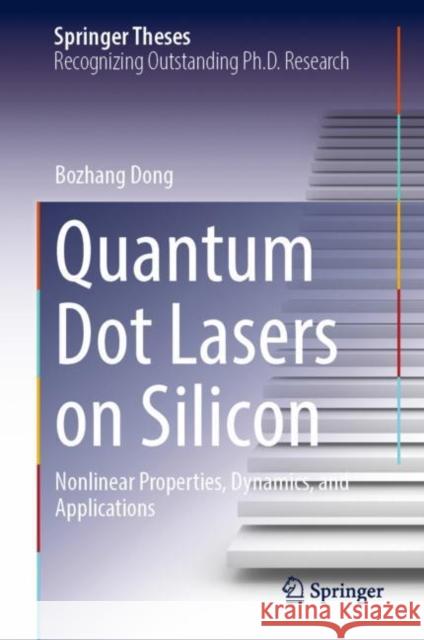
Quantum Dot Lasers on Silicon: Nonlinear Properties, Dynamics, and Applications
ISBN-13: 9783031178269 / Angielski / Twarda / 2023 / 189 str.
(netto: 851,36 VAT: 5%)
Najniższa cena z 30 dni: 771,08
ok. 16-18 dni roboczych.
Darmowa dostawa!
This book provides guidelines and design rules for developing high-performance, low-cost, and energy-efficient quantum-dot (QD) lasers for silicon photonic integrated circuits (PIC), optical frequency comb generation, and quantum information systems. To this end, the nonlinear properties and dynamics of QD lasers on silicon are investigated in depth by both theoretical analysis and experiment.This book aims at addressing four issues encountered in developing silicon PIC:1) The instability of laser emission caused by the chip-scale back-reflection. During photonic integration, the chip-scale back-reflection is usually responsible for the generation of severe instability (i.e., coherence collapse) from the on-chip source. As a consequence, the transmission performance of the chip could be largely degraded. To overcome this issue, we investigate the nonlinear properties and dynamics of QD laser on Si in this book to understand how can it be applied to isolator-free photonic integration in which the expensive optical isolator can be avoided. Results show that the QD laser exhibits a high degree of tolerance for chip-scale back-reflections in absence of any instability, which is a promising solution for isolator-free applications.2) The degradation of laser performance at a high operating temperature. In this era of Internet-of-Thing (IoT), about 40% of energy is consumed for cooling in the data center. In this context, it is important to develop a high-temperature continuous-wave (CW) emitted laser source. In this book, we introduce a single-mode distributed feedback (DFB) QD laser with a design of optical wavelength detuning (OWD). By taking advantage of the OWD technique and the high-performance QD with high thermal stability, all the static and dynamical performances of the QD device are improved when the operating temperature is high. This study paves the way for developing uncooled and isolator-free PIC.3) The limited phase noise level and optical bandwidth of the laser are the bottlenecks for further increasing the transmission capacity. To improve the transmission capacity and meet the requirement of the next generation of high-speed optical communication, we introduce the QD-based optical frequency comb (OFC) laser in this book. Benefiting from the gain broadening effect and the low-noise properties of QD, the OFC laser is realized with high optical bandwidth and low phase noise. We also provide approaches to further improve the laser performance, including the external optical feedback and the optical injection.4) Platform with rich optical nonlinearities is highly desired by future integrated quantum technologies. In this book, we investigate the nonlinear properties and four-wave mixing (FWM) of QD laser on Si. This study reveals that the FWM efficiency of QD laser is more than ten times higher than that of quantum-well laser, which gives insight into developing a QD-based silicon platform for quantum states of light generation.Based on the results in this book, scientists, researchers, and engineers can come up with an informed judgment in utilizing the QD laser for applications ranging from classical silicon PIC to integrated quantum technologies.
This book provides guidelines and design rules for developing high-performance, low-cost, and energy-efficient quantum-dot (QD) lasers for silicon photonic integrated circuits (PIC), optical frequency comb generation, and quantum information systems. To this end, the nonlinear properties and dynamics of QD lasers on silicon are investigated in depth by both theoretical analysis and experiment. This book aims at addressing four issues encountered in developing silicon PIC: 1) The instability of laser emission caused by the chip-scale back-reflection. During photonic integration, the chip-scale back-reflection is usually responsible for the generation of severe instability (i.e., coherence collapse) from the on-chip source. As a consequence, the transmission performance of the chip could be largely degraded. To overcome this issue, we investigate the nonlinear properties and dynamics of QD laser on Si in this book to understand how can it be applied to isolator-free photonic integration in which the expensive optical isolator can be avoided. Results show that the QD laser exhibits a high degree of tolerance for chip-scale back-reflections in absence of any instability, which is a promising solution for isolator-free applications. 2) The degradation of laser performance at a high operating temperature. In this era of Internet-of-Thing (IoT), about 40% of energy is consumed for cooling in the data center. In this context, it is important to develop a high-temperature continuous-wave (CW) emitted laser source. In this book, we introduce a single-mode distributed feedback (DFB) QD laser with a design of optical wavelength detuning (OWD). By taking advantage of the OWD technique and the high-performance QD with high thermal stability, all the static and dynamical performances of the QD device are improved when the operating temperature is high. This study paves the way for developing uncooled and isolator-free PIC. 3) The limited phase noise level and optical bandwidth of the laser are the bottlenecks for further increasing the transmission capacity. To improve the transmission capacity and meet the requirement of the next generation of high-speed optical communication, we introduce the QD-based optical frequency comb (OFC) laser in this book. Benefiting from the gain broadening effect and the low-noise properties of QD, the OFC laser is realized with high optical bandwidth and low phase noise. We also provide approaches to further improve the laser performance, including the external optical feedback and the optical injection. 4) Platform with rich optical nonlinearities is highly desired by future integrated quantum technologies. In this book, we investigate the nonlinear properties and four-wave mixing (FWM) of QD laser on Si. This study reveals that the FWM efficiency of QD laser is more than ten times higher than that of quantum-well laser, which gives insight into developing a QD-based silicon platform for quantum states of light generation. Based on the results in this book, scientists, researchers, and engineers can come up with an informed judgment in utilizing the QD laser for applications ranging from classical silicon PIC to integrated quantum technologies.




Czytaj nas na:
KrainaKsiazek.PL - Księgarnia Internetowa


