• Wyszukiwanie zaawansowane
  • Kategorie
  • Kategorie BISAC
  • Książki na zamówienie
  • Promocje
  • Granty
  • Książka na prezent
  • Opinie
  • Pomoc
  • Załóż konto
  • Zaloguj się

Quantitative Microbial Risk Assessment » książka


zaloguj się | załóż konto
Logo Krainaksiazek.pl

koszyk

konto

szukaj
topmenu
Księgarnia internetowa
Szukaj
Książki na zamówienie
Promocje
Granty
Książka na prezent
Moje konto
Pomoc
 
 
Wyszukiwanie zaawansowane
Pusty koszyk
Bezpłatna dostawa dla zamówień powyżej 20 złBezpłatna dostawa dla zamówień powyżej 20 zł

Kategorie główne

• Nauka
 [2949965]
• Literatura piękna
 [1857847]

  więcej...
• Turystyka
 [70818]
• Informatyka
 [151303]
• Komiksy
 [35733]
• Encyklopedie
 [23180]
• Dziecięca
 [617748]
• Hobby
 [139972]
• AudioBooki
 [1650]
• Literatura faktu
 [228361]
• Muzyka CD
 [398]
• Słowniki
 [2862]
• Inne
 [444732]
• Kalendarze
 [1620]
• Podręczniki
 [167233]
• Poradniki
 [482388]
• Religia
 [509867]
• Czasopisma
 [533]
• Sport
 [61361]
• Sztuka
 [243125]
• CD, DVD, Video
 [3451]
• Technologie
 [219309]
• Zdrowie
 [101347]
• Książkowe Klimaty
 [123]
• Zabawki
 [2362]
• Puzzle, gry
 [3791]
• Literatura w języku ukraińskim
 [253]
• Art. papiernicze i szkolne
 [7933]
Kategorie szczegółowe BISAC

Quantitative Microbial Risk Assessment

ISBN-13: 9781118145296 / Angielski / Twarda / 2014 / 440 str.
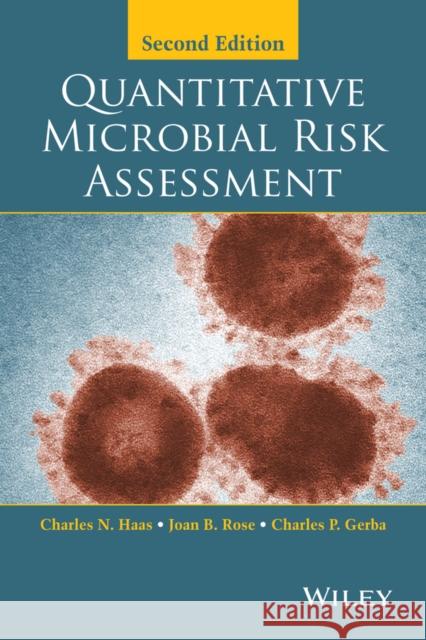
Charles N. Haas; Joan B. Rose; Charles P. Gerba
Quantitative Microbial Risk Assessment Haas, Charles N.; Rose, Joan B.; Gerba, Charles P. 9781118145296 John Wiley & Sons - książkaWidoczna okładka, to zdjęcie poglądowe, a rzeczywista szata graficzna może różnić się od prezentowanej.

Quantitative Microbial Risk Assessment

ISBN-13: 9781118145296 / Angielski / Twarda / 2014 / 440 str.

Charles N. Haas; Joan B. Rose; Charles P. Gerba
cena 600,48 zł
(netto: 571,89 VAT:  5%)

Najniższa cena z 30 dni: 594,34 zł
Termin realizacji zamówienia:
ok. 30 dni roboczych
Bez gwarancji dostawy przed świętami

Darmowa dostawa!

Provides the latest QMRA methodologies to determine infection risk cause by either accidental microbial infections or deliberate infections caused by terrorism
- Reviews the latest methodologies to quantify at every step of the microbial exposure pathways, from the first release of a pathogen to the actual human infection
- Provides techniques on how to gather information, on how each microorganism moves through the environment, how to determine their survival rates on various media, and how people are exposed to the microorganism
- Explains how QMRA can be used as a tool to measure the impact of interventions and identify the best policies and practices to protect public health and safety
- Includes new information on genetic methods
- Techniques use to develop risk models for drinking water, groundwater, recreational water, food and pathogens in the indoor environment


Kategorie:
Nauka, Biologia i przyroda
Kategorie BISAC:
Technology & Engineering > Environmental - General
Medical > Toxicology
Technology & Engineering > Engineering (General)
Wydawca:
John Wiley & Sons
Język:
Angielski
ISBN-13:
9781118145296
Rok wydania:
2014
Wydanie:
Revised
Ilość stron:
440
Waga:
0.72 kg
Wymiary:
23.62 x 15.75 x 2.79
Oprawa:
Twarda
Wolumenów:
01
Dodatkowe informacje:
Bibliografia

PREFACE xi

CHAPTER 1 MOTIVATION 1

Prevalence of Infectious Disease 1

Prior Approaches 4

Scope of Coverage 4

Potential Objectives of a QMRA 5

Site–Specific Assessment 5

Ensemble of Sites 6

Secondary Transmission 7

Outbreaks versus Endemic Cases 7

References 10

CHAPTER 2 MICROBIAL AGENTS AND TRANSMISSION 15

Microbial Taxonomy 15

Eukaryotes 15

Prokaryotes 18

Viruses 20

Prions 22

Clinical Characterization 24

Microorganisms of Interest 27

Viruses 27

Bacteria 37

Protozoa 42

Transmission Routes 45

Inhalation 48

Dermal Exposure 50

Oral Ingestion 50

References 55

CHAPTER 3 RISK ASSESSMENT PARADIGMS 63

Chemical Risk Assessment: National Academy of Sciences Paradigm 63

Ecological Risk Assessment 67

Approaches for Assessing Microbial Risks 71

Background 71

The QMRA Framework 74

Hazard Identification 74

Dose Response Assessment 74

Exposure Assessment 76

Risk Characterization 77

Risk Management 79

Development of the QMRA Framework and Processes 79

QMRA and the Safety of Water 82

QMRA, Food Safety, and the HACCP System 84

References 86

CHAPTER 4 CONDUCTING THE HAZARD IDENTIFICATION (HAZ ID) 91

Identifying and Diagnosing Infectious Disease 92

Health Outcomes Associated with Microbial Infections 95

Sensitive Populations 100

Women during Pregnancy, Neonates, and Young Babies 101

Diabetes 102

The Elderly 102

The Immunocompromised 104

Databases for Statistical Assessment of Disease 106

ICD Codes 107

Waterborne and Foodborne Outbreaks 111

Epidemiological Methods for Undertaking HAZ ID 117

Controlled Epidemiological Investigations 118

HAZ ID Data Used in the Risk Assessment Process 119

Recommendations for Updating Quantitative Data for HAZ ID Information 121

References 122

CHAPTER 5 ANALYTICAL METHODS AND THE QMRA FRAMEWORK: DEVELOPING OCCURRENCE AND EXPOSURE DATABASES 129

Introduction 129

Approaches for Developing Occurrence and Exposure Databases 132

Overview of Methodological Issues 134

Sampling Water 136

Sampling Surfaces and Food 138

Sampling Aerosols 138

Specific Techniques for Bacteria, Protozoa, and Viruses 140

Bacteria 140

Protozoa 142

Viruses 143

Molecular Techniques 145

Probes (FISH) 146

Typing 146

Metagenomics 147

PCR and Quantitative PCR 147

References 151

CHAPTER 6 EXPOSURE ASSESSMENT 159

Conducting the Exposure Assessment 159

Characterizing Concentration/Duration Distributions 160

Random (Poisson) Distributions of Organisms 160

Estimation of Poisson Mean in Count Assay (Constant and Variable Volumes) 162

Count Assay with Upper Limits 163

Estimation with Quantal Assay 164

Goodness of Fit to Poisson: Plate Assay 168

Goodness of Fit: MPN 178

Confidence Limits: Likelihood 182

Implications for Risk Assessment 187

Consumption Distributions 214

Systematic Subpopulation Differences 221

Afterword 223

Appendix 224

Microsoft Excel 224

MATLAB 225

R 227

References 230

CHAPTER 7 PREDICTIVE MICROBIOLOGY 235

Objective 235

Basic First–Order Processes and Deviations 236

Biological and Physical Bases for Deviations 236

Physical Removal 238

Types of Decay Processes 238

General Forms of Decay and Reasons for Nonlinearity 238

Spontaneous/Endogenous 240

Chemical Agents 241

Thermally Induced 243

Ionizing and Nonionizing Radiation 243

Predation and Antagonism 245

Types of Growth Processes 245

Mathematical Modeling of Growth Curves 246

Substrate Dependency 252

Structured Growth Models 255

Incorporation of Decay into Growth Models 256

Systems Biology Approaches 258

Dependence of Growth Parameters on Other Environmental Variables 258

Interacting Populations 258

Data Sources 260

References 263

CHAPTER 8 CONDUCTING THE DOSE RESPONSE ASSESSMENT 267

Plausible Dose Response Models 268

Framework for Mechanistic Dose Response Relationships 269

Exponential Dose Response Model 271

Beta–Poisson Dose Response Model 272

Simple Threshold Models 274

Negative Binomial Dose Distributions 277

Variable Threshold Models 278

Other Mixture Models 279

Biological Arguments for One–Hit Models 281

Empirical Models 282

Fitting Available Data 283

Types of Data Sets 284

Potential Impacts of Immune Status 298

Relationship between Dose and Severity (Morbidity and Mortality) 299

Morbidity Ratio (PD:I) 299

Mortality Ratio 303

Reality Checking: Validation 304

Validation: 1993 Milwaukee Outbreak 304

Use of Indicators and Other Proxy Measures in Dose Response 305

Indicator Methods 305

Molecular Methods 307

Advanced Topics in Dose Response Modeling 308

Dose Response Time Models 308

Physiological Models 313

Appendix 315

References 317

CHAPTER 9 UNCERTAINTY 323

Point Estimates of Risk 324

Terminology: Types of Uncertainty 326

Sources of Uncertainty 327

Sources of Variability 328

Variability that is Uncertain 329

Approaches to Quantify Parametric Uncertainty 329

Likelihood 329

Bootstrap 330

Other Methods 330

Applications 332

Exposure Assessment 332

Dose Response Assessment 338

Combining Parametric Uncertainty from Multiple Sources 344

Propagation Methods 344

Monte Carlo Analyses 347

Overall Risk Characterization Example 365

Second–Order Methods 368

Model Uncertainty and Averaging 370

References 373

CHAPTER 10 POPULATION DISEASE TRANSMISSION 377

Introduction: Models for Population and Community Illnesses 377

Basic SIR Model 378

Incubation Period 386

Duration of Illness 388

Secondary Cases 389

Impact of Immunity 392

Outbreak Detection 393

References 397

CHAPTER 11 RISK CHARACTERIZATION AND DECISION MAKING 399

Introduction 399

Valuing Residual Outcomes 400

Classical Economics 400

DALYs and QALYs 404

Decision Making 407

Cost Benefit Analysis 408

Multivariate Approaches 411

Other Aspects Entering into a Decision 412

Equity and Justice Aspects 412

References 413

INDEX 415

Charles N. Haas is the head of the department of Civil, Architectural and Environmental Engineering at Drexel University and the Betz Chair Professor of Environmental Engineering.  He has served on numerous advisory committees of the US EPA and the National Research Council

Joan Rose serves as the Homer Nowlin Chair in Water Research at Michigan State University, the Co–Director of the Center for Advancing Microbial Risk Assessment (CAMRA) and the Director of the Center for Water Sciences (CWS).  She is a member of the National Academy of Engineering.

Charles P. Gerba is a Professor in the department of Soil, Water and Environmental Science at the University of Arizona. He is the author of 11 books and over 400 journal papers. Dr. Gerba is a member of the U.S. Environmental Protection Agency′s Science Advisory Board Committees on Drinking Water and Research Strategies.

The new edition of this book is an outgrowth of an independent research center established by the United States Department of Homeland Security and the Environmental Protection Agency, dedicated to advancing laboratory techniques, creating mathematical tools, and developing datasets needed to improve Quantitative Microbial Risk Assessment (QMRA).  This book looks at the latest methodologies to quantify at every step of the microbial exposure pathways, from the first release of a pathogen to the actual human infection.   It provides techniques on how to  gather information, on how each microorganism moves through the environment, how to determine their survival rates on various media, and how people are exposed to the microorganism (i.e. skin contact, inhalation, or ingestion).  The book explains how these measurements can give us a comprehensive view of how environmental contamination (deliberate or accidental) can lead to human infection and reveals key points where interventions can be employed to save lives.  Since QMRA allows the reader to incorporate interventions into risk estimates, the book explains how QMRA can be used as a tool to measure the impact of interventions and identify the best policies and practices to protect public health and safety.


Udostępnij

Facebook - konto krainaksiazek.pl


Opinie o Krainaksiazek.pl na Opineo.pl

Partner Mybenefit

Krainaksiazek.pl w programie rzetelna firma Krainaksiaze.pl - płatności przez paypal

Czytaj nas na:

Facebook - krainaksiazek.pl
  • książki na zamówienie
  • granty
  • książka na prezent
  • kontakt
  • pomoc
  • opinie
  • regulamin
  • polityka prywatności

Zobacz:

  • Księgarnia czeska

  • Wydawnictwo Książkowe Klimaty

1997-2025 DolnySlask.com Agencja Internetowa

© 1997-2022 krainaksiazek.pl
     
KONTAKT | REGULAMIN | POLITYKA PRYWATNOŚCI | USTAWIENIA PRYWATNOŚCI
Zobacz: Księgarnia Czeska | Wydawnictwo Książkowe Klimaty | Mapa strony | Lista autorów
KrainaKsiazek.PL - Księgarnia Internetowa

Polityka prywatnosci - link
Krainaksiazek.pl - płatnośc Przelewy24
Przechowalnia Przechowalnia





