• Wyszukiwanie zaawansowane
  • Kategorie
  • Kategorie BISAC
  • Książki na zamówienie
  • Promocje
  • Granty
  • Książka na prezent
  • Opinie
  • Pomoc
  • Załóż konto
  • Zaloguj się

Protein Folding Protocols » książka


zaloguj się | załóż konto
Logo Krainaksiazek.pl

koszyk

konto

szukaj
topmenu
Księgarnia internetowa
Szukaj
Książki na zamówienie
Promocje
Granty
Książka na prezent
Moje konto
Pomoc
 
 
Wyszukiwanie zaawansowane
Pusty koszyk
Bezpłatna dostawa dla zamówień powyżej 20 złBezpłatna dostawa dla zamówień powyżej 20 zł

Kategorie główne

• Nauka
 [2949965]
• Literatura piękna
 [1857847]

  więcej...
• Turystyka
 [70818]
• Informatyka
 [151303]
• Komiksy
 [35733]
• Encyklopedie
 [23180]
• Dziecięca
 [617748]
• Hobby
 [139972]
• AudioBooki
 [1650]
• Literatura faktu
 [228361]
• Muzyka CD
 [398]
• Słowniki
 [2862]
• Inne
 [444732]
• Kalendarze
 [1620]
• Podręczniki
 [167233]
• Poradniki
 [482388]
• Religia
 [509867]
• Czasopisma
 [533]
• Sport
 [61361]
• Sztuka
 [243125]
• CD, DVD, Video
 [3451]
• Technologie
 [219309]
• Zdrowie
 [101347]
• Książkowe Klimaty
 [123]
• Zabawki
 [2362]
• Puzzle, gry
 [3791]
• Literatura w języku ukraińskim
 [253]
• Art. papiernicze i szkolne
 [7933]
Kategorie szczegółowe BISAC

Protein Folding Protocols

ISBN-13: 9781588296221 / Angielski / Twarda / 2006 / 328 str.
Yawen Bai; Ruth Nussinov
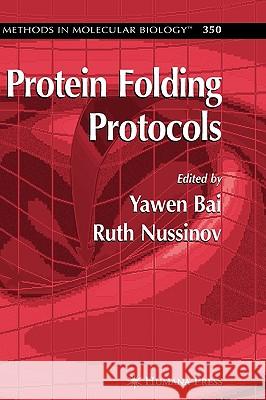
Protein Folding Protocols Yawen Bai Ruth Nussinov 9781588296221 Humana Press - książkaWidoczna okładka, to zdjęcie poglądowe, a rzeczywista szata graficzna może różnić się od prezentowanej.

Protein Folding Protocols

ISBN-13: 9781588296221 / Angielski / Twarda / 2006 / 328 str.

Yawen Bai; Ruth Nussinov
cena 605,23
(netto: 576,41 VAT:  5%)

Najniższa cena z 30 dni: 578,30
Termin realizacji zamówienia:
ok. 22 dni roboczych
Bez gwarancji dostawy przed świętami

Darmowa dostawa!

Protein Folding Protocols presents protocols for studying and characterizing steps and conformational ensembles populating pathways in protein folding from the unfolded to the folded state. It further presents a sample of approaches toward the prediction of protein structure starting from the amino acid sequence, in the absence of overall homologous sequences. Protein folding is a crucial step in the transfer of genetic information from the DNA to the protein. The Genome Project has led to a huge number of available DNA sequences and, therefore, protein sequences. The Structural Genomics initiative largely aims to obtain new folds not currently present in the Protein Data Bank. Yet, the number of available structures inevitably lags behind the number of sequences. At the same time, an equally important problem is to find out the types and scope of dissimilar (nonhomologous) protein sequences that adopt a similar fold. Assembling data and comprehension of the sequence space of protein folds should be very useful in computational protein structure prediction. This would enhance the scope of homology modeling, which currently is the method of choice. Thus, experimental and theoretical studies on the relationship between sequence and structure are critical. Figuring out the relationship between sequence and structure would further assist in the prediction of fibril structures observed in protein misfolding diseases, and in figuring out the conformational changes and dynamics resulting from mutations. Protein folding is one of the most important and challenging problems in current molecular and chemical biology."


Kategorie:
Nauka, Biologia i przyroda
Kategorie BISAC:
Science > Biochemia
Science > Cytologia
Wydawca:
Humana Press
Seria wydawnicza:
Methods in Molecular Biology
Język:
Angielski
ISBN-13:
9781588296221
Rok wydania:
2006
Wydanie:
2006
Numer serii:
000014950
Ilość stron:
328
Waga:
0.68 kg
Wymiary:
24.3 x 16.6 x 2.7
Oprawa:
Twarda
Wolumenów:
01
Dodatkowe informacje:
Bibliografia
Wydanie ilustrowane

"...great value to graduate students and researchers who would like to learn about modern techniques to probe protein folding events." -Journal of American Chemical Society

Infrared Temperature-Jump Study of the Folding Dynamics of a-Helices and b-Hairpins Feng Gai, Deguo Du, and Yao Xu The Use of High-Pressure Nuclear Magnetic Resonance to Study Protein Folding Michael W. Lassalle and Kazuyuki Akasaka Characterization of Denatured Proteins Using Residual Dipolar Couplings Erika B. Gebel and David Shortle Characterizing Residual Structure in Disordered Protein States Using Nuclear Magnetic Resonance David Eliezer Population and Structure Determination of Hidden Folding, Intermediates by Native-State Hydrogen Exchange-Directed Protein Engineering and Nuclear Magnetic Resonance Yawen Bai, Hanqiao Feng, and Zheng Zhou Characterizing Protein Folding Transition States Using Y-Analysis Adarsh D. Pandit, Bryan A. Krantz, Robin S. Dothager, and Tobin R. Sosnick Advances in the Analysis of Conformational Transitions in Peptides Using Differential Scanning Calorimetry Werner W. Streicher and George I. Makhatadze Application of Single Molecule Förster Resonance Energy Transfer to Protein Folding Benjamin Schuler Single Molecule Studies of Protein Folding Using Atomic Force Microscopy Sean P. Ng, Lucy G. Randles, and Jane Clarke Using Triplet-Triplet Energy Transfer to Measure Conformational Dynamics in Polypeptide Chains Beat Fierz, Karin Joder, Florian Krieger, and Thomas Kiefhaber A Hierarchical Protein Folding Scheme Based on the Building Block Folding Model Nurit Haspel, Gilad Wainreb, Yuval Inbar, Hui-Hsu (Gavin) Tsai, Chung-Jung Tsai, Haim J. Wolfson, and Ruth Nussinov Replica Exchange Molecular Dynamics Method for Protein Folding Simulation Ruhong Zhou Estimation of Folding Probabilities and F Values From Molecular Dynamics Simulations of Reversible Peptide Folding Francesco Rao, Giovanni Settanni, and Amedeo Caflisch PackingRegularities in Biological Structures Relate to Their Dynamics Robert L. Jernigan and Andrzej Kloczkowski Intermediates and Transition States in Protein Folding D. Thirumalai and Dmitri K. Klimov Thinking the Impossible: How to Solve the Protein Folding Problem With and Without Homologous Structures and Morem Rita Casadio, Piero Fariselli, Pier Luigi Martelli, and Gianluca Tasco Index

Protein Folding Protocols presents protocols for studying and characterizing protein folding from the unfolded to the folded state. Covering experiment and theory, bioinformatics approaches, and state-of-the-art simulation protocols for better sampling of the conformational space, this volume describes a broad range of techniques to study, predict, and analyze the protein folding process.
Protein Folding Protocols also provides sample approaches toward the prediction of protein structure starting from the amino acid sequence, in the absence of overall homologous sequences. These approaches have tremendous implications, ranging from drug design, functional assignment, comprehension of the nature of regulation, understanding molecular machines, viral entry into cells, and putting together cellular pathways and their dynamics.


Udostępnij

Facebook - konto krainaksiazek.pl


Opinie o Krainaksiazek.pl na Opineo.pl

Partner Mybenefit

Krainaksiazek.pl w programie rzetelna firma Krainaksiaze.pl - płatności przez paypal

Czytaj nas na:

Facebook - krainaksiazek.pl
  • książki na zamówienie
  • granty
  • książka na prezent
  • kontakt
  • pomoc
  • opinie
  • regulamin
  • polityka prywatności

Zobacz:

  • Księgarnia czeska

  • Wydawnictwo Książkowe Klimaty

1997-2025 DolnySlask.com Agencja Internetowa

© 1997-2022 krainaksiazek.pl
     
KONTAKT | REGULAMIN | POLITYKA PRYWATNOŚCI | USTAWIENIA PRYWATNOŚCI
Zobacz: Księgarnia Czeska | Wydawnictwo Książkowe Klimaty | Mapa strony | Lista autorów
KrainaKsiazek.PL - Księgarnia Internetowa

Polityka prywatnosci - link
Krainaksiazek.pl - płatnośc Przelewy24
Przechowalnia Przechowalnia





