• Wyszukiwanie zaawansowane
  • Kategorie
  • Kategorie BISAC
  • Książki na zamówienie
  • Promocje
  • Granty
  • Książka na prezent
  • Opinie
  • Pomoc
  • Załóż konto
  • Zaloguj się

Protein Engineering Protocols » książka


zaloguj się | załóż konto
Logo Krainaksiazek.pl

koszyk

konto

szukaj
topmenu
Księgarnia internetowa
Szukaj
Książki na zamówienie
Promocje
Granty
Książka na prezent
Moje konto
Pomoc
 
 
Wyszukiwanie zaawansowane
Pusty koszyk
Bezpłatna dostawa dla zamówień powyżej 20 złBezpłatna dostawa dla zamówień powyżej 20 zł

Kategorie główne

• Nauka
 [2949965]
• Literatura piękna
 [1857847]

  więcej...
• Turystyka
 [70818]
• Informatyka
 [151303]
• Komiksy
 [35733]
• Encyklopedie
 [23180]
• Dziecięca
 [617748]
• Hobby
 [139972]
• AudioBooki
 [1650]
• Literatura faktu
 [228361]
• Muzyka CD
 [398]
• Słowniki
 [2862]
• Inne
 [444732]
• Kalendarze
 [1620]
• Podręczniki
 [167233]
• Poradniki
 [482388]
• Religia
 [509867]
• Czasopisma
 [533]
• Sport
 [61361]
• Sztuka
 [243125]
• CD, DVD, Video
 [3451]
• Technologie
 [219309]
• Zdrowie
 [101347]
• Książkowe Klimaty
 [123]
• Zabawki
 [2362]
• Puzzle, gry
 [3791]
• Literatura w języku ukraińskim
 [253]
• Art. papiernicze i szkolne
 [7933]
Kategorie szczegółowe BISAC

Protein Engineering Protocols

ISBN-13: 9781617373381 / Angielski / Miękka / 2010 / 328 str.
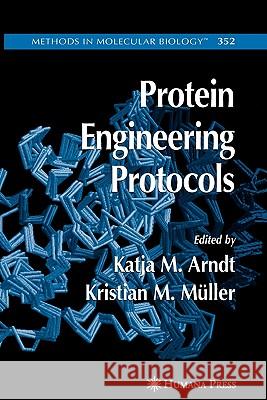
Kristian Muller; Katja Arndt
Protein Engineering Protocols Kristian Muller Katja Arndt 9781617373381 Springer - książkaWidoczna okładka, to zdjęcie poglądowe, a rzeczywista szata graficzna może różnić się od prezentowanej.

Protein Engineering Protocols

ISBN-13: 9781617373381 / Angielski / Miękka / 2010 / 328 str.

Kristian Muller; Katja Arndt
cena 645,58
(netto: 614,84 VAT:  5%)

Najniższa cena z 30 dni: 616,85
Termin realizacji zamówienia:
ok. 22 dni roboczych
Bez gwarancji dostawy przed świętami

Darmowa dostawa!

Protein engineering is a fascinating mixture of molecular biology, protein structure analysis, computation, and biochemistry, with the goal of developing useful or valuable proteins. Protein Engineering Protocols will consider the two general, but not mutually exclusive, strategies for protein engineering. The first is known as rational design, in which the scientist uses detailed knowledge of the structure and function of the protein to make desired changes. The s- ond strategy is known as directed evolution. In this case, random mutagenesis is applied to a protein, and selection or screening is used to pick out variants that have the desired qualities. By several rounds of mutation and selection, this method mimics natural evolution. An additional technique known as DNA shuffling mixes and matches pieces of successful variants to produce better results. This process mimics recombination that occurs naturally during sexual reproduction. The first section of Protein Engineering Protocols describes rational p- tein design strategies, including computational methods, the use of non-natural amino acids to expand the biological alphabet, as well as impressive examples for the generation of proteins with novel characteristics. Although procedures for the introduction of mutations have become routine, predicting and und- standing the effects of these mutations can be very challenging and requires profound knowledge of the system as well as protein structures in general.


Kategorie:
Nauka, Biologia i przyroda
Kategorie BISAC:
Science > Biochemia
Science > Biologia molekularna
Science > Biotechnology
Wydawca:
Springer
Seria wydawnicza:
Methods in Molecular Biology (Paperback)
Język:
Angielski
ISBN-13:
9781617373381
Rok wydania:
2010
Numer serii:
000203440
Ilość stron:
328
Waga:
0.48 kg
Wymiary:
22.91 x 15.19 x 1.85
Oprawa:
Miękka
Wolumenów:
01
Dodatkowe informacje:
Wydanie ilustrowane

From the reviews:

"Whether the research in your laboratory focuses on protein engineering or you wish to adopt a method for engineering a protein of interest, you will find this book, with it up-to-date stepwise protocols and experimentally oriented language, well suited to these goals." -Quarterly Review of Biology

"The chapters of Protein Engineering Protocols have been written by researchers with years of practical experience at the bench. It represents a methodological 'cook-book' of high quality. The diverse topics are well written and covered in an up-to-date manner. This makes it a bench-top handbook indispensable for all scientists who either work directly in protein engineering and design or use the described approaches of this field for their own research." (Nediljko Budisa, ChemBioChem, Vol. 8, 2007)

Part I. Design and Computational Strategies for Protein Engineering Combinatorial Protein Design Strategies Using Computational Methods Hidetoshi Kono, Wei Wang, and Jeffery G. Saven Global Incorporation of Unnatural Amino Acids in Escherichia coli Jamie M. Bacher and Andrew D. Ellington Considerations in the Design and Optimization of Coiled Coil Structures Jody M. Mason, Kristian M. Müller, and Katja M. Arndt Calcium Indicators Based on Calmodulin-Fluorescent Protein Fusions Kevin Truong, Asako Sawano, Atsushi Miyawaki, and Mitsuhiko Ikura Design and Synthesis of Artificial Zinc Finger Proteins Wataru Nomura and Yukio Sugiura Monobodies: Antibody Mimics Based on the Scaffold of the Fibronectin Type III Domain Akiko Koide and Shohei Koide Engineering Site-Specific Endonucleases Peter Friedhoff and Alfred Pingoud Part II. Evolutionary Strategies for Protein Engineering Protein Library Design and Screening: Working Out the Probabilities Michel Denault and Joelle N. Pelletier Protein Design by Binary Patterning of Polar and Nonpolar Amino Acids Luke H. Bradley, Yinan Wei, Peter Thumfort, Christine Wurth, and Michael H. Hecht Versatile DNA Fragmentation and Directed Evolution With Nucleotide Exchange and Excision Technology Sabine C. Stebel, Katja M. Arndt, and Kristian M. Müller Degenerate Oligonucleotide Gene Shuffling Peter L. Bergquist and Moreland D. Gibbs. M13 Bacteriophage Coat Proteins Engineered for Improved Phage Display Sachdev S. Sidhu, Birte K. Feld, and Gregory A. Weiss Ribosome-Inactivation Display System Satoshi Fujita, Jing-Min Zhou, and Kazunari Taira Compartmentalized Self-Replication: A Novel Method for the Directed Evolution of Polymerases and Other Enzymes Farid J. Ghadessy and Philipp Holliger Synthesisof Degenerated Libraries of the Ras-Binding Domain of Raf and Rapid Selection of Fast-Folding and Stable Clones With the Dihydrofolate Reductase Protein Fragment Complementation Assay François-Xavier Campbell-Valois and Stephen W. Michnick A General Method of Terminal Truncation, Evolution, and Re-Elongation to Generate Enzymes of Enhanced Stability Jochen Hecky, Jody M. Mason, Katja M. Arndt, and Kristian M. Müller Index

Protein Engineering Protocols considers the general, but not mutually exclusive, strategies for protein engineering. The first is known as rational design, in which the scientist uses detailed knowledge of the structure and function of the protein to make desired changes. The second strategy is known as directed evolution. This volume provides a comprehensive guide to the methods used at every stage of the engineering process. It combines a thorough theoretical foundation with detailed protocols and will be invaluable to all research workers in the area, from graduate students to senior investigators.

Protein engineering is a fascinating mixture of molecular biology, protein structure analysis, computation, and biochemistry, with the goal of developing useful or valuable proteins. Divided into two sections, Protein Engineering Protocols reviews rational protein design strategies and directed evolutionary techniques, and their impact on protein engineering.
The first section presents design and computational strategies for protein engineering focusing on designing a protein with desired properties, including examples covering a wide range of engineering techniques, such as protein-protein interactions, DNA binding, antibody mimics, and enzymatic activity. The second section on evolutionary techniques provides step-by-step instructions on library design and statistical assessment of library quality. New methods for DNA shuffling as well as different selection strategies are also presented.
Following the successful Methods in Molecular Biology™ series format, this volume provides a comprehensive guide to the methods used at every stage of the engineering process. By combining a thorough theoretical foundation with detailed protocols, Protein Engineering Protocols will be invaluable to all research workers in the area, from graduate students to senior investigators.


Udostępnij

Facebook - konto krainaksiazek.pl


Opinie o Krainaksiazek.pl na Opineo.pl

Partner Mybenefit

Krainaksiazek.pl w programie rzetelna firma Krainaksiaze.pl - płatności przez paypal

Czytaj nas na:

Facebook - krainaksiazek.pl
  • książki na zamówienie
  • granty
  • książka na prezent
  • kontakt
  • pomoc
  • opinie
  • regulamin
  • polityka prywatności

Zobacz:

  • Księgarnia czeska

  • Wydawnictwo Książkowe Klimaty

1997-2025 DolnySlask.com Agencja Internetowa

© 1997-2022 krainaksiazek.pl
     
KONTAKT | REGULAMIN | POLITYKA PRYWATNOŚCI | USTAWIENIA PRYWATNOŚCI
Zobacz: Księgarnia Czeska | Wydawnictwo Książkowe Klimaty | Mapa strony | Lista autorów
KrainaKsiazek.PL - Księgarnia Internetowa

Polityka prywatnosci - link
Krainaksiazek.pl - płatnośc Przelewy24
Przechowalnia Przechowalnia





