Protein Aggregation » książka





Protein Aggregation
ISBN-13: 9781071625996 / Angielski / Miękka / 2023
Protein Aggregation
ISBN-13: 9781071625996 / Angielski / Miękka / 2023
(netto: 691,70 VAT: 5%)
Najniższa cena z 30 dni: 693,97
ok. 16-18 dni roboczych.
Darmowa dostawa!
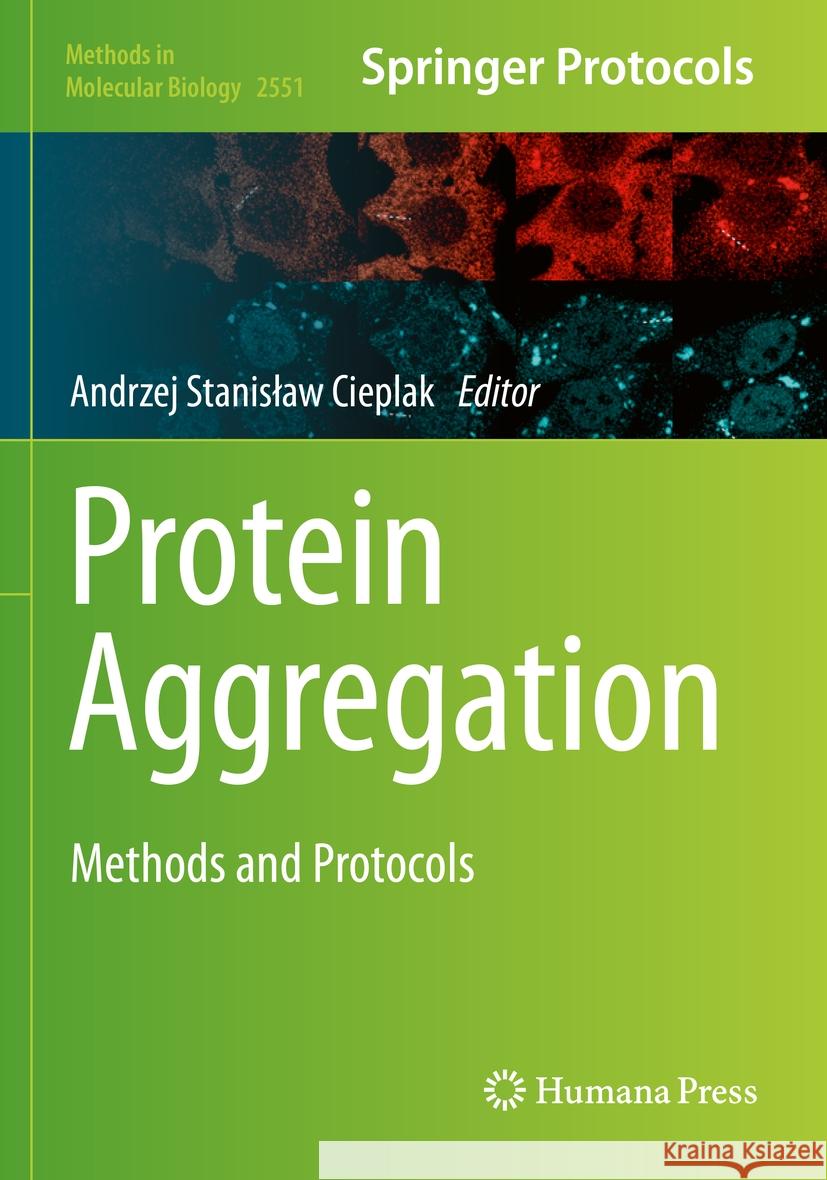
The volume details techniques, methods, and conceptual developments to further the study of protein aggregation with emphasis on the pleiomorphic proteins implicated in etiology of neurodegeneration. Chapters guide readers through in vitro and in vivo studies of fibrillization and liquid-liquid phase separation processes, and offer a comprehensive account of the state-of-art of structural studies of protein aggregation. Written in the format of the highly successful Methods in Molecular Biology series, each chapter includes an introduction to the topic, lists necessary materials and reagents, includes tips on troubleshooting and known pitfalls, and step-by-step, readily reproducible protocols.
1. Early aggregation of Amyloid-β (1-42) studied by Fluorescence Correlation Spectroscopy
Mercedes Novo, Cibrán Pérez-González, Sonia Freire, and Wajih Al-Soufi
2. Preparation and investigation of crucial oligomers in the early stages of Aβ40 and Aβ42 aggregation
Bertrand Morel and Francisco Conejero-Lara
3. Preparation and fractionation of heterogeneous Aβ42 oligomers with different aggregation properties
Erica W. Chen and Zhefeng Guo
4. An efficient method of expression and purification of amyloid beta (Aβ1-42) peptide from E.coli
Dhiman Ghosh, Marielle Aulikki Wälti, and Roland Riek
5. Solid-state NMR structure of amyloid-β fibrils
Beat H. Meier and Anja Böckmann
6. Time-resolved in situ AFM measurement of growth rates of Aβ40 fibrils
Peter G. Vekilov and Peter G. Wolynes
7. Monitoring kinetics of pH-dependent aggregation and disaggregation of the Pmel17 repeat domain
Dexter N. Dean and Jennifer C. Lee
8.Analysis of Tau:nucleoporin interactions by Surface Plasmon Resonance Spectroscopy
Lisa Diez, Larisa E. Kapinos, Roderick Y. H. Lim, and Susanne Wegmann
9. Microfluidic chamber technology to study missorting and spreading of Tau protein in Alzheimer disease
Senthilvelrajan Kaniyappan, Varun Balaji, Yipeng Wang, and Eckhard Mandelkow
10. Using FRET-based biosensor cells to study the seeding activity of tau and α-synuclein
Katherine N. Maina, Caroline Smet-Nocca, and Gal Bitan
11. Functional applications of stable tau oligomers in cell biology and electrophysiology studies
Emily Hill, Kevin G. Moffat, Mark J. Wall, Henrik Zetterberg, Kaj Blennow, and Thomas K. Karikari
12. An additive-free model for tau self-assembly
Youssra K Al-Hilaly, Karen E Marshall, Liisa Lutter, Luca Biasetti, Kurtis Mengham, Charles R Harrington, Wei-Feng Xue, Claude M Wischik, and Louise C Serpell
13. Cross-linking mass spectrometry analysis of metastable compact structures in intrinsically disordered proteins
Dailu Chen and Lukasz A. Joachimiak
14. A validated method to prepare stable tau oligomers
Emily Hill, Kevin G. Moffat, Mark J. Wall, Henrik Zetterberg, Kaj Blennow, and Thomas K. Karikari
15. Light microscopy and dynamic light scattering to study liquid-liquid phase separation of Tau proteins in vitro
Janine Hochmair, Christian Exner, Christian Betzel, Eckhard Mandelkow, and Susanne Wegmann
16. Study of tau liquid-liquid phase separation in vitro
Solomiia Boyko and Witold K. Surewicz
17. Liquid-Liquid Phase Separation to study the association of proteins in solution
Irving Vega and Andrew Umstead
18. Mapping phase diagram of tau-RNA LLPS under live cell coculturing conditions
Yanxian Lin, Yann Fichou, Jennifer N. Rauch, Xuemei Zhang, Kenneth S. Kosik, and Songi Han
19. The role of buffers in wild-type HEWL amyloid fibril formation mechanism - a methodological approach
Sandi Brudar and Barbara Hribar-Lee
20. Reproducible formation of insulin superstructures: amyloid-like fibrils, spherulites and particulates
Camilla Thorlaksen, Martin Busch Neergaard, Minna Groenning, and Vito Foderà
21. CD and solid-state NMR studies of low-order oligomers of transthyretin
Anvesh K. R. Dasari and Kwang Hun Lim
22. Identifying biological and biophysical features of different maturation states of α-synuclein amyloid fibrils
Thomas Skamris, Bente Vestergaard, Kenneth L. Madsen, Annette E. Langkilde, and Vito Foderà
23. Preparation of α-synuclein fibril, ribbon and fibril-91 amyloid polymorphs for structural studies
Luc Bousset, Ania Alik, Ana Arteni, Anja Böckmann, Beat H. Meier, and Ronald Melki
24. Propagation of distinct alpha-synuclein strains within human reconstructed neuronal network and associated neuronal dysfunctions
Simona Gribaudo, Luc Bousset, Josquin Courte, Ronald Melki, Jean-Michel Peyrin, and Anselme L. Perrier
25. Single-particle analysis of the interaction between molecules and protein aggregated species by Dual-Color Time-Resolved Fluorescence Spectroscopy
Pablo Gracia and Nunilo Cremades
26. FRAP & FRET investigation of α-synuclein fibrillization via liquid-liquid phase separation in vitro and in HeLa cells
Soumik Ray, Nitu Singh, Komal Patel, G. Krishnamoorthy, and Samir K. Maji
27. Spectrally-resolved FRET microscopy of -synuclein phase-separated liquid droplets
Jaladhar Mahato, Soumik Ray, Samir K. Maji, and Arindam Chowdhury
28. Combined H-N cross polarization and carbonyl detection NMR spectroscopy allows to record high-resolution, high-sensitivity spectra of alpha-synuclein in bacterial cells
Juan M. Lopez
29. Identification of distinct soluble states during fibril formation using multilinear analysis of NMR diffusion data
Kristine Steen Jensen, Mathias Nilsson, Mikael Akke, and Anders Malmendal
30. Structural analysis of SOD1 fibrils with mass spectrometry, limited proteolysis and atomic force microscopy (AFM)
Bon-Kyung Koo and Julian Whitelegge
31. Biophysical studies of LLPS and aggregation of TDP-43 LCD
W. Michael Babinchak and Witold K. Surewicz
32. A spectrophotometric turbidity assay to study Liquid-Liquid Phase Separation of UBQLN2 in vitro
Peter Raymond-Smied1, Barrington Bucknor, Yiran Yang2, Tongyin Zheng, and Carlos A. Castañeda
33. An optimized SG detection method: Investigation of UBQLN2 effect on RNA-FUS interaction and SG formation
Elizabeth J. Alexander and Jiou Wang
34. Neuronal puncta/aggregate formation by wild-type and mutant UBQLN2
Nathaniel Safren, Lisa M. Sharkey and Sami J. Barmada
35. In vivo analysis of a biomolecular condensate in the nervous system of C. elegans
Matthew G. Andrusiak and Yishi Jin
36. FLIM-FRET investigation of heterogeneous huntingtin aggregation in HeLa cells
Maria Chiara Lionetti and C.A.M La Porta
37. In vitro characterization of protein:nucleic acid liquid-liquid phase separation by microscopy methods and nanoparticle tracking analysis
Mariana J. do Amaral, Yulli M. Passos, Marcius S. Almeida, Anderson S. Pinheiro, and Yraima Cordeiro
38. Cross-seeding assay in the investigation of the amyloid core of prion fibrils
Brett K.-Y. Chu, Yu-Sheng Lin, Howard C.-H. Shen, and Rita P.-Y. Chen
39 Mapping the domain structure and aggregation propensity of proteins using a Gateway plasmid vector system
Beti Zaharija and Nicholas J. Bradshaw
1. Early aggregation of Amyloid-β (1-42) studied by Fluorescence Correlation Spectroscopy
Mercedes Novo, Cibrán Pérez-González, Sonia Freire, and Wajih Al-Soufi
2. Preparation and investigation of crucial oligomers in the early stages of Aβ40 and Aβ42 aggregation
Bertrand Morel and Francisco Conejero-Lara
3. Preparation and fractionation of heterogeneous Aβ42 oligomers with different aggregation properties
Erica W. Chen and Zhefeng Guo
4. An efficient method of expression and purification of amyloid beta (Aβ1-42) peptide from E.coli
Dhiman Ghosh, Marielle Aulikki Wälti, and Roland Riek
5. Solid-state NMR structure of amyloid-β fibrils
Beat H. Meier and Anja Böckmann
6. Time-resolved in situ AFM measurement of growth rates of Aβ40 fibrils
Peter G. Vekilov and Peter G. Wolynes
7. Monitoring kinetics of pH-dependent aggregation and disaggregation of the Pmel17 repeat domain
Dexter N. Dean and Jennifer C. Lee
8.Analysis of Tau:nucleoporin interactions by Surface Plasmon Resonance Spectroscopy
Lisa Diez, Larisa E. Kapinos, Roderick Y. H. Lim, and Susanne Wegmann
9. Microfluidic chamber technology to study missorting and spreading of Tau protein in Alzheimer disease
Senthilvelrajan Kaniyappan, Varun Balaji, Yipeng Wang, and Eckhard Mandelkow
10. Using FRET-based biosensor cells to study the seeding activity of tau and α-synuclein
Katherine N. Maina, Caroline Smet-Nocca, and Gal Bitan
11. Functional applications of stable tau oligomers in cell biology and electrophysiology studies
Emily Hill, Kevin G. Moffat, Mark J. Wall, Henrik Zetterberg, Kaj Blennow, and Thomas K. Karikari
12. An additive-free model for tau self-assembly
Youssra K Al-Hilaly, Karen E Marshall, Liisa Lutter, Luca Biasetti, Kurtis Mengham, Charles R Harrington, Wei-Feng Xue, Claude M Wischik, and Louise C Serpell
13. Cross-linking mass spectrometry analysis of metastable compact structures in intrinsically disordered proteins
Dailu Chen and Lukasz A. Joachimiak
14. A validated method to prepare stable tau oligomers
Emily Hill, Kevin G. Moffat, Mark J. Wall, Henrik Zetterberg, Kaj Blennow, and Thomas K. Karikari
15. Light microscopy and dynamic light scattering to study liquid-liquid phase separation of Tau proteins in vitro
Janine Hochmair, Christian Exner, Christian Betzel, Eckhard Mandelkow, and Susanne Wegmann
16. Study of tau liquid-liquid phase separation in vitro
Solomiia Boyko and Witold K. Surewicz
17. Liquid-Liquid Phase Separation to study the association of proteins in solution
Irving Vega and Andrew Umstead
18. Mapping phase diagram of tau-RNA LLPS under live cell coculturing conditions
Yanxian Lin, Yann Fichou, Jennifer N. Rauch, Xuemei Zhang, Kenneth S. Kosik, and Songi Han
19. The role of buffers in wild-type HEWL amyloid fibril formation mechanism - a methodological approach
Sandi Brudar and Barbara Hribar-Lee
20. Reproducible formation of insulin superstructures: amyloid-like fibrils, spherulites and particulates
Camilla Thorlaksen, Martin Busch Neergaard, Minna Groenning, and Vito Foderà
21. CD and solid-state NMR studies of low-order oligomers of transthyretin
Anvesh K. R. Dasari and Kwang Hun Lim
22. Identifying biological and biophysical features of different maturation states of α-synuclein amyloid fibrils
Thomas Skamris, Bente Vestergaard, Kenneth L. Madsen, Annette E. Langkilde, and Vito Foderà
23. Preparation of α-synuclein fibril, ribbon and fibril-91 amyloid polymorphs for structural studies
Luc Bousset, Ania Alik, Ana Arteni, Anja Böckmann, Beat H. Meier, and Ronald Melki
24. Propagation of distinct alpha-synuclein strains within human reconstructed neuronal network and associated neuronal dysfunctions
Simona Gribaudo, Luc Bousset, Josquin Courte, Ronald Melki, Jean-Michel Peyrin, and Anselme L. Perrier
25. Single-particle analysis of the interaction between molecules and protein aggregated species by Dual-Color Time-Resolved Fluorescence Spectroscopy
Pablo Gracia and Nunilo Cremades
26. FRAP & FRET investigation of α-synuclein fibrillization via liquid-liquid phase separation in vitro and in HeLa cells
Soumik Ray, Nitu Singh, Komal Patel, G. Krishnamoorthy, and Samir K. Maji
27. Spectrally-resolved FRET microscopy of -synuclein phase-separated liquid droplets
Jaladhar Mahato, Soumik Ray, Samir K. Maji, and Arindam Chowdhury
28. Combined H-N cross polarization and carbonyl detection NMR spectroscopy allows to record high-resolution, high-sensitivity spectra of alpha-synuclein in bacterial cells
Juan M. Lopez
29. Identification of distinct soluble states during fibril formation using multilinear analysis of NMR diffusion data
Kristine Steen Jensen, Mathias Nilsson, Mikael Akke, and Anders Malmendal
30. Structural analysis of SOD1 fibrils with mass spectrometry, limited proteolysis and atomic force microscopy (AFM)
Bon-Kyung Koo and Julian Whitelegge
31. Biophysical studies of LLPS and aggregation of TDP-43 LCD
W. Michael Babinchak and Witold K. Surewicz
32. A spectrophotometric turbidity assay to study Liquid-Liquid Phase Separation of UBQLN2 in vitro
Peter Raymond-Smied1, Barrington Bucknor, Yiran Yang2, Tongyin Zheng, and Carlos A. Castañeda
33. An optimized SG detection method: Investigation of UBQLN2 effect on RNA-FUS interaction and SG formation
Elizabeth J. Alexander and Jiou Wang
34. Neuronal puncta/aggregate formation by wild-type and mutant UBQLN2
Nathaniel Safren, Lisa M. Sharkey and Sami J. Barmada
35. In vivo analysis of a biomolecular condensate in the nervous system of C. elegans
Matthew G. Andrusiak and Yishi Jin
36. FLIM-FRET investigation of heterogeneous huntingtin aggregation in HeLa cells
Maria Chiara Lionetti and C.A.M La Porta
37. In vitro characterization of protein:nucleic acid liquid-liquid phase separation by microscopy methods and nanoparticle tracking analysis
Mariana J. do Amaral, Yulli M. Passos, Marcius S. Almeida, Anderson S. Pinheiro, and Yraima Cordeiro
38. Cross-seeding assay in the investigation of the amyloid core of prion fibrils
Brett K.-Y. Chu, Yu-Sheng Lin, Howard C.-H. Shen, and Rita P.-Y. Chen
39 Mapping the domain structure and aggregation propensity of proteins using a Gateway plasmid vector system
Beti Zaharija and Nicholas J. Bradshaw
The volume details techniques, methods, and conceptual developments to further the study of protein aggregation with emphasis on the pleiomorphic proteins implicated in etiology of neurodegeneration. Chapters guide readers through in vitro and in vivo studies of fibrillization and liquid-liquid phase separation processes, and offer a comprehensive account of the state-of-art of structural studies of protein aggregation. Written in the format of the highly successful Methods in Molecular Biology series, each chapter includes an introduction to the topic, lists necessary materials and reagents, includes tips on troubleshooting and known pitfalls, and step-by-step, readily reproducible protocols.




Czytaj nas na:
1997-2026 DolnySlask.com Agencja Internetowa
KrainaKsiazek.PL - Księgarnia Internetowa


