• Wyszukiwanie zaawansowane
  • Kategorie
  • Kategorie BISAC
  • Książki na zamówienie
  • Promocje
  • Granty
  • Książka na prezent
  • Opinie
  • Pomoc
  • Załóż konto
  • Zaloguj się

Pocket Guide to Biomolecular NMR » książka


zaloguj się | załóż konto
Logo Krainaksiazek.pl

koszyk

konto

szukaj
topmenu
Księgarnia internetowa
Szukaj
Książki na zamówienie
Promocje
Granty
Książka na prezent
Moje konto
Pomoc
 
 
Wyszukiwanie zaawansowane
Pusty koszyk
Bezpłatna dostawa dla zamówień powyżej 20 złBezpłatna dostawa dla zamówień powyżej 20 zł

Kategorie główne

• Nauka
 [2944077]
• Literatura piękna
 [1814251]

  więcej...
• Turystyka
 [70679]
• Informatyka
 [151074]
• Komiksy
 [35590]
• Encyklopedie
 [23169]
• Dziecięca
 [611005]
• Hobby
 [136031]
• AudioBooki
 [1718]
• Literatura faktu
 [225599]
• Muzyka CD
 [379]
• Słowniki
 [2916]
• Inne
 [443741]
• Kalendarze
 [1187]
• Podręczniki
 [166463]
• Poradniki
 [469211]
• Religia
 [506887]
• Czasopisma
 [481]
• Sport
 [61343]
• Sztuka
 [242115]
• CD, DVD, Video
 [3348]
• Technologie
 [219293]
• Zdrowie
 [98602]
• Książkowe Klimaty
 [124]
• Zabawki
 [2385]
• Puzzle, gry
 [3504]
• Literatura w języku ukraińskim
 [260]
• Art. papiernicze i szkolne
 [7151]
Kategorie szczegółowe BISAC

Pocket Guide to Biomolecular NMR

ISBN-13: 9783642162503 / Angielski / Miękka / 2011 / 159 str.
Doucleff
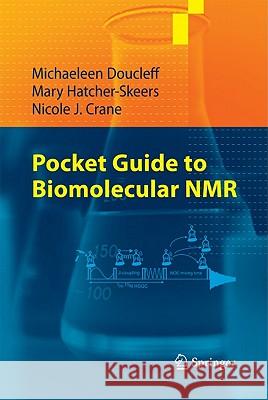
Pocket Guide to Biomolecular NMR  Doucleff 9783642162503  - książkaWidoczna okładka, to zdjęcie poglądowe, a rzeczywista szata graficzna może różnić się od prezentowanej.

Pocket Guide to Biomolecular NMR

ISBN-13: 9783642162503 / Angielski / Miękka / 2011 / 159 str.

Doucleff
cena 281,76
(netto: 268,34 VAT:  5%)

Najniższa cena z 30 dni: 269,85
Termin realizacji zamówienia:
ok. 22 dni roboczych.

Darmowa dostawa!

* Easy-to-understand guide to the subject * Written specifically for life scientists * Avoids complex mathematics Steering clear of quantum mechanics and product operators, "Pocket Guide to Biomolecular NMR" uses intuitive, concrete analogies to explain the theory required to understand NMR studies on the structure and dynamics of biological macromolecules. For example, instead of explaining nuclear spin with angular momentum equations or Hamiltonians, the books describes nuclei as "bells" in a choir, ringing at specific frequencies depending on the atom type and their surrounding electromagnetic environment.This simple bell analogy, which is employed throughout the book, has never been used to explain NMR and makes it surprisingly easy to learn complex, bewildering NMR concepts, such as dipole-dipole coupling and CPMG pulse sequences. Other topics covered include the basics of multi-dimensional NMR, relaxation theory, and Model Free analysis. The small size and fast pace of "Pocket Guide to Biomolecular NMR" makes the book a perfect companion to traditional biophysics and biochemistry textbooks, but the book's unique perspective will provide even seasoned spectroscopists with new insights and handy "thought" short-cuts.


Kategorie:
Nauka, Biologia i przyroda
Kategorie BISAC:
Science > Biochemia
Medical > Biochemistry
Science > Spectroscopy & Spectrum Analysis
Język:
Angielski
ISBN-13:
9783642162503
Rok wydania:
2011
Wydanie:
2011
Ilość stron:
159
Waga:
0.21 kg
Wymiary:
19.6 x 12.9 x 1.0
Oprawa:
Miękka
Wolumenów:
01

1 Atomic Bells and Frequency Finders 1.1 Chemical Choirs 1.2 Essentials of Electromagnetism 1.3 Electromagnetic Microsensors 1.4 Frequency Finders Mathematical Sidebar 1.1: Fourier Transform 1.5 Basics of one-dimensional NMR Mathematical Sidebar 1.2 Converting Hz to PPM References 2 Bonded Bells and Two-Dimensional Spectra 2.1 Introduction to Coupling 2.2 Bonded Bells: J-Coupling Mathematical Sidebar 2.1: Karplus Equation 2.3 NMR Maps: Two-Dimensional Spectra Mathematical Sidebar 2.2 Why 12C and 14N atoms are so shy? 2.4 The 1H-15N HSQC: Our Bread and Butter 2.5 Hidden Notes: Creating Two-Dimensional Spectra References 3 Neighboring Bells and Structure Bundles 3.1 Bumping Bells: Dipole-Dipole Coupling Mathematical Sidebar 3.1: Dipole-dipole Coupling 3.2 Atomic Meter Stick: the NOE 3.3 Into “Three-D” 3.4 Adult “Connect-the-Dots:” HNCA 3.5 Putting the Pieces Together: A Quick Review 3.6 Wet Noodles and Proteins Bundles: Building a Three-Dimensional Structure References 4 Relaxation Theory Part One: Silencing of the Bells 4.1 Nothing Rings Forever: Two Paths to Relax 4.2 Relaxation: Ticket to the Protein Prom Mathematical Sidebar 4.1: Boltzmann Distribution 4.3 Oh-My, How Your Field Fluctuates 4.4 Blowing Off Steam and Returning to Equilibrium: T1 Mathematical Sidebar 4.2: T1 Relaxation 4.5 Loosing Lock-Step : Coherence and T2 Mathematical Sidebar 4.3: T2 Relaxation and Spin Echo References 5 Relaxation Theory Part Two: Moving Atoms and Changing Notes 5.1 Keeping the Terms Straight 5.2 NMR Dynamics in a Nutshell: The Rules of Exchange 5.3 Two States, One Peak: Atoms in the Fast Lane of Exchange 5.4 Two States, Two Peaks: Atoms in the Slow Lane of Exchange 5.5 Two States, One Strange Peak: Atoms in Intermediate Exchange 5.6 Tumbling Together: Rotational Correlation Time (c) 5.7 Summary References 6 Protein Dynamics 6.1 Dynamics Analysis by NMR: Multli-Channel Metronomes, Not a GPS 6.2 Elegant Simplicity: Lipari and Szabo Throw Out the Models 6.3 Wagging Tails and Wiggling Bottoms: Local versus Global Motion 6.4 Measuring Fast Motion: Model Free Analysis Mathematical Sidebar 6.1: Correlation Functions and Model Free 6.5 Changing Directions on the Track: Refocusing Pulses 6.6 Measuring Intermediate Motion: CPMG Relaxation Dispersion Analysis 6.7 Measuring Slow Motion: Z-Exchange Spectroscopy 6.8 Measuring Motion Summary References

Currently an Assistant Editor for the journal Cell, Michaeleen Doucleff obtained her PhD in Chemistry from the University of California, Berkeley while working in the lab of David E. Wemmer. Doucleff then became a Nancy Nossal postdoctoral fellow at the National Institute's of Health in the lab of G. Marius Clore. Throughout her career, she has used NMR spectroscopy and X-ray crystallography to characterize the structure and dynamics of transcription factors and their interaction with DNA.

Mary Hatcher-Skeers is a Professor of Chemistry in the Joint Science Dept. of Claremont McKenna, Pitzer and Scripps Colleges in Claremont CA.  She teaches General Chemistry, Biochemistry, Physical Chemistry and NMR Spectroscopy.  Hatcher-Skeers received her PhD in Chemistry from the University of Washington while working in the lab of Gary Drobny.  She was then a NIH Post-Doctoral Fellow in the labs of Judith Herzfeld at Brandeis University and Robert Griffin at MIT.  Professor Hatcher-Skeers’ research uses solid-state and solution NMR spectroscopy to investigate the role of DNA structure and dynamics in protein and drug binding.  She has trained over 70 undergraduates in her research lab, a number who have gone on to graduate programs in chemistry and biochemistry.

Nicole Crane, Ph.D. is currently a Scientist at the Naval Medical Research Center in Silver Spring, MD where she is establishing the Regenerative Medicine Department’s Advanced Imaging Program.  Her research focuses on development and utilization of spectroscopic techniques to improve understanding of the wound healing process, particularly in traumatic acute wounds, as well as identifying and quantifying transplant-associated ischemia and reperfusion injury. Her experience as an applied spectroscopist includes applications in forensics, pharmaceuticals, and biomedicine. Dr. Crane has published over fifteen peer-reviewed publications and presented at numerous regional and national scientific meetings. She is also an inventor on two US patents. 

Steering clear of quantum mechanics and product operators, "Pocket Guide to Biomolecular NMR" uses intuitive, concrete analogies to explain the theory required to understand NMR studies on the structure and dynamics of biological macromolecules. For example, instead of explaining nuclear spin with angular momentum equations or Hamiltonians, the books describes nuclei as "bells" in a choir, ringing at specific frequencies depending on the atom type and their surrounding electromagnetic environment.This simple bell analogy, which is employed throughout the book, has never been used to explain NMR and makes it surprisingly easy to learn complex, bewildering NMR concepts, such as dipole-dipole coupling and CPMG pulse sequences. Other topics covered include the basics of multi-dimensional NMR, relaxation theory, and Model Free analysis. The small size and fast pace of “Pocket Guide to Biomolecular NMR” makes the book a perfect companion to traditional biophysics and biochemistry textbooks, but the book's unique perspective will provide even seasoned spectroscopists with new insights and handy “thought” short-cuts.


Udostępnij

Facebook - konto krainaksiazek.pl


Opinie o Krainaksiazek.pl na Opineo.pl

Partner Mybenefit

Krainaksiazek.pl w programie rzetelna firma Krainaksiaze.pl - płatności przez paypal

Czytaj nas na:

Facebook - krainaksiazek.pl
  • książki na zamówienie
  • granty
  • książka na prezent
  • kontakt
  • pomoc
  • opinie
  • regulamin
  • polityka prywatności

Zobacz:

  • Księgarnia czeska

  • Wydawnictwo Książkowe Klimaty

1997-2026 DolnySlask.com Agencja Internetowa

© 1997-2022 krainaksiazek.pl
     
KONTAKT | REGULAMIN | POLITYKA PRYWATNOŚCI | USTAWIENIA PRYWATNOŚCI
Zobacz: Księgarnia Czeska | Wydawnictwo Książkowe Klimaty | Mapa strony | Lista autorów
KrainaKsiazek.PL - Księgarnia Internetowa

Polityka prywatnosci - link
Krainaksiazek.pl - płatnośc Przelewy24
Przechowalnia Przechowalnia






