• Wyszukiwanie zaawansowane
  • Kategorie
  • Kategorie BISAC
  • Książki na zamówienie
  • Promocje
  • Granty
  • Książka na prezent
  • Opinie
  • Pomoc
  • Załóż konto
  • Zaloguj się

Peroxisome Proliferator-Activated Receptors (Ppars): Methods and Protocols » książka


zaloguj się | załóż konto
Logo Krainaksiazek.pl

koszyk

konto

szukaj
topmenu
Księgarnia internetowa
Szukaj
Książki na zamówienie
Promocje
Granty
Książka na prezent
Moje konto
Pomoc
 
 
Wyszukiwanie zaawansowane
Pusty koszyk
Bezpłatna dostawa dla zamówień powyżej 20 złBezpłatna dostawa dla zamówień powyżej 20 zł

Kategorie główne

• Nauka
 [2944077]
• Literatura piękna
 [1814251]

  więcej...
• Turystyka
 [70679]
• Informatyka
 [151074]
• Komiksy
 [35590]
• Encyklopedie
 [23169]
• Dziecięca
 [611005]
• Hobby
 [136031]
• AudioBooki
 [1718]
• Literatura faktu
 [225599]
• Muzyka CD
 [379]
• Słowniki
 [2916]
• Inne
 [443741]
• Kalendarze
 [1187]
• Podręczniki
 [166463]
• Poradniki
 [469211]
• Religia
 [506887]
• Czasopisma
 [481]
• Sport
 [61343]
• Sztuka
 [242115]
• CD, DVD, Video
 [3348]
• Technologie
 [219293]
• Zdrowie
 [98602]
• Książkowe Klimaty
 [124]
• Zabawki
 [2385]
• Puzzle, gry
 [3504]
• Literatura w języku ukraińskim
 [260]
• Art. papiernicze i szkolne
 [7151]
Kategorie szczegółowe BISAC

Peroxisome Proliferator-Activated Receptors (Ppars): Methods and Protocols

ISBN-13: 9781627031547 / Angielski / Twarda / 2012 / 343 str.
Mostafa Z. Badr; Jihan Youssef
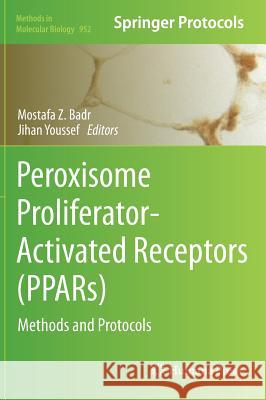
Peroxisome Proliferator-Activated Receptors (Ppars): Methods and Protocols Badr, Mostafa Z. 9781627031547 Humana Press - książkaWidoczna okładka, to zdjęcie poglądowe, a rzeczywista szata graficzna może różnić się od prezentowanej.

Peroxisome Proliferator-Activated Receptors (Ppars): Methods and Protocols

ISBN-13: 9781627031547 / Angielski / Twarda / 2012 / 343 str.

Mostafa Z. Badr; Jihan Youssef
cena 603,81
(netto: 575,06 VAT:  5%)

Najniższa cena z 30 dni: 578,30
Termin realizacji zamówienia:
ok. 22 dni roboczych.

Darmowa dostawa!

All three peroxisome proliferator-activated receptor (PPAR) subtypes share a high degree of structural homology but differ in function, tissue distribution and ligand specificity. PPARs play critical roles as regulators of numerous physiological as well as pathophysiological pathways, and efforts are currently underway to fully characterize their functioning and to develop safer and more effective PPAR modulators to treat a myriad of diseases and conditions. In Peroxisome proliferator-Activated Receptors: Methods and Protocols, renowned experts in the PPAR arena provide detailed protocols for investigating these receptors. Chapters contain methods ranging from the cloning of receptors to their knockdown, to protocols exploring posttranslational modifications of PPARs and coactivators, as well as receptor subcellular localization. Also assembled are methods to evaluate the involvement of these receptors in behavior functions, an emerging facet in PPAR research. Written in the successful Methods in Molecular Biology series format, chapters include introductions to their respective topics, lists of the necessary materials and reagents, step-by-step, readily reproducible protocols, and notes on troubleshooting and avoiding known pitfalls.With its well-honed methodologies, Peroxisome proliferator-Activated Receptors: Methods and Protocols, will be a useful resource for all seeking to advance their knowledge of this field.


Kategorie:
Nauka, Biologia i przyroda
Kategorie BISAC:
Science > Biochemia
Technology & Engineering > Materials Science - General
Wydawca:
Humana Press
Seria wydawnicza:
Methods in Molecular Biology
Język:
Angielski
ISBN-13:
9781627031547
Rok wydania:
2012
Wydanie:
2013
Numer serii:
000014950
Ilość stron:
343
Waga:
8.20 kg
Wymiary:
25.4 x 17.8
Oprawa:
Twarda
Wolumenów:
01
Dodatkowe informacje:
Bibliografia
Wydanie ilustrowane

1. PPARs: History and Advances

            Jihan Youssef and Mostafa Badr


2. PPAR-Alpha Cloning, Expression and Characterization

            Suong N. T. Ngo and Ross McKinnon


3. PPARGC1A and PPARG Genotyping. Beginner’s Guide to Genotyping with Unlabeled Probes

            Viera Habalova and Josef Židzik


4. Generation of an Inducible, Cardiomyocyte-Specific Transgenic Mouse Model with PPARβ/d Overexpression

Teayoum Kim, Olga Zhelyabovska, Jian Liu, and Qinglin Yang


5. Specific knockdown of PPARd Gene in Colon Cancer Cells by Lentivirus-Mediated RNA Interfering

            Lie Yang, Zong-Guang Zhou, and Xiao-Feng Sun


6. Dominant-Negative and Knockdown Approaches to Studying PPAR activity

            Sudhir Singh and Robert G. Bennett


7. Producing PPARgamma2 Knockdown in Mouse Liver

            Tomomi Yamazaki and Osamu Ezaki


8. Adipose Tissue-Specific PPARg Gene Targeting

            Weimin He


9. Site-Directed Mutagenesis to Study the Role of Specific Amino Acids in the Ligand Binding Domain of PPARs

            Nico Mitro, Frederica Gilardi, Marco Giudici, Cristina Godio, Elena Scotti, and Maurizio Crestani


10. PPAR SUMOylation: Some Useful Experimental Tips

            Benoit Pourcet, Bart Staels, and Corine Glineur


11. Analyzing Phosphorylation-Dependent Regulation of Subcellular Transcriptional Activity of Transcriptional Coactivator NT-PGC-1a

            Ji Suk Chang and Thomas W. Gettys


12. In vivo Studies of PPAR-Chromatin Interactions: Chromatin Immunoprecipitation for Single-Locus and Genomewide Analyses

            Till Adhikary and Rolf Müller


13. FISH Analysis Using PPARg  Specific Probes for Detection of PAX8-PPARg Translocation in Follicular Thyroid Neoplasms

            Sharifah Noor Akmal Syed Hussain, Chia Wai Kit, and Zubaidah Zakaraia


14. Immunohistochemical Techniques to Identify and Localize Proteins of Interest in Paraffin-Embedded Tissue Sections

            Carolyn M. Komar and Mary Jane Long


15. Determination of PPAR Expression by Western-Blot

            Aziz Gullich and Catherine Coirault


16. Fluorescence Resonance Energy Transfer Techniques to Study Ligand-Mediated Interactions of PPARs with Coregulators

            Nico Mitro, Cristina Godio, and Maurizio Crestani


17. Estimation of the PPARa Agonism of Fibrates by a Combined MM-Docking Approach

            Fabio Lannutti, Alessandro Marrone, and Nazzareno Re


18. Combined Biophysical and Cell-based Approaches for the Assessment of Ligand Binding to PPARg

            Silvia Zorrilla and Dolores Pérez-Sala


19. Exploring PPAR Modulation in Experimental Mice

            Anna Rull, Gerard Aragonès, Raúl Beltrán-Debón, Esther Rodríguez-Gallego, Jordi Camps, Jorge Joven


20. Induction of Adipogenic Differentiation in Three-Dimensional Culture Model on a Novel Microfabricated Scaffold

            Yoshitaka Miyagawa, Hajime Okita, and Nobutaka Kiyokawa


21. Analyzing PPAa/Ligand Interactions by Chemical Cross-Linking and High-Resolution Mass Spectrometry

            Mathias Muller, Christian Ihling, and Andrea Sinz


22. Synthesis, Mass Spectrometric Characterization, and Analysis of the PPARd Agonist GW1516 and its Major Human Metabolites – Targets in Sports Drug Testing

            Mario Thevis, Ines Möller, Simon Beuk, and Wihelm Schänzer


23. LC-MS-Based Method for the Qualitative and Quantitative Analysis of the Novel PPARg Agonist KR-62980

            Mi-Sun Kim and Myung Ae Bae


24. Behavioral Paradigms to Evaluate PPAR Modulation in Animal Models of Brain   Injury

            Dana Greene-Schloesser, Caroline I. Schnegg, and Mike E. Robbins

All three peroxisome proliferator-activated receptor (PPAR) subtypes share a high degree of structural homology but differ in function, tissue distribution and ligand specificity. PPARs play critical roles as regulators of numerous physiological as well as pathophysiological pathways, and efforts are currently underway to fully characterize their functioning and to develop safer and more effective PPAR modulators to treat a myriad of diseases and conditions. In Peroxisome proliferator-Activated Receptors: Methods and Protocols, renowned experts in the PPAR arena provide detailed protocols for investigating these receptors. Chapters contain methods ranging from the cloning of receptors to their knockdown, to protocols exploring posttranslational modifications of PPARs and coactivators, as well as receptor subcellular localization. Also assembled are methods to evaluate the involvement of these receptors in behavior functions, an emerging facet in PPAR research. Written in the successful Methods in Molecular Biology™ series format, chapters include introductions to their respective topics, lists of the necessary materials and reagents, step-by-step, readily reproducible protocols, and notes on troubleshooting and avoiding known pitfalls.


With its well-honed methodologies, Peroxisome proliferator-Activated Receptors: Methods and Protocols,  will be a useful resource for all seeking to advance their knowledge of this field.



Udostępnij

Facebook - konto krainaksiazek.pl


Opinie o Krainaksiazek.pl na Opineo.pl

Partner Mybenefit

Krainaksiazek.pl w programie rzetelna firma Krainaksiaze.pl - płatności przez paypal

Czytaj nas na:

Facebook - krainaksiazek.pl
  • książki na zamówienie
  • granty
  • książka na prezent
  • kontakt
  • pomoc
  • opinie
  • regulamin
  • polityka prywatności

Zobacz:

  • Księgarnia czeska

  • Wydawnictwo Książkowe Klimaty

1997-2026 DolnySlask.com Agencja Internetowa

© 1997-2022 krainaksiazek.pl
     
KONTAKT | REGULAMIN | POLITYKA PRYWATNOŚCI | USTAWIENIA PRYWATNOŚCI
Zobacz: Księgarnia Czeska | Wydawnictwo Książkowe Klimaty | Mapa strony | Lista autorów
KrainaKsiazek.PL - Księgarnia Internetowa

Polityka prywatnosci - link
Krainaksiazek.pl - płatnośc Przelewy24
Przechowalnia Przechowalnia




