On the Old Saw: That May Be Right in Theory But It Won't Work in Practice » książka





On the Old Saw: That May Be Right in Theory But It Won't Work in Practice
ISBN-13: 9780812210583 / Angielski / Miękka / 1974 / 88 str.
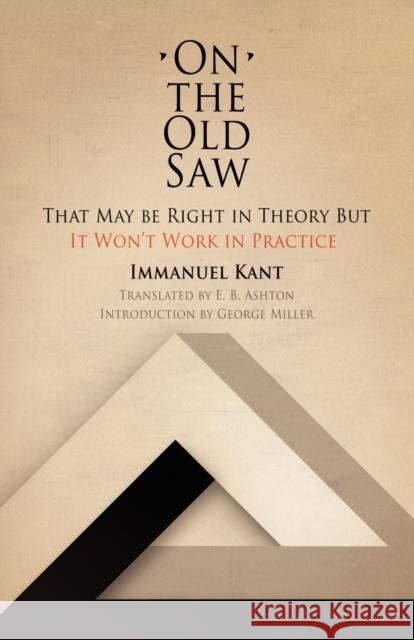
"The old objection to philosophy that it is 'impractical' seems to have as one of its best targets Kant's philosophy. In this essay, Kant responds to this objection in the name of philosophy in general and in his own name as a philosopher whose thoughts were and still are commonly believed to be singularly applicable to the realities of politics and everyday life. This essay is of prime importance in reaching a just estimate of the contribution philosophy, including Kantian philosophy, can make to the practical solution of human problems."--Lewis White Beck In this famous essay, first published in 1793, Kant considers the alleged conflict between theory and practice in the conduct of human affairs in three widening contexts: those of the common person faced with a moral decision, of the politician and the citizen concerned with the extent and limits of political obligation, and, finally, of the citizen of the world whose actions have a bearing on war and peace among nations. Unlike other animals, Kant reminds us, people must decide how they will live their lives. They therefore ask for a guide to action, a set of principles--a theory. From the outset, Kant rejects the ancient claim that the practical possibilities of action cannot always be reconciled with moral demands. He offers his own moral theory, a theory starting out from the principle of the right as an unequivocal guide to action. In partial disagreement with the rival theories of Hobbes and Locke, he proposes that the only condition under which the individual can achieve true destiny as a person and a member of the human race is the civil state. Such a state can be secured only by law. Although "from such crooked wood as man is made of, nothing perfectly straight can be built," only the rule of law can bring about a stable society. Last, Kant turns to the relation between theory and practice in international relations. "Nowhere," he writes, "does human nature appear less lovable than in the relation of whole nations to each other." But to hope for world peace on the basis of "the so-called balance of power is a mere chimera." There is no other remedy to international lawlessness and war than an international coercive law, and such law can grow only out of sound theory. "I put my trust in theory. At the same time, I trust in the nature of things, and also take account of human nature, which I cannot, or will not, consider so steeped in evil that in the end reason should not triumph." Immanuel Kant (1724-1804) was one of the most important philosophers of the eighteenth century. His Critique of Pure Reason continues to influence thinkers and critics today. E. B. Ashton is translator of many works, including Kant's Political Thought: Its Origins and Development and Primal Vision: Selected Writings of Gottfried Benn. George Miller (1920- ) is James S. McDonnell Distinguished University Professor, Emeritus, at Princeton University. His books include Language and Speech and Mathematics and Psychology.
"The old objection to philosophy that it is impractical seems to have as one of its best targets Kants philosophy. In this essay, Kant responds to this objection in the name of philosophy in general and in his own name as a philosopher whose thoughts were and still are commonly believed to be singularly applicable to the realities of politics and everyday life. This essay is of prime importance in reaching a just estimate of the contribution philosophy, including Kantian philosophy, can make to the practical solution of human problems."--Lewis White BeckIn this famous essay, first published in 1793, Kant considers the alleged conflict between theory and practice in the conduct of human affairs in three widening contexts: those of the common person faced with a moral decision, of the politician and the citizen concerned with the extent and limits of political obligation, and, finally, of the citizen of the world whose actions have a bearing on war and peace among nations.Unlike other animals, Kant reminds us, people must decide how they will live their lives. They therefore ask for a guide to action, a set of principles--a theory.From the outset, Kant rejects the ancient claim that the practical possibilities of action cannot always be reconciled with moral demands. He offers his own moral theory, a theory starting out from the principle of the right as an unequivocal guide to action. In partial disagreement with the rival theories of Hobbes and Locke, he proposes that the only condition under which the individual can achieve true destiny as a person and a member of the human race is the civil state. Such a state can be secured only by law. Although "from such crooked wood as man is made of, nothing perfectly straight can be built," only the rule of law can bring about a stable society.Last, Kant turns to the relation between theory and practice in international relations. "Nowhere," he writes, "does human nature appear less lovable than in the relation of whole nations to each other." But to hope for world peace on the basis of "the so-called balance of power is a mere chimera." There is no other remedy to international lawlessness and war than an international coercive law, and such law can grow only out of sound theory. "I put my trust in theory. At the same time, I trust in the nature of things, and also take account of human nature, which I cannot, or will not, consider so steeped in evil that in the end reason should not triumph."Immanuel Kant (1724-1804) was one of the most important philosophers of the eighteenth century. His Critique of Pure Reason continues to influence thinkers and critics today.E. B. Ashton is translator of many works, including Kants Political Thought: Its Origins and Development and Primal Vision: Selected Writings of Gottfried Benn.George Miller (1920- ) is James S. McDonnell Distinguished University Professor, Emeritus, at Princeton University. His books include Language and Speech and Mathematics and Psychology.




Czytaj nas na:
KrainaKsiazek.PL - Księgarnia Internetowa


