A refreshing approach to the study of major Western philosophers. Introductory essays by noted scholars enliven each volume with insights into the human side of the great thinkers, and provide authoritative discussions of the historical background, evolution, and importance of their ideas. Highly recommended as stimulating classroom texts.
A refreshing approach to the study of major Western philosophers. Introductory essays by noted scholars enliven each volume with insights into the hum...
A refreshing approach to the study of major Western philosophers. Introductory essays by noted scholars enliven each volume with insights into the human side of the great thinkers, and provide authoritative discussions of the historical background, evolution, and imporace of their ideas. Highly recommended as stimulating classroom texts.
A refreshing approach to the study of major Western philosophers. Introductory essays by noted scholars enliven each volume with insights into the hum...
In this classic text, Kant sets out to articulate and defend the Categorical Imperative - the fundamental principle that underlies moral reasoning - and to lay the foundation for a comprehensive account of justice and human virtues. This new edition and translation of Kant's work is designed especially for students. An extensive and comprehensive introduction explains the central concepts of Groundwork and looks at Kant's main lines of argument. Detailed notes aim to clarify Kant's thoughts and to correct some common misunderstandings of his doctrines.
In this classic text, Kant sets out to articulate and defend the Categorical Imperative - the fundamental principle that underlies moral reasoning - a...
Drawn from the Prussian Academy edition of Kant's collected works, these letters make it possible to trace the development of Kant's thought from his earliest worries about the topics discussed in the "Critique of Pure Reason" to his attempts in later life to meet the objections of his critics and erstwhile disciples. "Perhaps the major value of these writings is their demonstration of Kant's own attitude towards his philosophical works."-Paul Arthur Schilpp, "Saturday Review"
Drawn from the Prussian Academy edition of Kant's collected works, these letters make it possible to trace the development of Kant's thought from his ...
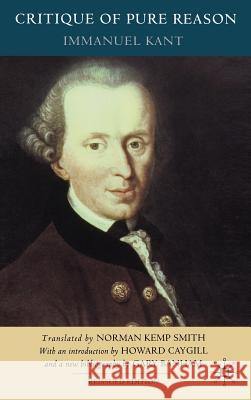
Kant's Critique of Pure Reason is one of the most rewarding of all philosophical works. The text follows the second edition of 1787, with a translation of all first edition passages altered or omitted. For this reissue of Kemp Smith's classic 1929 edition, Gary Banham contributes a major new Bibliography of secondary sources on Kant.
Kant's Critique of Pure Reason is one of the most rewarding of all philosophical works. The text follows the second edition of 1787, with a translatio...
The second of Kant's three critiques, Critique of Practical Reason forms the center of Kantian philosophy; published in 1788, it is bookended by his Critique of Pure Reason and Critique of Judgement. With this work Kant establishes his role as a vindicator of the truth of Christianity; he approaches his proof by presenting positive affirmation of the immortality of the soul and the existence of God. The philosopher offers an argument concerning the summum bonum of life: people should not simply search after happiness, but follow the moral law and seek to become...
The second of Kant's three critiques, Critique of Practical Reason forms the center of Kantian philosophy; published in 1788, it is bookended b...
What is morally permissible, and what is morally obligatory? These questions form the core of a vast amount of philosophical reasoning. In his Fundamental Principles of the Metaphysics of Morals, Immanuel Kant developed a basis for the answers. In this landmark work, the German philosopher asks what sort of maxim might function as a guide to appropriate action under a given set of circumstances. By universalizing such a maxim, would morally permissible behavior not become clear? Suppose that everyone were to behave in accordance with this maxim. If everyone followed the maxim in...
What is morally permissible, and what is morally obligatory? These questions form the core of a vast amount of philosophical reasoning. In his Fund...
This 1790 polemic by one of philosophy's most important and influential figures attempts to establish the principles that support the faculty of judgment. Kant's third critique after Critique of Practical Reason and Critique of Pure Reason remains one of the most important works on human reason. The Critique of Judgment informs the very basis of modern aesthetics by establishing the almost universally accepted framework for debate of aesthetic issues. As in his previous critiques, Kant seeks to establish a priori principles. The first part of this work...
This 1790 polemic by one of philosophy's most important and influential figures attempts to establish the principles that support the faculty of judgm...
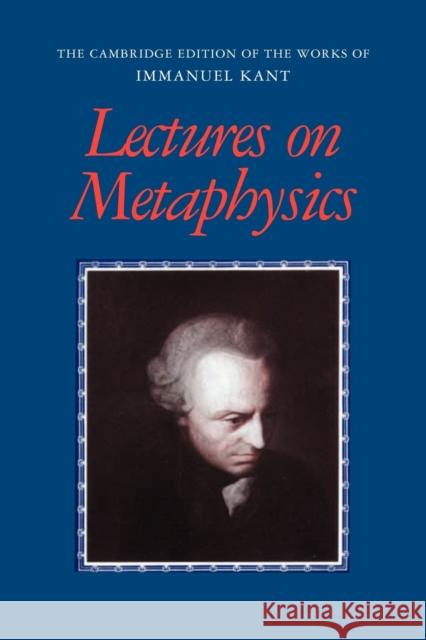
The purpose of the Cambridge Edition is to offer translations of the best modern German edition of Kant's work in a uniform format suitable for Kant scholars. This volume contains the first translation into English of notes from Kant's lectures on metaphysics. These lectures, dating from the 1760's to the 1790's, touch on all the major topics and phases of Kant's philosophy. Most of these notes have appeared only recently in the German Academy Edition and this translation offers many corrections of that edition.
The purpose of the Cambridge Edition is to offer translations of the best modern German edition of Kant's work in a uniform format suitable for Kant s...