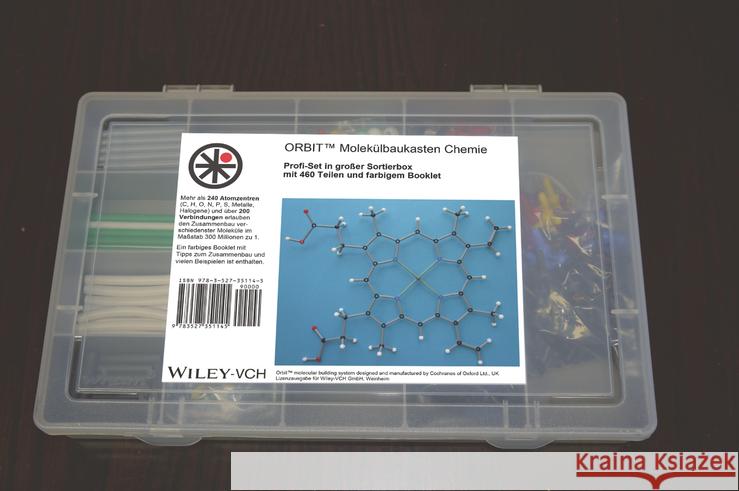
246 Atomzentren in folgender Aufteilung:55 x Wasserstoff (weiß / monovalent)10 x Kohlenstoff (schwarz / divalent / 180 Grad)24 x Kohlenstoff (schwarz / trivalent / trigonal-planar)36 x Kohlenstoff (schwarz / tetravalent / tetraedrisch)2 x Kohlenstoff (schwarz / pentavalent / trigonal-bipyramidal)2 x Kohlenstoff (schwarz / hexavalent / oktaedrisch)4 x Stickstoff (blau / monovalent)2 x Stickstoff (blau / divalent / 180 Grad)6 x Stickstoff (blau / divalent / 120 Grad)6 x Stickstoff (blau / trivalent / trigonal-planar)6 x Stickstoff (blau / tetravalent / tetraedrisch)1 x Stickstoff (blau / pentavalent / trigonal-bipyramidal)10 x Sauerstoff (rot / monovalent)25 x Sauerstoff (rot / divalent / 110 Grad)4 x Sauerstoff (rot / tetravalent / tetraedrisch)10 x Fluor (hellgrün / monovalent)5 x Phosphor (violett / tetravalent / tetraedrisch)1 x Phosphor (violett / pentavalent / trigonal-bipyramidal)2 x Schwefel (gelb / monovalent)10 x Schwefel (gelb / divalent / 100 Grad)5 x Schwefel (gelb / tetravalent / tetraedrisch)1 x Schwefel (gelb / hexavalent / oktaedrisch)15 x Chlor (grün / monovalent)2 x Metall (silber / tetravalent / tetraedrisch)2 x Metall (silber / hexavalent / oktaedrisch)außerdem 213 Verbindungen in unterschiedlichen Längen, eine große Aufbewahrungsbox mit 13 Fächern und transparentem Deckel sowie ein farbiges Anleitungsheft
Das ORBIT-Baukastensystem ist eine Entwicklung der Firma Cochrane's of Oxford, die seit 1962 Molekülbaukästen und andere Lehrmittel für Schule und Hochschule produziert.