• Wyszukiwanie zaawansowane
  • Kategorie
  • Kategorie BISAC
  • Książki na zamówienie
  • Promocje
  • Granty
  • Książka na prezent
  • Opinie
  • Pomoc
  • Załóż konto
  • Zaloguj się

Nonlinear Control Systems: Analysis and Design » książka


zaloguj się | załóż konto
Logo Krainaksiazek.pl

koszyk

konto

szukaj
topmenu
Księgarnia internetowa
Szukaj
Książki na zamówienie
Promocje
Granty
Książka na prezent
Moje konto
Pomoc
 
 
Wyszukiwanie zaawansowane
Pusty koszyk
Bezpłatna dostawa dla zamówień powyżej 20 złBezpłatna dostawa dla zamówień powyżej 20 zł

Kategorie główne

• Nauka
 [2946600]
• Literatura piękna
 [1856966]

  więcej...
• Turystyka
 [72221]
• Informatyka
 [151456]
• Komiksy
 [35826]
• Encyklopedie
 [23190]
• Dziecięca
 [619653]
• Hobby
 [140543]
• AudioBooki
 [1577]
• Literatura faktu
 [228355]
• Muzyka CD
 [410]
• Słowniki
 [2874]
• Inne
 [445822]
• Kalendarze
 [1744]
• Podręczniki
 [167141]
• Poradniki
 [482898]
• Religia
 [510455]
• Czasopisma
 [526]
• Sport
 [61590]
• Sztuka
 [243598]
• CD, DVD, Video
 [3423]
• Technologie
 [219201]
• Zdrowie
 [101638]
• Książkowe Klimaty
 [124]
• Zabawki
 [2473]
• Puzzle, gry
 [3898]
• Literatura w języku ukraińskim
 [254]
• Art. papiernicze i szkolne
 [8170]
Kategorie szczegółowe BISAC

Nonlinear Control Systems: Analysis and Design

ISBN-13: 9780471427995 / Angielski / Twarda / 2003 / 376 str.
Horacio J. Marquez
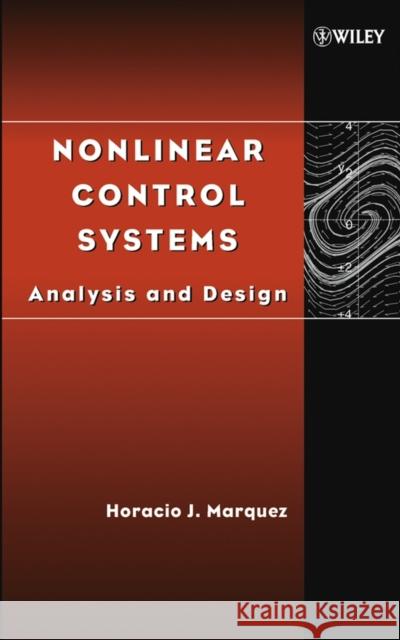
Nonlinear Control Systems: Analysis and Design Márquez, Horacio 9780471427995 Wiley-Interscience - książkaWidoczna okładka, to zdjęcie poglądowe, a rzeczywista szata graficzna może różnić się od prezentowanej.

Nonlinear Control Systems: Analysis and Design

ISBN-13: 9780471427995 / Angielski / Twarda / 2003 / 376 str.

Horacio J. Marquez
cena 573,64 zł
(netto: 546,32 VAT:  5%)

Najniższa cena z 30 dni: 568,93 zł
Termin realizacji zamówienia:
ok. 30 dni roboczych
Bez gwarancji dostawy przed świętami

Darmowa dostawa!

Provides complete coverage of both the Lyapunov and Input-Output stability theories, ina readable, concise manner.
* Supplies an introduction to the popular backstepping approach to nonlinear control design
* Gives a thorough discussion of the concept of input-to-state stability
* Includes a discussion of the fundamentals of feedback linearization and related results.
* Details complete coverage of the fundamentals of dissipative system's theory and its application in the so-called L2gain control prooblem, for the first time in an introductory level textbook.
* Contains a thorough discussion of nonlinear observers, a very important problem, not commonly encountered in textbooksat this level. *An Instructor's Manual presenting detailed solutions to all the problems in the book is available from the Wiley editorial department.


Kategorie:
Technologie
Kategorie BISAC:
Technology & Engineering > Robotics
Science > System Theory
Mathematics > Matematyka
Wydawca:
Wiley-Interscience
Język:
Angielski
ISBN-13:
9780471427995
Rok wydania:
2003
Ilość stron:
376
Waga:
0.64 kg
Wymiary:
23.88 x 16.41 x 2.26
Oprawa:
Twarda
Wolumenów:
01
Dodatkowe informacje:
Bibliografia
Wydanie ilustrowane

a self–contained readable presentation of nonlinear control systems ( Zentralblatt Math, Vol.1037, No.12, 2004)

" an excellent, pedagogically sound book on analysis and design of nonlinear control systems." (International Journal of General Systems, December 2003)

Introduction.

1.1 Linear Time–Invariant Systems.

1.2 Nonlinear Systems.

1.3 Equilibrium Points.

1.4 First–Order Autonomous Nonlinear Systems.

1.5 Second–Order Systems: Phase–Plane Analysis.

1.6 Phase–Plane Analysis of Linear Time–Invariant Systems.

1.7 Phase–Plane Analysis of Nonlinear Systems.

1.8 Higher–Order Systems.

1.9 Examples of Nonlinear Systems.

1.10 Exercises.

Mathematical Preliminaries.

2.1 Sets.

2.2 Metric Spaces.

2.3 Vector Spaces.

2.4 Matrices.

2.5 Basic Topology.

2.6 Sequences.

2.7 Functions.

2.8 Differentiability.

2.9 Lipschitz Continuity.

2.10 Contraction Mapping.

2.11 Solution of Differential Equations.

2.12 Exercises.

Lyapunov Stability I: Autonomous Systems.

3.1 Definitions.

3.2 Positive Definite Functions.

3.3 Stability Theorems.

3.4 Examples.

3.5 Asymptotic Stability in the Large.

3.6 Positive Definite Functions Revisited.

3.7 Construction of Lyapunov Functions.

3.8 The Invariance Principle.

3.9 Region of Attraction.

3.10 Analysis of Linear Time–Invariant Systems.

3.11 Instability.

3.12 Exercises.

Lyapunov Stability II: Nonautonomous Systems.

4.1 Definitions.

4.2 Positive Definite Functions.

4.3 Stability Theorems.

4.4 Proof of the Stability Theorems.

4.5 Analysis of Linear Time–Varying Systems.

4.6 Perturbation Analysis.

4.7 Converse Theorems.

4.8 Discrete–Time Systems.

4.9 Discretization.

4.10 Stability of Discrete–Time Systems.

4.11 Exercises.

Feedback Systems.

5.1 Basic Feedback Stabilization.

5.2 Integrator Backstepping.

5.3 Backstepping: More General Cases.

5.4 Examples.

5.5 Exercises.

Input–Output Stability.

6.1 Function Spaces.

6.2 Input–Output Stability.

6.3 Linear Time–Invariant Systems.

6.4 Lp  Gains for LTI Systems.

6.5 Closed Loop Input–Output Stability.

6.6 The Small Gain Theorem.

6.7 Loop Transformations.

6.8 The Circle Criterion.

6.9 Exercises.

Input–to–State Stability.

7.1 Motivation.

7.2 Definitions.

7.3 Input–to–State Stability (ISS) Theorems.

7.4 Input–to–State Stability Revisited.

7.5 Cascade Connected Systems.

7.6 Exercises.

Passivity.

8.1 Power and Energy: Passive Systems.

8.2 Definitions.

8.3 Interconnections of Passivity Systems.

8.4 Stability of Feedback Interconnections.

8.5 Passivity of Linear Time–Invariant Systems.

8.6 Strictly Positive Real Rational Functions.

Exercises.

Dissipativity.

9.1 Dissipative Systems.

9.2 Differentiable Storage Functions.

9.3 QSR Dissipativity.

9.4 Examples.

9.5 Available Storage.

9.6 Algebraic Condition for Dissipativity.

9.7 Stability of Dissipative Systems.

9.8 Feedback Interconnections.

9.9 Nonlinear L2 Gain.

9.10 Some Remarks about Control Design.

9.11 Nonlinear L2–Gain Control.

9.12 Exercises.

Feedback Linearization.

10.1 Mathematical Tools.

10.2 Input–State Linearization.

10.3 Examples.

10.4 Conditions for Input–State Linearization.

10.5 Input–Output Linearization.

10.6 The Zero Dynamics.

10.7 Conditions for Input–Output Linearization.

10.8 Exercises.

Nonlinear Observers.

11.1 Observers for Linear Time–Invariant Systems.

11.2 Nonlinear Observability.

11.3 Observers with Linear Error Dynamics.

11.4 Lipschitz Systems.

11.5 Nonlinear Separation Principle.

Proofs.

Bibliography.

List of Figures.

Index.

HORACIO J. MARQUEZ is currently Associate Professor and Associate Chair of Graduate Studies in the Department of Electrical and Computer Engineering at the University of Alberta, Canada. Dr. Marquez has published numerous articles in journals and conference proceedings on subjects including control theory, nonlinear systems, robust control, and gain scheduling. He received the University of Alberta McCalla Research Professorship for 2003 04.

A thorough yet highly readable introduction to the complex world of nonlinear science

Today’s technological advances have brought about a growing demand for better performance. This, coupled with the availability of low–cost computing power, has led control engineers to face problems of increasingly higher complexity. Consequently, the linear approximations once used to analyze these problems are giving way to more accurate and realistic nonlinear models, forcing both students and industry practitioners to abandon the peripheral view of the linear world and immerse themselves in the reality of nonlinear science. Nonlinear Control Systems: Analysis and Design addresses the need for an up–to–date yet readable pedagogical presentation of this difficult subject. Assuming no previous background on the subject, the author takes readers from the very basics to some of the most current research topics being addressed today.

Highlights of the text include:

  • Complete yet concise coverage of both the Lyapunov and Input–Output stability theories
  • An introduction to the popular backstepping approach to nonlinear control design
  • Thorough discussion of the concept of input–to–state stability
  • Coverage of the fundamentals of feedback linearization and related results
  • Detailed coverage of the fundamentals of dissipative systems theory and its application in the so–called L2gain control problem
  • In–depth discussion of nonlinear observers, a very important problem not commonly covered in introductory textbooks

The author’s friendly, accessible treatment of even highly complex topics makes this text an invaluable resource for students and professionals alike.

Marquez, Horacio J. HORACIO J. MARQUEZ is currently Associate Professo... więcej >


Udostępnij

Facebook - konto krainaksiazek.pl


Opinie o Krainaksiazek.pl na Opineo.pl

Partner Mybenefit

Krainaksiazek.pl w programie rzetelna firma Krainaksiaze.pl - płatności przez paypal

Czytaj nas na:

Facebook - krainaksiazek.pl
  • książki na zamówienie
  • granty
  • książka na prezent
  • kontakt
  • pomoc
  • opinie
  • regulamin
  • polityka prywatności

Zobacz:

  • Księgarnia czeska

  • Wydawnictwo Książkowe Klimaty

1997-2025 DolnySlask.com Agencja Internetowa

© 1997-2022 krainaksiazek.pl
     
KONTAKT | REGULAMIN | POLITYKA PRYWATNOŚCI | USTAWIENIA PRYWATNOŚCI
Zobacz: Księgarnia Czeska | Wydawnictwo Książkowe Klimaty | Mapa strony | Lista autorów
KrainaKsiazek.PL - Księgarnia Internetowa

Polityka prywatnosci - link
Krainaksiazek.pl - płatnośc Przelewy24
Przechowalnia Przechowalnia





