• Wyszukiwanie zaawansowane
  • Kategorie
  • Kategorie BISAC
  • Książki na zamówienie
  • Promocje
  • Granty
  • Książka na prezent
  • Opinie
  • Pomoc
  • Załóż konto
  • Zaloguj się

New Pathways for Organic Synthesis: Practical Applications of Transition Metals » książka


zaloguj się | załóż konto
Logo Krainaksiazek.pl

koszyk

konto

szukaj
topmenu
Księgarnia internetowa
Szukaj
Książki na zamówienie
Promocje
Granty
Książka na prezent
Moje konto
Pomoc
 
 
Wyszukiwanie zaawansowane
Pusty koszyk
Bezpłatna dostawa dla zamówień powyżej 20 złBezpłatna dostawa dla zamówień powyżej 20 zł

Kategorie główne

• Nauka
 [2944077]
• Literatura piękna
 [1814251]

  więcej...
• Turystyka
 [70679]
• Informatyka
 [151074]
• Komiksy
 [35590]
• Encyklopedie
 [23169]
• Dziecięca
 [611005]
• Hobby
 [136031]
• AudioBooki
 [1718]
• Literatura faktu
 [225599]
• Muzyka CD
 [379]
• Słowniki
 [2916]
• Inne
 [443741]
• Kalendarze
 [1187]
• Podręczniki
 [166463]
• Poradniki
 [469211]
• Religia
 [506887]
• Czasopisma
 [481]
• Sport
 [61343]
• Sztuka
 [242115]
• CD, DVD, Video
 [3348]
• Technologie
 [219293]
• Zdrowie
 [98602]
• Książkowe Klimaty
 [124]
• Zabawki
 [2385]
• Puzzle, gry
 [3504]
• Literatura w języku ukraińskim
 [260]
• Art. papiernicze i szkolne
 [7151]
Kategorie szczegółowe BISAC

New Pathways for Organic Synthesis: Practical Applications of Transition Metals

ISBN-13: 9781461296539 / Angielski / Miękka / 2011 / 468 str.
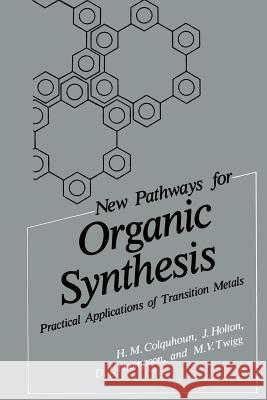
H. M. Colquhoun; J. Holton;D. J. Thompson
New Pathways for Organic Synthesis: Practical Applications of Transition Metals Colquhoun, H. M. 9781461296539 Springer - książkaWidoczna okładka, to zdjęcie poglądowe, a rzeczywista szata graficzna może różnić się od prezentowanej.

New Pathways for Organic Synthesis: Practical Applications of Transition Metals

ISBN-13: 9781461296539 / Angielski / Miękka / 2011 / 468 str.

H. M. Colquhoun; J. Holton;D. J. Thompson
cena 201,24
(netto: 191,66 VAT:  5%)

Najniższa cena z 30 dni: 192,74
Termin realizacji zamówienia:
ok. 22 dni roboczych.

Darmowa dostawa!

The continually growing contribution of transition metal chemistry to synthetic organic chemistry is, of course, widely recognized. Equally well known is the difficulty in keeping up-to-date with the multifarious reactions and procedures that seem to be spawned at an ever-increasing rate. These can certainly be summarized on the basis of reviews under the headings of the individual transition metals. More useful to the bench organic chemist, however, would be the opposite type of concordance based on the structural type of the desired synthetic product. This is the approach taken in the present monograph, which presents for each structural entity a conspectus of the transition metal-mediated processes that can be employed in its production. The resulting comparative survey should be a great help in devising the optimum synthetic approach for a particular goal. It is presented from an essentially practical viewpoint, with detailed direc tions interspersed in the Houben-Weyl style. The wide scope of the volume should certainly encourage synthetic organic chemists to utilize fully the range and versatility of these transition metal-mediated processes. This will certainly be a well-thumbed reference book R. A. RAPHAEL Cambridge University v Preface In recent years an enormous amount of work has been done on the catalysis of organic reactions by various transition metal species and on the organic reactivity of organo-transition-metal compounds."


Kategorie:
Nauka, Chemia
Kategorie BISAC:
Science > Chemia - Nieorganiczna
Science > Chemia - Organiczna
Science > Chemia - Fizyczna
Wydawca:
Springer
Język:
Angielski
ISBN-13:
9781461296539
Rok wydania:
2011
Wydanie:
Softcover Repri
Ilość stron:
468
Waga:
0.62 kg
Wymiary:
22.86 x 15.24 x 2.41
Oprawa:
Miękka
Wolumenów:
01
Dodatkowe informacje:
Wydanie ilustrowane

1. Introduction.- 2. Formation of Carbon—Carbon Bonds.- 2.1. Formation of Carbon—Carbon Single Bonds.- 2.1.1. Preparation of Substituted Alkenes.- 2.1.2. Dienes and Polyenes.- 2.1.3. Substituted Alkynes.- 2.1.4. Substituted Arenes.- 2.1.5. Substituted Alkanes (By Conjugate Addition of Organocopper Reagents to Activated Alkenes).- 2.2. Formation of Carbon—Carbon Double Bonds.- 2.2.1. Catalytic Alkene Metathesis.- 2.2.2. Dehalogenation of vic-Dihalides and Coupling of gem-Dihalides, Aldehydes, and Ketones.- 2.2.3. Deoxygenation of Epoxides.- 3. Formation of Carbocyclic Compounds.- 3.1. Introduction.- 3.2. Formation of Three-Membered Rings.- 3.2.1. Carbene Addition to Alkenes or Alkynes.- 3.2.2. Cyclization Reactions.- 3.3. Formation of Four-Membered Rings.- 3.3.1. 2?-2? Cycloaddition of Alkenes.- 3.3.2. Cyclization Reactions.- 3.4. Formation of Five-Membered Rings.- 3.4.1. Cycloaddition Reactions Involving Alkenes, Alkynes, and Dienes.- 3.4.2. Cycloaddition of Two Unsaturated Species with a Third Substrate.- 3.4.3. Cyclization of Difunctional Substrates.- 3.5. Formation of Six-Membered Rings.- 3.5.1. Alkyne Trimerization—Formation of Aromatic Rings.- 3.5.2. Formation of Nonaromatic Six-Membered Rings from Alkynes.- 3.5.3. Cyclotrimerization of Alkenes and Allenes.- 3.5.4. Cyclodimerization of Dienes and Trienes.- 3.5.5. Cycloaddition of Dienes to Alkenes or Alkynes.- 3.5.6. Cyclization of Difunctional Substrates.- 3.6. Formation of Seven-Membered Rings.- 3.6.1. 3?–4? Cycloaddition Reactions.- 3.6.2. Cyclization of Difunctional Substrates.- 3.7. Formation of Eight-Membered Rings.- 3.7.1. Cyclodimerization of 1,3 Dienes.- 3.7.2. Cyclotetramerization of Alkynes.- 3.8. Formation of Large Rings (?9).- 3.8.1. Cycloaddition Reactions.- 3.8.2. Intramolecular Coupling.- 4. Formation of Heterocyclic Compounds.- 4.1. Introduction.- 4.2. Nitrogen Heterocycles.- 4.2.1. Three-Membered Rings.- 4.2.2. Four-Membered Rings.- 4.2.3. Five-Membered Rings.- 4.2.4. Six-Membered Rings.- 4.2.5. Seven-Membered Rings.- 4.3. Oxygen Heterocycles.- 4.3.1. Five-Membered Rings.- 4.3.2. Six-Membered Rings.- 4.4. Sulfur Heterocycles.- 4.5. Cyclic Compounds Containing Two Hetero Atoms.- 5. Isomerization of Alkenes.- 5.1. Introduction.- 5.2. Thermodynamic Considerations.- 5.3. Isolation of Organometallic Intermediates.- 5.4. Mechanisms of Catalytic Alkene Isomerization.- 5.5. Formation of a,?-Unsaturated Compounds.- 5.5.1. Propenyl Ethers from Allyl Ethers.- 5.5.2. ?,?-Unsaturated Aldehydes and Ketones from Diallyl Ethers.- 5.5.3. Ketones from Allylic Alcohols.- 5.5.4. Enamines from Allylamines.- 5.5.5. Propenylamides from N-Allylamines.- 5.5.6. a,?-Unsaturated Cyclic Ketones via Remote Double-Bond Migration.- 5.5.7. Intercoriversion of a,?-Unsaturated Ketones.- 5.6. Formation of Conjugated Dienes.- 5.7. Migration into Conjugation with Aromatic Rings.- 5.8. Formation of Aromatic Compounds—Isoaromatization.- 5.8.1. Formation of Substituted Phenols.- 5.8.2. Formation of Hydroxytropolones.- 5.8.3. Formation of Substituted Anilines.- 6. Direct Introduction and Removal of Carbonyl Groups.- 6.1. Preliminaries.- 6.2. Preparation of Carboxylic Acids, Esters, and Related Derivatives.- 6.2.1. Carboxylic Acids.- 6.2.2. Esters.- 6.2.3. Preparation of Amides.- 6.2.4. Preparation of Anhydrides.- 6.2.5. Preparation of Acyl Halides.- 6.3. Preparation of Aldehydes.- 6.3.1. Aldehydes: From Halides.- 6.3.2. Aldehydes: From Alkenes.- 6.3.3. Aldehydes: From Aldehydes and Silanes.- 6.4. Preparation of Ketones.- 6.4.1. Ketones: From Halides.- 6.4.2. Ketones: From Alkenes and Alkynes.- 6.4.3. Ketones: From Organomercury Compounds.- 6.5. Preparation of Isocyanates.- 6.6. Decarbonylation of Aldehydes and Acyl Halides.- 7. Reduction.- 7.1. Introduction.- 7.1.1. Hydrogenation.- 7.1.2. Transfer Hydrogenation.- 7.1.3. Transition Metal—Metal Hydride Reductions.- 7.2. Reduction of Triple Bonds.- 7.2.1. Formation of Alkanes.- 7.2.2. Formation of Alkenes.- 7.2.3. Selective Reductions.- 7.2.4. Formation of Polyunsaturated Species by Partial Reduction.- 7.3. Reduction of Double Bonds (Nonaromatic).- 7.3.1. Formation of Alkanes.- 7.3.2. Partial Reduction of Polyunsaturated Substrates.- 7.3.3. Reduction of Unsaturated Aldehydes and Ketones.- 7.4. Reduction of Aromatic Systems.- 7.4.1. Formation of Cycloalkanes.- 7.4.2. Partial Reduction of Aromatic and Polyaromatic Compounds.- 7.5. Reduction of Carbonyl Groups.- 7.5.1. Formation of Alcohols from Aldehydes and Ketones.- 7.5.2. Selective Reduction of Aldehydes and Ketones.- 7.5.3. Reduction of Carboxylic Acids and Acid Derivatives.- 7.6. Reduction of Nitro, Nitrile, and Other Nitrogen-Containing Functional Groups.- 7.6.1. Reduction of Nitro Groups.- 7.6.2. Partial Reduction of the Nitro Group.- 7.6.3. Selective Reduction of Nitro Compounds.- 7.6.4. Reduction of the Nitrile Functional Group.- 7.6.5. Formation of Mixed Amines from Nitriles.- 7.6.6. Selective Reduction of the Nitrile Group.- 7.6.7. Reduction of Oximes, Imines, and Nitroso Groups.- 7.7. Asymmetric Hydrogenation.- 7.7.1. Heterogeneous Catalysts.- 7.7.2. Homogeneous Catalysts.- 7.7.3. Mechanism of Asymmetric Hydrogenation.- 7.7.4. Asymmetric Hydrogenation of a-Acylaminoacrylic Acids.- 7.7.5. Optically Active Alcohols from Asymmetric Hydrogenation of Ketones.- 7.7.6. Asymmetric Hydrosilylation.- 7.8. Hydrogenolysis.- 7.8.1. Dehalogenation.- 7.8.2. Selective Reduction of Polyhalo Compounds.- 7.8.3. Hydrogenolysis of Benzylic and Allylic Groups.- 8. Oxidation.- 8.1. Formation of Alcohols.- 8.2. Formation of 1,2 Diols and Amino Alcohols.- 8.3. Acetoxylation.- 8.4. Epoxidation.- 8.4.1. Epoxidation of Allylic Alcohols.- 8.4.2. Asymmetric Epoxidation.- 8.5. Formation of Aldehydes and Ketones.- 8.5.1. Oxidation of Hydrocarbons.- 8.5.2. Oxidation of Alkenes and Alkynes.- 8.5.3. Oxidation of Alcohols.- 8.5.4. Oxidation of Amines.- 8.6. Formation of Acids.- 8.6.1. Oxidation of Alkanes and Alkenes.- 8.6.2. Oxidation of Alcohols.- 8.6.3. Oxidation of Aldehydes and Ketones.- 8.7. Formation of Esters.- 8.8. Dehydrogenation.- 9. Preparing and Handling Transition Metal Catalysts.- 9.1. Introduction.- 9.2. Preparation of Catalysts.- 9.2.1. Chlorotris(triphenylphosphine)rhodium(I)—RhCl(PPh3)3 (Wilkinson’s catalyst).- 9.2.2. trans-Chlorocarbonylbis(triphenylphosphine)-rhodium(I)—trans-RhCl(CO)(PPh3)2.- 9.2.3. Hydridocarbonyltris(triphenylphosphine)—rhodium(I)—RhH(CO)(PPh3)3.- 9.2.4. Dichlorotetrakis(ethylene)dirhodium(I)—[RhCl(C2H4)2]2.- 9.2.5. Dichlorotetracarbonyldirhodium(I)—[RhCl(CO)2]2 (Rhodium Carbonylchloride Dimer).- 9.2.6. cis-Dichlorobis(benzonitrile)palladium(II)—PdCl2(PhCN)2.- 9.2.7. Dichlorobis(triphenylphosphine)palladium(II)—PdCl2(PPh3)2.- 9.2.8. Tetrakis(triphenylphosphine)palladium(0)—Pd(PPh3)4.- 9.2.9. Palladium(II) Acetate Trimer—[Pd(CH3C02)2]3.- 9.2.10. Palladium on Charcoal.- 9.2.11. Lead-Conditioned Palladium on Calcium Carbonate—Selective Hydrogenation Catalyst (Lindlar Catalyst).- 9.2.12. Tetrakis- and Tris(triphenylphosphine)-platinum(0)—Pt(PPh3)4 and Pt(PPh3)3.- 9.2.13. Platinum Oxide Catalyst (Adams’Catalyst).- 9.2.14. Dicyclopentadienylcobalt(II)—Co(C5H5)2 (Cobaltocene).- 9.2.15. Nickel Dichlorobis(phosphine) Complexes—NiCl2(PPh3)2, NiCl2(Ph2PCH2CH2PPh2), and NiCl2(DIOP).- 9.2.16. Bis(l,5-cyclooctadiene)nickel(0)—Ni(C8H12)2.- 9.2.17. trans-Chlorocarbonylbis(triphenylphosphine)-iridium(I)—trans-IrCl(CO)(PPh3)2.- 9.2.18. Dichlorotris(triphenylphosphine)ruthenium(II)—RuCl2(PPh3)3.- 9.3. Metal Acetylacetonates.- 9.4. Arene Metal Tricarbonyls—ArM(CO)3 (M = Cr, Mo, or W).- 9.5. Transition Metal Carbonyls.- 9.6. Recovery of Precious Metals.- 9.7. Handling Air-Sensitive Compounds.- 9.7.1. Reactions under Nitrogen.- 9.7.2. Handling Solids.- 9.7.3. Schlenk-Type Glassware.- References.- Compound Index.


Udostępnij

Facebook - konto krainaksiazek.pl


Opinie o Krainaksiazek.pl na Opineo.pl

Partner Mybenefit

Krainaksiazek.pl w programie rzetelna firma Krainaksiaze.pl - płatności przez paypal

Czytaj nas na:

Facebook - krainaksiazek.pl
  • książki na zamówienie
  • granty
  • książka na prezent
  • kontakt
  • pomoc
  • opinie
  • regulamin
  • polityka prywatności

Zobacz:

  • Księgarnia czeska

  • Wydawnictwo Książkowe Klimaty

1997-2026 DolnySlask.com Agencja Internetowa

© 1997-2022 krainaksiazek.pl
     
KONTAKT | REGULAMIN | POLITYKA PRYWATNOŚCI | USTAWIENIA PRYWATNOŚCI
Zobacz: Księgarnia Czeska | Wydawnictwo Książkowe Klimaty | Mapa strony | Lista autorów
KrainaKsiazek.PL - Księgarnia Internetowa

Polityka prywatnosci - link
Krainaksiazek.pl - płatnośc Przelewy24
Przechowalnia Przechowalnia






