• Wyszukiwanie zaawansowane
  • Kategorie
  • Kategorie BISAC
  • Książki na zamówienie
  • Promocje
  • Granty
  • Książka na prezent
  • Opinie
  • Pomoc
  • Załóż konto
  • Zaloguj się

Neural Correlates of Deception: A Special Issue of Social Neuroscience » książka


zaloguj się | załóż konto
Logo Krainaksiazek.pl

koszyk

konto

szukaj
topmenu
Księgarnia internetowa
Szukaj
Książki na zamówienie
Promocje
Granty
Książka na prezent
Moje konto
Pomoc
 
 
Wyszukiwanie zaawansowane
Pusty koszyk
Bezpłatna dostawa dla zamówień powyżej 20 złBezpłatna dostawa dla zamówień powyżej 20 zł

Kategorie główne

• Nauka
 [2946912]
• Literatura piękna
 [1852311]

  więcej...
• Turystyka
 [71421]
• Informatyka
 [150889]
• Komiksy
 [35717]
• Encyklopedie
 [23177]
• Dziecięca
 [617324]
• Hobby
 [138808]
• AudioBooki
 [1671]
• Literatura faktu
 [228371]
• Muzyka CD
 [400]
• Słowniki
 [2841]
• Inne
 [445428]
• Kalendarze
 [1545]
• Podręczniki
 [166819]
• Poradniki
 [480180]
• Religia
 [510412]
• Czasopisma
 [525]
• Sport
 [61271]
• Sztuka
 [242929]
• CD, DVD, Video
 [3371]
• Technologie
 [219258]
• Zdrowie
 [100961]
• Książkowe Klimaty
 [124]
• Zabawki
 [2341]
• Puzzle, gry
 [3766]
• Literatura w języku ukraińskim
 [255]
• Art. papiernicze i szkolne
 [7810]
Kategorie szczegółowe BISAC

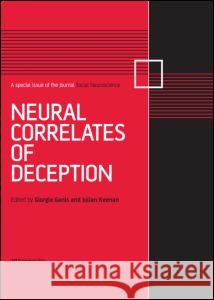
Neural Correlates of Deception: A Special Issue of Social Neuroscience

ISBN-13: 9781848727120 / Angielski / Twarda / 2009 / 112 str.
Giorgio Ganis;Julian Keenan
Neural Correlates of Deception: A Special Issue of Social Neuroscience Ganis, Giorgio 9781848727120 Taylor & Francis - książkaWidoczna okładka, to zdjęcie poglądowe, a rzeczywista szata graficzna może różnić się od prezentowanej.

Neural Correlates of Deception: A Special Issue of Social Neuroscience

ISBN-13: 9781848727120 / Angielski / Twarda / 2009 / 112 str.

Giorgio Ganis;Julian Keenan
cena 632,81
(netto: 602,68 VAT:  5%)

Najniższa cena z 30 dni: 604,49
Termin realizacji zamówienia:
ok. 22 dni roboczych
Bez gwarancji dostawy przed świętami

Darmowa dostawa!

Deception, also known as "lying," is a pervasive and fundamental social behavior in which a person attempts to persuade another to accept as true what the deceiver believes to be untrue. Because of its essential role in our social life, it is important for social neuroscience to reveal the inner workings of deception. This special issue provides a representative sample of new empirical research on the cognitive and neural processes associated with producing deceptive responses. Eight contributions report studies employing a variety of paradigms and techniques (behavioral, functional magnetic resonance imaging, event-related potentials, and transcranial magnetic stimulation) that address several theoretical and methodological issues for deception research. Numerous questions are raised by these studies. First, is deception a unitary phenomenon, and are all lies the same? If there are different types of lies and there are individual differences in deception, can lies be detected reliably in single individuals? Second, are deception processes special in any way or do they depend only on a set of general-purpose cognitive and neural processes? Third, is it valid to study deception in the laboratory, and to what extent can laboratory studies be designed to resemble real-life deception situations? Fourth, are different cognitive and neural measures associated with deception affected equally by different factors? Can we devise reliable methods to detect deception by exploiting this knowledge? These questions provide important directions for future research. Establishing the brain correlates of deception behaviour will be challenging, but already we have made great strides.


Deception, also known as "lying", is a pervasive and fundamental social behavior in which a person attempts to persuade another to accept as true what the deceiver believes to be untrue. Because of its essential role in our social life, it is important for social neuroscience to reveal the inner workings of deception. This special issue provides a representative sample of new empirical research on the cognitive and neural processes associated with producing deceptive responses. Eight contributions report studies employing a variety of paradigms and techniques (behavioral, functional magnetic resonance imaging, event-related potentials, and transcranial magnetic stimulation) that address several theoretical and methodological issues for deception research.

Numerous questions are raised by these studies. First, is deception a unitary phenomenon, and are all lies the same? If there are different types of lies and there are individual differences in deception, can lies be detected reliably in single individuals? Second, are deception processes special in any way or do they depend only on a set of general-purpose cognitive and neural processes? Third, is it valid to study deception in the laboratory, and to what extent can laboratory studies be designed to resemble real-life deception situations? Fourth, are different cognitive and neural measures associated with deception affected equally by different factors? Can we devise reliable methods to detect deception by exploiting this knowledge? These questions provide important directions for future research. Establishing the brain correlates of deception behaviour will be challenging, but already we have made great strides.

Kategorie:
Nauka, Psychologia
Kategorie BISAC:
Psychology > Neuropsychology
Wydawca:
Taylor & Francis
Seria wydawnicza:
Special Issues of Social Neuroscience
Język:
Angielski
ISBN-13:
9781848727120
Rok wydania:
2009
Numer serii:
000405795
Ilość stron:
112
Oprawa:
Twarda
Wolumenów:
01

G. Ganis, J.P. Keenan, The Cognitive Neuroscience of Deception. J.B. Allen, R. Mertens, Limitations to the Detection of Deception: True and False Recollections are Poorly Distinguished Using an Event-related Potential Procedure. M.A. Lui, J.P. Rosenfeld, A.H. Ryan, Thirty-Site P300 Scalp Distribution, Amplitude Variance Across Sites, and Amplitude in Detection of Deceptive Concealment of Multiple Guilty Items. F.A. Kozel, K.A. Johnson, S.J. Laken, E.L. Grenesko, J.A. Smith, J. Walker, M.S. George, Can Simultaneously Acquired Electrodermal Activity Improve Accuracy of fMRI Detection of Deception? J.G. Hakun, K. Ruparel, D. Seelig, E. Busch, J.W. Loughead, R.C. Gur, D.D. Langleben, Resume Query Test: Towards Clinical Trials of Lie Detection with fMRI. G. Monteleone, K.L. Phan, H. Nusbaum, D. Fitzgerald, J. Stockton Irick, S. Fienberg, J. Cacioppo, Detection of Deception Using Functional Magnetic Resonance Imaging: Well Above Chance, Though Well Below Perfection. G. Ganis, R.R. Morris, S.M. Kosslyn, Neural Processes Underlying Self- and Other-related Lies: An Individual Difference Approach using fMRI. C.J. Morgan, J.B. LeSage, S.M. Kosslyn, Types of Deception Revealed by Individual Differences in Cognitive Abilities. K.J. Kelly, E. Murray, V. Barrios, J. Gorman, G. Ganis, J.P. Keenan, The Effect of Deception on Motor Cortex Excitability.

Giorgio Ganis, Harvard Medical School, USA
Julian Keenan, Montclair State University, USA


Udostępnij

Facebook - konto krainaksiazek.pl


Opinie o Krainaksiazek.pl na Opineo.pl

Partner Mybenefit

Krainaksiazek.pl w programie rzetelna firma Krainaksiaze.pl - płatności przez paypal

Czytaj nas na:

Facebook - krainaksiazek.pl
  • książki na zamówienie
  • granty
  • książka na prezent
  • kontakt
  • pomoc
  • opinie
  • regulamin
  • polityka prywatności

Zobacz:

  • Księgarnia czeska

  • Wydawnictwo Książkowe Klimaty

1997-2025 DolnySlask.com Agencja Internetowa

© 1997-2022 krainaksiazek.pl
     
KONTAKT | REGULAMIN | POLITYKA PRYWATNOŚCI | USTAWIENIA PRYWATNOŚCI
Zobacz: Księgarnia Czeska | Wydawnictwo Książkowe Klimaty | Mapa strony | Lista autorów
KrainaKsiazek.PL - Księgarnia Internetowa

Polityka prywatnosci - link
Krainaksiazek.pl - płatnośc Przelewy24
Przechowalnia Przechowalnia





