• Wyszukiwanie zaawansowane
  • Kategorie
  • Kategorie BISAC
  • Książki na zamówienie
  • Promocje
  • Granty
  • Książka na prezent
  • Opinie
  • Pomoc
  • Załóż konto
  • Zaloguj się

Mutagenicity, Carcinogenicity, and Teratogenicity of Industrial Pollutants » książka


zaloguj się | załóż konto
Logo Krainaksiazek.pl

koszyk

konto

szukaj
topmenu
Księgarnia internetowa
Szukaj
Książki na zamówienie
Promocje
Granty
Książka na prezent
Moje konto
Pomoc
 
 
Wyszukiwanie zaawansowane
Pusty koszyk
Bezpłatna dostawa dla zamówień powyżej 20 złBezpłatna dostawa dla zamówień powyżej 20 zł

Kategorie główne

• Nauka
 [2946912]
• Literatura piękna
 [1852311]

  więcej...
• Turystyka
 [71421]
• Informatyka
 [150889]
• Komiksy
 [35717]
• Encyklopedie
 [23177]
• Dziecięca
 [617324]
• Hobby
 [138808]
• AudioBooki
 [1671]
• Literatura faktu
 [228371]
• Muzyka CD
 [400]
• Słowniki
 [2841]
• Inne
 [445428]
• Kalendarze
 [1545]
• Podręczniki
 [166819]
• Poradniki
 [480180]
• Religia
 [510412]
• Czasopisma
 [525]
• Sport
 [61271]
• Sztuka
 [242929]
• CD, DVD, Video
 [3371]
• Technologie
 [219258]
• Zdrowie
 [100961]
• Książkowe Klimaty
 [124]
• Zabawki
 [2341]
• Puzzle, gry
 [3766]
• Literatura w języku ukraińskim
 [255]
• Art. papiernicze i szkolne
 [7810]
Kategorie szczegółowe BISAC

Mutagenicity, Carcinogenicity, and Teratogenicity of Industrial Pollutants

ISBN-13: 9781461296492 / Angielski / Miękka / 2011 / 336 str.
Micheline Kirsch-Volders
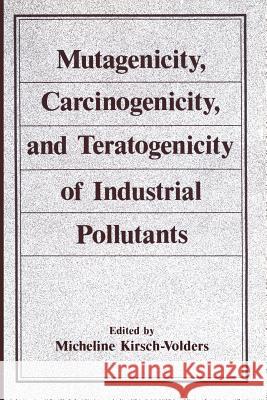
Mutagenicity, Carcinogenicity, and Teratogenicity of Industrial Pollutants Micheline Kirsch-Volders 9781461296492 Springer - książkaWidoczna okładka, to zdjęcie poglądowe, a rzeczywista szata graficzna może różnić się od prezentowanej.

Mutagenicity, Carcinogenicity, and Teratogenicity of Industrial Pollutants

ISBN-13: 9781461296492 / Angielski / Miękka / 2011 / 336 str.

Micheline Kirsch-Volders
cena 401,58
(netto: 382,46 VAT:  5%)

Najniższa cena z 30 dni: 385,52
Termin realizacji zamówienia:
ok. 22 dni roboczych
Bez gwarancji dostawy przed świętami

Darmowa dostawa!

This book is intended for anyone who cares about the health of people exposed to industrial pollutants. Attention is given to those pollutants which present a possible risk to the genetic material of exposed workers. Chapters are devoted to heavy metals such as arsenic, beryllium, cadmium, chromium, lead, mercury, nickel, etc.; insecticides (chlorinated, organophosphorus, and carbonate insecticides); monomers such as vinyl-chloride, acrylonitrile, styrene, vinylidene chloride, butadiene, chlorobutadiene, hexachlorobuta- diene, etc.; and halogenated hydrocarbon solvents such as chloroform, carbon tetrachloride, trichloroethylene, I, 2-dichloroethane, tetrachloroethyl- ene, dichloromethane, and I, I, I-trichloroethane. The main aim of this work is to provide the physician, the biologist, the pharmacologist, or anyone involved in genetic toxicology with a useful compendium of up-to-date information and references. Efforts are made to open the field to nonspecialists. An introductory chapter deals with the mechanisms whereby a given compound, reaching genetic material, either directly or indirectly, may increase the risk of a cancer developing in the exposed individual and of abnormalities being passed on to his or her progeny. Efforts are also made to allow easy and efficient reading for those who are not interested in detailed results. Comparative tables provide the following data on the compounds studied: chemical properties, production, occurrence, accepted standards in the industry, and positive or negative results with different test systems. Finally, senior research workers might find good descriptions in this book of the most recent results from mutagenesis and carcinogenesis testing in plant, nonmammalian, and mammalian systems.


Kategorie:
Nauka, Medycyna
Kategorie BISAC:
Medical > Toxicology
Science > Biologia i przyroda
Medical > Farmakologia
Wydawca:
Springer
Język:
Angielski
ISBN-13:
9781461296492
Rok wydania:
2011
Wydanie:
Softcover Repri
Ilość stron:
336
Waga:
0.55 kg
Wymiary:
23.5 x 15.5
Oprawa:
Miękka
Wolumenów:
01
Dodatkowe informacje:
Wydanie ilustrowane

Introduction: Mutagenesis as a Health Problem.- 1 Molecular Mechanisms of Mutagenesis and Carcinogenesis.- I: Cellular Factors which Modify the Expression of Mutagenic Action Into Genetic Lesions.- 1. The Nature of the Target.- 1.1. Direct Mutagenesis with DNA as Target.- 1.2. Indirect Mutagenesis through Non-DNA Targets.- 1.2.1. Spindle Inhibitors.- 1.2.2. Action on Enzymatic Processes.- 1.3. Role of the Cell Cycle.- 1.4. Interspecies Differences.- 2. The Nature of the Mutagen.- 2.1. True Mutagens.- 2.2. Turbagens.- 3. An Overview of DNA Repair Processes.- 3.1. Prereplicative Error Correction.- 3.2. Replicative Error Avoidance.- 3.3. Post-Replicative Error Avoidance.- 3.4. Post-Replicative DNA Repair (PRR).- 3.5. Direct and Indirect Mutagens.- 3.6. Why SOS Repair?.- 4. Metabolization, Synergism, and Protection.- II: Relation Between Mutation, Repair, and Chromosome Aberration.- 5. Estimation of DNA Damage.- 6. Mechanisms Involved in Structural Chromosome Aberrations.- 6.1. Chromosome Breaks and Exchanges.- 6.1.1. Chromosome Breaks.- 6.1.2. Chromosome Exchanges.- 6.2. Chromosome Gaps.- 6.3. Sister Chromatid Exchanges.- 7. Significance of Aneuploidy.- III: Chromosomal Alterations and Carcinogenesis.- 8. Carcinogens and Chromosomal Rearrangements.- 9. Chromosomal Rearrangement Associated with Carcinogenesis.- 10. Chromosomal Rearrangements in Human Cancer-Prone Syndromes.- 11. Carcinogenic Chromosomal Rearrangement.- 12. Induction of Chromosomal Rearrangement.- 13. Role of Chromosomal Rearrangement in Carcinogenesis.- 14. Mechanisms of Carcinogenesis.- References.- 2 Mutagenicity, Carcinogenicity, and Teratogenicity of Industrially Used Metals.- 1. General Considerations.- 1.1. Risks and Their Assessment.- 1.2. Metabolism and Toxicity.- 1.3. Mechanisms of Metal Toxicity.- 1.4. Mutagenesis: Tests and Their Interpretation.- 1.5. Carcinogenesis: Mechanisms and Evaluation.- 1.6. Action on the Developing Organism.- 2. Arsenic.- 2.1. Exposure, Occurrence, and General Toxicity.- 2.2. Mutagenesis.- 2.3. Carcinogenesis.- 2.4. Teratogenesis.- 3. Beryllium.- 3.1. Exposure, Occurrence, and General Toxicity.- 3.2. Mutagenesis.- 3.3. Carcinogenesis.- 4. Cadmium.- 4.1. Exposure, Occurrence, and General Toxicity.- 4.2. Mutagenesis.- 4.3. Carcinogenesis.- 4.4. Teratogenesis.- 5. Chromium.- 5.1. Exposure, Occurrence, and General Toxicity.- 5.2. Mutagenesis.- 5.3. Carcinogenesis.- 5.4. Teratogenesis.- 6. Lead.- 6.1. Exposure, Occurrence, and General Toxicity.- 6.2. Mutagenesis.- 6.3. Carcinogenesis.- 6.4. Teratogenesis.- 7. Mercury.- 7.1. Exposure, Occurrence, and General Toxicity.- 7.2. Mutagenesis.- 7.3. Carcinogenesis.- 7.4. Teratogenesis.- 8. Nickel.- 8.1. Exposure, Occurrence, and General Toxicity.- 8.2. Mutagenesis.- 8.3. Carcinogenesis.- 8.4. Teratogenesis.- 9. Other Metals.- 9.1. Mutagenesis.- 9.2. Carcinogenesis.- 9.3. Teratogenesis.- 10. Conclusions.- References.- 3 Mutagenicity, Carcinogenicity, and Teratogenicity of Insecticides.- 1. Introduction.- 2. Chemical and Biochemical Properties.- 2.1. Chlorinated Insecticides.- 2.1.1. Chemical Properties.- 2.1.2. Biochemical Properties.- 2.2. Organophosphorus Insecticides.- 2.2.1. Chemical Properties.- 2.2.2. Biochemical Properties.- 2.3. Carbamate Insecticides.- 2.3.1. Chemical Properties.- 2.3.2. Biochemical Properties.- 2.4. Miscellaneous Insecticides.- 2.4.1. Chemical Properties.- 2.4.2. Biochemical Properties.- 3. Mutagenicity.- 3.1. Chlorinated Insecticides.- 3.1.1. DDT and Related Compounds.- 3.1.2. Cyclodienes: Aldrin and Dieldrin.- 3.1.3. Cyclodienes: Heptachlor and Chlordane.- 3.1.4. Chlordecone and Mirex.- 3.1.5. Lindane and Paradichlorobenzene.- 3.1.6. Toxaphene.- 3.2. Organophosphorus Insecticides.- 3.2.1. Prokaryotes.- 3.2.2. Eukaryotes.- 3.3. Carbamate Insecticides.- 3.3.1. Carbaryl.- 3.3.2. Other Carbamate Insecticides.- 3.4. Miscellaneous Insecticides.- 4. Carcinogenicity.- 4.1. Chlorinated Insecticides.- 4.1.1. DDT and Related Compounds.- 4.1.2. Cyclodienes: Aldrin and Dieldrin.- 4.1.3. Cyclodienes: Chlordane and Heptachlor.- 4.1.4. Chlordecone and Mirex.- 4.1.5. Lindane.- 4.1.6. Toxaphene.- 4.2. Organophosphorus Insecticides.- 4.3. Carbamate Insecticides.- 4.4. Miscellaneous Insecticides.- 5. Teratogenicity.- 5.1. Chlorinated Insecticides.- 5.2. Organophosphorus Insecticides.- 5.3. Carbamate Insecticides.- 5.4. Miscellaneous Insecticides.- 6. Discussion and Conclusions.- References.- 4 Mutagenicity, Carcinogenicity, and Teratogenicity of Industrially Important Monomers.- 1. Introduction.- 2. Vinyl Chloride.- 2.1. Toxicity.- 2.2. Metabolism.- 2.3. Mutagenicity.- 2.4. Carcinogenicity.- 2.5. Teratogenicity and Embryotoxicity.- 3. Acrylonitrile.- 3.1. Toxicity.- 3.2. Metabolism.- 3.3. Mutagenicity.- 3.4. Carcinogenicity.- 3.5. Teratogenicity and Embryotoxicity.- 4. Styrene.- 4.1. Toxicity.- 4.2. Metabolism.- 4.3. Mutagenicity.- 4.4. Carcinogenicity.- 4.5. Teratogenicity and Embryotoxicity.- 5. Vinylidene Chloride.- 5.1. Toxicity.- 5.2. Metabolism.- 5.3. Mutagenicity.- 5.4. Carcinogenicity.- 5.5. Teratogenicity and Embryotoxicity.- 6. Butadiene.- 6.1. Toxicity.- 6.2. Metabolism.- 6.3. Mutagenicity.- 6.4. Carcinogenicity.- 6.5. Teratogenicity and Embryotoxicity.- 7. Chlorobutadiene.- 7.1. Toxicity.- 7.2. Metabolism.- 7.3. Mutagenicity.- 7.4. Carcinogenicity.- 7.5. Teratogenicity and Embryotoxicity.- 8. Hexachlorobutadiene.- 8.1. Toxicity.- 8.2. Metabolism.- 8.3. Mutagenicity.- 8.4. Carcinogenicity.- 8.5. Teratogenicity and Embryotoxicity.- 9. General Discussion and Conclusions.- References.- 5 Mutagenicity, Carcinogenicity, and Teratogenicity of Halogenated Hydrocarbon Solvents.- 1. Introduction.- 2. Chloroform.- 2.1. Absorption, Distribution, Metabolism, and Excretion.- 2.2. Toxicity.- 2.3. Mutagenicity and Carcinogenicity.- 2.4. Embryotoxicity and Teratogenicity.- 3. Carbon Tetrachloride.- 3.1. Absorption, Distribution, Metabolism, and Excretion.- 3.2. Toxicity.- 3.3. Mutagenicity and Carcinogenicity.- 3.4. Embryotoxicity and Teratogenicity.- 4. Trichlorethylene (TCE).- 4.1. Absorption, Distribution, Metabolism, and Excretion.- 4.2. Mutagenicity and Carcinogenicity.- 4.3. Embryotoxicity and Teratogenicity.- 5. 1,2-Dichloroethane.- 5.1. Absorption, Distribution, Metabolism, and Excretion.- 5.2. Toxicity.- 5.3. Mutagenicity and Carcinogenicity.- 5.4. Teratogenicity and Embryotoxicity.- 6. Tetrachloroethylene.- 6.1. Absorption, Distribution, Metabolism, and Excretion.- 6.2. Toxicity.- 6.3. Mutagenicity and Carcinogenicity.- 6.4. Embryotoxicity and Teratogenicity.- 7. Dichloromethane.- 7.1. Absorption, Distribution, Metabolism, and Excretion.- 7.2. Toxicity.- 7.3. Carcinogenic and Mutagenic Effects.- 7.4. Teratogenicity and Embryotoxicity.- 8. 1-1,1-Trichloroethane.- 8.1. Absorption, Distribution, Metabolism, and Excretion.- 8.2. Toxicity.- 8.3. Mutagenicity and Carcinogenicity.- 8.4. Embryotoxicity and Teratogenicity.- 9. Conclusions.- References.- Conclusions.


Udostępnij

Facebook - konto krainaksiazek.pl


Opinie o Krainaksiazek.pl na Opineo.pl

Partner Mybenefit

Krainaksiazek.pl w programie rzetelna firma Krainaksiaze.pl - płatności przez paypal

Czytaj nas na:

Facebook - krainaksiazek.pl
  • książki na zamówienie
  • granty
  • książka na prezent
  • kontakt
  • pomoc
  • opinie
  • regulamin
  • polityka prywatności

Zobacz:

  • Księgarnia czeska

  • Wydawnictwo Książkowe Klimaty

1997-2025 DolnySlask.com Agencja Internetowa

© 1997-2022 krainaksiazek.pl
     
KONTAKT | REGULAMIN | POLITYKA PRYWATNOŚCI | USTAWIENIA PRYWATNOŚCI
Zobacz: Księgarnia Czeska | Wydawnictwo Książkowe Klimaty | Mapa strony | Lista autorów
KrainaKsiazek.PL - Księgarnia Internetowa

Polityka prywatnosci - link
Krainaksiazek.pl - płatnośc Przelewy24
Przechowalnia Przechowalnia






