• Wyszukiwanie zaawansowane
  • Kategorie
  • Kategorie BISAC
  • Książki na zamówienie
  • Promocje
  • Granty
  • Książka na prezent
  • Opinie
  • Pomoc
  • Załóż konto
  • Zaloguj się

Multi-Microprocessor Systems for Real-Time Applications » książka


zaloguj się | załóż konto
Logo Krainaksiazek.pl

koszyk

konto

szukaj
topmenu
Księgarnia internetowa
Szukaj
Książki na zamówienie
Promocje
Granty
Książka na prezent
Moje konto
Pomoc
 
 
Wyszukiwanie zaawansowane
Pusty koszyk
Bezpłatna dostawa dla zamówień powyżej 20 złBezpłatna dostawa dla zamówień powyżej 20 zł

Kategorie główne

• Nauka
 [2946600]
• Literatura piękna
 [1856966]

  więcej...
• Turystyka
 [72221]
• Informatyka
 [151456]
• Komiksy
 [35826]
• Encyklopedie
 [23190]
• Dziecięca
 [619653]
• Hobby
 [140543]
• AudioBooki
 [1577]
• Literatura faktu
 [228355]
• Muzyka CD
 [410]
• Słowniki
 [2874]
• Inne
 [445822]
• Kalendarze
 [1744]
• Podręczniki
 [167141]
• Poradniki
 [482898]
• Religia
 [510455]
• Czasopisma
 [526]
• Sport
 [61590]
• Sztuka
 [243598]
• CD, DVD, Video
 [3423]
• Technologie
 [219201]
• Zdrowie
 [101638]
• Książkowe Klimaty
 [124]
• Zabawki
 [2473]
• Puzzle, gry
 [3898]
• Literatura w języku ukraińskim
 [254]
• Art. papiernicze i szkolne
 [8170]
Kategorie szczegółowe BISAC

Multi-Microprocessor Systems for Real-Time Applications

ISBN-13: 9789027720542 / Angielski / Twarda / 1985 / 299 str.
Gianni Conte; Dante Del Corso
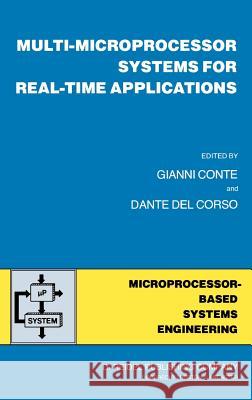
Multi-Microprocessor Systems for Real-Time Applications Gianni Conte Dante De 9789027720542 Springer - książkaWidoczna okładka, to zdjęcie poglądowe, a rzeczywista szata graficzna może różnić się od prezentowanej.

Multi-Microprocessor Systems for Real-Time Applications

ISBN-13: 9789027720542 / Angielski / Twarda / 1985 / 299 str.

Gianni Conte; Dante Del Corso
cena 605,23 zł
(netto: 576,41 VAT:  5%)

Najniższa cena z 30 dni: 578,30 zł
Termin realizacji zamówienia:
ok. 22 dni roboczych
Bez gwarancji dostawy przed świętami

Darmowa dostawa!

The continous development of computer technology supported by the VLSI revolution stimulated the research in the field .of multiprocessors systems. The main motivation for the migration of design efforts from conventional architectures towards multiprocessor ones is the possibi I ity to obtain a significant processing power together with the improvement of price/performance, reliability and flexibility figures. Currently, such systems are moving from research laboratories to real field appl ications. Future technological advances and new generations of components are I ikely to further enhance this trend. This book is intended to provide basic concepts and design methodologies for engineers and researchers involved in the development of mul tiprocessor systems and/or of appl ications based on multiprocessor architectures. In addition the book can be a source of material for computer architecture courses at graduate level. A preliminary knowledge of computer architecture and logical design has been assumed in wri ting this book. Not all the problems related with the development of multiprocessor systems are addressed in th i s book. The covered range spans from the electrical and logical design problems, to architectural issues, to design methodologis for system software. Subj ects such as software development in a multiprocessor environment or loosely coupled multiprocessor systems are out of the scope of the book. Since the basic elements, processors and memories, are now available as standard integrated circuits, the key design problem is how to put them together in an efficient and reliable way.


Kategorie:
Technologie
Kategorie BISAC:
Reference > Questions & Answers
Technology & Engineering > Electrical
Computers > Computer Architecture
Wydawca:
Springer
Seria wydawnicza:
International Series on Microprocessor-Based Systems Enginee
Język:
Angielski
ISBN-13:
9789027720542
Rok wydania:
1985
Wydanie:
1985
Numer serii:
000171857
Ilość stron:
299
Waga:
1.36 kg
Wymiary:
29.7 x 21.0
Oprawa:
Twarda
Wolumenów:
01
Dodatkowe informacje:
Bibliografia
Wydanie ilustrowane

1. Multiprocessor System Architecture.- 1.1 Distributed Processing and Multiprocessors.- 1.1.1 Classification Criteria.- 1.1.2 Computer Networks.- 1.1.3 Multiple Processor Systems.- 1.1.4 Special Purpose Machines.- 1.1.5 Other Classifications of Distributed Systems.- 1.2 Multiprocessor Systems.- 1.2.1 Multiprocessor Structures.- 1.2.2 The Interconnection Network.- 1.2.3 Shared Bus.- 1.2.4 Multiport Memory.- 1.2.5 Crossbar Switches.- 1.2.6 Multistage Interconnection Networks.- 1.2.7 Applications of Multiple Processors.- 1.3 Description Techniques for Multiprocessors.- 1.3.1 Levels of Description.- 1.3.2 Selection of the Description Level.- 1.3.3 The PMS Notation.- 1.3.4 The MSBI Notation.- 1.4 Some Multiprocessor Systems.- 1.4.1 Selection Criteria.- 1.4.2 The Cm*.- 1.4.3 The C.mmp.- 1.4.4 The PLURIBUS.- 1.4.5 The ?* System.- 1.4.6 The iAPX432 System.- 1.4.7 The TOMP Multiprocessor System.- 1.5 References.- 2. Performance Analysis of Multiprocessor Systems.- 2.1 Performance Evaluation of Bus Oriented Multiprocessor Systems.- 2.1.1 Introduction.- 2.1.2 Modeling Assumptions.- 2.1.3 The System Workload.- 2.1.4 Architecture 1.- 2.1.5 Architecture 2.- 2.1.6 Architecture 3.- 2.1.7 Architecture 4.- 2.1.8 Architecture Comparison.- 2.1.9 Choice of the Architecure of TOMP.- 2.2 Other Modeling Techniques and Measurements.- 2.2.1 Introduction.- 2.2.2 Stochastic Petri Net Models.- 2.2.3 Queueing Network Models.- 2.2.4 Measurements.- 2.3 References.- 3. TOMP Software.- 3.1 Introduction.- 3.1.1 Goals and Motivations.- 3.1.2 Limits.- 3.1.3 Overall System Description.- 3.2 Interprocess Communication.- 3.2.1 Model and Primitive Operations.- 3.2.2 Low Level Communication Protocol.- 3.3 The Executive.- 3.3.1 System Initialization.- 3.3.2 Process Management.- 3.3.3 Interrupt Handling.- 3.3.4 Monitoring Functions.- 3.4 Monitoring and Debug.- 3.4.1 General Architecture.- 3.4.2 Debugging Functions.- 3.5 Utilities.- 3.5.1 Terminal Handler.- 3.5.2 File System.- 3.5.3 Common Memory Allocator.- 3.6 System Generation.- 3.7 A Critical Review.- 3.8 References.- 4. Design of Multiprocessor Buses.- 4.1 Introduction.- 4.2 Basic Protocols.- 4.2.1 Elementary Operations.- 4.2.2 Types of Information Transfer Cycles.- 4.2.3 Synchronization of the Action Flow.- 4.3 Bused Systems.- 4.3.1 Channel Allocation Techniques.- 4.3.2 Bus Arbitration.- 4.3.3 The Distributed Self-selection Arbiter.- 4.4 Electrical Behaviour of Backplane Lines.- 4.4.1 Definition of Signal Levels.- 4.4.2 Transmission Line Effects.- 4.4.3 Crosstalk.- 4.4.4 Protocol Speed.- 4.5 Protocol Extension.- 4.5.1 The Enable/Disable Technique.- 4.5.2 Bus Supervisors.- 4.6 References.- 5. Some Examples of Multiprocessor Buses.- 5.1 Introduction.- 5.2 The Multibus Backplane.- 5.2.1 History and Main Features.- 5.2.2 Physical and Electrical Specifications.- 5.2.3 The Information Transfer Protocol.- 5.2.4 Special Features.- 5.2.5 Timing and Pinout.- 5.3 The VME Backplane Bus.- 5.3.1 History and Main Features.- 5.3.2 Physical and Electrical Specifications.- 5.3.3 The Information Transfer Protocol.- 5.3.4 Special Features.- 5.4 The 896 Backplane Bus.- 5.4.1 History and Main Features.- 5.4.2 Physical and Electrical Specifications.- 5.4.3 The Information Transfer Protocol.- 5.4.4 Special Features.- 5.4.5 Timing and Pinout.- 5.5 The M3BUS Backplane.- 5.5.1 History and Main Features.- 5.5.2 Physical and Electrical Specifications.- 5.5.3 System Organization and Control.- 5.5.4 The Arbitration Protocol.- 5.5.5 The Addressing Protocol.- 5.5.6 The Data Transfer Protocol.- 5.5.7 Interrupt and Interprocessor Communication.- 5.5.8 Supervisor Protocol.- 5.5.9 The Serial Bus.- 5.5.10 Timing and Pinout.- 5.6 References.- 6. Hardware Modules for Multiprocessor Systems.- 6.1 Introduction.- 6.2 System Design.- 6.2.1 Physical Organization of Multiprocessor Systems.- 6.2.2 Board Design Guidelines.- 6.3 Slave Modules.- 6.3.1 Organization of Slave Modules.- 6.3.2 Address Decoders and Latches.- 6.3.3 Slave Control Logic.- 6.3.4 Slave Buffering.- 6.4 Master Modules.- 6.4.1 Organization of Master Modules.- 6.4.2 External Access Decoder and Bus Arbitration.- 6.4.3 Master Control Logic.- 6.4.4 Master Buffering.- 6.5 Interrupt Structures.- 6.5.1 Requirements for Multiprocessor Systems.- 6.5.2 System Controls.- 6.5.3 Processor Interrupts.- 6.5.4 Centralized Interrupt Handler.- 6.5.5 Distributed Interrupt Handler.- 6.5.6 Serial Lines.- 6.6 Special Modules.- 6.6.1 Multiple-slave Modules.- 6.6.2 Bus Windows.- 6.6.3 Dual-port Slaves.- 6.6.4 Master-slave Modules.- 6.6.5 Block Transfer Units.- 6.6.6 Supervisor Modules.- 6.7 References.- 7. Multiprocessor Benchmarks.- 7.1 Introduction.- 7.2 The Concept of Performance.- 7.3 Parallel Programming.- 7.4 Parallel Notation Form.- 7.5 Parallel Sorting Techniques.- 7.6 Measurements and Analysis of Results.- 7.7 Conclusion.- 7.8 References.

Conte, Gianni University of Parma, Italy.... więcej >


Udostępnij

Facebook - konto krainaksiazek.pl


Opinie o Krainaksiazek.pl na Opineo.pl

Partner Mybenefit

Krainaksiazek.pl w programie rzetelna firma Krainaksiaze.pl - płatności przez paypal

Czytaj nas na:

Facebook - krainaksiazek.pl
  • książki na zamówienie
  • granty
  • książka na prezent
  • kontakt
  • pomoc
  • opinie
  • regulamin
  • polityka prywatności

Zobacz:

  • Księgarnia czeska

  • Wydawnictwo Książkowe Klimaty

1997-2025 DolnySlask.com Agencja Internetowa

© 1997-2022 krainaksiazek.pl
     
KONTAKT | REGULAMIN | POLITYKA PRYWATNOŚCI | USTAWIENIA PRYWATNOŚCI
Zobacz: Księgarnia Czeska | Wydawnictwo Książkowe Klimaty | Mapa strony | Lista autorów
KrainaKsiazek.PL - Księgarnia Internetowa

Polityka prywatnosci - link
Krainaksiazek.pl - płatnośc Przelewy24
Przechowalnia Przechowalnia





