• Wyszukiwanie zaawansowane
  • Kategorie
  • Kategorie BISAC
  • Książki na zamówienie
  • Promocje
  • Granty
  • Książka na prezent
  • Opinie
  • Pomoc
  • Załóż konto
  • Zaloguj się

Multi-Body Dynamic Modeling of Multi-Legged Robots » książka


zaloguj się | załóż konto
Logo Krainaksiazek.pl

koszyk

konto

szukaj
topmenu
Księgarnia internetowa
Szukaj
Książki na zamówienie
Promocje
Granty
Książka na prezent
Moje konto
Pomoc
 
 
Wyszukiwanie zaawansowane
Pusty koszyk
Bezpłatna dostawa dla zamówień powyżej 20 złBezpłatna dostawa dla zamówień powyżej 20 zł

Kategorie główne

• Nauka
 [2946600]
• Literatura piękna
 [1856966]

  więcej...
• Turystyka
 [72221]
• Informatyka
 [151456]
• Komiksy
 [35826]
• Encyklopedie
 [23190]
• Dziecięca
 [619653]
• Hobby
 [140543]
• AudioBooki
 [1577]
• Literatura faktu
 [228355]
• Muzyka CD
 [410]
• Słowniki
 [2874]
• Inne
 [445822]
• Kalendarze
 [1744]
• Podręczniki
 [167141]
• Poradniki
 [482898]
• Religia
 [510455]
• Czasopisma
 [526]
• Sport
 [61590]
• Sztuka
 [243598]
• CD, DVD, Video
 [3423]
• Technologie
 [219201]
• Zdrowie
 [101638]
• Książkowe Klimaty
 [124]
• Zabawki
 [2473]
• Puzzle, gry
 [3898]
• Literatura w języku ukraińskim
 [254]
• Art. papiernicze i szkolne
 [8170]
Kategorie szczegółowe BISAC

Multi-Body Dynamic Modeling of Multi-Legged Robots

ISBN-13: 9789811529528 / Angielski / Twarda / 2020 / 203 str.
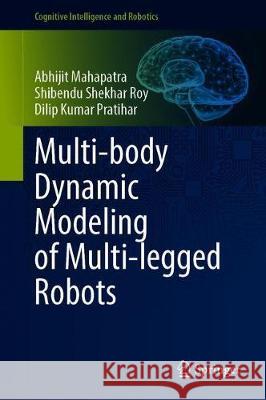
Abhijit Mahapatra; Shibendu Shekhar Roy; Dilip Kumar Pratihar
Multi-Body Dynamic Modeling of Multi-Legged Robots Mahapatra, Abhijit 9789811529528 Springer - książkaWidoczna okładka, to zdjęcie poglądowe, a rzeczywista szata graficzna może różnić się od prezentowanej.

Multi-Body Dynamic Modeling of Multi-Legged Robots

ISBN-13: 9789811529528 / Angielski / Twarda / 2020 / 203 str.

Abhijit Mahapatra; Shibendu Shekhar Roy; Dilip Kumar Pratihar
cena 403,47 zł
(netto: 384,26 VAT:  5%)

Najniższa cena z 30 dni: 385,52 zł
Termin realizacji zamówienia:
ok. 22 dni roboczych
Bez gwarancji dostawy przed świętami

Darmowa dostawa!
inne wydania
Kategorie:
Informatyka, Bazy danych
Kategorie BISAC:
Computers > Artificial Intelligence - General
Technology & Engineering > Robotics
Technology & Engineering > Electrical
Wydawca:
Springer
Seria wydawnicza:
Cognitive Intelligence and Robotics
Język:
Angielski
ISBN-13:
9789811529528
Rok wydania:
2020
Wydanie:
2020
Numer serii:
000829766
Ilość stron:
203
Waga:
0.50 kg
Wymiary:
23.39 x 15.6 x 1.42
Oprawa:
Twarda
Wolumenów:
01
Dodatkowe informacje:
Wydanie ilustrowane

Chapter 1 Introduction

1.1 Introduction to Multi-legged robots
1.2 Gait Planning of six-legged robots
1.3 Literature Review of legged robot
1.3.1 Kinematics of legged robots
1.3.2 Dynamics of legged robots
1.3.3 Foot-ground contact modeling
1.3.4 Foot Force Distribution and power consumption
1.3.5 Stability of legged robots
1.4 Gaps in Literature
1.5 Aims and Objectives
1.6 Book Overview
1.7 Book’s Contributions
1.8 Summary

Chapter 2 Kinematic Modeling and Analysis of Six-Legged Robots

2.1 Description of the Problem
2.1.1 Description of Proposed Six-legged Walking Robot
2.1.2 Gait Terminologies and their Relationships
2.1.3 Steps involved in Proposed Methodology
2.2 Analytical Framework
2.2.1 Reference system in cartesian coordinates
2.2.2 Kinematic constraint equations
2.2.3 Inverse Kinematic Model of the six-legged robotic system
2.2.4 Terrain model
2.2.5 Locomotion planning on varying terrain
2.2.5.1 Motion planning for robot’s body
2.2.5.2 Swing leg trajectory planning
2.2.5.3 Foot Slip During Support Phase
2.2.6 Gait planning strategy
2.2.7 Evaluation of kinematic parameters
2.2.8 Estimation of aggregate center of mass
2.3 Numerical Simulation: Study of kinematic motion parameters
2.3.1 Case Study 1: Robot motion in an uneven terrain with straight-forward motion (DF=1/2)
2.3.2 Case Study 2: Crab Motion of the robot on a banked terrain (DF=3/4)
2.4 Summary

Chapter 3 Multi-body Inverse Dynamic Modeling and Analysis of Six-Legged Robots

3.1 Analytical Framework
3.1.1 Implicit Constrained Inverse Dynamic Model
3.1.2 Newtonian Mechanics with Explicit Constraints
3.1.3 Three Dimensional Contact Force Model
3.1.3.1 Compliant contact-impact model
3.1.3.2 Interactive forces and moments
3.1.3.3 Amonton-Coulomb’s friction model
3.1.4 Static Equilibrium Moment Equation
3.1.5 Actuator torque limits
3.1.6 Optimal feet forces’ distributions
3.1.7 Energy consumption of a six-legged robot
3.1.8 Stability measures of six-legged robots
3.1.8.1. Statically-stable walking based on ESM, NESM
3.1.8.2. Dynamically stable walking based on DGSM
3.2 Numerical Illustrations
3.2.1 Study of optimal feet forces’ distribution
3.2.1.1 Case Study 1: Robot motion in an uneven terrain with straight-forward motion (DF=1/2)
3.2.1.2 Case Study 2: Crab Motion of the robot on a banked surface (DF=3/4)
3.2.2 Study of performance indices- power consumption and stability measure
3.2.2.1 Effect of trunk body velocity on energy consumption and stability
3.2.2.2 Effect of stroke on energy consumption and stability
3.2.2.3 Effect of body height on energy consumption and stability
3.2.2.4 Effect of leg offset on energy consumption and stability
3.2.2.5 Effect of variable geometry of trunk body on energy consumption and stability
3.2.2.6 Effect of crab angle on energy consumption and stability
3.3 Summary

Chapter 4 Validation using Virtual Prototyping tools and Experiments

4.1 Modeling using Virtual prototyping tools
4.2 Numerical Simulation and Validation using VP Tools and Experiments
4.2.1. Validation of Kinematic motion parameters
4.2.1.1 Case Study 1: Crab motion of the robot to avoid obstacle on a flat terrain
4.2.1.2 Case Study 2: Turning Motion of the robot on a banked surface
4.2.1.3 Case Study 3: Turning Motion of the robot in an uneven terrain
4.2.2. Validation of Dynamic motion parameters
4.2.2.1 Case Study 1: Staircase climbing of the robot with straight-forward motion
4.2.2.2 Case Study 2: Experimentation with a Hex Crawler HDATS robot maneuvering on a concrete floor with straight-forward motion
4.2.2.3 Case Study 3: Experimentation with a Hex Crawler HDATS robot maneuvering on a concrete floor with Crab Motion motion (DF=1/2)
4.3 Summary

Chapter 5 Conclusion and Future Work

5.1 Concluding remarks
5.2 Future Work

Appendix

Appendix A.1 Matrix Projectors
Appendix A.2 Loop Equations w.r.t frame G.
Appendix A.3 Important Transformation Matrices
Appendix A.4 Trajectory Planning of Swing Leg
I.  Straight-forward and Turning Motion
II. Crab Motion
Appendix A.5 Time calculations for gait planning
I. Calculation of total time taken to complete n-duty cycles
II. Calculation of end time for each of the duty cycles
Appendix A.6 Kinematic Velocity and Acceleration
Appendix A.7 Jacobian Matrices
Appendix A.8 Parameters affecting the dynamics of the six-legged robot
Appendix A.9 Kinematic constraints with respect to G0
Appendix A.10 Geometrical Interpretation of the interaction region
Appendix A.11 Objective function and evaluation of the constraints
References
List of Publications made by the Scholar

Dr. Abhijit Mahapatra received  B.E. and M.Tech. degrees in Mechanical Engineering from B.E. College (now, BESU), Shibpur, India, and NIT Durgapur, India, in 2002 and 2008, respectively. He received his Ph.D. from NIT Durgapur, India, in 2018. He is currently working as a Senior Scientist in the Advanced Design and Analysis Group at CSIR- Central Mechanical Engineering Research Institute, Durgapur, India.
Dr. Mahapatra has published a number of research papers in national and international journals and conference proceedings and filed several patents in the area of product development. His current research interests include design & analysis, multi-body dynamics, and modelling and simulating legged robots.

Dr. Shibendu Shekhar Roy received B.E. and M.Tech. degrees in Mechanical Engineering from NIT, Durgapur. He also holds a Ph.D. from IIT, Kharagpur, India. He is currently working as a Professor at the Department of Mechanical Engineering and Associate Dean (Alumni Affairs & Outreach) at the National Institute of Technology, Durgapur.
Dr. Roy has published more than 68 papers in national and international journals and conference proceedings, as well as 4 book chapters, and has filed a number of patents in the area of product development. His current research interests include modelling and simulating legged robots, soft robotics, rehabilitation robotics, additive manufacturing and 3D printing on macro- and micro-scales.

Dr. Dilip Kumar Pratihar completed his  B.E. and M. Tech. in Mechanical Engineering at NIT, Durgapur, India, in 1988 and 1995, respectively. He received his Ph.D. from IIT Kanpur in 2000. Dr. Pratihar pursued postdoctoral studies in Japan and then in Germany under the Alexander von Humboldt Fellowship Program. He is currently working as a Professor at IIT Kharagpur, India. His research areas include robotics, soft computing and manufacturing science.
He has made significant contributions in the development of intelligent autonomous systems in various fields, including robotics, and manufacturing science. He has published more than 230 papers, mostly in international journals, and is on the editorial board of 12 international journals. He is a member of the FIE, MASME and SMIEEE. He has completed a number of sponsored (funded by DST, DAE, MHRD, DBT) and consultancy projects and is a member of Expert Committee of Advanced Manufacturing Technology, DST, Government of India.

This book describes the development of an integrated approach for generating the path and gait of realistic hexapod robotic systems. It discusses in detail locomation with straight-ahead, crab and turning motion capabilities in varying terrains, like sloping surfaces, staircases, and various user-defined rough terrains. It also presents computer simulations and validation using Virtual Prototyping (VP) tools and real-world experiments.

The book also explores improving solutions by applying the developed nonlinear, constrained inverse dynamics model of the system formulated as a coupled dynamical problem based on the Newton–Euler (NE) approach and taking into account realistic environmental conditions. The approach is developed on the basis of rigid multi-body modelling and the concept that there is no change in the configuration of the system in the short time span of collisions.




Udostępnij

Facebook - konto krainaksiazek.pl


Opinie o Krainaksiazek.pl na Opineo.pl

Partner Mybenefit

Krainaksiazek.pl w programie rzetelna firma Krainaksiaze.pl - płatności przez paypal

Czytaj nas na:

Facebook - krainaksiazek.pl
  • książki na zamówienie
  • granty
  • książka na prezent
  • kontakt
  • pomoc
  • opinie
  • regulamin
  • polityka prywatności

Zobacz:

  • Księgarnia czeska

  • Wydawnictwo Książkowe Klimaty

1997-2025 DolnySlask.com Agencja Internetowa

© 1997-2022 krainaksiazek.pl
     
KONTAKT | REGULAMIN | POLITYKA PRYWATNOŚCI | USTAWIENIA PRYWATNOŚCI
Zobacz: Księgarnia Czeska | Wydawnictwo Książkowe Klimaty | Mapa strony | Lista autorów
KrainaKsiazek.PL - Księgarnia Internetowa

Polityka prywatnosci - link
Krainaksiazek.pl - płatnośc Przelewy24
Przechowalnia Przechowalnia



