• Wyszukiwanie zaawansowane
  • Kategorie
  • Kategorie BISAC
  • Książki na zamówienie
  • Promocje
  • Granty
  • Książka na prezent
  • Opinie
  • Pomoc
  • Załóż konto
  • Zaloguj się

Models and Modeling: Cognitive Tools for Scientific Enquiry » książka


zaloguj się | załóż konto
Logo Krainaksiazek.pl

koszyk

konto

szukaj
topmenu
Księgarnia internetowa
Szukaj
Książki na zamówienie
Promocje
Granty
Książka na prezent
Moje konto
Pomoc
 
 
Wyszukiwanie zaawansowane
Pusty koszyk
Bezpłatna dostawa dla zamówień powyżej 20 złBezpłatna dostawa dla zamówień powyżej 20 zł

Kategorie główne

• Nauka
 [2949965]
• Literatura piękna
 [1857847]

  więcej...
• Turystyka
 [70818]
• Informatyka
 [151303]
• Komiksy
 [35733]
• Encyklopedie
 [23180]
• Dziecięca
 [617748]
• Hobby
 [139972]
• AudioBooki
 [1650]
• Literatura faktu
 [228361]
• Muzyka CD
 [398]
• Słowniki
 [2862]
• Inne
 [444732]
• Kalendarze
 [1620]
• Podręczniki
 [167233]
• Poradniki
 [482388]
• Religia
 [509867]
• Czasopisma
 [533]
• Sport
 [61361]
• Sztuka
 [243125]
• CD, DVD, Video
 [3451]
• Technologie
 [219309]
• Zdrowie
 [101347]
• Książkowe Klimaty
 [123]
• Zabawki
 [2362]
• Puzzle, gry
 [3791]
• Literatura w języku ukraińskim
 [253]
• Art. papiernicze i szkolne
 [7933]
Kategorie szczegółowe BISAC

Models and Modeling: Cognitive Tools for Scientific Enquiry

ISBN-13: 9789400735484 / Angielski / Miękka / 2013 / 292 str.
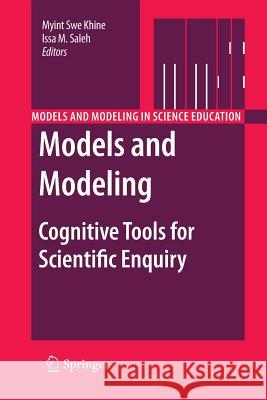
Myint Swe Khine; Issa M. Saleh
Models and Modeling: Cognitive Tools for Scientific Enquiry Khine, Myint Swe 9789400735484 Springer - książkaWidoczna okładka, to zdjęcie poglądowe, a rzeczywista szata graficzna może różnić się od prezentowanej.

Models and Modeling: Cognitive Tools for Scientific Enquiry

ISBN-13: 9789400735484 / Angielski / Miękka / 2013 / 292 str.

Myint Swe Khine; Issa M. Saleh
cena 403,47 zł
(netto: 384,26 VAT:  5%)

Najniższa cena z 30 dni: 385,52 zł
Termin realizacji zamówienia:
ok. 22 dni roboczych
Bez gwarancji dostawy przed świętami

Darmowa dostawa!
inne wydania

The process of developing models, known as modeling, allows scientists to visualize difficult concepts, explain complex phenomena and clarify intricate theories. In recent years, science educators have greatly increased their use of modeling in teaching, especially real-time dynamic modeling, which is central to a scientific investigation. Modeling in science teaching is being used in an array of fields, everything from primary sciences to tertiary chemistry to college physics, and it is sure to play an increasing role in the future of education. Models and Modeling: Cognitive Tools for Scientific Enquiry is a comprehensive introduction to the use of models and modeling in science education. It identifies and describes many different modeling tools and presents recent applications of modeling as a cognitive tool for scientific enquiry.


Kategorie:
Podręczniki
Kategorie BISAC:
Education > Teaching - Subjects - Science & Technology
Education > Educational Psychology
Science > Study & Teaching
Wydawca:
Springer
Seria wydawnicza:
Models and Modeling in Science Education
Język:
Angielski
ISBN-13:
9789400735484
Rok wydania:
2013
Wydanie:
2011
Numer serii:
000322497
Ilość stron:
292
Waga:
0.42 kg
Wymiary:
23.39 x 15.6 x 1.6
Oprawa:
Miękka
Wolumenów:
01

PART I - Theory Formation and Modeling in Science Education.- Chapter 1. Modeling and the Future of Science Learning, Richard K. Coll, Denis Laijum.- Chapter 2. A Study of Expert Theory Formation: The Role of Different Model Types and Domain Frameworks, Allan Collins.-Chapter 3. The Nature of Scientific Meta-Knowledge, Barbara Y. White, Allan Collins, John R. Frederiksen.- Chapter 4. From Modeling Schemata to the Profiling Schema: Modeling across the Curricula for Profile Shaping Education, Ibrahim A. Halloun. - PART II – Modeling and Student Learning in Science Education.- Chapter 5. Helping Students Construct Robust Conceptual Models, Colleen Megowan-Romanowicz.- Chapter 6. The Molecular Workbench Software: An Innovative Dynamic Modeling Tool for Nanoscience Education, Charles Xie, Amy Pallant .- Chapter 7. Lowering the Learning Threshold: Multi-Agent-Based Models and Learning Electricity, Pratim Sengupta, Uri Wilensky.- Chapter 8. Engineering-based Modeling Experiences in the Elementary and Middle Classroom, Lyn D. English, Nicholas G. Mousoulides.- Chapter 9. Engaging Elementary Students in Scientific Modeling: The MoDeLS 5th Grade Approach and Findings, Hamin Baek, Christina Schwarz, Jing Chen, Hayat Hokayem, Li Zhan.- PART III – Modeling and Teachers’ Knowledge.- Chapter 10. Relationships between Elementary Teachers’ Conceptions of Scientific Modeling and the Nature of Science, Valarie L. Akerson, Orvil White, Huseyin Colak,Khemmawaddee Pongsanon.- Chapter 11. Science teachers’ knowledge about learning and teaching models and modeling in Public Understanding of Science, Ineke Henze, Jan H. van Driel.- Chapter 12. Teaching Pre-service Elementary Teachers to Teach Science with Computer Models, Nicos Valanides, Charoula Angeli.- Subject Index.

 The process of developing models, known as modeling, allows scientists to visualize difficult concepts, explain complex phenomena and clarify intricate theories. In recent years, science educators have greatly increased their use of modeling in teaching, especially real-time dynamic modeling, which is central to a scientific investigation. Modeling in science teaching is being used in an array of fields, everything from primary sciences to tertiary chemistry to college physics, and it is sure to play an increasing role in the future of education.

 Models and Modeling: Cognitive Tools for Scientific Enquiry is a comprehensive introduction to the use of models and modeling in science education. It identifies and describes many different modeling tools and presents recent applications of modeling as a cognitive tool for scientific enquiry.

The processes of modelling and the use of the resulting models to inform predictions play key roles in the nature of science and hence in science education, especially in inquiry-based approaches. Against a background of the philosophical basis for modelling and models, the implications for science education are explored. Well-designed and thoroughly classroom-tested schemes to support students in learning how to model are reviewed. Research into teachers’ understanding of models and their place in the nature of science are reviewed as are successful strategies for the further development of that knowledge. This book has a major contribution to make to the pre- and in-service education of elementary (primary) and high (secondary) school science teachers.

John K. Gilbert
Professor Emeritus, The University of Reading
Visiting Professor, King's College London
Editor-in-Chief, International Journal of Science Education


Udostępnij

Facebook - konto krainaksiazek.pl


Opinie o Krainaksiazek.pl na Opineo.pl

Partner Mybenefit

Krainaksiazek.pl w programie rzetelna firma Krainaksiaze.pl - płatności przez paypal

Czytaj nas na:

Facebook - krainaksiazek.pl
  • książki na zamówienie
  • granty
  • książka na prezent
  • kontakt
  • pomoc
  • opinie
  • regulamin
  • polityka prywatności

Zobacz:

  • Księgarnia czeska

  • Wydawnictwo Książkowe Klimaty

1997-2025 DolnySlask.com Agencja Internetowa

© 1997-2022 krainaksiazek.pl
     
KONTAKT | REGULAMIN | POLITYKA PRYWATNOŚCI | USTAWIENIA PRYWATNOŚCI
Zobacz: Księgarnia Czeska | Wydawnictwo Książkowe Klimaty | Mapa strony | Lista autorów
KrainaKsiazek.PL - Księgarnia Internetowa

Polityka prywatnosci - link
Krainaksiazek.pl - płatnośc Przelewy24
Przechowalnia Przechowalnia




