• Wyszukiwanie zaawansowane
  • Kategorie
  • Kategorie BISAC
  • Książki na zamówienie
  • Promocje
  • Granty
  • Książka na prezent
  • Opinie
  • Pomoc
  • Załóż konto
  • Zaloguj się

Model-Free Prediction and Regression: A Transformation-Based Approach to Inference » książka


zaloguj się | załóż konto
Logo Krainaksiazek.pl

koszyk

konto

szukaj
topmenu
Księgarnia internetowa
Szukaj
Książki na zamówienie
Promocje
Granty
Książka na prezent
Moje konto
Pomoc
 
 
Wyszukiwanie zaawansowane
Pusty koszyk
Bezpłatna dostawa dla zamówień powyżej 20 złBezpłatna dostawa dla zamówień powyżej 20 zł

Kategorie główne

• Nauka
 [2949965]
• Literatura piękna
 [1857847]

  więcej...
• Turystyka
 [70818]
• Informatyka
 [151303]
• Komiksy
 [35733]
• Encyklopedie
 [23180]
• Dziecięca
 [617748]
• Hobby
 [139972]
• AudioBooki
 [1650]
• Literatura faktu
 [228361]
• Muzyka CD
 [398]
• Słowniki
 [2862]
• Inne
 [444732]
• Kalendarze
 [1620]
• Podręczniki
 [167233]
• Poradniki
 [482388]
• Religia
 [509867]
• Czasopisma
 [533]
• Sport
 [61361]
• Sztuka
 [243125]
• CD, DVD, Video
 [3451]
• Technologie
 [219309]
• Zdrowie
 [101347]
• Książkowe Klimaty
 [123]
• Zabawki
 [2362]
• Puzzle, gry
 [3791]
• Literatura w języku ukraińskim
 [253]
• Art. papiernicze i szkolne
 [7933]
Kategorie szczegółowe BISAC

Model-Free Prediction and Regression: A Transformation-Based Approach to Inference

ISBN-13: 9783319213460 / Angielski / Twarda / 2015 / 246 str.
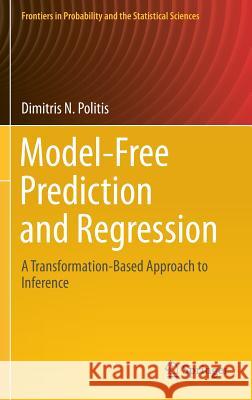
Dimitris N. Politis
Model-Free Prediction and Regression: A Transformation-Based Approach to Inference Politis, Dimitris N. 9783319213460 Springer - książkaWidoczna okładka, to zdjęcie poglądowe, a rzeczywista szata graficzna może różnić się od prezentowanej.

Model-Free Prediction and Regression: A Transformation-Based Approach to Inference

ISBN-13: 9783319213460 / Angielski / Twarda / 2015 / 246 str.

Dimitris N. Politis
cena 403,47 zł
(netto: 384,26 VAT:  5%)

Najniższa cena z 30 dni: 346,96 zł
Termin realizacji zamówienia:
ok. 22 dni roboczych
Bez gwarancji dostawy przed świętami

Darmowa dostawa!

The Model-Free Prediction Principle expounded upon in this monograph is based on the simple notion of transforming a complex dataset to one that is easier to work with, e.g., i.i.d. or Gaussian. As such, it restores the emphasis on observable quantities, i.e., current and future data, as opposed to unobservable model parameters and estimates thereof, and yields optimal predictors in diverse settings such as regression and time series. Furthermore, the Model-Free Bootstrap takes us beyond point prediction in order to construct frequentist prediction intervals without resort to unrealistic assumptions such as normality.Prediction has been traditionally approached via a model-based paradigm, i.e., (a) fit a model to the data at hand, and (b) use the fitted model to extrapolate/predict future data. Due to both mathematical and computational constraints, 20th century statistical practice focused mostly on parametric models. Fortunately, with the advent of widely accessible powerful computing in the late 1970s, computer-intensive methods such as the bootstrap and cross-validation freed practitioners from the limitations of parametric models, and paved the way towards the big data' era of the 21st century. Nonetheless, there is a further step one may take, i.e., going beyond even nonparametric models; this is where the Model-Free Prediction Principle is useful.Interestingly, being able to predict a response variable Y associated with a regressor variable X taking on any possible value seems to inadvertently also achieve the main goal of modeling, i.e., trying to describe how Y depends on X. Hence, as prediction can be treated as a by-product of model-fitting, key estimation problems can be addressed as a by-product of being able to perform prediction. In other words, a practitioner can use Model-Free Prediction ideas in order to additionally obtain point estimates and confidence intervals for relevant parameters leading to an alternative, transformation-based approach to statistical inference.


Kategorie:
Nauka, Matematyka
Kategorie BISAC:
Mathematics > Prawdopodobieństwo i statystyka
Computers > Mathematical & Statistical Software
Business & Economics > Statystyka gospodarcza
Wydawca:
Springer
Seria wydawnicza:
Frontiers in Probability and the Statistical Sciences
Język:
Angielski
ISBN-13:
9783319213460
Rok wydania:
2015
Wydanie:
2015
Numer serii:
000693945
Ilość stron:
246
Waga:
0.54 kg
Wymiary:
23.39 x 15.6 x 1.6
Oprawa:
Twarda
Wolumenów:
01
Dodatkowe informacje:
Wydanie ilustrowane

"The monograph restores the emphasis on observable quantities. Considering model-free and model-based prediction, the monograph emphasises on model-free approach but also shows the close relation between these two approaches. The book is of interest for both academics and practitioners in the field of data analysis." (Pavel Stoynov, zbMATH 1397.62008, 2018)

"This self-contained and fascinating book, intended for advanced graduate and Ph.D. students, teachers, researchers and practitioners, is useful, well written, and directly oriented toward real data applications." (Gilles Teyssière, Mathematical Reviews, February, 2017)

Prediction: some heuristic notions.- The Model-free Prediction Principle.- Model-based prediction in regression.- Model-free prediction in regression.- Model-free vs. model-based confidence intervals.- Linear time series and optimal linear prediction.- Model-based prediction in autoregression.- Model-free inference for Markov processes.- Predictive inference for locally stationary time series.- Model-free vs. model-based volatility prediction.

Dimitris N. Politis is Professor of Mathematics and Adjunct Professor of Economics at the University of California, San Diego. His research interests include Time Series Analysis, Resampling and Subsampling, Nonparametric Function Estimation, and Model-free Prediction. He has served as Editor of the IMS Bulletin (2010-2013), Co-Editor of the Journal of Time Series Analysis (2013-present), Co-Editor of the Journal of Nonparametric Statistics (2008-2011), and as Associate Editor for several journals including Bernoulli, the Journal of the American Statistical Association, and the Journal of the Royal Statistical Society, Series B. He is a fellow of the Institute of Mathematical Statistics (IMS) and the American Statistical Association, former fellow of the John Simon Guggenheim Memorial Foundation, and co-founder (with M. Akritas and S.N. Lahiri) of the International Society for NonParametric Statistics.

The  Model-Free  Prediction Principle expounded upon in this monograph is based on the simple notion of transforming a complex dataset to one that is easier  to work with, e.g., i.i.d. or Gaussian. As such, it restores the emphasis on observable quantities, i.e., current and future data, as opposed to unobservable model parameters and estimates thereof, and yields optimal predictors in diverse settings such as regression and time series. Furthermore, the Model-Free Bootstrap takes us beyond point prediction in order to construct frequentist prediction intervals without resort to unrealistic assumptions such as normality.

Prediction has been traditionally approached via a model-based paradigm, i.e.,  (a) fit a model to the data at hand, and (b) use the fitted model to extrapolate/predict future data. Due to both mathematical and computational constraints, 20th century  statistical practice focused mostly on parametric models. Fortunately, with the advent of widely accessible powerful computing in the late 1970s, computer-intensive methods  such as    the bootstrap and cross-validation freed practitioners from the limitations of parametric models, and paved  the way towards the `big data' era of the 21st century. Nonetheless, there is a further step one may take, i.e.,  going beyond even nonparametric models; this is where the Model-Free Prediction Principle is useful.

Interestingly, being able to predict a response variable Y associated with a regressor variable  X taking on any possible value seems to inadvertently also achieve  the main goal of modeling, i.e., trying to describe how Y depends on X. Hence, as prediction can be  treated as a by-product of model-fitting, key estimation problems can be addressed as a by-product  of being able to perform prediction. In other words, a practitioner can use Model-Free  Prediction ideas in order to additionally obtain point estimates  and confidence intervals for relevant  parameters   leading to an alternative, transformation-based approach to statistical inference.



Udostępnij

Facebook - konto krainaksiazek.pl


Opinie o Krainaksiazek.pl na Opineo.pl

Partner Mybenefit

Krainaksiazek.pl w programie rzetelna firma Krainaksiaze.pl - płatności przez paypal

Czytaj nas na:

Facebook - krainaksiazek.pl
  • książki na zamówienie
  • granty
  • książka na prezent
  • kontakt
  • pomoc
  • opinie
  • regulamin
  • polityka prywatności

Zobacz:

  • Księgarnia czeska

  • Wydawnictwo Książkowe Klimaty

1997-2025 DolnySlask.com Agencja Internetowa

© 1997-2022 krainaksiazek.pl
     
KONTAKT | REGULAMIN | POLITYKA PRYWATNOŚCI | USTAWIENIA PRYWATNOŚCI
Zobacz: Księgarnia Czeska | Wydawnictwo Książkowe Klimaty | Mapa strony | Lista autorów
KrainaKsiazek.PL - Księgarnia Internetowa

Polityka prywatnosci - link
Krainaksiazek.pl - płatnośc Przelewy24
Przechowalnia Przechowalnia




