• Wyszukiwanie zaawansowane
  • Kategorie
  • Kategorie BISAC
  • Książki na zamówienie
  • Promocje
  • Granty
  • Książka na prezent
  • Opinie
  • Pomoc
  • Załóż konto
  • Zaloguj się

Model Based Learning and Instruction in Science » książka

zaloguj się | załóż konto
Logo Krainaksiazek.pl

koszyk

konto

szukaj
topmenu
Księgarnia internetowa
Szukaj
Książki na zamówienie
Promocje
Granty
Książka na prezent
Moje konto
Pomoc
 
 
Wyszukiwanie zaawansowane
Pusty koszyk
Bezpłatna dostawa dla zamówień powyżej 20 złBezpłatna dostawa dla zamówień powyżej 20 zł

Kategorie główne

• Nauka
 [2950560]
• Literatura piękna
 [1849509]

  więcej...
• Turystyka
 [71097]
• Informatyka
 [151150]
• Komiksy
 [35848]
• Encyklopedie
 [23178]
• Dziecięca
 [617388]
• Hobby
 [139064]
• AudioBooki
 [1657]
• Literatura faktu
 [228597]
• Muzyka CD
 [383]
• Słowniki
 [2855]
• Inne
 [445295]
• Kalendarze
 [1464]
• Podręczniki
 [167547]
• Poradniki
 [480102]
• Religia
 [510749]
• Czasopisma
 [516]
• Sport
 [61293]
• Sztuka
 [243352]
• CD, DVD, Video
 [3414]
• Technologie
 [219456]
• Zdrowie
 [101002]
• Książkowe Klimaty
 [124]
• Zabawki
 [2311]
• Puzzle, gry
 [3459]
• Literatura w języku ukraińskim
 [254]
• Art. papiernicze i szkolne
 [8079]
Kategorie szczegółowe BISAC

Model Based Learning and Instruction in Science

ISBN-13: 9789402413106 / Angielski / Miękka / 2019 / 279 str.
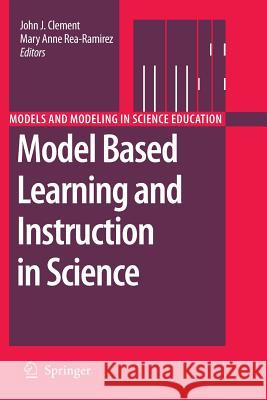
John Clement;Mary Anne Rea-Ramirez
Model Based Learning and Instruction in Science John Clement Mary Anne Rea-Ramirez  9789402413106 Springer - książkaWidoczna okładka, to zdjęcie poglądowe, a rzeczywista szata graficzna może różnić się od prezentowanej.

Model Based Learning and Instruction in Science

ISBN-13: 9789402413106 / Angielski / Miękka / 2019 / 279 str.

John Clement;Mary Anne Rea-Ramirez
cena 402,53
(netto: 383,36 VAT:  5%)

Najniższa cena z 30 dni: 385,52
Termin realizacji zamówienia:
ok. 22 dni roboczych
Dostawa w 2026 r.

Darmowa dostawa!

Anyone involved in science education will find that this text can enhance their pedagogical practice. It describes new, model-based teaching methods that integrate social and cognitive perspectives for science instruction. It presents research that describes how these new methods are applied in a diverse group of settings, including middle school biology, high school physics, and college chemistry classrooms. They offer practical tips for teaching the toughest of key concepts.


Kategorie:
Podręczniki
Kategorie BISAC:
Education > Teaching - Subjects - Science & Technology
Education > Professional Development
Psychology > Cognitive Psychology & Cognition
Wydawca:
Springer
Język:
Angielski
ISBN-13:
9789402413106
Rok wydania:
2019
Wydanie:
Softcover Repri
Ilość stron:
279
Waga:
0.41 kg
Wymiary:
23.39 x 15.6 x 1.57
Oprawa:
Miękka
Wolumenów:
01
Dodatkowe informacje:
Wydanie ilustrowane

Introduction: A 'Hidden World' Of Nonformal Expert Reasoning 1.1 Why Study Nonformal Reasoning? 1.2 The Background From Which I Approached This Work 1.3 Methodology: Qualitative Nature Of The Study 1.4 General Features Of The Descriptive Methodology Used 1.5 General Theoretical Framework 1.6 Section Summaries And Approaches To Reading This Book PART ONE: ANALOGIES, MODELS AND CREATIVE LEARNING IN EXPERTS AND STUDENTS SECTION I: EXPERT REASONING AND LEARNING VIA ANALOGY 2 Major Subprocesses Involved in Spontaneous Analogical Reasoning 2.1 Some Major Issues in Analogical Reasoning 2.2 Method of Study 2.3 Initial Observations from Transcripts 2.4 Major processes used in analogical reasoning 2.5 Conclusion 3 Methods Experts Use to Generate Analogies 3.1 Introduction 3.2 Definitions of Basic Concepts and Observations 3.3 Discussion 4 Methods Experts Use to Evaluate an Analogy Relation 4.1 The Importance of Establishing the Validity of an Analogy Relation 4.2 Examples from Case Studies 4.3 Analogy Evaluation in the Doughnut Problem 4.4 Discussion of Findings and Connections to History of Science 4.5 Summary 5 Expert Methods for Developing an Understanding of the Analogous Case and Transferring Findings 5.1 Evaluating and Developing Understanding of the Analogous Case. 5.2 Transferring Findings 5.3 Summary on Creative Analogy Generation SECTION II: MODEL CONSTRUCTION AND SCIENTIFIC INSIGHT IN EXPERTS 6 Case Study of Model Construction Cycles in Expert Reasoning 6.1 Introduction 6.2 Background Questions from Philosophy of Science 6.3 How Are Theoretical Hypotheses Formed in the Individual Scientist? 6.4 Protocol Evidence on Construction Cycles That Use Analogies 6.5 Summary of Evidence For AModel Construction Cycle as A Non-Inductive Source for Hypotheses 6.6 Major Nonformal Reasoning Patterns in the Preceding Chapters 7 Creativity and Scientific Insight in the Case Study for S2 7.1 Eureka or Accretion? The Presence of Insight in S2’s Protocol 7.2 Creative Mental Processes 7.3 Darwin’s Theory of Natural Selection 7.4 Initial List of Features of Creative Thinking from this Case Study and Remaining Challenges SECTION III: NONFORMAL REASONING IN STUDENTS AND IMPLICATIONS FOR INSTRUCTION 8 Spontaneous Analogies Generated by Students Solving Science Problems 8.1 Use of Analogies by Students 8.2 Conclusion 8.3 Appendix: Examples of Problems and Spontaneous Analogies 9 Case Study of a Student who Counters and Improves his own Misconception by Generating a Chain of Analogies 9.1 Spontaneous Analogies in a Student’s Problem Solution 9.2 Conclusion 10 Using Analogies and Models in Instruction to Deal with Students Preconceptions 10.1 Introduction 10.2 Teaching Strategy 10.3 Teaching Interviews 10.4 Applications to Classroom Teaching 10.5 Conclusion 10.5.2 Explanatory Models vs. Specific Analogous Cases PART TWO: ADVANCED USES OF IMAGERY AND PLAUSIBLE REASONING IN SCIENCE AND MATHEMATICS SECTION IV: IMAGERY AND PHYSICAL INTUITION IN EXPERTS AND STUDENTS 11 Analogy, Extreme Cases, and Spatial Transformations in Mathematical Problem Solving by Experts 11.1 Introduction 11.2 Case Study of Analogical Reasoning in a Mathematics Problem 11.3 Results on the Use of Analogies for Eight Subjects 11.4 Other Creative Non-formal Reasoning Processes 11.5 Discussion 11.6 Conclusion 12 Depictive Gestures and Other Case Study Evidence for Mental Simulation in Experts and Students 12.1 Introduction 12.2

This book describes new, model based teaching methods for science instruction. It presents research that describes these new methods in a very diverse group of settings: middle school biology, high school physics, and college chemistry classrooms. Mental models in these areas such as understanding the structure of the lungs or cells, molecular structures and reaction mechanisms in chemistry, or causes of current flow in electricity are notoriously difficult for many students to learn. Yet these lie at the core of conceptual understanding in these areas. The studies focus on a variety of teaching strategies such as discrepant questioning, analogies, animations, model competition, and hands on activities. Five different levels of organization for teaching strategies are described, from those operating over months (design of the sequence of units in a curriculum) to those operating over minutes ( teaching tactics for guiding discussion minute by minute).


Udostępnij

Facebook - konto krainaksiazek.pl


Opinie o Krainaksiazek.pl na Opineo.pl

Partner Mybenefit

Krainaksiazek.pl w programie rzetelna firma Krainaksiaze.pl - płatności przez paypal

Czytaj nas na:

Facebook - krainaksiazek.pl
  • książki na zamówienie
  • granty
  • książka na prezent
  • kontakt
  • pomoc
  • opinie
  • regulamin
  • polityka prywatności

Zobacz:

  • Księgarnia czeska

  • Wydawnictwo Książkowe Klimaty

1997-2025 DolnySlask.com Agencja Internetowa

© 1997-2022 krainaksiazek.pl
     
KONTAKT | REGULAMIN | POLITYKA PRYWATNOŚCI | USTAWIENIA PRYWATNOŚCI
Zobacz: Księgarnia Czeska | Wydawnictwo Książkowe Klimaty | Mapa strony | Lista autorów
KrainaKsiazek.PL - Księgarnia Internetowa

Polityka prywatnosci - link
Krainaksiazek.pl - płatnośc Przelewy24
Przechowalnia Przechowalnia






