• Wyszukiwanie zaawansowane
  • Kategorie
  • Kategorie BISAC
  • Książki na zamówienie
  • Promocje
  • Granty
  • Książka na prezent
  • Opinie
  • Pomoc
  • Załóż konto
  • Zaloguj się

Melt Rheology and Its Applications in the Plastics Industry » książka


zaloguj się | załóż konto
Logo Krainaksiazek.pl

koszyk

konto

szukaj
topmenu
Księgarnia internetowa
Szukaj
Książki na zamówienie
Promocje
Granty
Książka na prezent
Moje konto
Pomoc
 
 
Wyszukiwanie zaawansowane
Pusty koszyk
Bezpłatna dostawa dla zamówień powyżej 20 złBezpłatna dostawa dla zamówień powyżej 20 zł

Kategorie główne

• Nauka
 [2949965]
• Literatura piękna
 [1857847]

  więcej...
• Turystyka
 [70818]
• Informatyka
 [151303]
• Komiksy
 [35733]
• Encyklopedie
 [23180]
• Dziecięca
 [617748]
• Hobby
 [139972]
• AudioBooki
 [1650]
• Literatura faktu
 [228361]
• Muzyka CD
 [398]
• Słowniki
 [2862]
• Inne
 [444732]
• Kalendarze
 [1620]
• Podręczniki
 [167233]
• Poradniki
 [482388]
• Religia
 [509867]
• Czasopisma
 [533]
• Sport
 [61361]
• Sztuka
 [243125]
• CD, DVD, Video
 [3451]
• Technologie
 [219309]
• Zdrowie
 [101347]
• Książkowe Klimaty
 [123]
• Zabawki
 [2362]
• Puzzle, gry
 [3791]
• Literatura w języku ukraińskim
 [253]
• Art. papiernicze i szkolne
 [7933]
Kategorie szczegółowe BISAC

Melt Rheology and Its Applications in the Plastics Industry

ISBN-13: 9789400763944 / Angielski / Twarda / 2013 / 282 str.
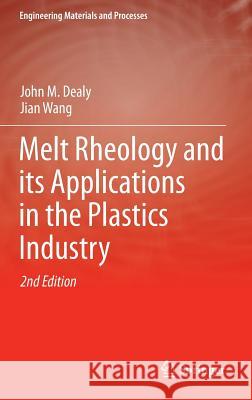
John M. Dealy; Jian Wang
Melt Rheology and Its Applications in the Plastics Industry Dealy, John M. 9789400763944 Springer - książkaWidoczna okładka, to zdjęcie poglądowe, a rzeczywista szata graficzna może różnić się od prezentowanej.

Melt Rheology and Its Applications in the Plastics Industry

ISBN-13: 9789400763944 / Angielski / Twarda / 2013 / 282 str.

John M. Dealy; Jian Wang
cena 726,29 zł
(netto: 691,70 VAT:  5%)

Najniższa cena z 30 dni: 693,97 zł
Termin realizacji zamówienia:
ok. 22 dni roboczych
Bez gwarancji dostawy przed świętami

Darmowa dostawa!
inne wydania

This is the second edition of Melt Rheology and its Role in Plastics Processing, although the title has changed to reflect its broadened scope. Advances in the recent years in rheometer technology and polymer science have greatly enhanced the usefulness of rheology in the plastics industry. It is now possible to design polymers having specific molecular structures and to predict the flow properties of melts having those structures. In addition, rheological properties now provide more precise information about molecular structure.This book provides all the information that is needed for the intelligent application of rheology in the development of new polymers, the determination of molecular structure and the correlation of processability with laboratory test data. Theory and equations are limited to what is essential for the use of rheology in the characterization of polymers, the development of new plastics materials and the prediction of plastics processing behavior. The emphasis is on information that will be of direct use to practitioners. Extensive references are provided for those wishing to pursue certain issues in greater depth. While the primary audience is applied polymer scientists and plastics engineers, the book will also be of use to postgraduate students in polymer science and engineering and as a text for a graduate course.


Kategorie:
Nauka, Chemia
Kategorie BISAC:
Technology & Engineering > Textiles & Polymers
Science > Chemia - Fizyczna
Science > Chemistry - Industrial & Technical
Wydawca:
Springer
Seria wydawnicza:
Engineering Materials and Processes
Język:
Angielski
ISBN-13:
9789400763944
Rok wydania:
2013
Wydanie:
2013
Numer serii:
000257314
Ilość stron:
282
Waga:
5.74 kg
Wymiary:
23.5 x 15.5
Oprawa:
Twarda
Wolumenów:
01
Dodatkowe informacje:
Wydanie ilustrowane

Preface.-  1.Introduction to Rheology: 1.1 What is rheology?.-  1.2 Why rheological properties are important.-  1.3 Stress- a measure of force.-  1.4 Strain – a measure of deformation.-  1.5 Rheological Phenomena.-  1.6 Why polymeric liquids are non-Newtonian and elastic.-  2.Viscosity and the Normal Stress Differences: 2.1  Simple shear and steady simple shear.-  2.2  Viscometric flow.-  2.3 The viscometric functions.-  2.4  The Viscosity.-  2.5  Normal stress differences.-  References.-  3. Linear Viscoelasticity: 3.1 Introduction.-  3.2 Stress relaxation and the relaxation modulus.-  3.3 The Boltzmann superposition principle.-  3.4 Start-up of steady simple shear.-  3.5  Relaxation moduli of rubbers and molten polymers.-  3.6  The Maxwell model for the relaxation modulus.-  3.7  The generalized Maxwell model and the discrete relaxation spectrum.-  3.8  The continuous spectrum.-  .9 Creep and creep recovery: The compliance.-  3.10  Start-up of steady simple extension.-  3.11 Small amplitude oscillatory shear.-  3.12 Inferring a discrete relaxation spectrum from storage and loss moduli.-  3.13  Combining creep and oscillatory shear data.-  3.14 Time-temperature superposition.-  3.15 Cole-Cole and related plots of linear data.-  3.16 Van Gurp-Palmen Plot of Loss Angle Versus Complex Modulus.-  3.17  Storage and loss moduli of molten linear polymers.-  3.18  The plateau modulus and the molecular weight between entanglements.-  3.19  The Rouse-Bueche model for unentangled melts.-  3.20  Tube models for entangled melts.-  3.21  Molecular weights fo the onset of entanglement effects.-  3.22  Summary.-  References.-  4. Nonlinear Viscoelasticity – Phenomena: 4.1 Introduction.-  4.2  Nonlinear phenomena from a tube modelp of view.-  4.3  Nonlinear stress relaxation.-  4.4  Dimensionless groups used to plot rheological data.-  4.5  The viscosity in terms of the tube model.-  4.6  Transient shear tests at finite rates.-  4.7  Extensional flow behavior – Introduction.-  4.8  Extensional Flow Behavior of Melts.-  4.9   Shear modification.-  4.10  Time-temperature superposition of nonlinear properties.-  References.-  5. Nonlinear Viscoelasticity – Models: 5.1 Introduction.-  5.2 Tensor notation.-  5.3 The stress tensor.-  5.4  A strain tensor for infinitesimal deformations.-  5.5  The Boltzmann superposition principle in tensor form.-  5.6 Strain tensors for large, rapid deformations.-  5.7  Integral constitutive equations based on continuum mechanics.-  5.8  Continuum differential constitutive equations.-  5.9  Constitutive equations from molecular models.-  5.10  Numerical simulation of melt flows.-  References.-  6. Measurement Techniques: 6.1. Introduction.-  6.2. Rotational and other drag-flow rheometers.-  6.3. Pressure-driven rheometers.-  6.4  On-line rheometers.-  6.5  High-throughput rheometry.-  6.6. Extensional rheometers.-  6.7  Torque Rheometers.-  6.8  Using Rheology for statistical process control.-  6.9  Sample Stability: Thermo-oxidative degradation and hydrolysis.-  Reference.-  7.  Rheology and molecular structure: 7.1 Rheology and structure of linear polymers.-  7.2 Long-chain branching and melt rheology.-  References.-  8.  Role of Rheology in Plastics Processing: 8.1.Introduction.-  8.2 Flow in simple channels and dies.-  8.3 Flow in an extruder.-  8.4 Sheet extrusion/film casting.-  8.5 Extrusion coating.-  8.6. Film blowing.-  8.7 Blow molding.-  8.8  Injection molding.-  8.9. Rotational molding.-  8.10. Foam Extrusion.-  References.-  Appendix A  Structural and Rheological Parameters for Several Polymers.-  Appendix B  The Displacement Gradient Tensor.-  Subject Index.

This is the second edition of Melt Rheology and its Role in Plastics Processing, although the title has changed to reflect its broadened scope. Advances in the recent years in rheometer technology and polymer science have greatly enhanced the usefulness of rheology in the plastics industry. It is now possible to design polymers having specific molecular structures and to predict the flow properties of melts having those structures. In addition, rheological properties now provide more precise information about molecular structure.

This book provides all the information that is needed for the intelligent application of rheology in the development of new polymers, the determination of molecular structure and the correlation of processability with laboratory test data. Theory and equations are limited to what is essential for the use of rheology in the characterization of polymers, the development of new plastics materials and the prediction of plastics processing behavior. The emphasis is on information that will be of direct use to practitioners. Extensive references are provided for those wishing to pursue certain issues in greater depth.

While the primary audience is applied polymer scientists and plastics engineers, the book will also be of use to postgraduate students in polymer science and engineering and as a text for a graduate course.




Udostępnij

Facebook - konto krainaksiazek.pl


Opinie o Krainaksiazek.pl na Opineo.pl

Partner Mybenefit

Krainaksiazek.pl w programie rzetelna firma Krainaksiaze.pl - płatności przez paypal

Czytaj nas na:

Facebook - krainaksiazek.pl
  • książki na zamówienie
  • granty
  • książka na prezent
  • kontakt
  • pomoc
  • opinie
  • regulamin
  • polityka prywatności

Zobacz:

  • Księgarnia czeska

  • Wydawnictwo Książkowe Klimaty

1997-2025 DolnySlask.com Agencja Internetowa

© 1997-2022 krainaksiazek.pl
     
KONTAKT | REGULAMIN | POLITYKA PRYWATNOŚCI | USTAWIENIA PRYWATNOŚCI
Zobacz: Księgarnia Czeska | Wydawnictwo Książkowe Klimaty | Mapa strony | Lista autorów
KrainaKsiazek.PL - Księgarnia Internetowa

Polityka prywatnosci - link
Krainaksiazek.pl - płatnośc Przelewy24
Przechowalnia Przechowalnia




