• Wyszukiwanie zaawansowane
  • Kategorie
  • Kategorie BISAC
  • Książki na zamówienie
  • Promocje
  • Granty
  • Książka na prezent
  • Opinie
  • Pomoc
  • Załóż konto
  • Zaloguj się

Mathematical Creativity: A Developmental Perspective » książka


zaloguj się | załóż konto
Logo Krainaksiazek.pl

koszyk

konto

szukaj
topmenu
Księgarnia internetowa
Szukaj
Książki na zamówienie
Promocje
Granty
Książka na prezent
Moje konto
Pomoc
 
 
Wyszukiwanie zaawansowane
Pusty koszyk
Bezpłatna dostawa dla zamówień powyżej 20 złBezpłatna dostawa dla zamówień powyżej 20 zł

Kategorie główne

• Nauka
 [2949965]
• Literatura piękna
 [1857847]

  więcej...
• Turystyka
 [70818]
• Informatyka
 [151303]
• Komiksy
 [35733]
• Encyklopedie
 [23180]
• Dziecięca
 [617748]
• Hobby
 [139972]
• AudioBooki
 [1650]
• Literatura faktu
 [228361]
• Muzyka CD
 [398]
• Słowniki
 [2862]
• Inne
 [444732]
• Kalendarze
 [1620]
• Podręczniki
 [167233]
• Poradniki
 [482388]
• Religia
 [509867]
• Czasopisma
 [533]
• Sport
 [61361]
• Sztuka
 [243125]
• CD, DVD, Video
 [3451]
• Technologie
 [219309]
• Zdrowie
 [101347]
• Książkowe Klimaty
 [123]
• Zabawki
 [2362]
• Puzzle, gry
 [3791]
• Literatura w języku ukraińskim
 [253]
• Art. papiernicze i szkolne
 [7933]
Kategorie szczegółowe BISAC

Mathematical Creativity: A Developmental Perspective

ISBN-13: 9783031144738 / Angielski / Twarda / 2022 / 250 str.
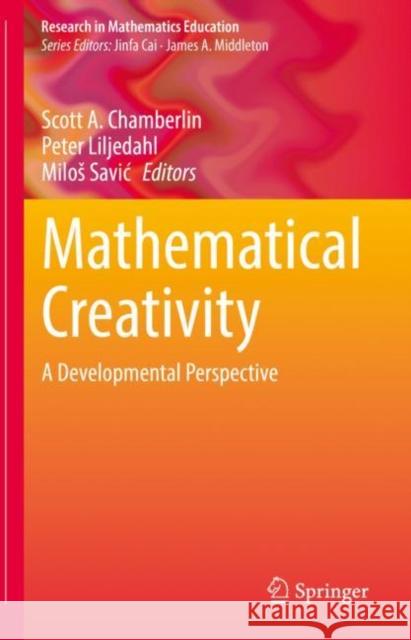
Scott A. Chamberlin; Peter Liljedahl; Milos Savic
Mathematical Creativity: A Developmental Perspective Scott A. Chamberlin Peter Liljedahl Milos Savic 9783031144738 Springer - książkaWidoczna okładka, to zdjęcie poglądowe, a rzeczywista szata graficzna może różnić się od prezentowanej.

Mathematical Creativity: A Developmental Perspective

ISBN-13: 9783031144738 / Angielski / Twarda / 2022 / 250 str.

Scott A. Chamberlin; Peter Liljedahl; Milos Savic
cena 887,69 zł
(netto: 845,42 VAT:  5%)

Najniższa cena z 30 dni: 771,08 zł
Termin realizacji zamówienia:
ok. 22 dni roboczych
Bez gwarancji dostawy przed świętami

Darmowa dostawa!
inne wydania

This book is important and makes a unique contribution in the field of mathematics education and creativity. The book comprises the most recent research by renowned international experts and scholars, as well as a comprehensive up to date literature review. The developmental lens applied to the research presented makes it unique in the field. Also, this book provides a discussion of future directions for research to complement what is already known in the field of mathematical creativity. Finally, a critical discussion of the importance of the literature in relation to development of learners and accordingly pragmatic applications for educators is provided.Many books provide the former (2) foci, but omit the final discussion of the research in relation to developmental needs of learners in the domain of mathematics. Currently, educators are expected to implement best practices and illustrate how their adopted approaches are supported by research.  The authors and editors of this book have invested significant effort in merging theory with practice to further this field and develop it for future generations of mathematics learners, teachers and researchers.

This book is important and makes a unique contribution in the field of mathematics education and creativity. The book comprises the most recent research by renowned international experts and scholars, as well as a comprehensive up to date literature review. The developmental lens applied to the research presented makes it unique in the field. Also, this book provides a discussion of future directions for research to complement what is already known in the field of mathematical creativity. Finally, a critical discussion of the importance of the literature in relation to development of learners and accordingly pragmatic applications for educators is provided. 


Many books provide the former (2) foci, but omit the final discussion of the research in relation to developmental needs of learners in the domain of mathematics. Currently, educators are expected to implement best practices and illustrate how their adopted approaches are supported by research.  The authors and editors of this book have invested significant effort in merging theory with practice to further this field and develop it for future generations of mathematics learners, teachers and researchers.

Kategorie:
Podręczniki
Kategorie BISAC:
Education > Teaching - Subjects - Mathematics
Mathematics > Matematyka
Education > Special Education - General
Wydawca:
Springer
Seria wydawnicza:
Research in Mathematics Education
Język:
Angielski
ISBN-13:
9783031144738
Rok wydania:
2022
Dostępne języki:
Numer serii:
000345947
Ilość stron:
250
Waga:
0.54 kg
Wymiary:
23.39 x 15.6 x 1.6
Oprawa:
Twarda
Dodatkowe informacje:
Wydanie ilustrowane

Foreword/Preface: Todd Kettler (Baylor University)

Section I: History and background of mathematical creativity
Chapter 1: Innovation and invention: Hadamard, Poincaré, and the pioneers of mathematical creativity
(authors: Peter Liljedahl and colleagues). A focus of this chapter pertains to sharing early research in the
field of mathematical creativity. As illustrated, early research dates to at least the 1900 era when
Poincaré discussed the concept of invention and innovation. Subsequently, Hadamard (circa 1945)
followed Poincaré’s seminal address, writings, and overall message. Hadamard and Poincaré, as an
example, discuss how such thinking comes to pass among mathematicians and mathematical thinkers.
Their thoughts and writings are quite antiquated, but likely as revelatory today as they were 75-100
years ago. The principal reason for infusing a chapter on the history of creativity is that many of the
fundamental principles that undergird creativity are those that have shaped the direction of research a
century later. Hence, in highlighting the literature and discussing where and how the research base
originated, readers will be better able to make sense of why creativity research is going in the direction
than it is today. The gap from the early 1900s to current is discussed in this chapter and much of the
groundwork is therefore laid for making sense of mathematical creativity in the book. The psychological
construct of development as a lens through which to view mathematical creativity, is also discussed in a
concise manner.
Chapter 2: Conceptions of mathematical creativity and their implicit and explicit value in society are
discussed (authors: Scott Chamberlin and colleagues). In this chapter, the construct of mathematical
creativity is discussed in relation to its value to greater society, as well as mathematics educators and
policy makers. In specific, the chasm between how society views mathematical creativity (i.e., as quite
important), the manner in which it is emphasized in mathematics standards documents (again, as quite
important), and lack of resources invested in it from educational administrators, enjoys a rather large
disparity. In short, policy makers and academicians assert the relative importance of mathematical
creativity, but scant resources are invested when it comes to engendering it in the mathematics
classroom. In this chapter, this chasm is explored. In addition, the organizational framework for the
book is outlined and readers will gain a deepened conception of mathematical creativity through the
lens of development. Creativity in mathematics is not as homogeneous as perhaps thought when one
analyzes the processes, as well as accompanying products, involved in ages 5-12, 13-18, and 19-23. This
is because mathematics becomes increasingly sophisticated as learners age and the domains of
mathematics are subtly altered from predominately number sense and operations to more complex
domains such as calculus, algebra, and geometry, in addition to requiring myriad types of reasoning and
processes, such as mathematical modeling.
Chapter 3: In this jointly written chapter (authors: Scott Chamberlin, Peter Liljedahl, and Miloš Savić),
the authors carefully elucidate their position regarding the relationship of development and
mathematical creativity. In specific, their thesis is that development has not been considered as a
fundamental psychological construct relative to mathematical creativity and it may hold promise for
making sense of its emergence at various age levels. As an example, mathematical creativity is multifaceted,
and variables involved with precipitating it (e.g., process and product) in mathematical learning
episodes should not be left to happenstance. When mathematics educators become intentional in
fostering mathematical creativity with learners, it may enhance the probability of it emerging.
Chapter 4: In this chapter (author Alane Starko), commentary is provided on the three chapters that
constitute section I. All commentary chapters for the book contain a summary of the section, along with
positive and negative attributes of the passages for reader interpretation. Commentator perspectives
are offered to provide readers with a point of view that may be in agreement or disagreement with the
authors.
NOTE: The first two chapters of this section of the book will use literature to put forth a thesis that is
elucidated in chapter 3. Consequently, in the first section, literature is utilized as a means to form and
support the developmental thesis along the lines of a literature review as articulated in Liljedahl (2019).
Section II: Synthesis of literature findings for researchers
Chapter 5: The focus of this chapter pertains to considerations of how mathematical creativity literature
influences and directs researcher efforts for mathematics education, ages 5-12 (Authors: Scott
Chamberlin and colleagues). In addition, the authors highlight research and how and what it informs the
field of mathematical creativity to do in order to provide an answer to the field’s most immediate
questions. Contrary to many academic books, this chapter, and the following two chapters, will arise as
a direct result of what is found in the research and construction of the first three chapters. Chapters 4,
5, and 6 cannot be written until an exhaustive investigation of extant literature is provided and all
chapters in this section are designed to provide insight to researchers regarding next steps in
mathematical creativity research endeavors. This chapter, as is true for chapters five and six, is guided
by a synthesis of literature, as explicated in Newman and Gough (2020).
Chapter 6: The focus of this chapter pertains to considerations of how mathematical creativity literature
influences and directs researcher efforts for mathematics education, ages 13-18 (Authors: Peter Liljedahl
and colleagues). Chapter 5 will follow the same format as that provided in the description for chapter 4,
but be specific to ages 13-18. In this sense, research on mathematical creativity between the three age
groups is not necessarily in harmony. Needs and nuances of students in secondary settings differs from
their peers in early grades, just as it does from students in later grades (college for instance). In so
viewing the ages as interrelated, yet somewhat discrete, the focus of the book, Mathematical creativity:
A developmental perspective, is truly realized. That is to say, the domain of mathematical creativity has
been done a disservice by considering all students to be identical in their approach to mathematical
creativity. As stated in the chapter four description, this chapter will maintain the structure of a
synthesis of literature, as provided in commentary from Newman and Gough (2020).
Chapter 7: In this chapter, a consideration of how mathematical creativity literature influences and
directs researcher efforts for mathematics education, ages 19-23 is provided (Authors: Miloš Savić and
colleagues). Similar to the prior two chapters, mathematical creativity enjoys a varied conception in
tertiary grades than it does in earlier (i.e., ages 5-18) ages. This is because creativity is not precisely the
same at this age as it was in the previous two age ranges in part due to learner changes in development,
school environments that can be more independent of instructors, and significantly more complex
mathematics than in primary and secondary grades. Consequently, research needs are varied in ages 19-
23, just as they are in ages 5-12, and 13-18. Commentary by Dr. Savić and colleagues precisely isolates
the needs of researchers for the next decade(s) in this chapter. This chapter, as well, will be a synthesis
of literature.
Chapter 8: In this chapter (proposed author Mehdi Nadjafikhah), commentary is provided on the three
chapters that constitute section II. All commentary chapters for the book contain a summary of the
section, along with positive and negative attributes of the passages for reader interpretation.
Commentator perspectives are offered to provide readers with a point of view that may be in
agreement or disagreement with the authors.
NOTE: The first three chapters in this section attempt to uncover what is already known, but yet
synthesized, about creativity as developmental. As such, the literature reviews will be a comprehensive
survey of research previously conducted in the three different age/grade bands: primary, secondary,
tertiary. To achieve this synthesis, a slightly adapted approach of the methodology laid out by Newman
and Gough (2020) will be employed. Given the limited scope of empirical research in K-16 mathematics
education, selection criteria may be mitigated.
Section III: Recently completed empirical studies in mathematics education
Chapter 9: In this chapter (written by Sandra Crespo and Higinio Dominguez), the authors illustrate how
dominant perspectives for theorizing and researching children’s mathematical thinking have rendered
invisible important aspects of children’s creative mathematical thinking. The authors unpack key
assumptions that traditional research on children’s thinking make and how these assumptions get
challenged when researchers work closely with children and learn with and from them about how they
play with and invent mathematical ideas. Using examples from their research with children in
elementary schools in the U.S. and in Latin America, they illustrate how children’s creative mathematics
become invisible and visible when researchers adopt different theoretical lenses. The authors invite
readers to consider what they can see children doing and saying in a selected video episode and then
show how different theoretical lenses can help describe and interpret different aspects of mathematical
creativity. The chapter concludes by offering implications for mathematics education research and
practice.
Chapter 10: In this chapter (written by Isabelle DeVink and Eveline Schoevers), a concise overview of
literature relevant to the study is presented, as well as the method employed, the results, and the
implications. The objective of this chapter is to share recent findings with readers, so that they will have
access to new findings in the realm of mathematical creativity in early grades. In this chapter, authors
qualitatively examine how 24 5th grade students (either with excellent mathematical performance or
mathematical difficulties) solve a problem posing, multiple-solution and routine mathematics task.
Differences between children and between the different tasks are described, as well as children’s use of
creative thinking, specifically divergent and convergent thinking. Insight into the different steps that are
taken to apply creative thinking in a mathematics task is pivotal to fully understand the relation between
the two and advise teachers on how to implement creativity in the mathematics classroom.
Chapter 11: In this chapter (written by Peter Liljedahl) instances of collaborative creativity in a
secondary classroom are investigated while students work in a pedagogical space called a Thinking
Classroom (Liljedahl, 2020). Continuing with the focus of this book on the creative process this chapter
provides an in depth look at the process of creativity as observed while students work collaboratively on
a series of tasks designed to elicit flow (Csíkszentmihályi, 1998, 1996, 1990). The data are analyzed
through the lens of 'burstiness' (Riedl & Williams Wooley, 2018) - a construct from psychology that
describes the way collaborative groups talk over top of each other when they are being creative. The
results will show that burstiness is an effective proxy for creativity that focuses on the creative process -
as opposed to most proxies which focus on creative products.
Chapter 12: In this chapter (written by Gulden Karakok, Emily Cilli-Turner, Gail Tang, Miloš Savić,
Houssein El Turkey, and Rani Satyam), the Creativity Research Group shares results from a recent study
in which undergraduate students’ perspective of mathematical creativity in an introduction-to-proofs
course were explored. The course was intentionally designed to explicitly value students’ creativity
throughout the in-class activities and out-of-class assignments. The Creativity-in-Progress Reflection
(CPR) on proving formative assessment tool was introduced to students and used in several class
sessions and assignments. In this qualitative study, the main question considered was: In what ways do
students’ perspectives of mathematical creativity evolve over the period of the course and how does
their perception of instructional design play a role in such evolvement? To answer this question,
students’ perspectives of mathematical creativity in pre- and post-course surveys were documented and
researchers captured students’ perception of instructional design that emphasized mathematical
creativity in an end-of-semester interview. Following grounded theory methodology, survey and
interview data were coded inductively and researchers triangulated analysis with other data sources
such as in-class video recording and students’ written work on assignments. Results of the data analysis
indicate that even though some students continued to view creativity as an ability that a person has
from birth, by the end of the semester other students identified the possibility of development of
creativity.
Chapter 13: In this chapter, the authors (Ceire Monahan and Mika Munakata) report on the role of
creativity in the adaptations instructors made in designing instructional tasks for an online
mathematics course for non-mathematics majors. Because the focus of the course was to encourage
students to think differently about mathematics and engage in mathematically creative
tasks, instructors were challenged to rework existing modules designed for in-person teaching
to encourage creativity in an online setting while thinking about what it means to teach creatively.
Chapter 14: In this chapter (author Esther S. Levenson), commentary is provided on the three chapters
that constitute section III. All commentary chapters for the book contain a summary of the section,
along with positive and negative attributes of the passages for reader interpretation. Commentator
perspectives are offered to provide readers with a point of view that may be in agreement or
disagreement with the authors.
Section IV: Research application and editors’ summative considerations
Chapter 15: In this chapter, the emphasis is on applying research to ages 5-12, 13-18, and 19-23
(Authors: Peter Liljedahl, Miloš Savić, and Scott Chamberlin). To accomplish this objective, a synthesis of
literature presented in the previous eight chapters is taken into consideration relative to what
could/should be done to generate ideal learning episodes for mathematics students at all three age
ranges. The intent is to have practitioners realize the importance of topics such as creative process,
creative person, educational value in development, as well as affect [feelings, emotions, and dispositions
(McLeod & Adams, 1989)], and cognition as a manner in which to shape mathematical environments
(Hiebert, et al., 1997; Wood, Merkel, Uerkwitz, 1996). Practical implications will be offered for
researchers as well as mathematics educators working with students on a daily basis. This chapter is a
call to action for educators and researchers alike.
Chapter 16: In this concluding chapter, the three editors summarize findings presented in the book and
offer a new paradigm for viewing mathematical creativity (Authors: Miloš Savić, Scott Chamberlin, and
Peter Liljedahl). In specific, the authors campaign that mathematical creativity is not as unidimensional
as advertised. From this perspective, they communicate that mathematical creativity is not identical in
process, product, and individual’s affect for a six year old grade one student as it is for a 19 year old
student in second year at university. Hence, the practicality of the research is interpreted in a manner
that enables stakeholders the opportunity to utilize the scholarly works and literature of peers in their
research and/or teaching efforts to forge new paths and respond to areas of interest in creativity that
are yet to be explored.
Chapter 17: In this chapter (author Tracy Zager), commentary is provided on the three chapters that
constitute section IV. All commentary chapters for the book contain a summary of the section, along
with positive and negative attributes of the passages for reader interpretation. Commentator
perspectives are offered to provide readers with a point of view that may be in agreement or
disagreement with the authors.
*Each chapter can be as long as 25 pages, including title page, text, tables, figures, graphs, diagrams,
references, and appendices).

Scott A. Chamberlin is a mathematics and gifted educator and professor at the University of Wyoming. Having completed his Ph. D. at Purdue University, he invests research and scholarly efforts in student affect and creativity in mathematical problem solving episodes. Of particular importance to him is mathematical modeling given early efforts in his career with Drs. Richard Lesh and Judy Zawojewski. Scott’s most recent book (scheduled to be released in January 2021) pertains to the Five Legs Theory of Creativity in which he and colleague Eric Mann (Hope College) have devoted considerable time in explicating the relationship between mathematical creativity and mathematical affect.

Peter Liljedahl is a mathematics educator and professor at Simon Fraser University. Many of his scholarly efforts in recent years have pertained to teacher education, mathematical modeling, mathematical affect and Flow, as well as mathematical creativity. In particular, Peter deeply understands the intricacies of creativity in mathematics as well as the pragmatic effects on student learning. Peter is a former co-editor in the Research in Mathematics series, having worked with Patricio Felmer and Boris Koichu, on a recent (2019) book entitled, Problem Solving in Mathematics Instruction and Teacher Professional Development.

Miloš Savić is a mathematics educator and associate professor at the University of Oklahoma. His recent efforts in developing the Creativity in Progress Reflections with the Creativity Research Group (CRG) that will be utilized in this publication. The CRG is known in the mathematical creativity field as leaders in the tertiary level, including in proof-based courses. Their recent National Science Foundation grant has generated substantial understanding about mathematical identity and creativity at the calculus level.

This book is important and makes a unique contribution in the field of mathematics education and creativity. The book comprises the most recent research by renowned international experts and scholars, as well as a comprehensive up to date literature review. The developmental lens applied to the research presented makes it unique in the field. Also, this book provides a discussion of future directions for research to complement what is already known in the field of mathematical creativity. Finally, a critical discussion of the importance of the literature in relation to development of learners and accordingly pragmatic applications for educators is provided. 


Many books provide the former (2) foci, but omit the final discussion of the research in relation to developmental needs of learners in the domain of mathematics. Currently, educators are expected to implement best practices and illustrate how their adopted approaches are supported by research.  The authors and editors of this book have invested significant effort in merging theory with practice to further this field and develop it for future generations of mathematics learners, teachers and researchers.


Udostępnij

Facebook - konto krainaksiazek.pl


Opinie o Krainaksiazek.pl na Opineo.pl

Partner Mybenefit

Krainaksiazek.pl w programie rzetelna firma Krainaksiaze.pl - płatności przez paypal

Czytaj nas na:

Facebook - krainaksiazek.pl
  • książki na zamówienie
  • granty
  • książka na prezent
  • kontakt
  • pomoc
  • opinie
  • regulamin
  • polityka prywatności

Zobacz:

  • Księgarnia czeska

  • Wydawnictwo Książkowe Klimaty

1997-2025 DolnySlask.com Agencja Internetowa

© 1997-2022 krainaksiazek.pl
     
KONTAKT | REGULAMIN | POLITYKA PRYWATNOŚCI | USTAWIENIA PRYWATNOŚCI
Zobacz: Księgarnia Czeska | Wydawnictwo Książkowe Klimaty | Mapa strony | Lista autorów
KrainaKsiazek.PL - Księgarnia Internetowa

Polityka prywatnosci - link
Krainaksiazek.pl - płatnośc Przelewy24
Przechowalnia Przechowalnia





