• Wyszukiwanie zaawansowane
  • Kategorie
  • Kategorie BISAC
  • Książki na zamówienie
  • Promocje
  • Granty
  • Książka na prezent
  • Opinie
  • Pomoc
  • Załóż konto
  • Zaloguj się

Long-Wavelength Semiconductor Lasers » książka


zaloguj się | załóż konto
Logo Krainaksiazek.pl

koszyk

konto

szukaj
topmenu
Księgarnia internetowa
Szukaj
Książki na zamówienie
Promocje
Granty
Książka na prezent
Moje konto
Pomoc
 
 
Wyszukiwanie zaawansowane
Pusty koszyk
Bezpłatna dostawa dla zamówień powyżej 20 złBezpłatna dostawa dla zamówień powyżej 20 zł

Kategorie główne

• Nauka
 [2949965]
• Literatura piękna
 [1857847]

  więcej...
• Turystyka
 [70818]
• Informatyka
 [151303]
• Komiksy
 [35733]
• Encyklopedie
 [23180]
• Dziecięca
 [617748]
• Hobby
 [139972]
• AudioBooki
 [1650]
• Literatura faktu
 [228361]
• Muzyka CD
 [398]
• Słowniki
 [2862]
• Inne
 [444732]
• Kalendarze
 [1620]
• Podręczniki
 [167233]
• Poradniki
 [482388]
• Religia
 [509867]
• Czasopisma
 [533]
• Sport
 [61361]
• Sztuka
 [243125]
• CD, DVD, Video
 [3451]
• Technologie
 [219309]
• Zdrowie
 [101347]
• Książkowe Klimaty
 [123]
• Zabawki
 [2362]
• Puzzle, gry
 [3791]
• Literatura w języku ukraińskim
 [253]
• Art. papiernicze i szkolne
 [7933]
Kategorie szczegółowe BISAC

Long-Wavelength Semiconductor Lasers

ISBN-13: 9789401169967 / Angielski / Miękka / 2012 / 474 str.
Govind P. Agrawal
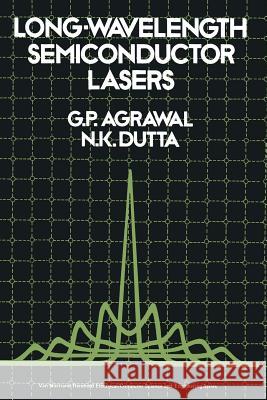
Long-Wavelength Semiconductor Lasers Govind P. Agrawal 9789401169967 Springer - książkaWidoczna okładka, to zdjęcie poglądowe, a rzeczywista szata graficzna może różnić się od prezentowanej.

Long-Wavelength Semiconductor Lasers

ISBN-13: 9789401169967 / Angielski / Miękka / 2012 / 474 str.

Govind P. Agrawal
cena 403,47 zł
(netto: 384,26 VAT:  5%)

Najniższa cena z 30 dni: 385,52 zł
Termin realizacji zamówienia:
ok. 22 dni roboczych
Bez gwarancji dostawy przed świętami

Darmowa dostawa!

Since its invention in 1962, the semiconductor laser has come a long way. Advances in material purity and epitaxial growth techniques have led to a variety of semiconductor lasers covering a wide wavelength range of 0. 3- 100 ILm. The development during the 1970s of GaAs semiconductor lasers, emitting in the near-infrared region of 0. 8--0. 9 ILm, resulted in their use for the first generation of optical fiber communication systems. However, to take advantage of low losses in silica fibers occurring around 1. 3 and 1. 55 ILm, the emphasis soon shifted toward long-wavelength semiconductor lasers. The material system of choice in this wavelength range has been the quaternary alloy InGaAsP. During the last five years or so, the intense development effort devoted to InGaAsP lasers has resulted in a technology mature enough that lightwave transmission systems using InGaAsP lasers are currently being deployed throughout the world. This book is intended to provide a comprehensive account of long-wave- length semiconductor lasers. Particular attention is paid to InGaAsP lasers, although we also consider semiconductor lasers operating at longer wave- lengths. The objective is to provide an up-to-date understanding of semicon- ductor lasers while incorporating recent research results that are not yet available in the book form. Although InGaAsP lasers are often used as an example, the basic concepts discussed in this text apply to all semiconductor lasers, irrespective of their wavelengths.


Kategorie:
Nauka
Kategorie BISAC:
Science > General
Reference > General
Non-Classifiable > Non-Classifiable
Wydawca:
Springer
Seria wydawnicza:
Van Nostrand Reinhold Electrical/Computer Science and Engine
Język:
Angielski
ISBN-13:
9789401169967
Rok wydania:
2012
Wydanie:
Softcover Repri
Numer serii:
000211748
Ilość stron:
474
Waga:
0.71 kg
Wymiary:
22.9 x 15.2
Oprawa:
Miękka
Wolumenów:
01

1. Introduction.- 1.1 Historical Perspective.- 1.2 Semiconductor Materials.- 1.3 Operating Principles.- 1.3.1 p-n Junction.- 1.3.2 Dielectric Waveguide.- 1.3.3 Recombination Mechanisms.- 1.3.4 Laser Threshold.- 1.4 Optical Fiber Communications.- 1.5 Overview.- References.- 2. Basic Concepts.- 2.1 Introduction.- 2.2 Maxwell’s Equations.- 2.3 Threshold Condition and Longitudinal Modes.- 2.4 Gain and Stimulated Emission.- 2.5 Waveguide Modes.- 2.5.1 Effective Index Approximation.- 2.5.2 Transverse Modes.- 2.5.3 Lateral Modes.- 2.6 Emission Characteristics.- 2.6.1 Light-Current Characteristics.- 2.6.2 Spatial-Mode Characteristics.- 2.6.3 Spectral Characteristics.- 2.6.4 Dynamic Characteristics.- References.- 3. Recombination Mechanisms in Semiconductors.- 3.1 Introduction.- 3.2 Radiative Recombination.- 3.2.1 Absorption and Emission Rates for Discrete Levels.- 3.2.2 Absorption and Emission Rates in Semiconductors.- 3.2.3 Absorption Coefficient and Optical Gain.- 3.3 Nonradiative Recombination.- 3.3.1 Band-to-Band Auger Processes.- 3.3.2 Phonon-Assisted Auger Processes.- 3.3.3 Defect and Surface Recombination.- 3.4 Experimental Results.- 3.5 Threshold Current Density.- 3.5.1 Carrier Leakage over the Heterojunctions.- 3.6 Temperature Dependence of Threshold Current.- 3.6.1 Carrier-Lifetime Measurements.- 3.6.2 Optical Gain Measurements.- 3.6.3 External Differential Quantum Efficiency.- 3.6.4 Discussion.- References.- 4. Epitaxy and Material Parameters of InGaAsP.- 4.1 Introduction.- 4.2 Liquid-Phase Epitaxy.- 4.2.1 LPE Apparatus.- 4.2.2 Growth Methods.- 4.2.3 LPE of InGaAsP.- 4.3 Vapor-Phase Epitaxy.- 4.4 Metal-Organic Vapor-Phase Epitaxy.- 4.5 Molecular-Beam Epitaxy.- 4.6 Lattice-Mismatch Effects.- 4.7 Material Parameters.- 4.7.1 Band-Structure Parameters.- 4.7.2 Mobility.- 4.7.3 Refractive Index.- References.- 5. Laser Structures and Their Performance.- 5.1 Introduction.- 5.2 Broad-Area Lasers.- 5.3 Gain-Guided Lasers.- 5.4 Weakly Index Guided Lasers.- 5.5 Strongly Index Guided Lasers.- 5.6 Leakage Current.- 5.7 Laser Arrays.- 5.8 Surface-Emitting Lasers.- References.- 6. Rate Equations and Operating Characteristics.- 6.1 Introduction.- 6.2 Rate Equations.- 6.3 Steady-State Characteristics.- 6.3.1 Light-Current Curve.- 6.3.2 Longitudinal-Mode Spectrum.- 6.4 Transient Response.- 6.4.1 Dynamic Longitudinal-Mode Spectrum.- 6.4.2 Turn-On Delay.- 6.4.3 Relaxation Oscillations.- 6.5 Noise Characteristics.- 6.5.1 Langevin Formulation.- 6.5.2 Intensity Noise.- 6.5.3 Phase Noise and Line Width.- 6.6 Modulation Response.- 6.6.1 Small-Signal Analysis.- 6.6.2 Intensity Modulation.- 6.6.3 Frequency Chirping.- 6.6.4 Large-Signal Modulation.- 6.7 External Optical Feedback.- 6.7.1 Modified Rate Equations.- 6.7.2 Steady-State Behavior.- 6.7.3 Dynamic Behavior.- 6.7.4 Noise Characteristics.- References.- 7. Distributed-Feedback Semiconductor Lasers.- 7.1 Introduction.- 7.2 DFB Laser Structures.- 7.3 Theory.- 7.3.1 Coupled-Wave Equations.- 7.3.2 Longitudinal Modes and Threshold Gain.- 7.3.3 Coupling Coefficient.- 7.3.4 Threshold Behavior.- 7.3.5 Light-Current Characteristics.- 7.4 Performance.- 7.4.1 CW Operation.- 7.4.2 Modulation Performance.- 7.5 DBR Lasers.- 7.6 Transmission Experiments.- 7.7 Concluding Remarks.- References.- 8. Coupled-Cavity Semiconductor Lasers.- 8.1 Introduction.- 8.2 Coupled-Cavity Schemes.- 8.3 Theory.- 8.3.1 Coupling Constant.- 8.3.2 Longitudinal Modes and Threshold Gain.- 8.3.3 Side-Mode Suppression.- 8.3.4 Modulation Response.- 8.4 Operating Characteristics.- 8.4.1 Longitudinal-Mode Control.- 8.4.2 Optimum Biasing for Direct Modulation.- 8.4.3 Frequency Chirp.- 8.4.4 Transmission Experiments.- 8.4.5 External-Cavity Semiconductor Lasers.- 8.5 Diverse Applications.- References.- 9. Quantum-Well Semiconductor Lasers.- 9.1 Energy Levels.- 9.2 Density of States.- 9.3 Experimental Observation of Confined States.- 9.4 Radiative Recombination.- 9.5 Auger Recombination.- 9.6 Single-Quantum-Well and Multiquantum-Well Lasers.- 9.7 Experimental Results.- 9.8 Modulation and Noise Characteristics.- References.- 10. Degradation and Reliability.- 10.1 Introduction.- 10.2 Defect Formation in the Active Region.- 10.2.1 Experimental Techniques.- 10.2.2 Electroluminescence.- 10.2.3 Photoluminescence.- 10.2.4 Cathodoluminescence.- 10.2.5 Dark Defects under Accelerated Aging.- 10.3 Catastrophic Degradation.- 10.4 Degradation of Current Confining Junctions.- 10.5 Reliability Assurance.- 10.5.1 Stress Aging.- 10.5.2 Activation Energy.- References.- 11. Lead-Salt Semiconductor Lasers.- 11.1 Introduction.- 11.2 Materials and Physical Properties.- 11.3 Band Structure.- 11.4 Optical Gain.- 11.5 Auger Recombination.- 11.6 Laser Diode Fabrication.- 11.7 Laser Properties.- 11.8 Tuning Characteristics.- 11.9 Other Material Systems.- References.- Epilogue.

Agrawal, Govind P. Govind P. Agrawal is Professor of Optics and Physi... więcej >


Udostępnij

Facebook - konto krainaksiazek.pl


Opinie o Krainaksiazek.pl na Opineo.pl

Partner Mybenefit

Krainaksiazek.pl w programie rzetelna firma Krainaksiaze.pl - płatności przez paypal

Czytaj nas na:

Facebook - krainaksiazek.pl
  • książki na zamówienie
  • granty
  • książka na prezent
  • kontakt
  • pomoc
  • opinie
  • regulamin
  • polityka prywatności

Zobacz:

  • Księgarnia czeska

  • Wydawnictwo Książkowe Klimaty

1997-2025 DolnySlask.com Agencja Internetowa

© 1997-2022 krainaksiazek.pl
     
KONTAKT | REGULAMIN | POLITYKA PRYWATNOŚCI | USTAWIENIA PRYWATNOŚCI
Zobacz: Księgarnia Czeska | Wydawnictwo Książkowe Klimaty | Mapa strony | Lista autorów
KrainaKsiazek.PL - Księgarnia Internetowa

Polityka prywatnosci - link
Krainaksiazek.pl - płatnośc Przelewy24
Przechowalnia Przechowalnia





