• Wyszukiwanie zaawansowane
  • Kategorie
  • Kategorie BISAC
  • Książki na zamówienie
  • Promocje
  • Granty
  • Książka na prezent
  • Opinie
  • Pomoc
  • Załóż konto
  • Zaloguj się

Literary Journalism in Colonial Australia » książka


zaloguj się | załóż konto
Logo Krainaksiazek.pl

koszyk

konto

szukaj
topmenu
Księgarnia internetowa
Szukaj
Książki na zamówienie
Promocje
Granty
Książka na prezent
Moje konto
Pomoc
 
 
Wyszukiwanie zaawansowane
Pusty koszyk
Bezpłatna dostawa dla zamówień powyżej 20 złBezpłatna dostawa dla zamówień powyżej 20 zł

Kategorie główne

• Nauka
 [2949965]
• Literatura piękna
 [1857847]

  więcej...
• Turystyka
 [70818]
• Informatyka
 [151303]
• Komiksy
 [35733]
• Encyklopedie
 [23180]
• Dziecięca
 [617748]
• Hobby
 [139972]
• AudioBooki
 [1650]
• Literatura faktu
 [228361]
• Muzyka CD
 [398]
• Słowniki
 [2862]
• Inne
 [444732]
• Kalendarze
 [1620]
• Podręczniki
 [167233]
• Poradniki
 [482388]
• Religia
 [509867]
• Czasopisma
 [533]
• Sport
 [61361]
• Sztuka
 [243125]
• CD, DVD, Video
 [3451]
• Technologie
 [219309]
• Zdrowie
 [101347]
• Książkowe Klimaty
 [123]
• Zabawki
 [2362]
• Puzzle, gry
 [3791]
• Literatura w języku ukraińskim
 [253]
• Art. papiernicze i szkolne
 [7933]
Kategorie szczegółowe BISAC

Literary Journalism in Colonial Australia

ISBN-13: 9783031317880 / Angielski
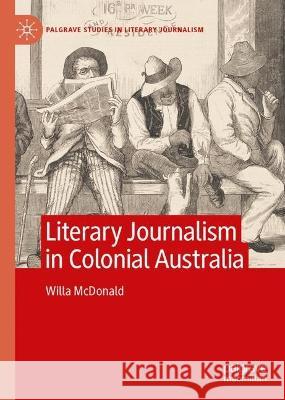
Willa McDonald
Literary Journalism in Colonial Australia Willa McDonald 9783031317880 Palgrave MacMillan - książkaWidoczna okładka, to zdjęcie poglądowe, a rzeczywista szata graficzna może różnić się od prezentowanej.

Literary Journalism in Colonial Australia

ISBN-13: 9783031317880 / Angielski

Willa McDonald
cena 443,82
(netto: 422,69 VAT:  5%)

Najniższa cena z 30 dni: 424,07
Termin realizacji zamówienia:
ok. 22 dni roboczych
Bez gwarancji dostawy przed świętami

Darmowa dostawa!
inne wydania

This book traces the beginnings of literary (narrative) journalism in Australia. It contributes to evolving international definitions of the form, while providing a glimpse into Australia’s early press history and development as a nation. The book comprises two parts. The first examines the forerunners of literary journalism before and during the establishment of a free press, including the letters, diaries and journals of the early colonists, as well as sketches published in the first magazines and newspapers. The book asks if these were “reporting” when there was no thriving press until well into the 19th century -- many were written by women and convicts whose voices otherwise went unheard. The second part examines the first expressions of literary journalism in forms more recognisable today, covering topics as varied as homelessness in Melbourne, the Queensland trade in Pacific Islander labour, and Australia’s involvement in overseas wars, particularly the Boer War. The resulting cultural history reveals important milestones in the development of Australia’s press and literature, while demonstrating the concerns unveiled in colonial literary journalism still resonate in Australia in the 21st century.


This book traces the beginnings of literary (narrative) journalism in Australia. It contributes to evolving international definitions of the form, while providing a glimpse into Australia’s early press history and development as a nation. The book comprises two parts. The first examines the forerunners of literary journalism before and during the establishment of a free press, including the letters, diaries and journals of the early colonists, as well as sketches published in the first magazines and newspapers. The book asks if these were “reporting” when there was no thriving press until well into the 19th century -- many were written by women and convicts whose voices otherwise went unheard. The second part examines the first expressions of literary journalism in forms more recognisable today, covering topics as varied as homelessness in Melbourne, the Queensland trade in Pacific Islander labour, and Australia’s involvement in overseas wars, particularly the Boer War. The resulting cultural history reveals important milestones in the development of Australia’s press and literature, while demonstrating the concerns unveiled in colonial literary journalism still resonate in Australia in the 21st century.

Kategorie:
Nauka
Kategorie BISAC:
Language Arts & Disciplines > Journalism
Social Science > Ethnic Studies - Australian & Oceanian Studies
Wydawca:
Palgrave MacMillan
Seria wydawnicza:
Palgrave Studies in Literary Journalism
Język:
Angielski
ISBN-13:
9783031317880

Acknowledgements

Preface

Chapter 1 — Writing Reality: Constructing a Nation

Reaching for a Definition

In the Beginning was the Word

Laying the Foundations

Chapter 2 — True Beginnings

The Printer Arrives

Towards a Free Press

Picking Up the Pace: the press after 1850

Popularising the Papers

Colonial Journals and Magazines: the creation of a literary culture

Irreverence and Tantrums: the emergence of The Bulletin

Unheard: First Nation voices

Women and Journalism: a man’s game

Chapter 3 — Journals, Letters and Unexpected Forms

‘Discovering’ the Land — the explorers

Writing Home — letters and journals

Reclaiming Unheard Voices

Broadening the Public Sphere

Literary Poetics and their Impacts


Chapter 4 — Captured Lives: Settler Memoir

Pioneering Lives: Katherine Kirkland

Farming Van Diemen’s Land: James Ross

Women as Political Commentators: Caroline Chisholm and Ada Cambridge

Memoir, Subjectivity and the Fact or Fiction Debate

Historical Reliability: Ellen Clacy on the goldfields

Where to Draw the Line? Martin Cash

Does the End Justify the Means? Arthur James Vogan

Scientific and Institutional Reliability: Carl Lumholtz and Edward M Curr

Chapter 5 — The Sketch: Colonial Characters

Savery’s Satire

Resurgence of the Sketch

Poking Fun, Revealing Hypocrisy: Thomas Revel Johnson’s social commentary

“The Devil in Sydney”: Theodore Emile Argles (Harold Grey)       

Satire and the “Gentler Sex”: Caroline Dexter

Forerunners of the Profile — the illustrated interview

Annie Bright and Cosmos Magazine

Who are We? William Baker’s Heads of the People

Christina Smith and the Booandick

Chapter 6 — Sketches of Place, Landscape and Travel

Master of All He Surveys: James Martin

Taming the Harsh Environment: Robert Harrison and May Vivienne

Negotiating the Highways and Byways: Richard Rose (Peter Possum)

Chronicling Nature: Louisa Meredith

Observing with the Eye of the Locally Born: Louisa Atkinson

Literary Journalist as Science Reporter: Henry Britton

Landscape and What it Meant to be Australian: Lawson and Paterson

Chapter 7 — Reporting on City Life: The Highs and Lows of ‘Marvellous Melbourne’

Female Flâneuse: Mary Fortune

Exploring the Slums: Marcus Clarke

Empathetic Responses

Investigating the Institutions: John Stanley James

A Woman’s Perpsective: Catherine Hay Thomson

Chapter 8 — Literary Journalism and Ned Kelly’s ‘Last Stand’

Before the Siege: Anti-Irish Catholic Sentiment

Unbounded Immersion

Press Freedom or Press Bias?

The Glenrowan “Press Conference” and the Inclusion of Interviews

The Reach of the Legend

Laying the Foundation for a Cultural Industry

The Result of a Flexible Form

Chapter 9 — ‘Blackbirding’, Subjectivity and the Unseeing ‘I’

An Uneasy Trade

Replacing Cotton: the “Sugaropolis”

In the Wake of the Carl: Henry Britton

British Superiority and Social Darwinism

“A Well-Fed Kitten”: women, children and Britton’s Orientalism

“It’s the Way We Always Speak of the Trade”: George ‘Chinese’ Morrison

“Happy Participants”: John Stanley James

An Enviable Fate: JD Melvin

A Rite of Passage

Chapter 10 — Life in the Trenches: The Challenges of Reporting War

First Overseas Conflict: war with the Maoris

The Great Australian Silence

Impact of the Telegraph         

Repatriating the ‘Kanaks’ as Humans

Covering the Sudan

Connecting with the Enemy: the Boer War

The Poetic Response: AB (Banjo) Paterson

Censorship by the British: Donald Macdonald

Chapter 11 — Boer War Journalism: Irony, Understatement and Sentiment

“From a Woman’s Standpoint”: Edith Dickenson

Refugee Camps or Concentration Camps?

Censorship of Mismanagement

News from the Field Hospital: Agnes Macready

Sentimentality and War: WT Reay

The Difficulties of Writing About Emotions

Emotional Engagement or Sentimentality?

Chapter 12 — Conclusion


Willa McDonald teaches and researches literary journalism and creative non-fiction writing at Macquarie University in Sydney, Australia. A former journalist, she is co-editor of Palgrave Macmillan’s Literary Journalism series. 


  “At the heart of Willa McDonald’s new text is an enthralling debate about what constitutes literary journalism…But she is careful always to place this debate … in its historical context—after all definitions can change overtime … Alongside the historical narrative goes an impressive attention to specific events and characters… McDonald is also able to blend an attention to broad literary trends with, at times, an impressive, critical analysis of specific texts.”    


- Richard Lance Keeble, Professor of Journalism, University of Lincoln, UK  


"A compelling and elegant cultural history of Australian literary journalism ranging from the violent frontier to bustling towns and cities. Willa McDonald shows how colonial storytelling in reports, sketches, memoirs, journals and letters helped to advance the British imperial project, build a nation, and engage with the world."   


- Bridget Griffen-Foley, Professor of Media, Macquarie University, Australia  


 This book traces the beginnings of literary (narrative) journalism in Australia. It contributes to evolving international definitions of the form, while providing a glimpse into Australia’s early press history and development as a nation. The book comprises two parts. The first examines the forerunners of literary journalism before and during the establishment of a free press, including the letters, diaries and journals of the early colonists, as well as sketches published in the first magazines and newspapers. The book asks if these were “reporting” when there was no thriving press until well into the 19th century -- many were written by women and convicts whose voices otherwise went unheard. The second part examines the first expressions of literary journalism in forms more recognisable today, covering topics as varied as homelessness in Melbourne, the Queensland trade in Pacific Islander labour, and Australia’s involvement in overseas wars, particularly the Boer War. The resulting cultural history reveals important milestones in the development of Australia’s press and literature, while demonstrating the concerns unveiled in colonial literary journalism still resonate in Australia in the 21st century.

 

 Willa McDonald teaches and researches literary journalism and creative non-fiction writing at Macquarie University in Sydney, Australia. A former journalist, she is co-editor of Palgrave Macmillan’s Literary Journalism series.


Udostępnij

Facebook - konto krainaksiazek.pl


Opinie o Krainaksiazek.pl na Opineo.pl

Partner Mybenefit

Krainaksiazek.pl w programie rzetelna firma Krainaksiaze.pl - płatności przez paypal

Czytaj nas na:

Facebook - krainaksiazek.pl
  • książki na zamówienie
  • granty
  • książka na prezent
  • kontakt
  • pomoc
  • opinie
  • regulamin
  • polityka prywatności

Zobacz:

  • Księgarnia czeska

  • Wydawnictwo Książkowe Klimaty

1997-2025 DolnySlask.com Agencja Internetowa

© 1997-2022 krainaksiazek.pl
     
KONTAKT | REGULAMIN | POLITYKA PRYWATNOŚCI | USTAWIENIA PRYWATNOŚCI
Zobacz: Księgarnia Czeska | Wydawnictwo Książkowe Klimaty | Mapa strony | Lista autorów
KrainaKsiazek.PL - Księgarnia Internetowa

Polityka prywatnosci - link
Krainaksiazek.pl - płatnośc Przelewy24
Przechowalnia Przechowalnia



