• Wyszukiwanie zaawansowane
  • Kategorie
  • Kategorie BISAC
  • Książki na zamówienie
  • Promocje
  • Granty
  • Książka na prezent
  • Opinie
  • Pomoc
  • Załóż konto
  • Zaloguj się

Linear Prediction of Speech » książka


zaloguj się | załóż konto
Logo Krainaksiazek.pl

koszyk

konto

szukaj
topmenu
Księgarnia internetowa
Szukaj
Książki na zamówienie
Promocje
Granty
Książka na prezent
Moje konto
Pomoc
 
 
Wyszukiwanie zaawansowane
Pusty koszyk
Bezpłatna dostawa dla zamówień powyżej 20 złBezpłatna dostawa dla zamówień powyżej 20 zł

Kategorie główne

• Nauka
 [2946912]
• Literatura piękna
 [1852311]

  więcej...
• Turystyka
 [71421]
• Informatyka
 [150889]
• Komiksy
 [35717]
• Encyklopedie
 [23177]
• Dziecięca
 [617324]
• Hobby
 [138808]
• AudioBooki
 [1671]
• Literatura faktu
 [228371]
• Muzyka CD
 [400]
• Słowniki
 [2841]
• Inne
 [445428]
• Kalendarze
 [1545]
• Podręczniki
 [166819]
• Poradniki
 [480180]
• Religia
 [510412]
• Czasopisma
 [525]
• Sport
 [61271]
• Sztuka
 [242929]
• CD, DVD, Video
 [3371]
• Technologie
 [219258]
• Zdrowie
 [100961]
• Książkowe Klimaty
 [124]
• Zabawki
 [2341]
• Puzzle, gry
 [3766]
• Literatura w języku ukraińskim
 [255]
• Art. papiernicze i szkolne
 [7810]
Kategorie szczegółowe BISAC

Linear Prediction of Speech

ISBN-13: 9783642662881 / Angielski / Miękka / 2011 / 290 str.
J. D. Markel; Jr. A. H. Gray
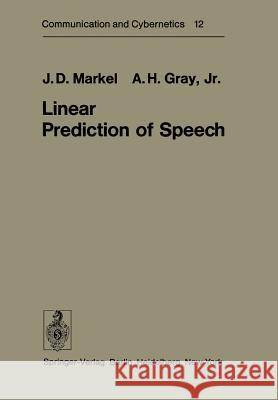
Linear Prediction of Speech J. D. Markel A. H. Jr. Gray 9783642662881 Springer - książkaWidoczna okładka, to zdjęcie poglądowe, a rzeczywista szata graficzna może różnić się od prezentowanej.

Linear Prediction of Speech

ISBN-13: 9783642662881 / Angielski / Miękka / 2011 / 290 str.

J. D. Markel; Jr. A. H. Gray
cena 402,53
(netto: 383,36 VAT:  5%)

Najniższa cena z 30 dni: 385,52
Termin realizacji zamówienia:
ok. 22 dni roboczych
Bez gwarancji dostawy przed świętami

Darmowa dostawa!

During the past ten years a new area in speech processing, generally referred to as linear prediction, has evolved. As with all scientific research, results did not always get published in a logical order and terminology was not always con sistent. In mid-1974, we decided to begin an extra hours and weekends project of organizing the literature in linear prediction of speech and developing it into a unified presentation in terms of content and terminology. This effort was completed in November, 1975, with the contents presented herein. If there are two words which describe our goals in this book, they are unifica tion and depth. Considerable effort has been spent on showing the interrelation ships among various linear prediction formulations and solutions, and in develop ing extensions such as acoustic tube models and synthesis filter structures in a unified manner with consistent terminology. Topics are presented in such a manner that derivations and theoretical details are covered, along with Fortran sub routines and practical considerations. Using this approach we hope to have made the material useful for a wide range of backgrounds and interests."


Kategorie:
Nauka, Fizyka
Kategorie BISAC:
Science > Fizyka
Science > Applied Sciences
Technology & Engineering > Mechanical
Wydawca:
Springer
Seria wydawnicza:
Communication and Cybernetics
Język:
Angielski
ISBN-13:
9783642662881
Rok wydania:
2011
Wydanie:
Softcover Repri
Numer serii:
000339554
Ilość stron:
290
Waga:
0.53 kg
Wymiary:
24.4 x 17.0
Oprawa:
Miękka
Wolumenów:
01

1. Introduction.- 1.1 Basic Physical Principles.- 1.2 Acoustical Waveform Examples.- 1.3 Speech Analysis and Synthesis Models.- 1.4 The Linear Prediction Model.- 1.5 Organization of Book.- 2. Formulations.- 2.1 Historical Perspective.- 2.2 Maximum Likelihood.- 2.3 Minimum Variance.- 2.4 Prony’s Method.- 2.5 Correlation Matching.- 2.6 PARCOR (Partial Correlation).- 2.6.1 Inner Products and an Orthogonality Principle.- 2.6.2 The PARCOR Lattice Structure.- 3. Solutions and Properties.- 3.1 Introduction.- 3.2 Vector Spaces and Inner Products.- 3.2.1 Filter or Polynomial Norms.- 3.2.2 Properties of Inner Products.- 3.2.3 Orthogonality Relations.- 3.3 Solution Algorithms.- 3.3.1 Correlation Matrix.- 3.3.2 Initialization.- 3.3.3 Gram-Schmidt Orthogonalization.- 3.3.4 Levinson Recursion.- 3.3.5 Updating Am(z).- 3.3.6 A Test Example.- 3.4 Matrix Forms.- 4. Acoustic Tube Modeling.- 4.1 Introduction.- 4.2 Acoustic Tube Derivation.- 4.2.1 Single Section Derivation.- 4.2.2 Continuity Conditions.- 4.2.3 Boundary Conditions.- 4.3 Relationship between Acoustic Tube and Linear Prediction.- 4.4 An Algorithm, Examples, and Evaluation.- 4.4.1 An Algorithm.- 4.4.2 Examples.- 4.4.3 Evaluation of the Procedure.- 4.5 Estimation of Lip Impedance.- 4.5.1 Lip Impedance Derivation.- 4.6 Further Topics.- 4.6.1 Losses in the Acoustic Tube Model.- 4.6.2 Acoustic Tube Stability.- 5. Speech Synthesis Structures.- 5.1 Introduction.- 5.2 Stability.- 5.2.1 Step-up Procedure.- 5.2.2 Step-down Procedure.- 5.2.3 Polynomial Properties.- 5.2.4 A Bound on |Fm(z)|.- 5.2.5 Necessary and Sufficient Stability Conditions.- 5.2.6 Application of Results.- 5.3 Recursive Parameter Evaluation.- 5.3.1 Inner Product Properties.- 5.3.2 Equation Summary with Program.- 5.4 A General Synthesis Structure.- 5.5 Specific Speech Synthesis Structures.- 5.5.1 The Direct Form.- 5.5.2 Two-Multiplier Lattice Model.- 5.5.3 Kelly-Lochbaum Model.- 5.5.4 One-Multiplier Models.- 5.5.5 Normalized Filter Model.- 5.5.6 A Test Example.- 6. Spectral Analysis.- 6.1 Introduction.- 6.2 Spectral Properties.- 6.2.1 Zero Mean All-Pole Model.- 6.2.2 Gain Factor for Spectral Matching.- 6.2.3 Limiting Spectral Match.- 6.2.4 Non-uniform Spectral Weighting.- 6.2.5 Minimax Spectral Matching.- 6.3 A Spectral Flatness Model.- 6.3.1 A Spectral Flatness Measure.- 6.3.2 Spectral Flatness Transformations.- 6.3.3 Numerical Evaluation.- 6.3.4 Experimental Results.- 6.3.5 Driving Function Models.- 6.4 Selective Linear Prediction.- 6.4.1 Selective Linear Prediction (SLP) Algorithm.- 6.4.2 A Selective Linear Prediction Program.- 6.4.3 Computational Considerations.- 6.5 Considerations in Choice of Analysis Conditions.- 6.5.1 Choice of Method.- 6.5.2 Sampling Rates.- 6.5.3 Order of Filter.- 6.5.4 Choice of Analysis Interval.- 6.5.5 Windowing.- 6.5.6 Pre-emphasis.- 6.6 Spectral Evaluation Techniques.- 6.7 Pole Enhancement.- 7. Automatic Formant Trajectory Estimation.- 7.1 Introduction.- 7.2 Formant Trajectory Estimation Procedure.- 7.2.1 Introduction.- 7.2.2 Raw Data from A(z).- 7.2.3 Examples of Raw Data.- 7.3 Comparison of Raw Data from Linear Prediction and Cepstral Smoothing.- 7.4 Algorithm 1.- 7.5 Algorithm 2.- 7.5.1 Definition of Anchor Points.- 7.5.2 Processing of Each Voiced Segment.- 7.5.3 Final Smoothing.- 7.5.4 Results and Discussion.- 7.6 Formant Estimation Accuracy.- 7.6.1 An Example of Synthetic Speech Analysis.- 7.6.2 An Example of Real Speech Analysis.- 7.6.3 Influence of Voice Periodicity.- 8. Fundamental Frequency Estimation.- 8.1 Introduction.- 8.2 Preprocessing by Spectral Flattening.- 8.2.1 Analysis of Voiced Speech with Spectral Regularity.- 8.2.2 Analysis of Voiced Speech with Spectral Irregularities.- 8.2.3 The STREAK Algorithm.- 8.3 Correlation Techniques.- 8.3.1 Autocorrelation Analysis.- 8.3.2 Modified Autocorrelation Analysis.- 8.3.3 Filtered Error Signal Autocorrelation Analysis.- 8.3.4 Practical Considerations.- 8.3.5 The SIFT Algorithm.- 9. Computational Considerations in Analysis.- 9.1 Introduction.- 9.2 Ill-Conditioning.- 9.2.1 A Measure of Ill-Conditioning.- 9.2.2 Pre-emphasis of Speech Data.- 9.2.3 Prefiltering before Sampling.- 9.3 Implementing Linear Prediction Analysis.- 9.3.1 Autocorrelation Method.- 9.3.2 Covariance Method.- 9.3.3 Computational Comparison.- 9.4 Finite Word Length Considerations.- 9.4.1 Finite Word Length Coefficient Computation.- 9.4.2 Finite Word Length Solution of Equations.- 9.4.3 Overall Finite Word Length Implementation.- 10. Vocoders.- 10.1 Introduction.- 10.2 Techniques.- 10.2.1 Coefficient Transformations.- 10.2.2 Encoding and Decoding.- 10.2.3 Variable Frame Rate Transmission.- 10.2.4 Excitation and Synthesis Gain Matching.- 10.2.5 A Linear Prediction Synthesizer Program.- 10.3 Low Bit Rate Pitch Excited Vocoders.- 10.3.1 Maximum Likelihood and PARCOR Vocoders.- 10.3.2 Autocorrelation Method Vocoders.- 10.3.3 Covariance Method Vocoders.- 10.4 Base-Band Excited Vocoders.- 11. Further Topics.- 11.1 Speaker Identification and Verification.- 11.2 Isolated Word Recognition.- 11.3 Acoustical Detection of Laryngeal Pathology.- 11.4 Pole-Zero Estimation.- 11.5 Summary and Future Directions.- References.


Udostępnij

Facebook - konto krainaksiazek.pl


Opinie o Krainaksiazek.pl na Opineo.pl

Partner Mybenefit

Krainaksiazek.pl w programie rzetelna firma Krainaksiaze.pl - płatności przez paypal

Czytaj nas na:

Facebook - krainaksiazek.pl
  • książki na zamówienie
  • granty
  • książka na prezent
  • kontakt
  • pomoc
  • opinie
  • regulamin
  • polityka prywatności

Zobacz:

  • Księgarnia czeska

  • Wydawnictwo Książkowe Klimaty

1997-2025 DolnySlask.com Agencja Internetowa

© 1997-2022 krainaksiazek.pl
     
KONTAKT | REGULAMIN | POLITYKA PRYWATNOŚCI | USTAWIENIA PRYWATNOŚCI
Zobacz: Księgarnia Czeska | Wydawnictwo Książkowe Klimaty | Mapa strony | Lista autorów
KrainaKsiazek.PL - Księgarnia Internetowa

Polityka prywatnosci - link
Krainaksiazek.pl - płatnośc Przelewy24
Przechowalnia Przechowalnia






